 |
|
|
In 1997 had I asked in usenet newsgroups about a once famous kind of driving games that nobody knew. It took me years to find out who created the mysterious 3D car racing arcade machines I saw in my childhood. It turned out, he even invented in 1975 the German predecessor of what was later copied by Atari as Night Driver - the world first 3 dimensional arcade driving videogame ever! - and much more - Reiner Foerst was the father of simracing.
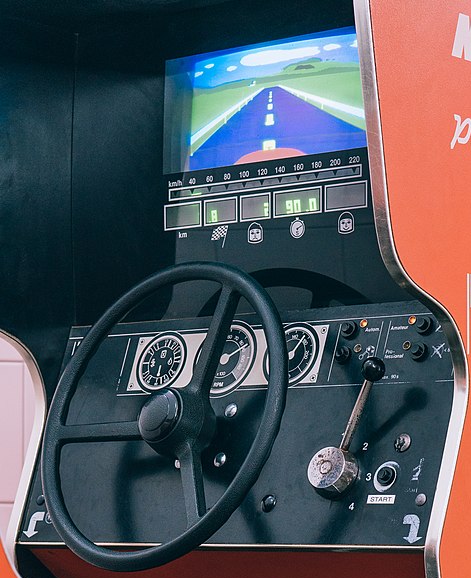
Meanwhile I managed to identify and describe here the whole Nürburgring arcade game series. Its successors became serious driving simulators. I finally added some pictures, screenshots, cultural context and even a few bits of scarce tech info about this barely documented key piece of videogame history. This is the origin of realistic driving games.
These were my memories...
In my childhood (ca. 1982?) I saw in two shopping centers ("Hertie" and "Karstadt" in the German city Bremen) a strange 3D car racing arcade machine of the name "Nürburg Ring". The one at Karstadt stood in a teenager fashion department that was called "Follow Me!"; the department was decorated with fake air condition pipes at the ceiling and also many home videogame consoles (Atari VCS2600, Intellivision, Philips G7000 etc.) were installed here for kids to play. Possibly a "Nürburg Ring" machine may also have been in the basement of the "Horten" shopping center for a short time, but I am not sure.
The cabinet was a quite strange, signal red, entirely rectangular upright
box (edges covered with silver metal protective ledges?) with a steering
wheel at its front and a quite small (17 inch?) colour monitor. There also
was a seat mounted in front of the machine, it had a accelerator pedal
and (I am not sure) a gearshift lever. There was in white letters written
"Nürburg Ring" on the (sides of the?) cabinet. (Possibly also drawings
of white "checkered flags" were there.)
| _______
| | | :| | :| <-screen | :| | |. <-button row | | | .-. | |=| | | <-steering wheel | | | | | | | _____|_| | | { | <-seat | +-------------| | ! | |_____!_____________| |
I don't remember the seat well; it may have been either a black plastics- or metal chair (was quite hard and uncomfortable?) or just a plain, rectangular box with a black top to be used for sitting on. I only remember that I sometimes sat on it (while waiting for the home videogame consoles in the "Follow Me" department of Karstadt to get unoccupied or to get switched on by the staff?).
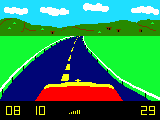
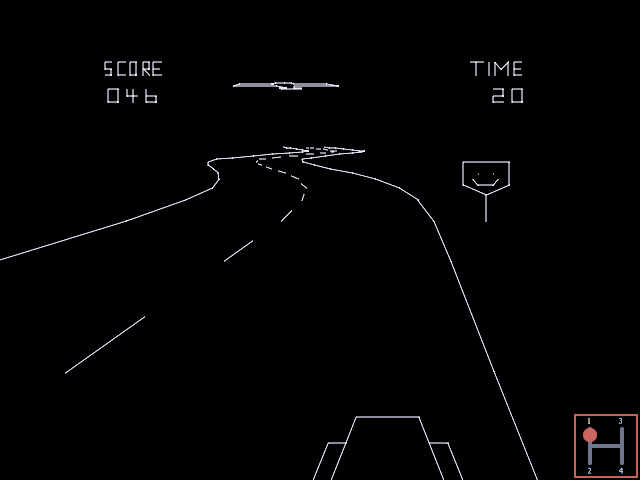
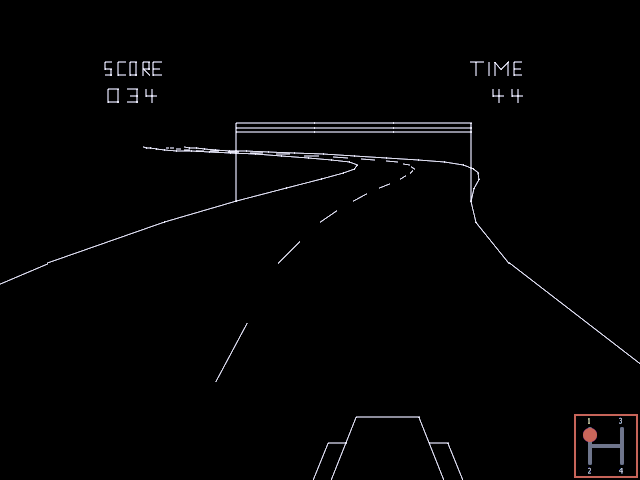
The screen showed in 3D raster graphics (max. 4 or 8 colours per scan line?) a dark blue road with yellow center stripes. You could also see the red (Rolls-Royce/ oldtimer-like) hood of your car there and in the background there was a cloudy sky and a 2D bitmap- landscape (similar like "Pole Position") that scrolled horizontally when passing curves. There were no(!) other cars on the road and I also don't remember any objects left or right to it.
Below the graphics was a black, ca. 4cm high area with very blocky yellow numbers (and a horizontal bar as speedometer?), showed through several rectangular holes in a similar high, plain red, opaque screen overlay (with (white?) writings describing the number fields on it?). There did neither title logos nor copyright messages nor any other writings appear on the screen, only the number stuff below the graphics (similar to some of the first Atari 2600 carts.) Nowadays I guess it was a timed game that played very similar like the Atari's "Night Driver" arcade version on MAME.
Below the screen on the cabinet was a row of ca. 4 (?) small buttons those allowed to switch between a mountainous and a flatter landscape (could be selected during attract mode; the screen panorama instantly changed when pressing these buttons). The mountain landscape had more curves (S curves?) in the road, but there were no up and down effects (unlike "OutRun") in the road graphics. I clearly remember that there were small, brown huts visible in the green background panorama (of the flatter landscape?). Possibly another button selected between good and bad weather (bad was rain?, or ice and snow?). There was also a button to select between a sober and drunk driver (caused a more difficult steering behaviour?). I believe to remember that each selected button was lit yellow (each button had a light bulb in it?), but they may also have been plain white(?) with a yellow LED close to each of them.
Here are 2 hand drawn pictures; as far I remember the graphics looked
very similar like this...
 |
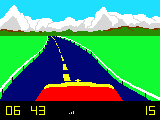 |
| game in flat landscape mode | game in mountainous mode |
It might be that one of the Nürburg Ring machines I saw had a bluish B/W monitor, but possibly I just mis- remember this. I don't remember if I ever put coins into this machine; if yes, then I only played it 2 or 3 times in my live. I believe to remember that the machine had only a single coin slot on a small, silver metal plate (like known from small chewing gum or condom vending machines), but I am not sure about this detail.
Does anybody else remember this machine? It may have been a Germany- only production or the name of this game may be different in other countries, because "Nürburg Ring" is the name of a German formula 1 racing track (although the game graphics didn't look in any way like formula 1 racing at all). I also believe to remember that in the early 80th I saw in TV news a driving simulator for research purposes those graphics looked very similar to this game.
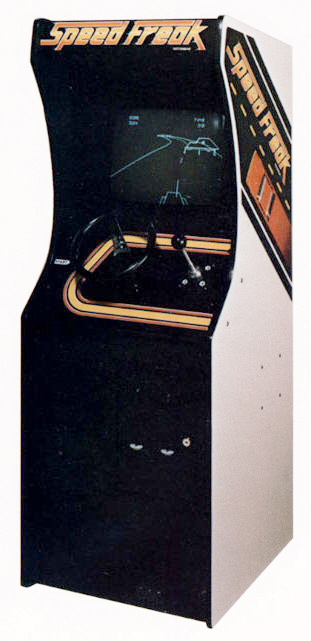
The "Nürburg Ring" game machine must have been something really old (like "Speed Freak") and I wish to know if this was a Germany- only release or if it is something more commonly known in the world. (I also would enjoy to see an emulation of this, although I guess that this game would be not much fun today.)
arcade mystery solved.
Some kind people e-mailed me an eBay photo and a French language flyer about a different machine version. The German machine on eBay was offered as "Formel 1 Nürnburgring" - manufactured by the German company Rainer Foerst GmbH in Gummersbach. And the great thing is that this company still exists, and it now manufactures nothing else than genuine scientific driving simulators!
See here: http://www.drfoerst.de/
On The Arcade Flyer Archive I found additional German language flyers of the machines Nürburgring 1, 2 and 3. (You can download high resolution versions of the flyers there.) According to the flyers, the German arcade machine distributor of the company was named SPOBAG ( = "Sportstätten-Betriebs-AG").
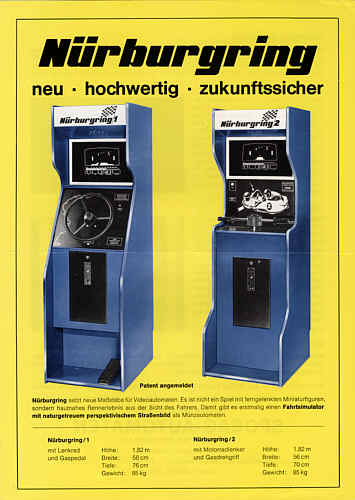 |
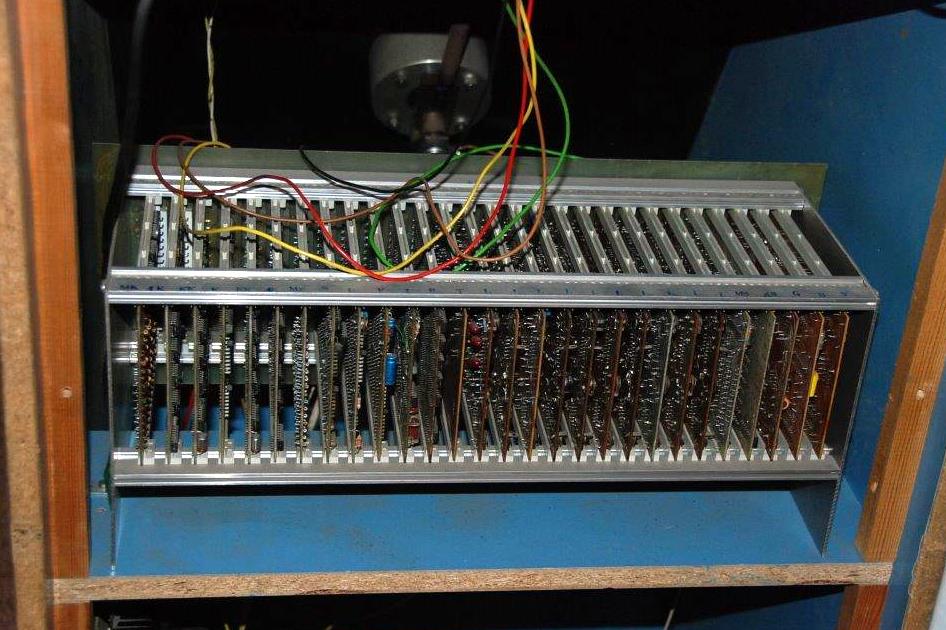
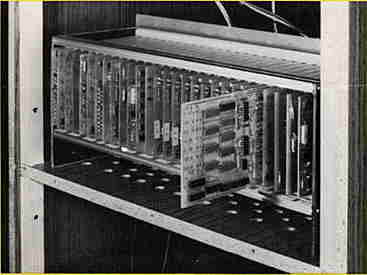 According to this Nürburgring 1 & 2 flyer, there was an
impressive lot of electronics inside, mounted on 28 cards in a rack.
According to this Nürburgring 1 & 2 flyer, there was an
impressive lot of electronics inside, mounted on 28 cards in a rack. |
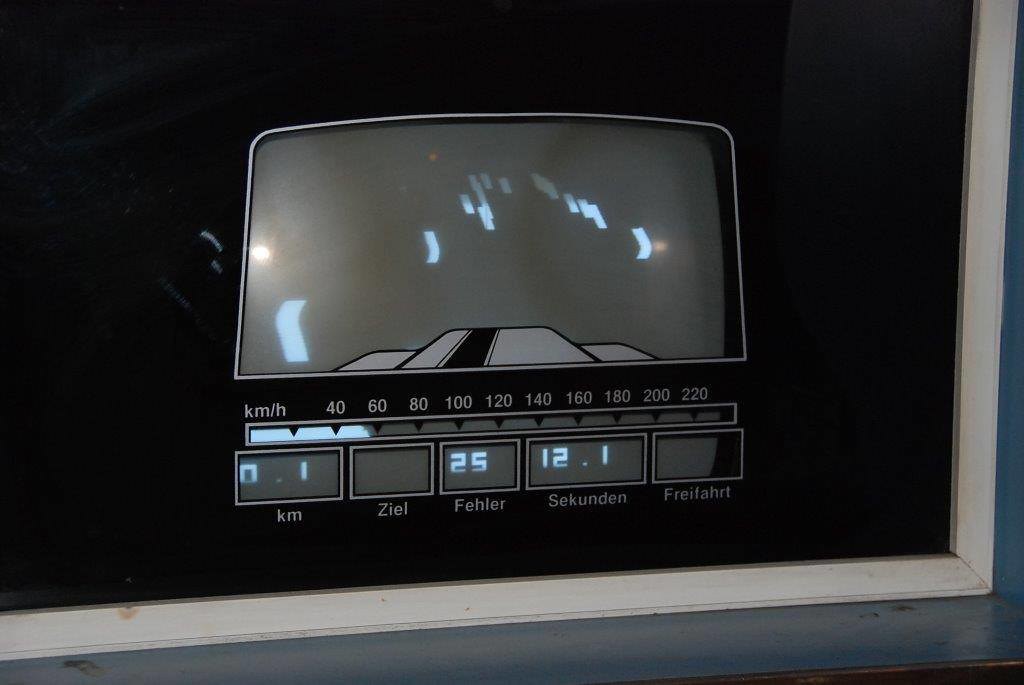
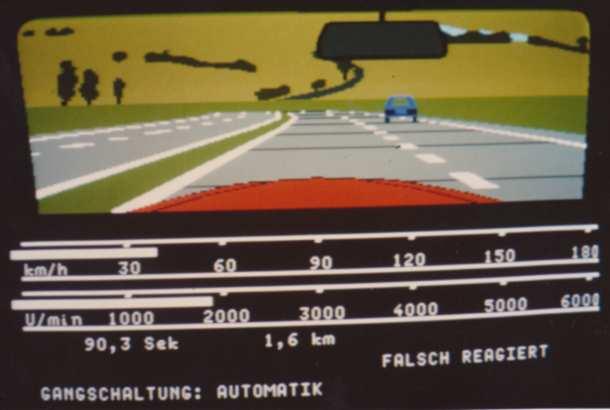
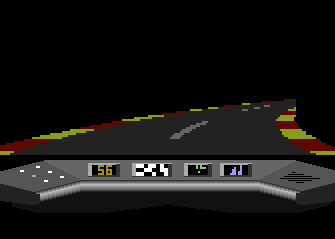
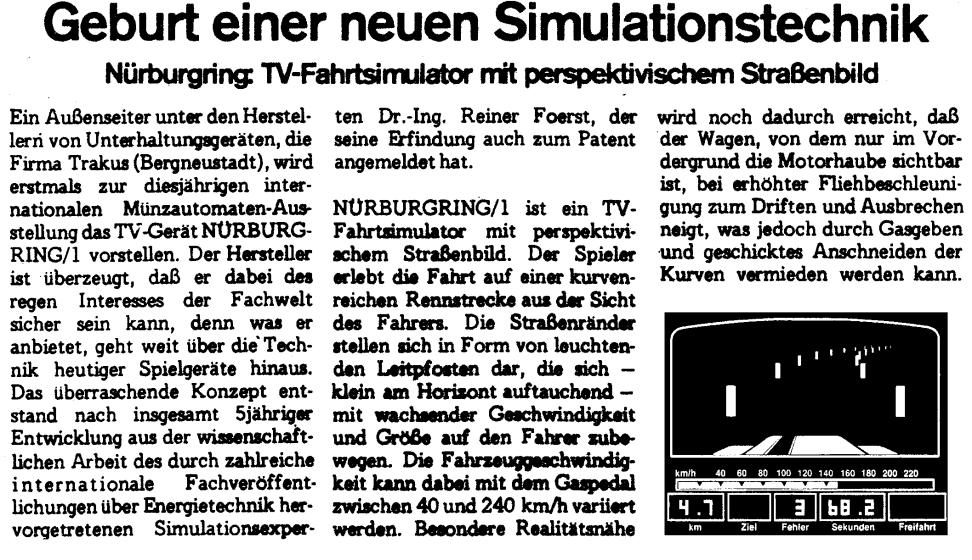
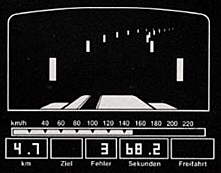 The graphics strongly resembled Night Driver, which Atari
apparently had copied from it. The English translation of the 5 number
displays is {km, finish, mistakes, seconds, free ride}.
The graphics strongly resembled Night Driver, which Atari
apparently had copied from it. The English translation of the 5 number
displays is {km, finish, mistakes, seconds, free ride}. |
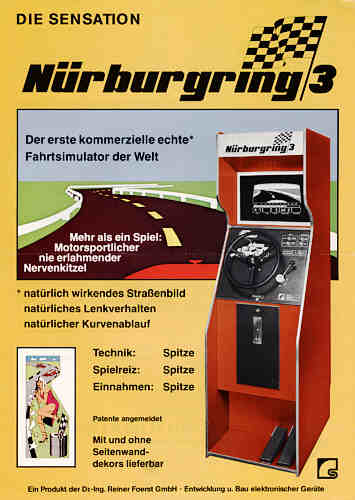 |
 The successor Nürburgring 3 still had 25 cards in it.
 |
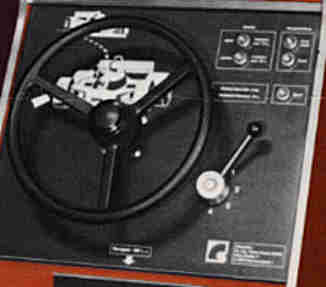 There are indeed some buttons on the control panel; unfortunately I can
not see their colour.
There are indeed some buttons on the control panel; unfortunately I can
not see their colour. |
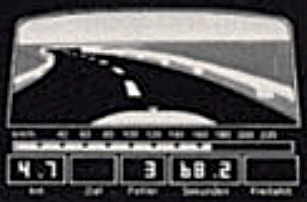 The
re-worked screenshot shows the white crash barrier clearer. This may have
been the B/W version of the machine with red bezel in front of the dashboard
graphics. Likely this flyer screenshot was made up when the software was
still unfinished, because the display numbers correspond to the previous
flyer. The
re-worked screenshot shows the white crash barrier clearer. This may have
been the B/W version of the machine with red bezel in front of the dashboard
graphics. Likely this flyer screenshot was made up when the software was
still unfinished, because the display numbers correspond to the previous
flyer. |
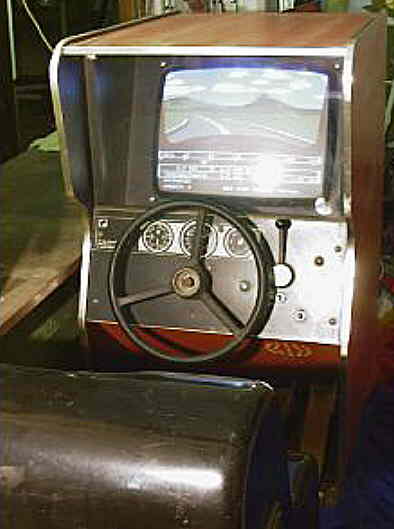
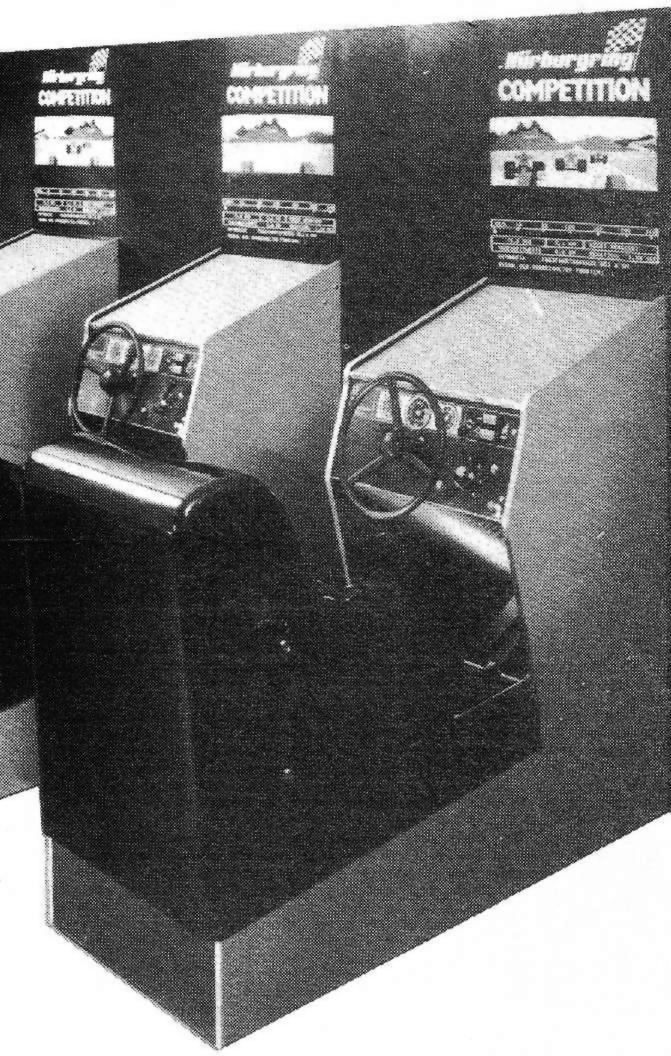
Likely various other versions of the arcade machine were released over time, since the versions on the photo and flyer don't really match my memories, but the video graphics, large steering wheel and gear shift lever match well, and the flyer says that the machine could be optionally ordered with side decals (those may have shown the remembered white chequered flags). The seat I remember may even have been a tractor seat (shaped like a wide bicycle saddle of black sheet metal) bolted to the coin door of this upright Nürburgring 3 machine. Although the screen graphics on the flyer is B/W, the colours of the flyer background picture (yellow stripes, red hood with tank lid etc.) match my memories of the screen colours in the colour version. Thus a successor with colour CRT apparently used the same colours. However the flyer shows no mountain horizon, which I apparently saw in a different version.
 |
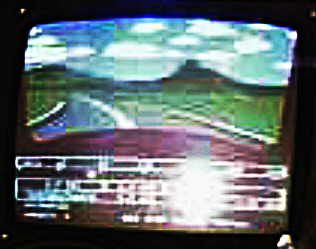 This apparently was a successor named Formel 1 Nürburgring. I
had reworked the screenshot. It looks like N4 or N5.
This apparently was a successor named Formel 1 Nürburgring. I
had reworked the screenshot. It looks like N4 or N5. |
MAY THE SOFTWARE BE WITH YOU!

|
I CYBERYOGI Christian Oliver(=CO=) Windler I I (teachmaster of LOGOLOGIE - the first cyberage-religion!) I I ! I *=============================ABANDON=THE=BRUTALITY==========================* |
Foerst GmbH, Historie*
https://youtu.be/GRVQLAQ5kZg
*) note: In this manufacturer's official video, the mentioned release years in text and depicted hardware often don't match. Many show N4 where they talk about N1 or N3.
Born in the year of Pong, I nowadays think I identified the arcade machines in shopping centers of my childhood in Bremen. In Karstadt at that time was the "Follow-Me!" department, which was a really strange attraction for young people, which had the ceilings decorated with flexible aluminium air duct hoses with "Follow Me!" signs (If I remember well) guiding through the entire shopping center from entrances up above escalators(?) into the place. They sold mainly decorative and novelty items (hologram foil-, goo- and sand swivel pictures, posters, deformed glass bottle vases, strange mugs etc.) and had a big red semi-open room full of game consoles. To the right of it was an optical illusions room (deformed perspective with e.g. a billiard table with balls rolling up; visitors had to stay behind a handrail on a kind of bridge) which soon got removed because it wasted space. As separation to the rest of the floor was a kind of long bench where a crowd of youngsters queued for entering the attraction. To the right in front of the illusions room was a sitdown Nürburgring N3 colour arcade machine, and later (instead of it?) to the left of the game console room a slimmer B/W version of N3 (upright with some kind of attached seat?).
At Hertie on the 2nd(?) floor was another B/W N3 machine (may be the same specimen that got moved there). It stood to the left at the rear wall, and vis-a-vis at the other side (at the side of escalators?) stood with generic brown upright cabinets a Vulgus and a Pole Position II machine (which track included a round Dunlop tyre arc (like in the Japanese MAME version) instead of the spectators framework bridge, and highscore music may have played only the bass channel). Later, to the right of both stood a sitdown colour version of N3. And only for one day (may have been a racing contest) at this place was a Nürburgring Power-Slide motion cabinet in colour (that might have been even N4, but I barely remember it - possibly it was covered by a crowd and mother dragged me away).
Modern kids may see arcade machines as trivial money waste and think of gambling. But at that time (and still in 1990th) they were the hitech avantgarde of videogames, often containing the newest specialized and much costlier hardware than possible at home. So home game ads promised "arcade quality graphics" and rarely could deliver. Arcade was for gaming like cinema for blockbuster movies.
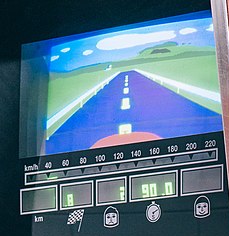
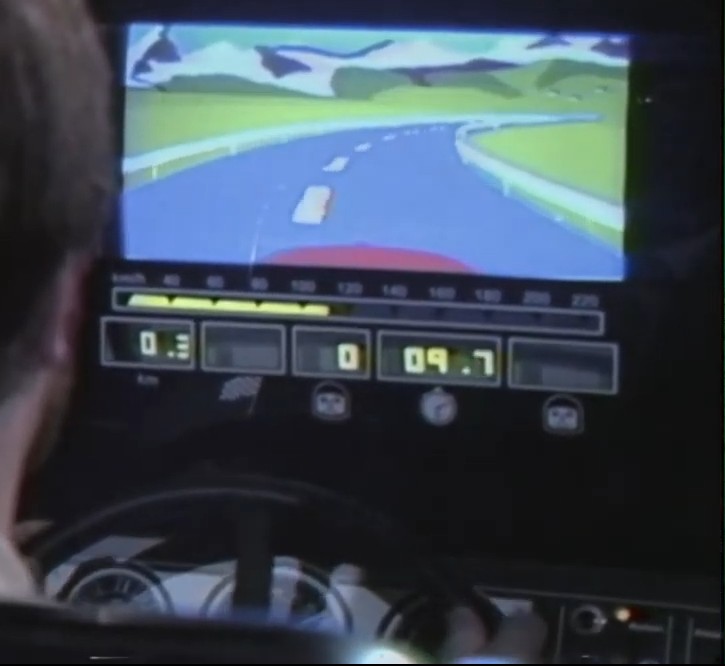
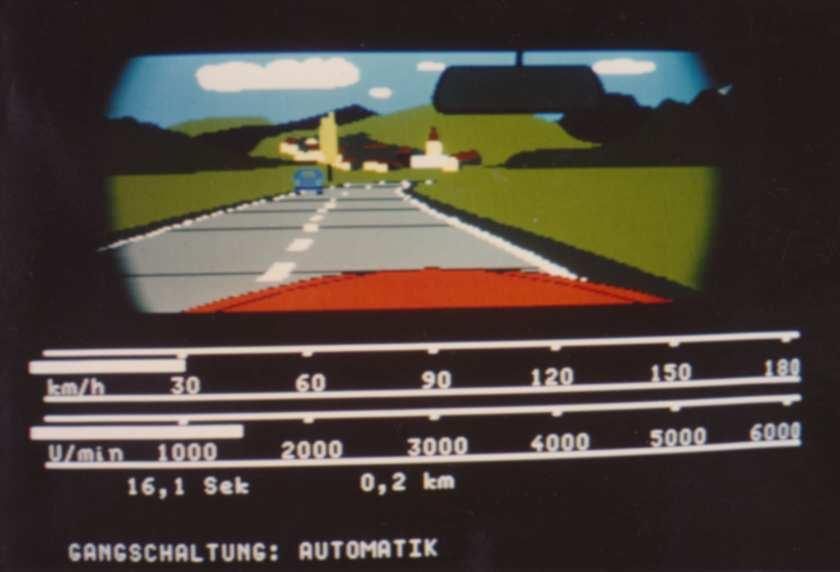
I am surprised now how close my handdrawn memories of Nürburgring
3 screenshots came to the real thing. So the (unlike on the arcade
flyer) bluish road with yellow center line was not misremembered from
the DOS MAME rendition of Hard
Drivin. Only the hood slightly differs.
 |
 |
| game in flat landscape mode | game in mountainous mode |
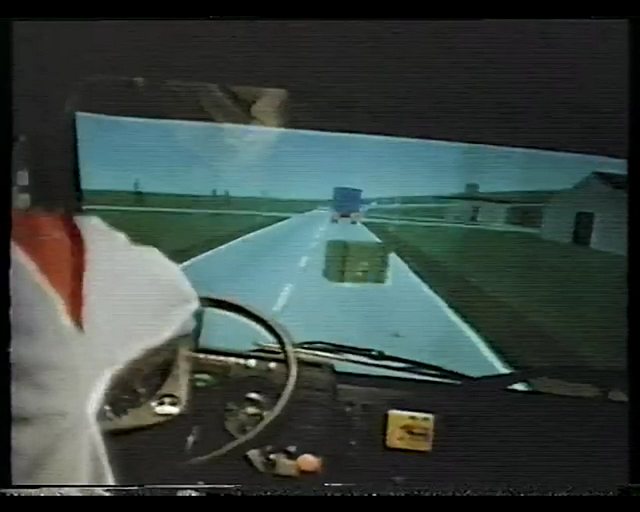
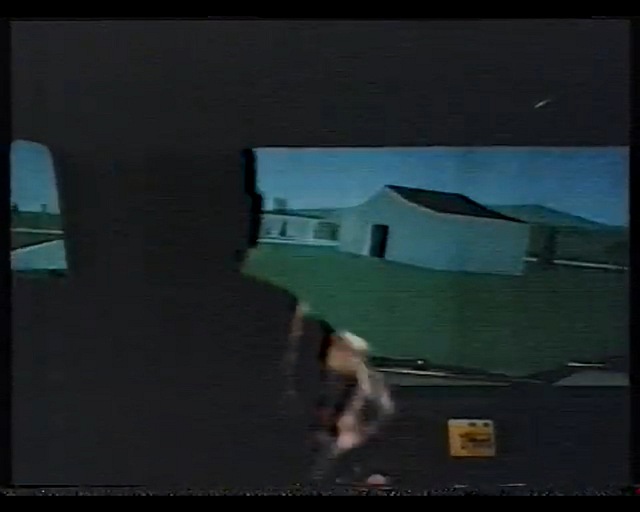
I also remember a TV docu of a research(?) simulator with big projection screen depicting block graphics with score displays of (what I later identified as) Nürburgring 1. The strange thing is it was in colour with the guide posts in yellow on green background (possibly with blue sky), so it may have been modified N1 hardware.
Reiner Foerst died in 2009, and his company "Foerst Fahrsimulatoren" is now managed by his son Kai. In the meantime more info about Nürburgring has appeared on the internet, including the very useful German language company history PDF with many old newspaper articles, pictures and screenshots those helped to assemble this summary about their different early machines and their hardware platforms. On the internet apparently nobody cared to document this groundbreaking piece of videogame and VR history. I also identified related patents those are often the only source to explain the inner working.
The engineer Dr. Reiner Foerst had previously worked on power station
components for controlling and stabilizing the electric power grid. He
planned to create a compact and sufficiently affordable driving simulator
for road safety training, that should be additionally suited as an arcade
machine to earn money. In 1970th however the only driving simulators with
1st person view were huge scientific research installations with mechanical
projection screen, and the most advanced machine at Volkswagen ("VW-Fahrsimulator")
had a DEC PDP-11 mainframe computer with tape drive cabinet and vector
monitor (resembling a large oscilloscope) that would have been prohibitively
expensive. So after a fruitless attempt of mechanically sideways sliding
20 lightbulb matrix graphics with 10 servo motors (that walking lights
scrolled too jerky for a realistic feel of driving), in 1974 Foerst dismantled
a "Pong" machine to adapt its CRT display technology.
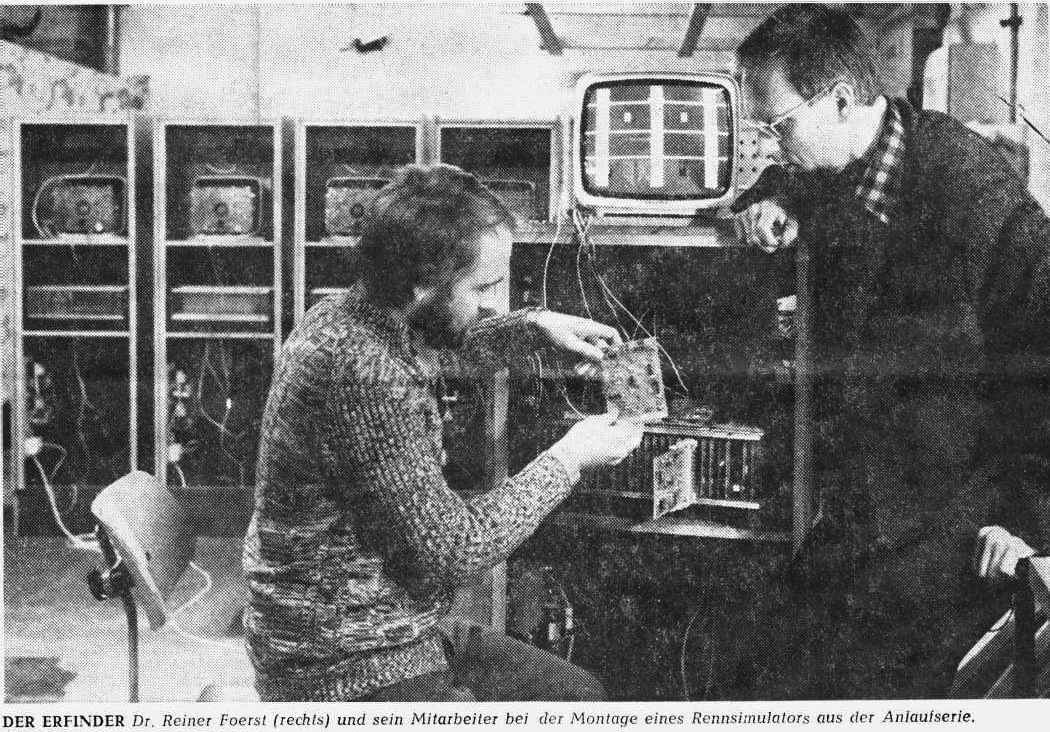 Foerst (right), adjusting a new N1 machine (1976, Kölner
Stadt-Anzeiger)
Foerst (right), adjusting a new N1 machine (1976, Kölner
Stadt-Anzeiger) |
Foerst licensed the brand name "Nürburgring" from the nearby German
racetrack to market his invention together with the company Trakus. The
machines got improved over time and came out in several versions, those
until mid of 1980th were famous and got mentioned in many newspapers and
TV shows. While most arcade versions were red, the serious later simulator
cabinets were painted blue. I remember many of them from science docus
on TV about physiological driving fitness tests, effects of drugs and alcohol
etc., but did not know that Foerst had made them. In 1980th the graphics
looked far more advanced than homecomputers and the style did not resemble
any known arcade games. Nowadays simracing hobby equipment became as common
as owning a model train table. But not even in a TV docu of 2024 about
the racetrack history "Nürburgring – 100 Jahre Grüne Hölle"
was any mentioning of this important arcade game series nor those training
simulators. I am shocked how little documented the cultural history of
driving simulators and inner working of those Foerst games is.
driving simulators were rocket scienceThe technology of driving simulators was derived from flight simulators those existed before. Because driving is less dangerous and cheaper than flight training, expensive simulators were a very rare and exotic niche product only used by science and car developing companies. And since road contact of cars is bumpier than the rather smooth (turbulences aside) turns of aircrafts, motion simulation is more difficult.Jason Torchinsky helped much to investigate the barely documented history of computerized driving simulators. His great essays "Meet The Doctor-Engineer Who Basically Invented The Modern Racing Game" (link) and "VW Invented First-Person Racing Video Games And They Don't Even Know It" (link) revealed more about the origins. He had contacted Volkswagen about their first simulator (VW-Fahrsimulator) that was likely invented around 1972. He got the answer about an article "Die Illusionsmaschine – GM driving simulator kopiert die Wirklichkeit" (The Illusion-Machine – GM Driving Simulator Copies Reality) in the magazine "Automobil Revue" Nr. 52" of 11. December 1969, about a simulator by General Motors that copied the interior of a Chevrolet Nova but was able to copy any other interior of any other car, and that was already the 2nd generation, so there must have been earlier experiments. Apparently it used film projection. Torchinsky finally identified an article in a German trade magazine, "Automobiltechnische Zeitschrift (ATZ)" of February 1974 about the VW driving simulator that first time used computer graphics. VW-Fahrsimulator
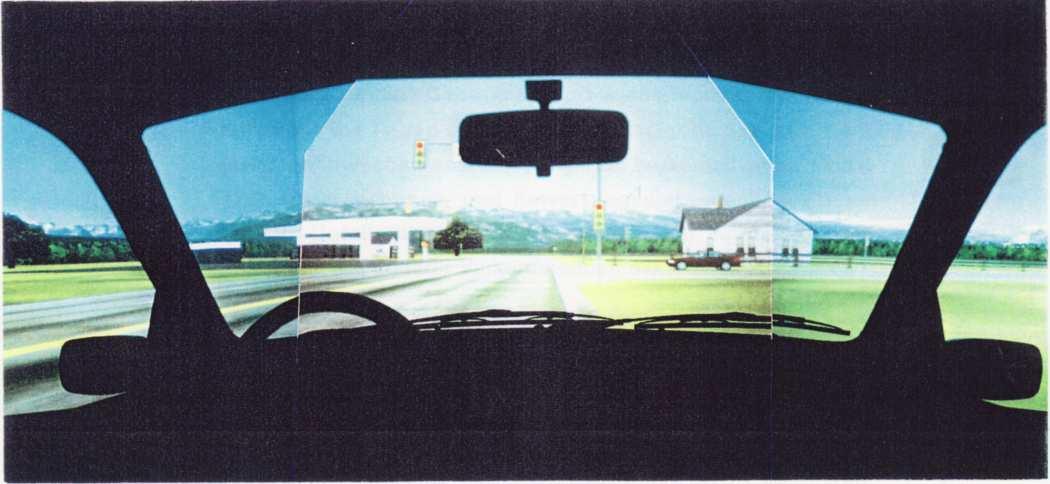
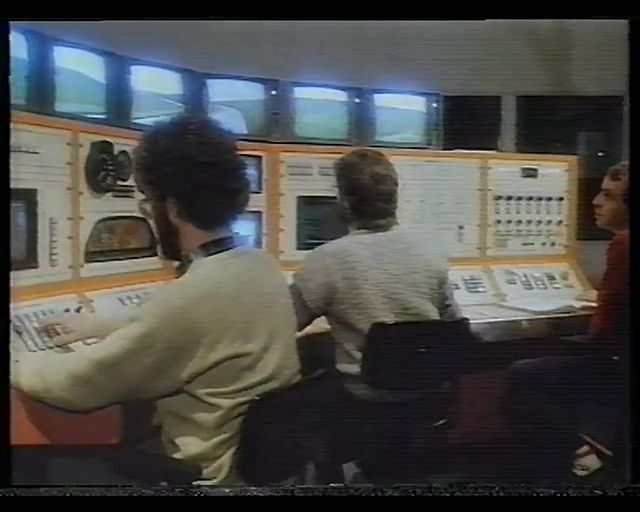
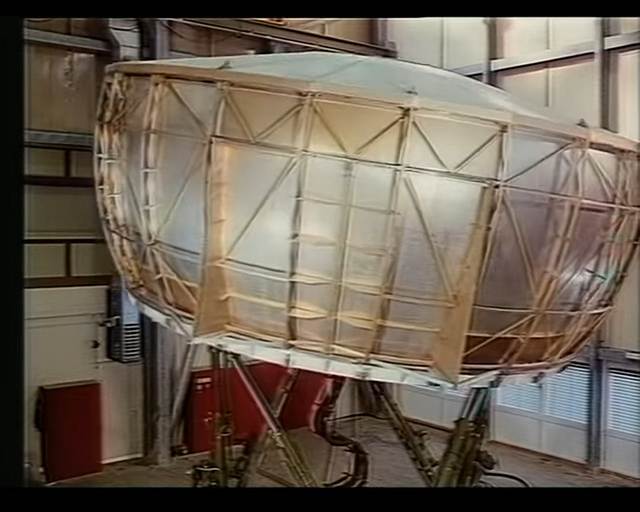
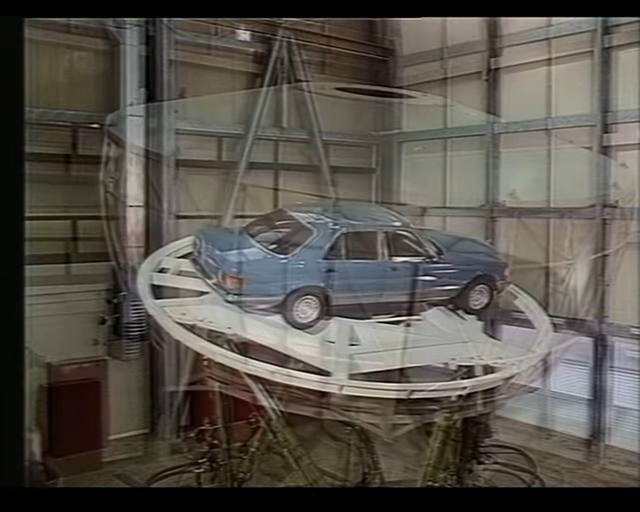
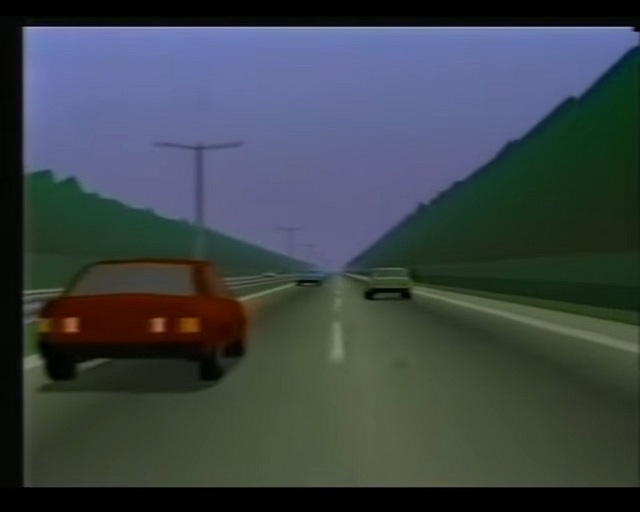
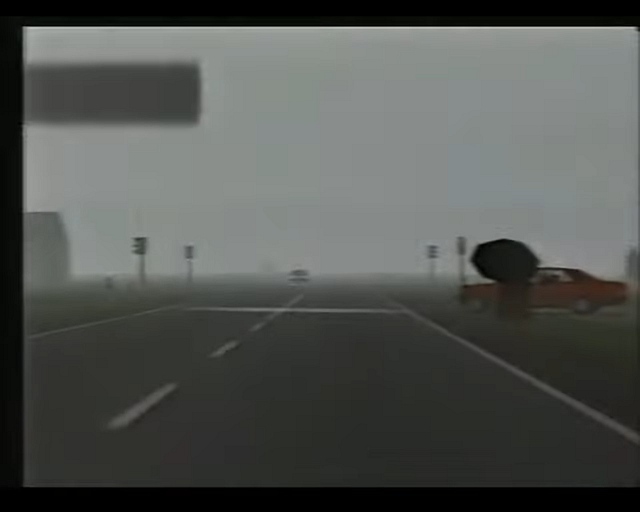
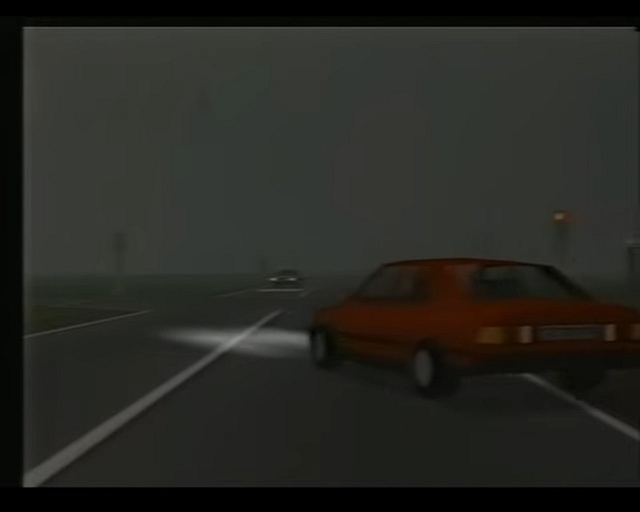
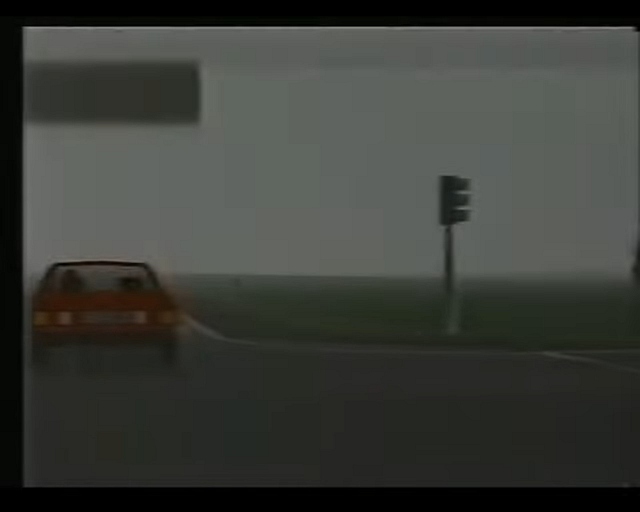
Daimler-Benz-FahrsimulatorIt is said, in Germany a toddler's first 3 words are Mama, Papa, Auto (mum, dad and - well, have a guess). In my childhood around 1980 Western Germany considered itself an automotive nation, CGI was new and driving simulators part of our pop culture. Demonstrated on TV as cutting edge technology, they were seen as scientific research machines and (like particle accelerators) known to be unimaginably expensive.So the Daimler-Benz-Fahrsimulator did cost 25 million DM and was the most advanced of its time. The apparatus was installed in the Daimler-Benz-Werk Berlin-Marienfelde (groundbreaking 1981-11-06, first operation 1984-10-19) and employed Evans & Sutherland simulation technology running on a supercomputer. According to specs found on the mercedes-benz publicarchive site (press info PRMIT19611 of 1985, english PRMIT22719), it had a motion cell for whole car body, diameter 7.4m, weight 4.7t, acceleration force 1.25G by 6 hydraulic cylinders. A Gould mainframe for realtime car model controls parrallel "sattelite computers" for motion, imaging, sound and forces. It computes 2000 equations for driving dynamics every 10ms. Imaging employs 6 projectors for 180° view, 50fps, 1.57 megapixel, computed every 80ms (quote: "a homecomputer would need each 65 years"), including weather and traffic. Landscape size 512 x 512km. Also digital audio is updated at 50 fps from vehicle characteristic curves. The purpose was to make a digital twin for virtual pretest of new car parts, concepts and ergonomics, and doing physiological research of driving and accident risks. This is footage with screenshots from 2 German
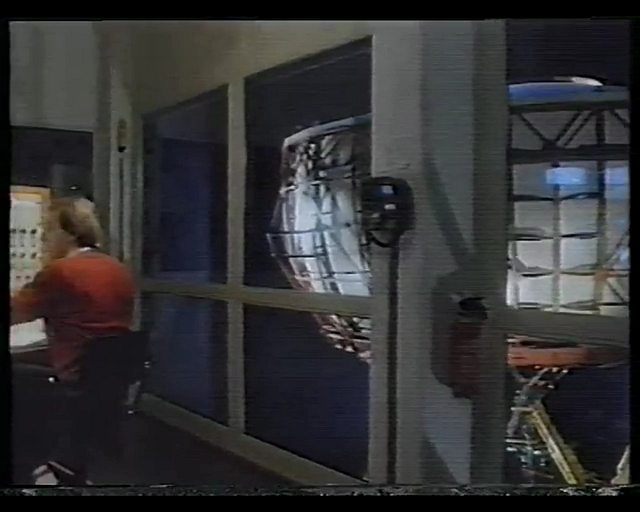
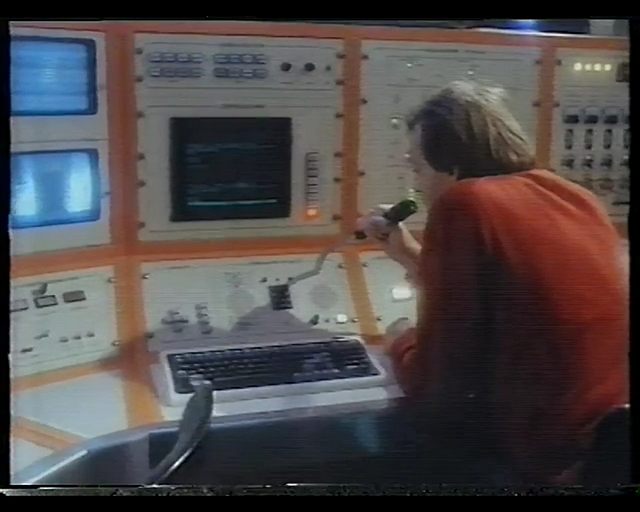
TV docus. The futuristic control room was like the bridge of starship Enterprise.
1980th computer freaks eyes grew wider when driving simulators were on
TV. Despite low quality (Youtube)
one can estimate the shaded 3D graphics that had nothing common with 8-bit
homecomputer games or anything seen before.
Far away in the temples of math and velocity, to common people these mythical machines were completely out of reach. So the closest they could try out for themselves was a Nürburgring arcade machine. Here in Germany these games were as popular as Pole Position. Die Fahrbahn ist ein graues Band - weiße Streifen, grüner Rand... As a symbol of progress, screenshots were used in ads and magazines. Also the album cover of Kraftwerk's "Autobahn" with its mountains was obviously inspired by the style of Nürburgring 3. In the first halve of 1980th people associated both with each others.
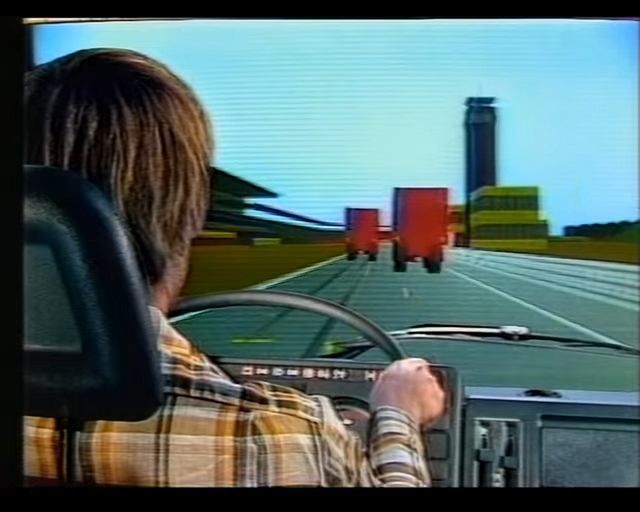
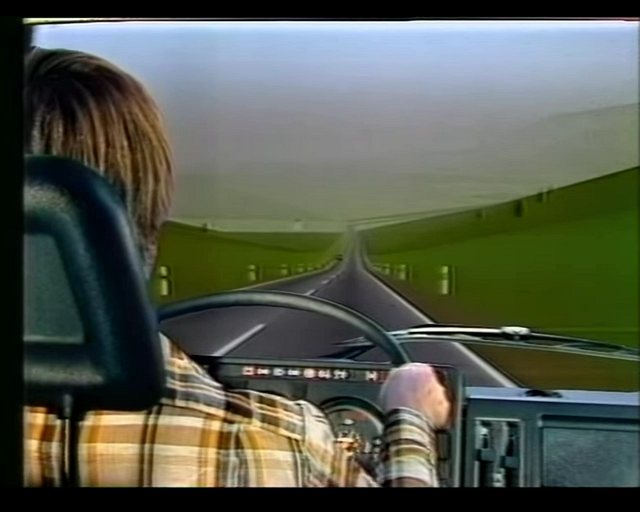
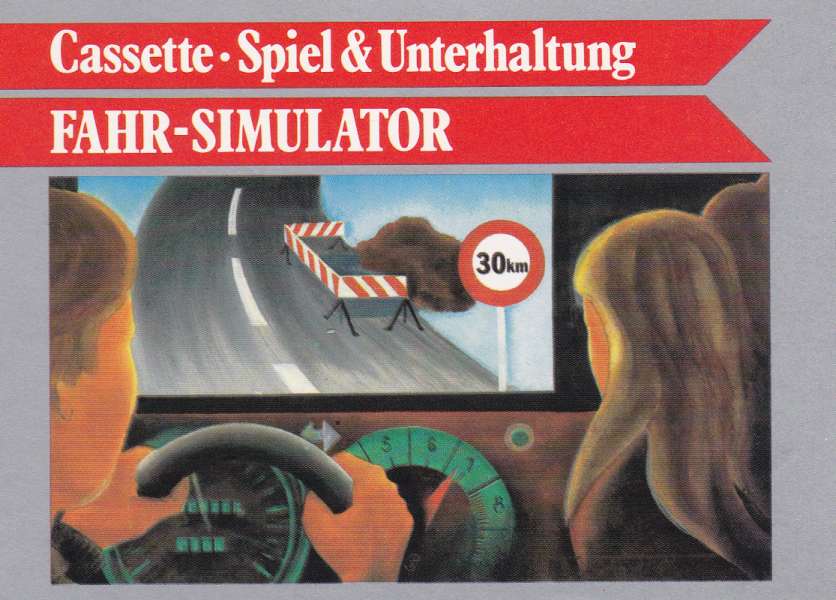
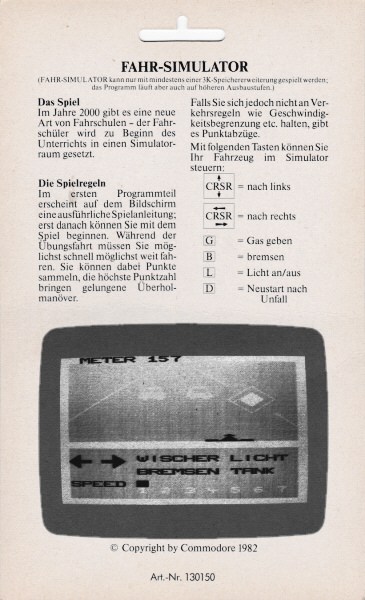
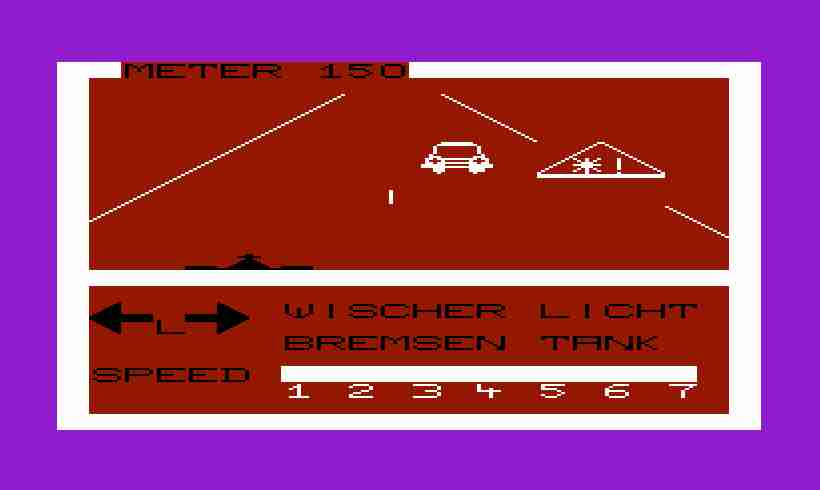
Fahr-Simulator (VC20)The driving simulator hype was popular enough that in 1982 even Commodore jumped on the bandwaggon with a crude VC20 game.
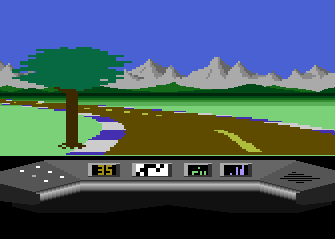
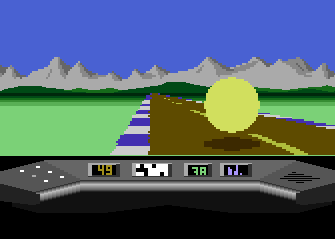
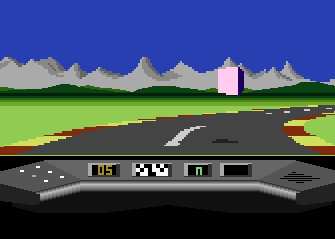
But the interesting part is not the product but its historical context; we all know now where the white on red of the graphics undoubtly got inspired from (and certainly disappointed children those wished something like this for Christmas); it's Nürburgring 3. The VC20 trash game didn't come out of nowhere. While gameplay was lousy, most amazing is its brief background story that at its time was sci-fi: "In the year 2000 there are a new kind of driving schools. To the begin of education the student is sat into a simulator room." Of course there came others. So in 1987 Test Drive by Accolade promised driving simulator thrill at home (even for C64), but despite big onscreen dashboard and rearview mirror this rather jerky car race still suffered of way too repetitive boring graphics. Elektra GlideAlso this spectacular 8-bit homecomputer game of 1985 was obviously inspired by Nürburgring 3. Elektra Glide by Adam Billyard (English Software) has those mountains and blocky numbers, and like there you can not leave the road (despite it has striped rims like Pole Position instead of the crash barrier).
|
It is hard to identify the later Nürburgring hardware generations from the few existing photos and patent texts, so I hope my description is correct. From what I see on pictures, the Foerst company apparently often upgraded their older sitdown machines from N3 to N4 or N5 hardware, so the game in each cabinet shape can differ. They also made many large single-unit productions and customized cabinet variants. My childhood memories were mostly of generation N3.
|
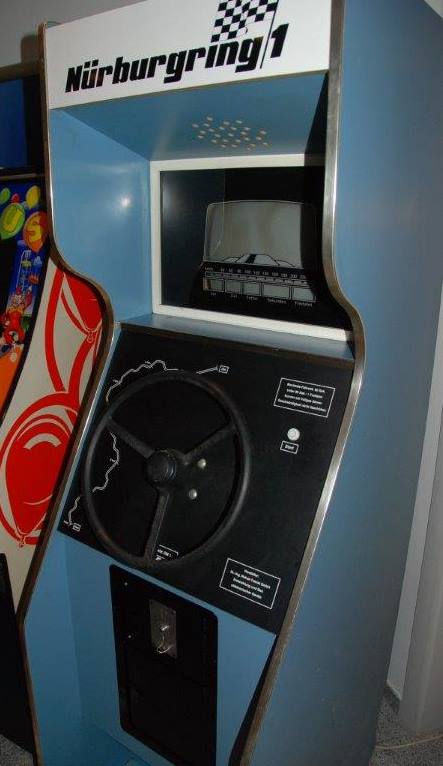
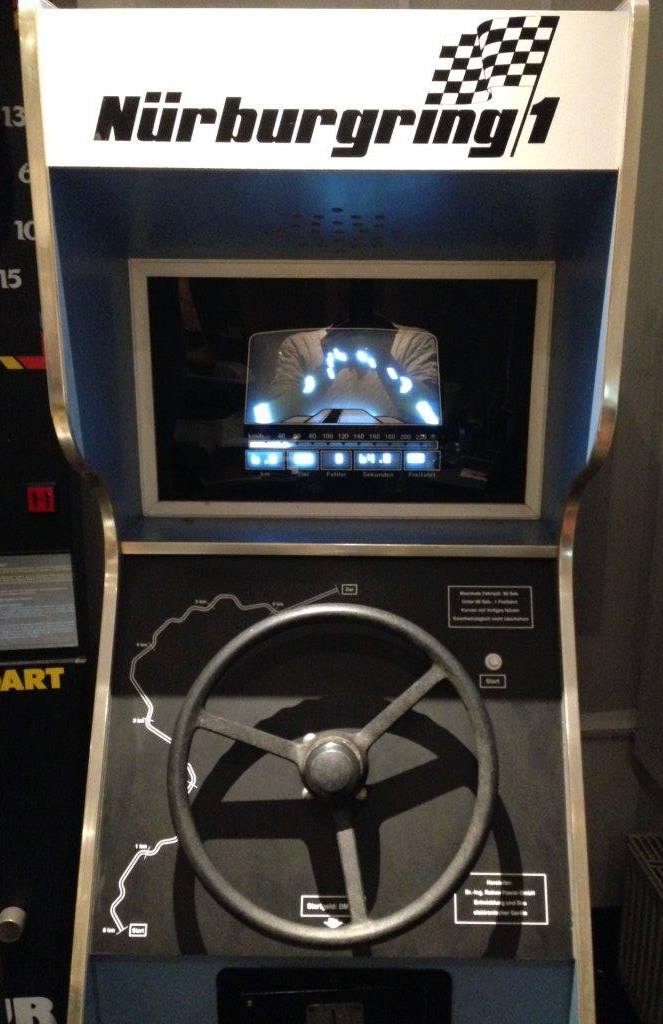
The N1 hardware contained 28 cards in an industrial rack, employing no CPU but an analogue computer for the simulation model, road graphics and sound. Only the character generator (drawing dashboard numbers on screen) was actually digital, so the technology rather resembled a Magnavox Odyssey than arcade version of Pong.
 |
 |
|
N1: Nürburgring/1
patents US4077138, US4077138A
The gameplay featured realistic drifting behaviour and was a great commercial success. The analogue sound synthesis included tire skid noise, crash sound, wind hissing at high speed and the dynamic motor sound was made from filtered sawtooth that turned loud at high rotation, sharp when stepping the gas pedal and hollow at engine brake.
According to the patent, the hardware uses dot pair generators to draw a series of rectangles as road posts. Their motion is controlled by analogue curve generators those are controlled by a digital sequencer that outputs the curve angles of the track. An additional curvature function generator shifts the displayed posts horizontally according to the steering. Schmitt triggers start and stop skidding or limit the brake intensity depending on speed, steering angle, brake pedal angle etc. all through analogue control voltages. According to the patent, an additional video signal generator can depict a rectangular obstacle (which AFAIK wasn't part of the Nürburgring 1 game). The digital character generator (not in the patent) works like in Pong, but had an additional speedometer bar (likely another analogue element, which pulse width controls the length). The sound is analogue.
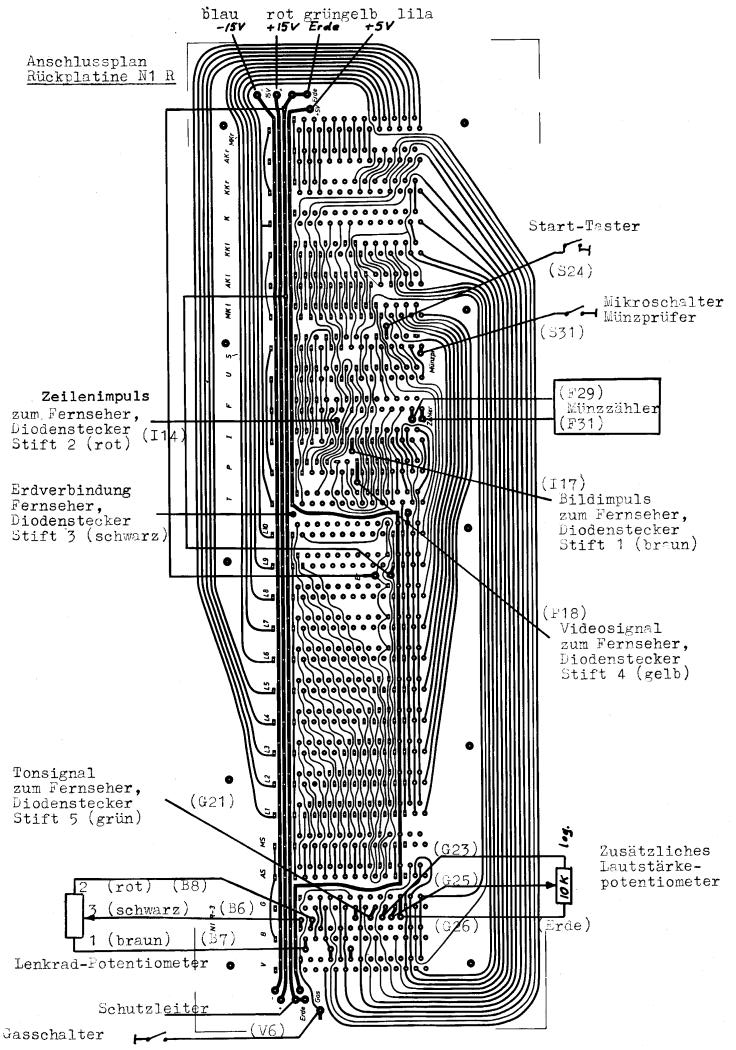
backplane |
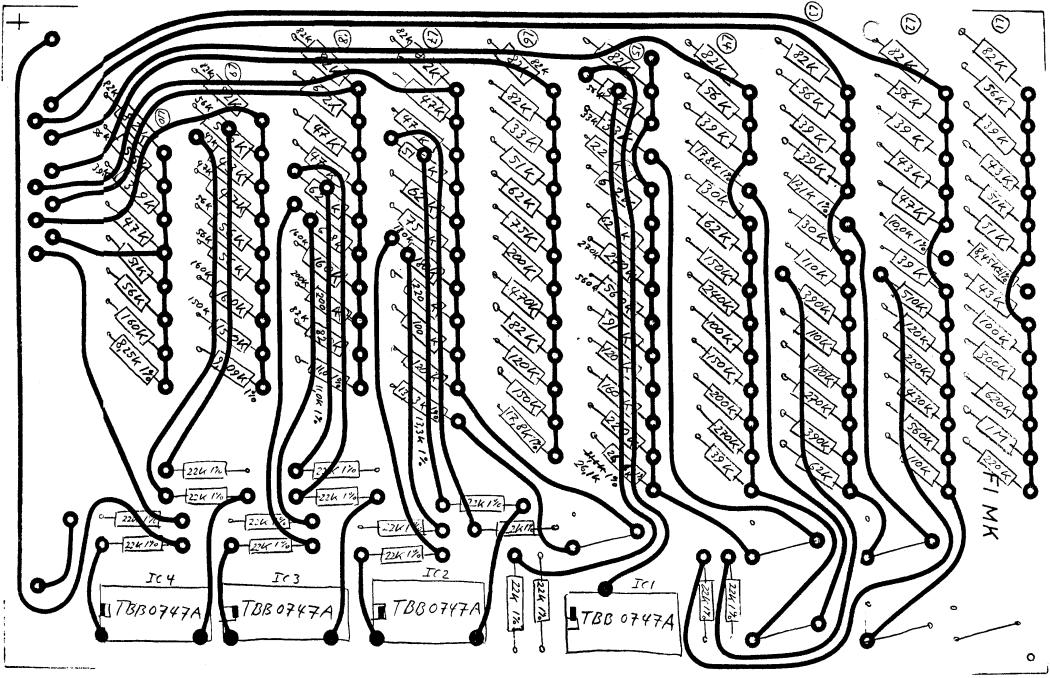
dot pair generator |
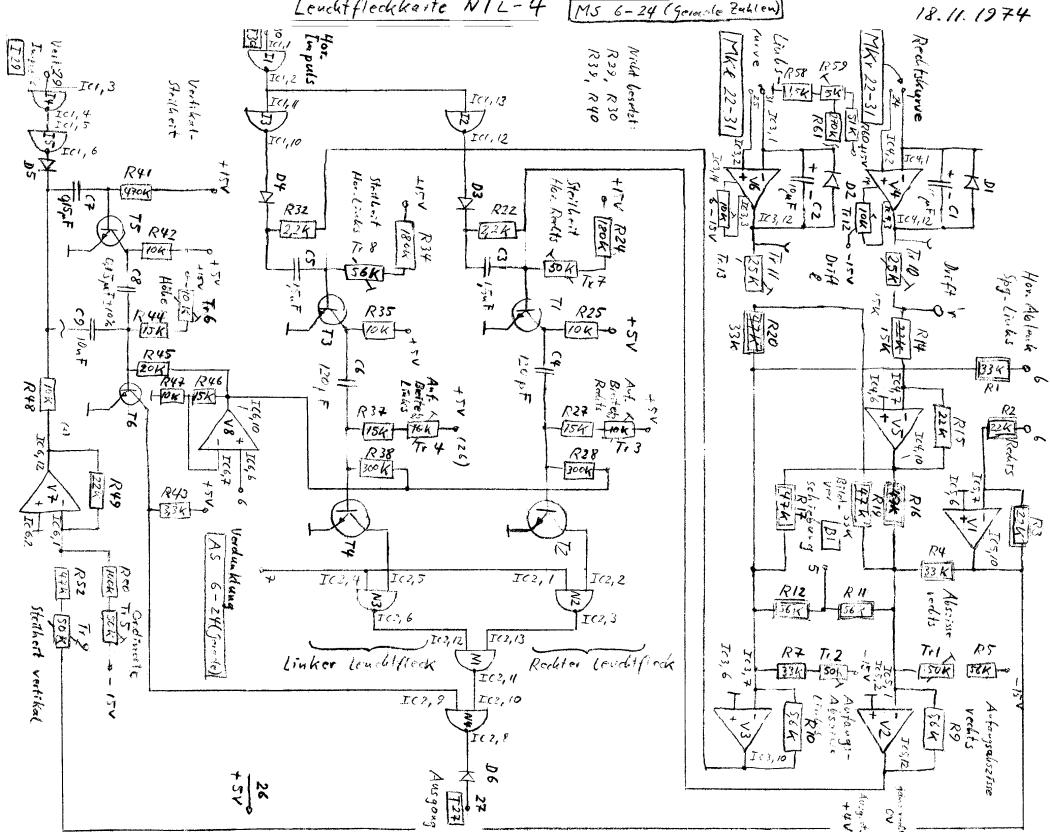 |
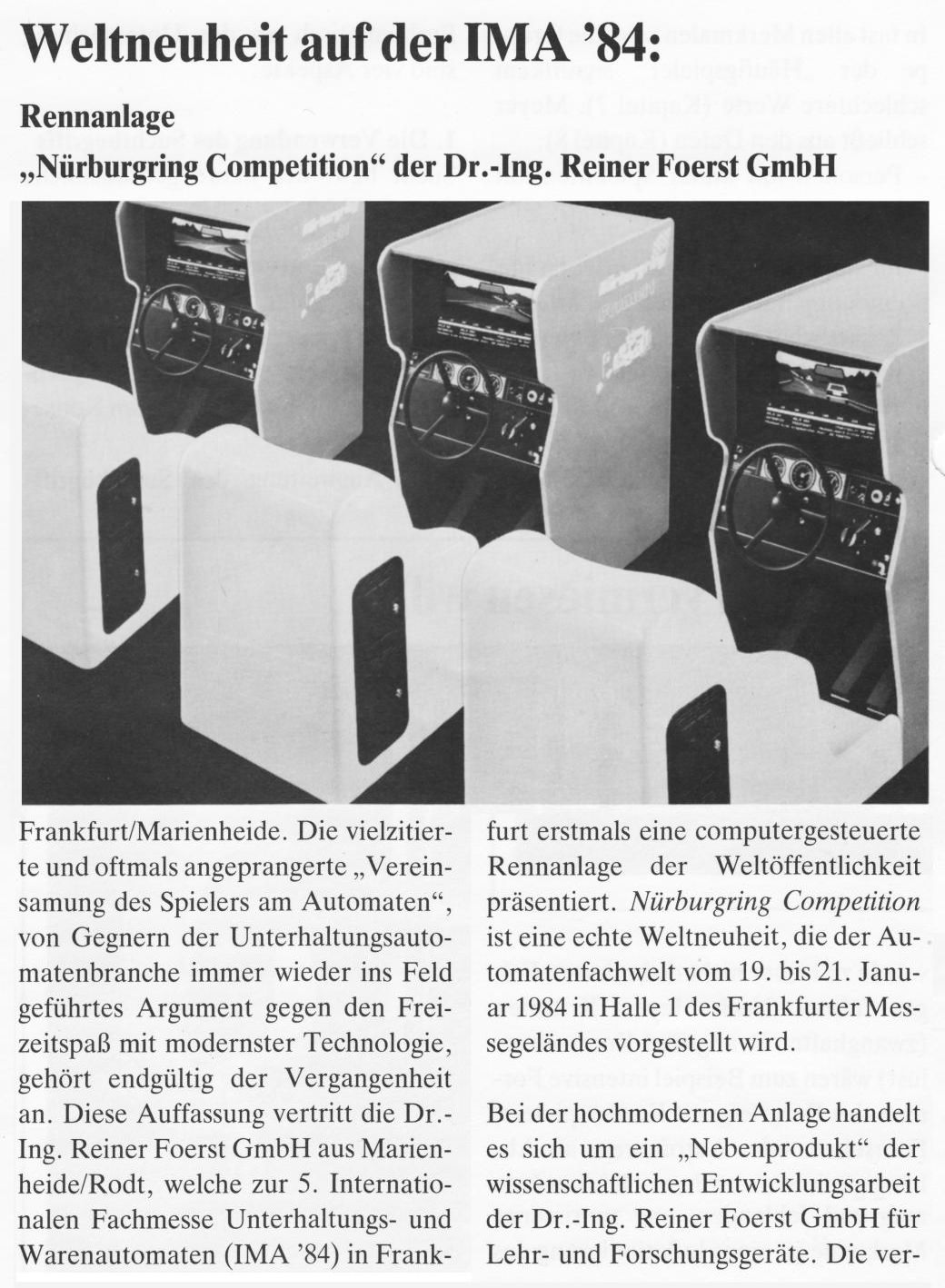
The arcade machine initially was a success. They were operated in public places like cinemas and bowling centers, and magazines wrote about its realistically simulated driving behaviour. US companies like Midway and also Japan promised to licence the game, but the complicated circuitry with about 2800 components and 10000 solder joints was expensive to manufacture and maintain.
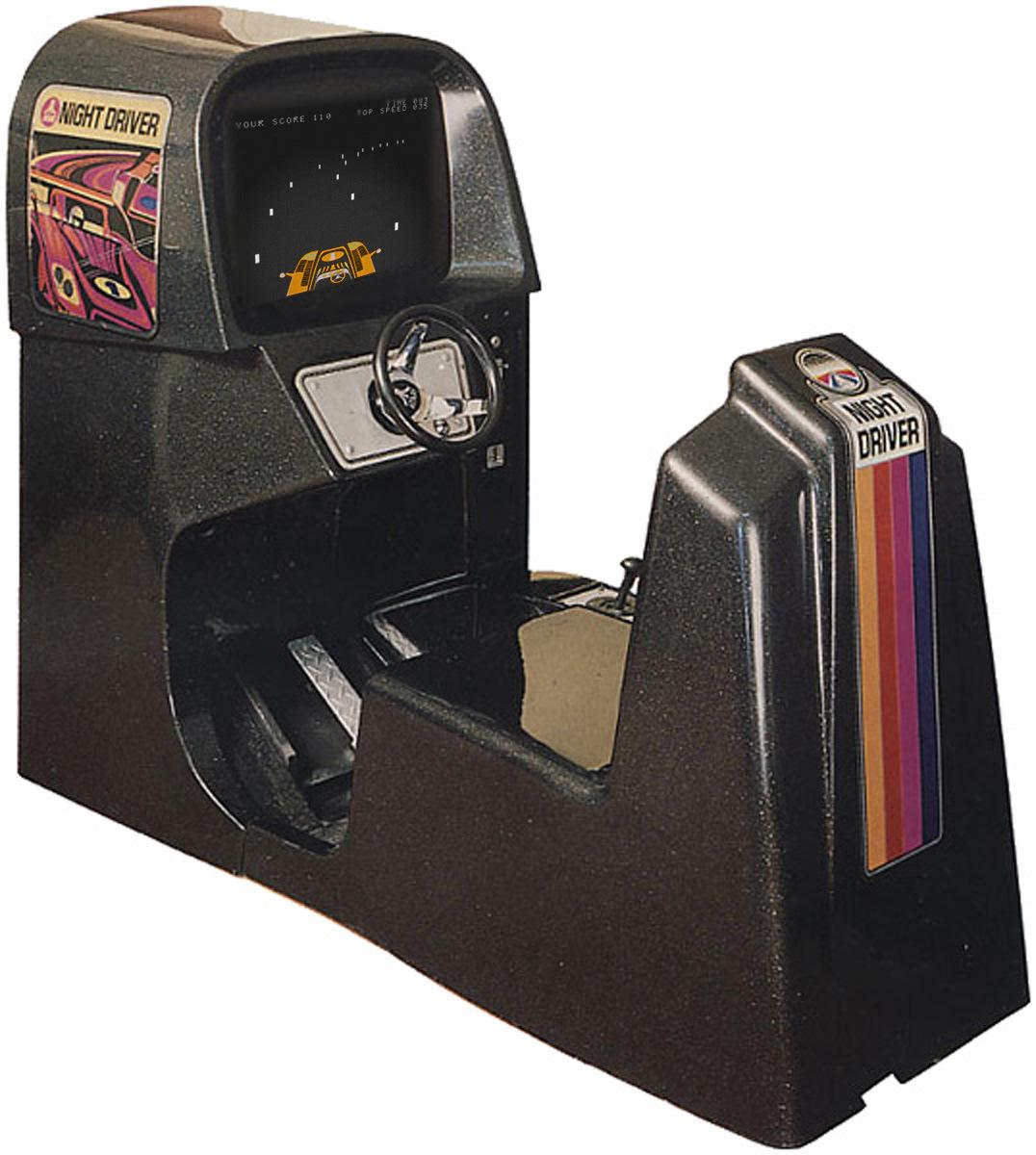 Because
others released in large quantities a knock-off with cheaper all-digital
hardware that needed no trimmer adjustments, the deal failed and Nürburgring
1 did not sell anymore. Also the patent lawsuit by Foerst failed, because
his patent was about the analogue implementation. (So SPOBAG cancelled
in 1976 an order of 10 pieces, those were each 4690DM+VAT.) The company
history text claims that the bootleg was named "Midnight Racer"
with the impudent slogan "Another Atari First" (Foersts own slogan had
been the alliteration "Foerst's First's"), which is likely incorrect. "Midnight
Racer" aka "280-Zzzap" was by Midway, while "Night Racer"
was by Micronetics and sold to Atari those rebranded it "Night
Driver".
Because
others released in large quantities a knock-off with cheaper all-digital
hardware that needed no trimmer adjustments, the deal failed and Nürburgring
1 did not sell anymore. Also the patent lawsuit by Foerst failed, because
his patent was about the analogue implementation. (So SPOBAG cancelled
in 1976 an order of 10 pieces, those were each 4690DM+VAT.) The company
history text claims that the bootleg was named "Midnight Racer"
with the impudent slogan "Another Atari First" (Foersts own slogan had
been the alliteration "Foerst's First's"), which is likely incorrect. "Midnight
Racer" aka "280-Zzzap" was by Midway, while "Night Racer"
was by Micronetics and sold to Atari those rebranded it "Night
Driver".
While Night Driver got ported to Atari 2600 and C64, and similar games were made for many other home consoles and computers, Nürburgring 1 itself was soon forgotten.
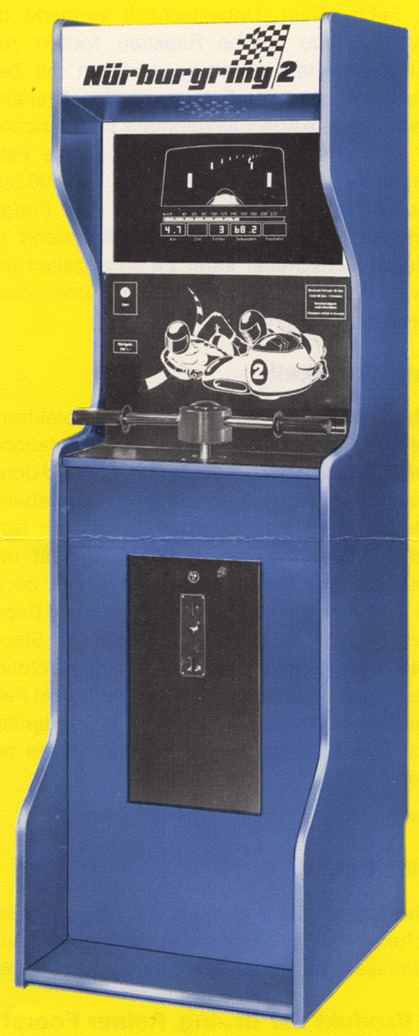
Nürburgring 2 |
N2: same game with motorcycle handlebar (hardware like N1)
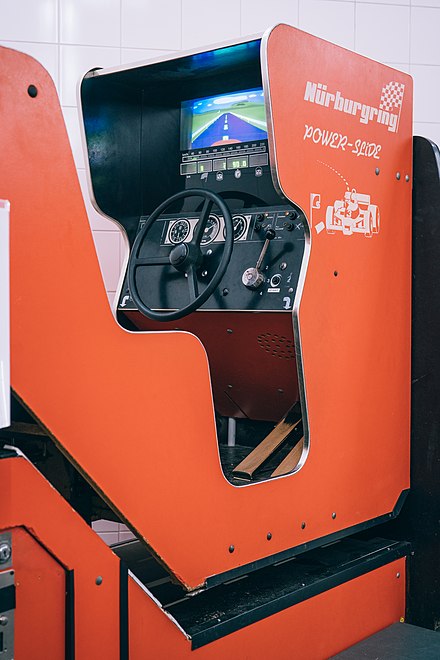
Nürburgring 3 Power-Slide |
|
|
|
 |
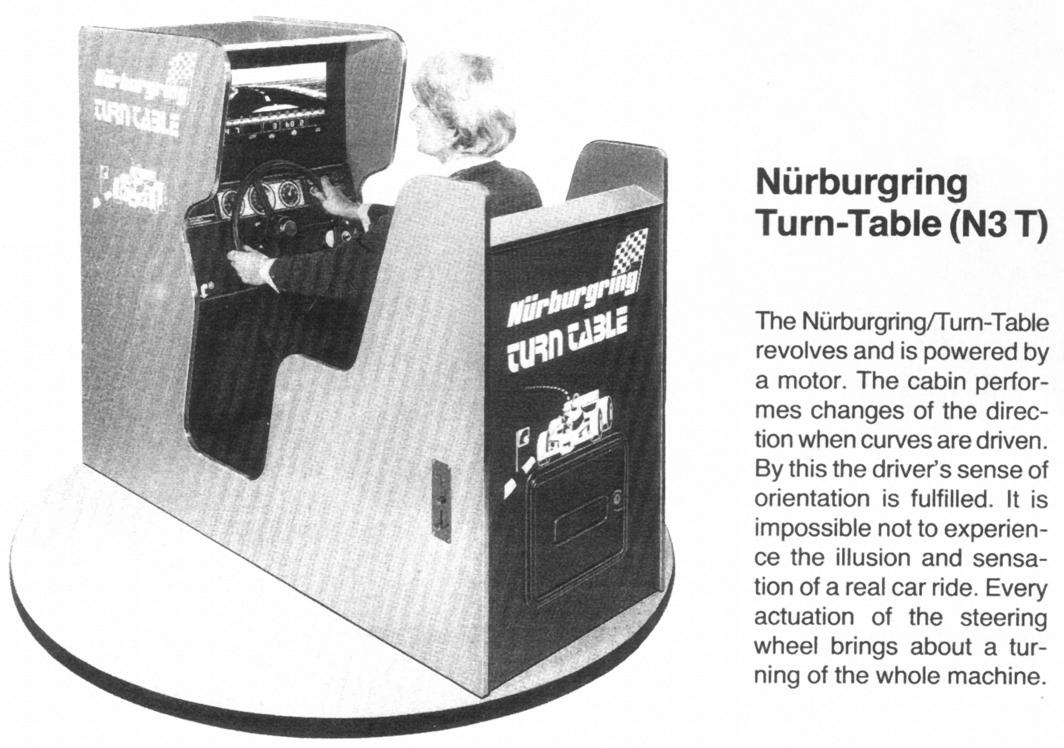 |
This swivel variant "Turn-Table" looks more like a vomit comet than fun to play. The regular "Formel 1" sitdown used the same cabinet without swivel disc. | 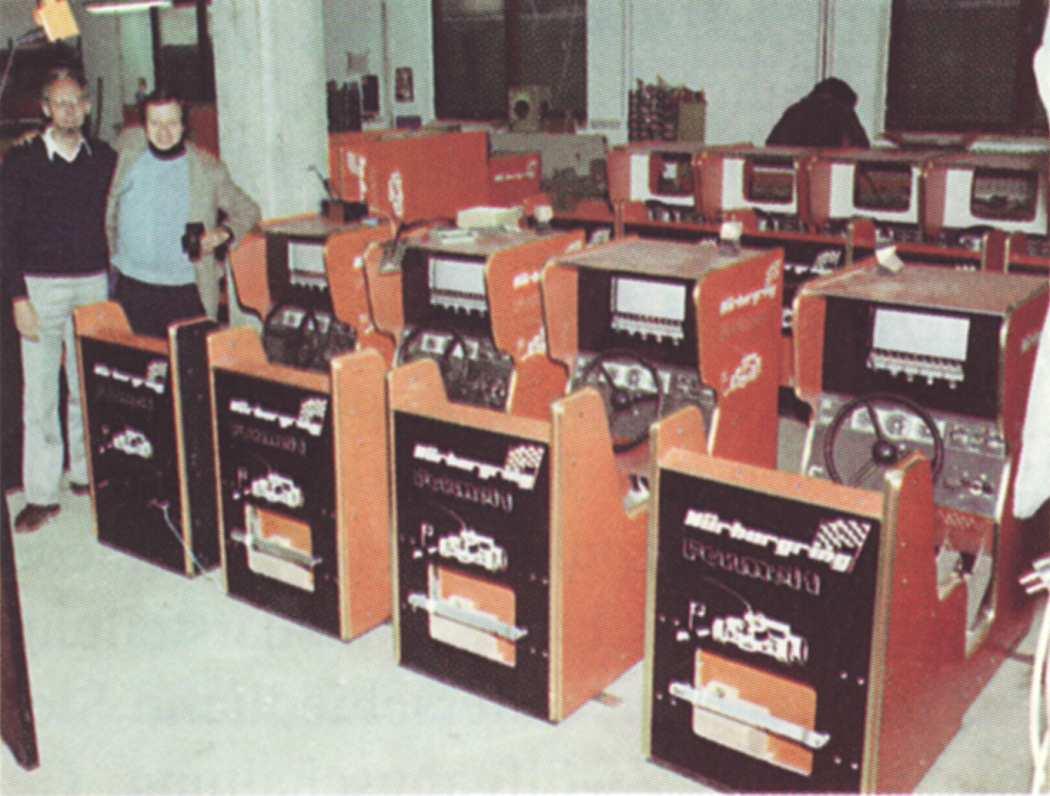 |
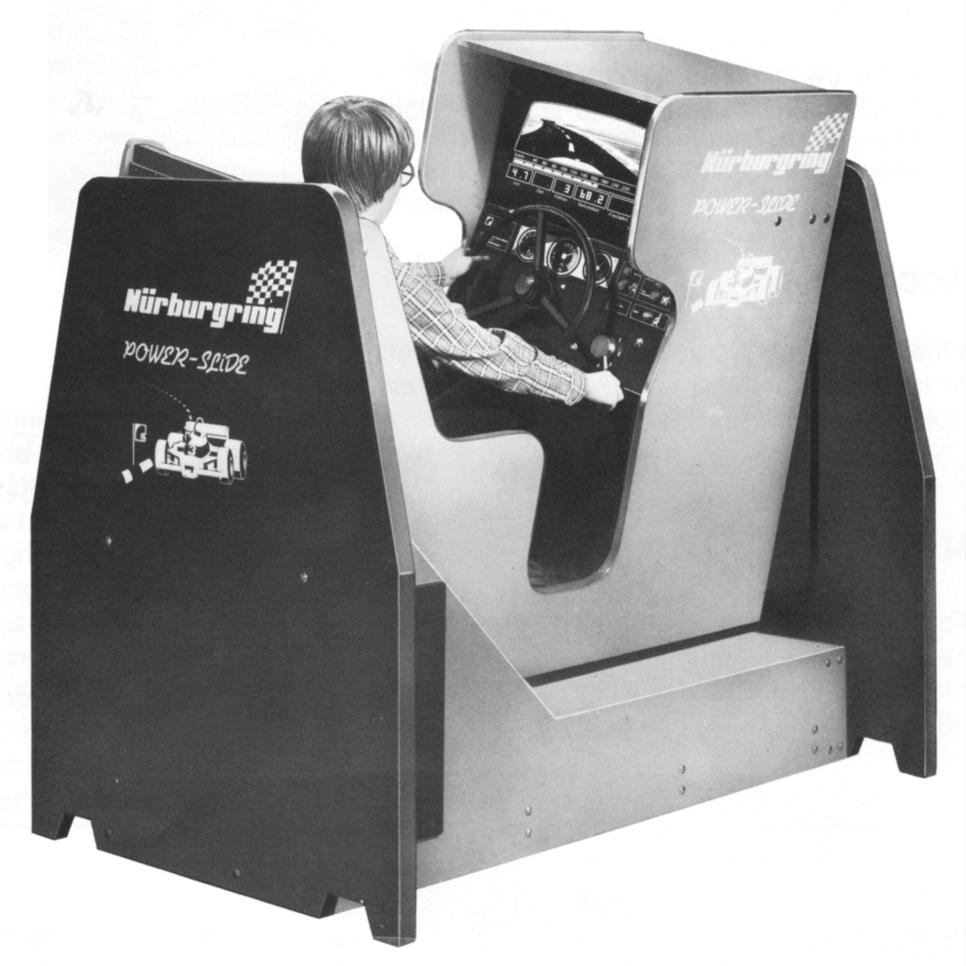 |
The tilt mechanism of N3 Power-Slide (1982)
looks more stomach friendly than the "Turn-Table" carousel.
The patent even has priority date 1975, hence it was used long before N3 hardware. |
N3 electronics still was costly and needed adjustment trimmers. |
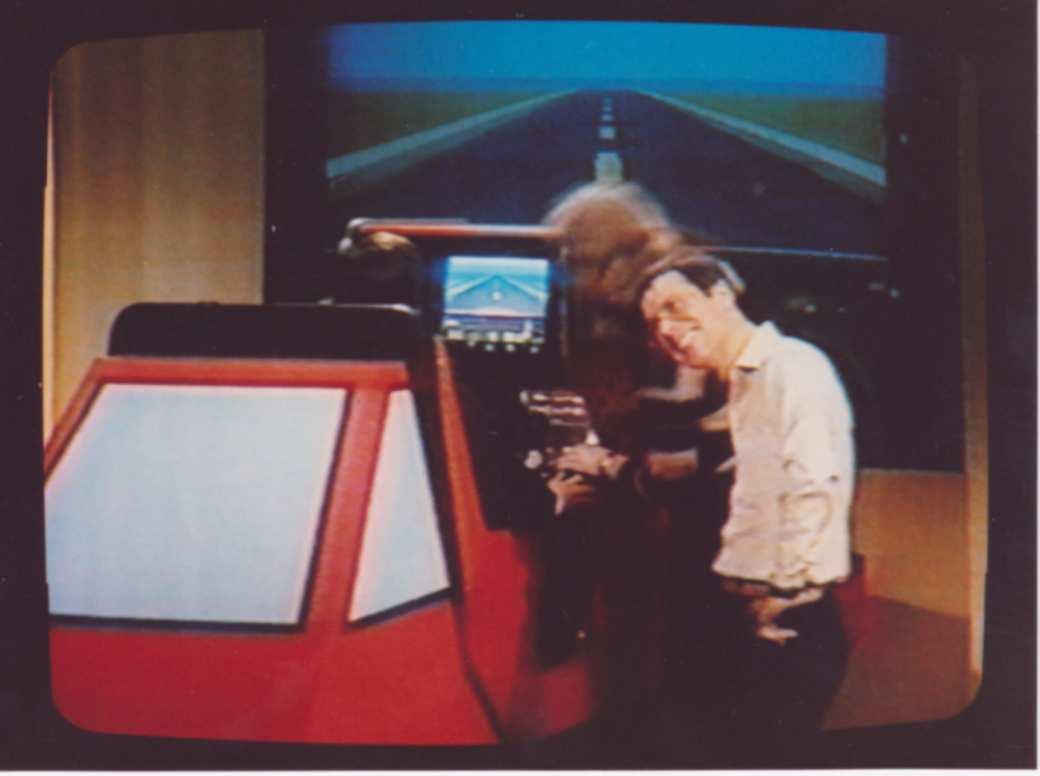
German gameshow "Telespiele" (1981, SWF) |
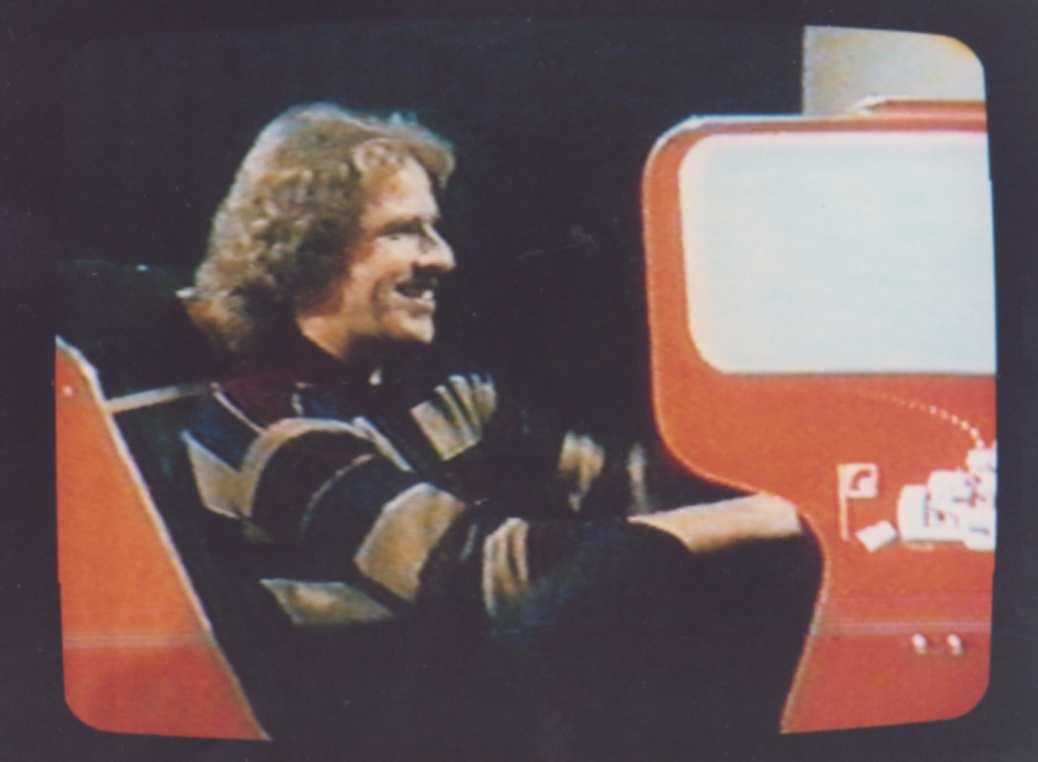
Thomas Gottschalk is playing. |
N3 S: Nürburgring/3 Upright Standing Game
N3 F?: Nürburgring Formel 1 (sitdown)
N3 P: Nürburgring/Power-Slide (motion sitdown with tilt mechanism)
N3 T: Nürburgring/Turn-Table (motion sitdown on horizontal moving
disc)
patents US4383827 + DE3243574A1 (hardwired graphics, no framebuffer), US4464117 + DE3032250A1 (Power-Slide mech)
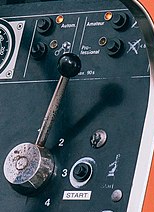 The
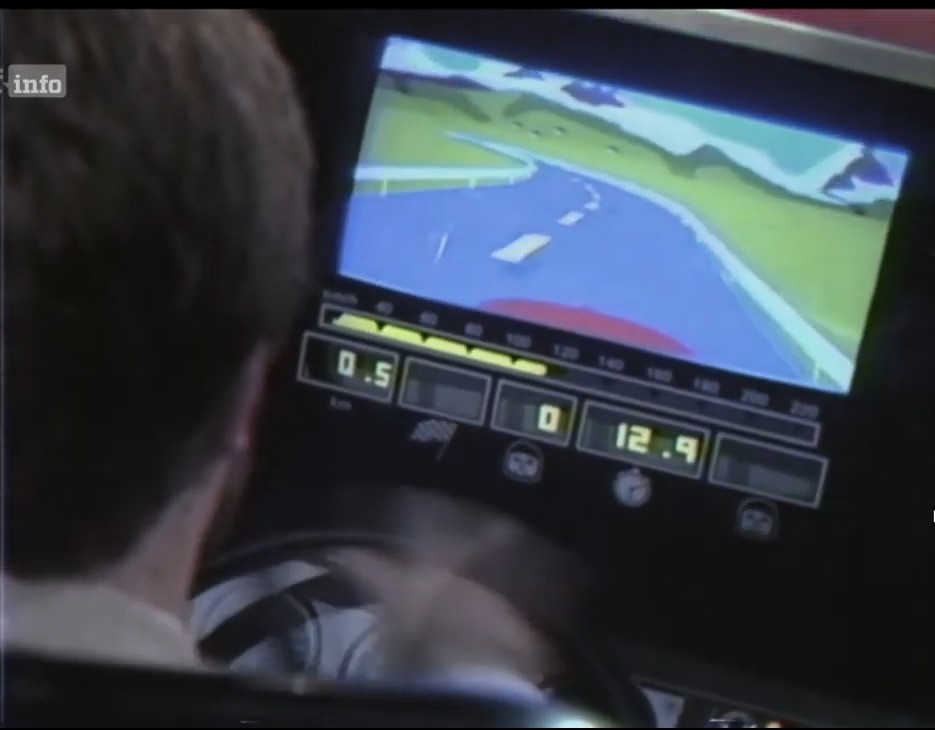
attract mode of this archaic machine blanked the sky. It stayed boring
blue above the road without any text or details - the diametically opposite
of how later arcade games tried hard to lure players. So like in tourist
stationary binoculars, you had to first insert a coin to view the iconic
mountain panorama background on the screen, that horizontally scrolled
during curve motion of the car. Although barely wider than the screen (on
videos it repeats and jumps), possibly at its time this was perceived as
such an impressive digital novelty feature that they considered people
would pay for seeing it. The 2 selectable roads showed each a different
one. After coin insertion the panorama appeared, and the player could now
press 4 buttons (with each a yellow LED) to select between 2 roads (amateur,
professional) and manual or automatic shifter, and then press start. (Apparently
the N3 standard models had no button for drunk driver simulation. I may
have misremembered this from a TV show that likely played a variant of
N4
or N5.) The horizontal analogue speedometer bar likely
inspired the one in the Atari 2600 version of Pole Position, which
exists in no other ports of that game.
The
attract mode of this archaic machine blanked the sky. It stayed boring
blue above the road without any text or details - the diametically opposite
of how later arcade games tried hard to lure players. So like in tourist
stationary binoculars, you had to first insert a coin to view the iconic
mountain panorama background on the screen, that horizontally scrolled
during curve motion of the car. Although barely wider than the screen (on
videos it repeats and jumps), possibly at its time this was perceived as
such an impressive digital novelty feature that they considered people
would pay for seeing it. The 2 selectable roads showed each a different
one. After coin insertion the panorama appeared, and the player could now
press 4 buttons (with each a yellow LED) to select between 2 roads (amateur,
professional) and manual or automatic shifter, and then press start. (Apparently
the N3 standard models had no button for drunk driver simulation. I may
have misremembered this from a TV show that likely played a variant of
N4
or N5.) The horizontal analogue speedometer bar likely
inspired the one in the Atari 2600 version of Pole Position, which
exists in no other ports of that game.
According to patent DE3243574A1 the colour graphics of this technical marvel works without framebuffer using gate logics with counters to draw the road etc. in realtime. The dot pairs of N1 here apparently became e.g. the crash barrier mounting posts. There are "range wedge generators" to draw objects in different distances (sharing parameters in RAM). It is hard to figure out if the curve generators for road computation were also reused to draw other things like car hood, clouds and mountains (likely controlled by an eprom). For pongish hardware this is totally unique. The lack of framebuffer not only made graphics fast, but may have also reduced cost at a time where RAM was the most expensive computer part. Although this machine yet had no opponent cars, the graphics style of drawing a 3D road with center line and horizontally scrolling 2D backdrop (sky and mountains) had set the standard for games like "Turbo" (1981 by Sega, which completely lacked car physics and switched curves as static still pictures) and the famous "Pole Position" (1982 by Namco, having car physics and proper curve motion).
Even more interesting is that Foerst envisioned in his patent DE3045841A1
already in 1975 (priority date, filed 1980) an open world 3D driving simulation
with roadmap featuring signs, traffic lights, opposing traffic, fire engines
etc. - suggesting a multi-player capable driving game with time measurement
and simulated police reprimands in case of traffic rule violations. - A
concept that took until 1990th to find its way into popular games like
"Test Drive III" and eventually climaxed into the "GTA" series.
The 3D visual road style of Nürburgring 3 got somewhat imitated
in Kaneko's rollerskate arcade game Fighting Roller (aka Roller
Ace) of 1983,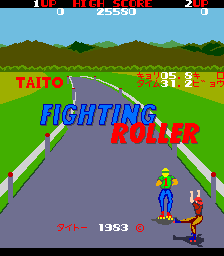 but I don't assume hardware similarities. One reason why Reiner Foerst
as a videogame pioneer became so unknown is that Nürburgring arcade
games were never officially ported to game consoles or homecomputers. The
experience of arcade drivesims strongly depends on haptic parts (controls,
motion mechanism) those were absent on home systems, thus other programmers
rather designed their own games. The closest similar home game may have
been Elektra Gilde. And neither the
Nürburgring arcade cabinets nor the few known screenshots include
a visible manufacturer's logo; apparently Foerst rated his drivesim graphics
purely utilitarian and not an advertising vehicle for his name brand like
modern game companies do, which did not help popularity either.
but I don't assume hardware similarities. One reason why Reiner Foerst
as a videogame pioneer became so unknown is that Nürburgring arcade
games were never officially ported to game consoles or homecomputers. The
experience of arcade drivesims strongly depends on haptic parts (controls,
motion mechanism) those were absent on home systems, thus other programmers
rather designed their own games. The closest similar home game may have
been Elektra Gilde. And neither the
Nürburgring arcade cabinets nor the few known screenshots include
a visible manufacturer's logo; apparently Foerst rated his drivesim graphics
purely utilitarian and not an advertising vehicle for his name brand like
modern game companies do, which did not help popularity either.
|
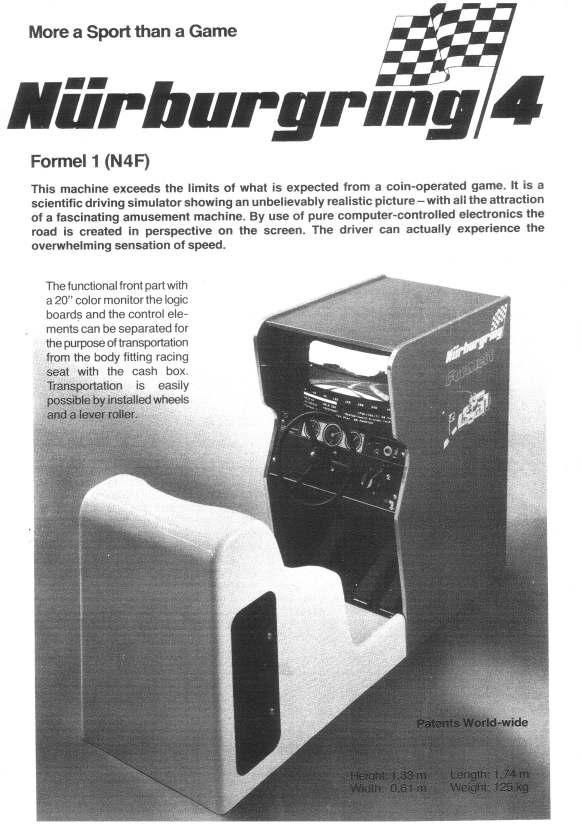
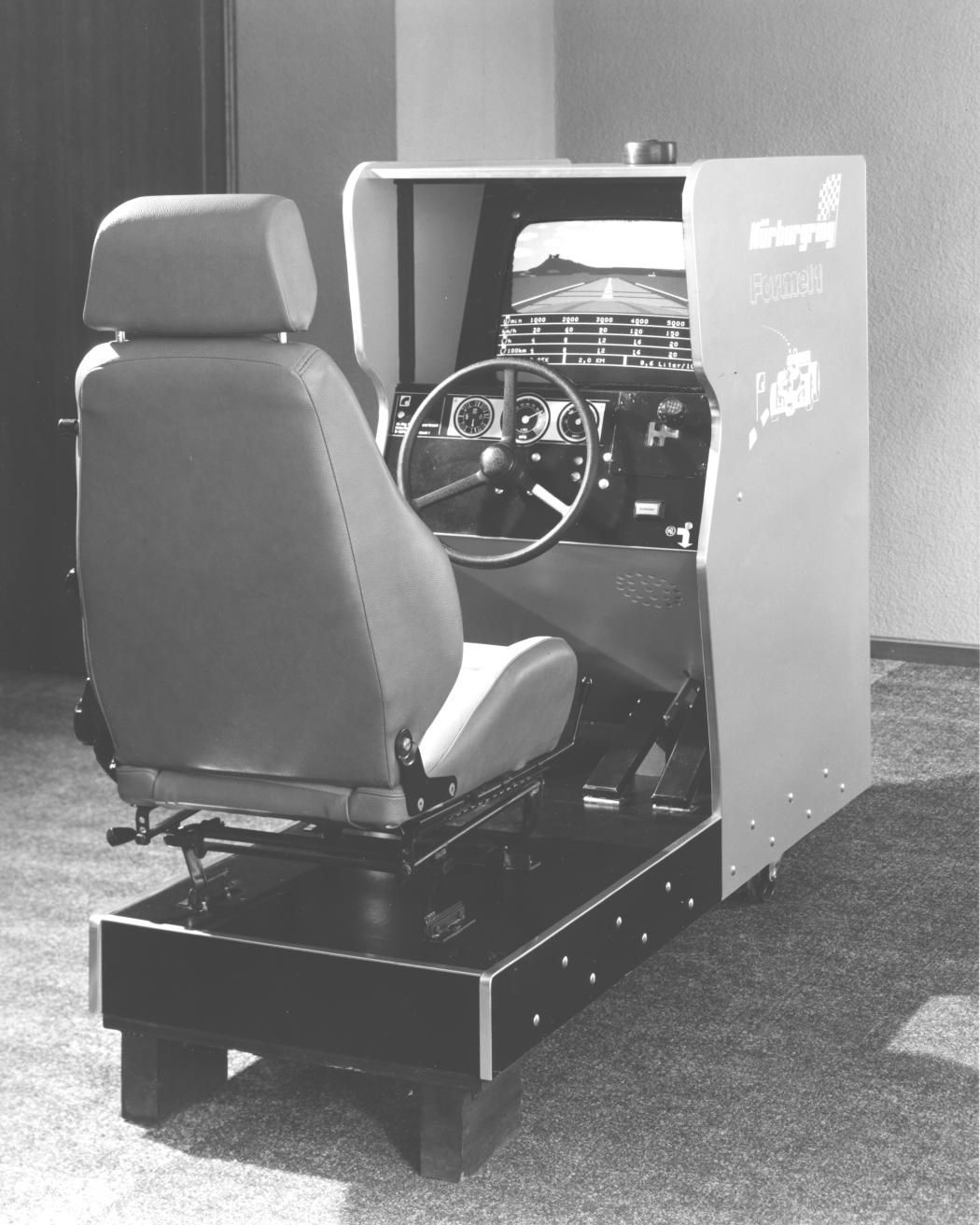
Nürburgring 4 Formel-1 (old eBay photo) |
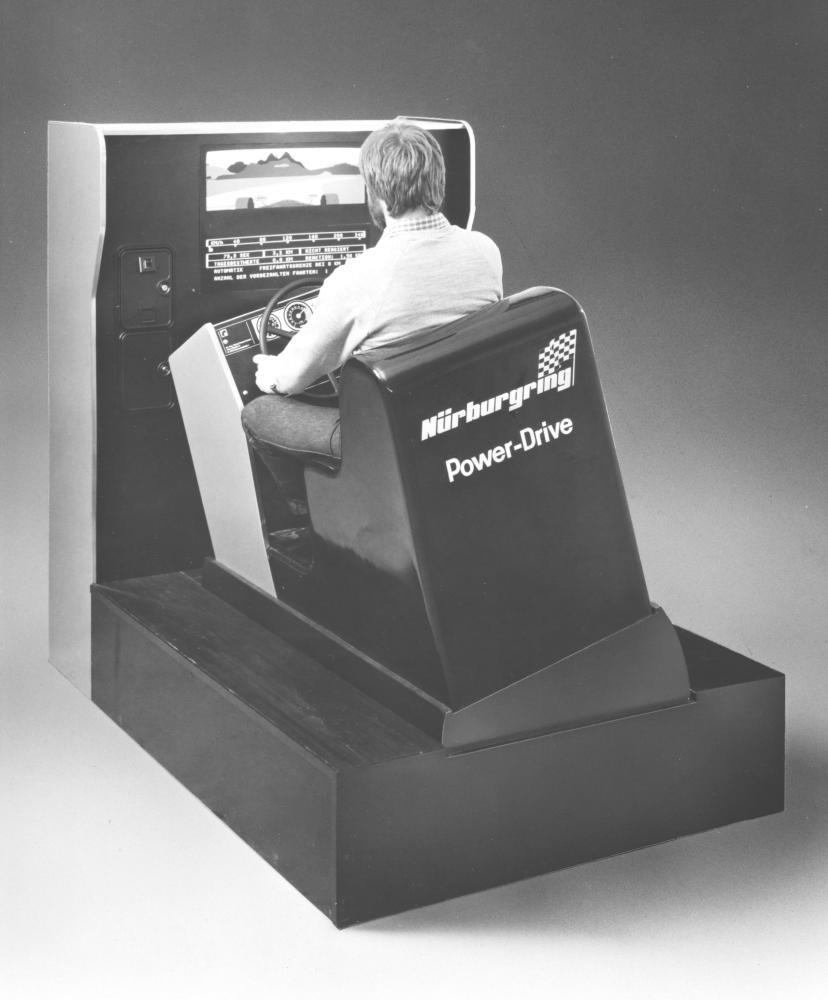
N4 hardware was used first in the Nürburgring 4 motorcycle simulator - a sitdown arcade machine which block shaped wooden bike with N2 handlebar had not even a seat.
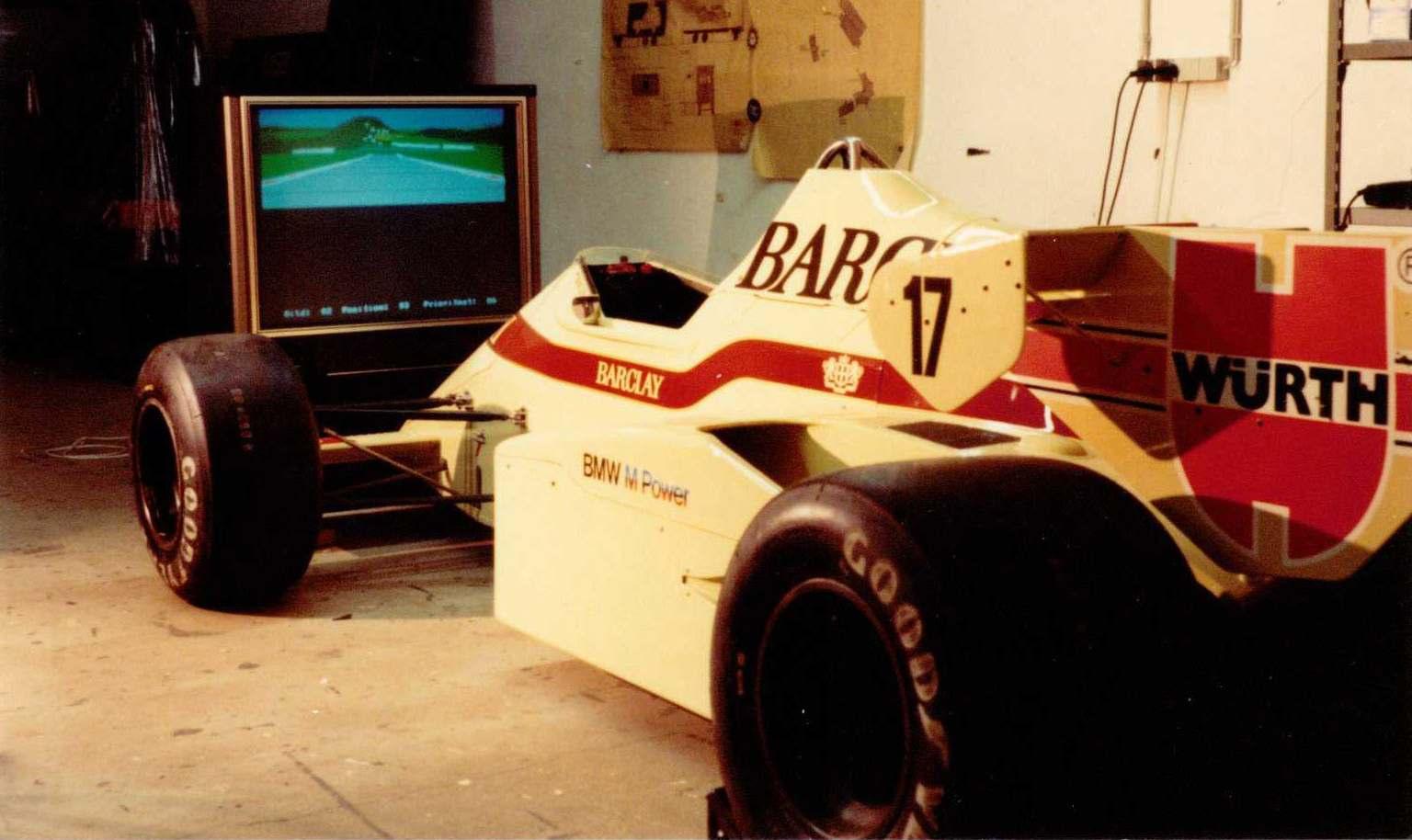 |
racing simulator Barclay with real F1 car (1983) | 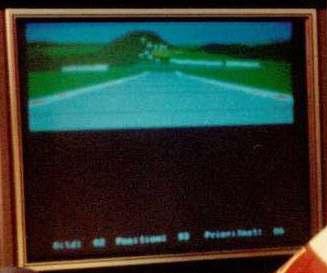 |
 |
 |
 |
eco-driving trainer 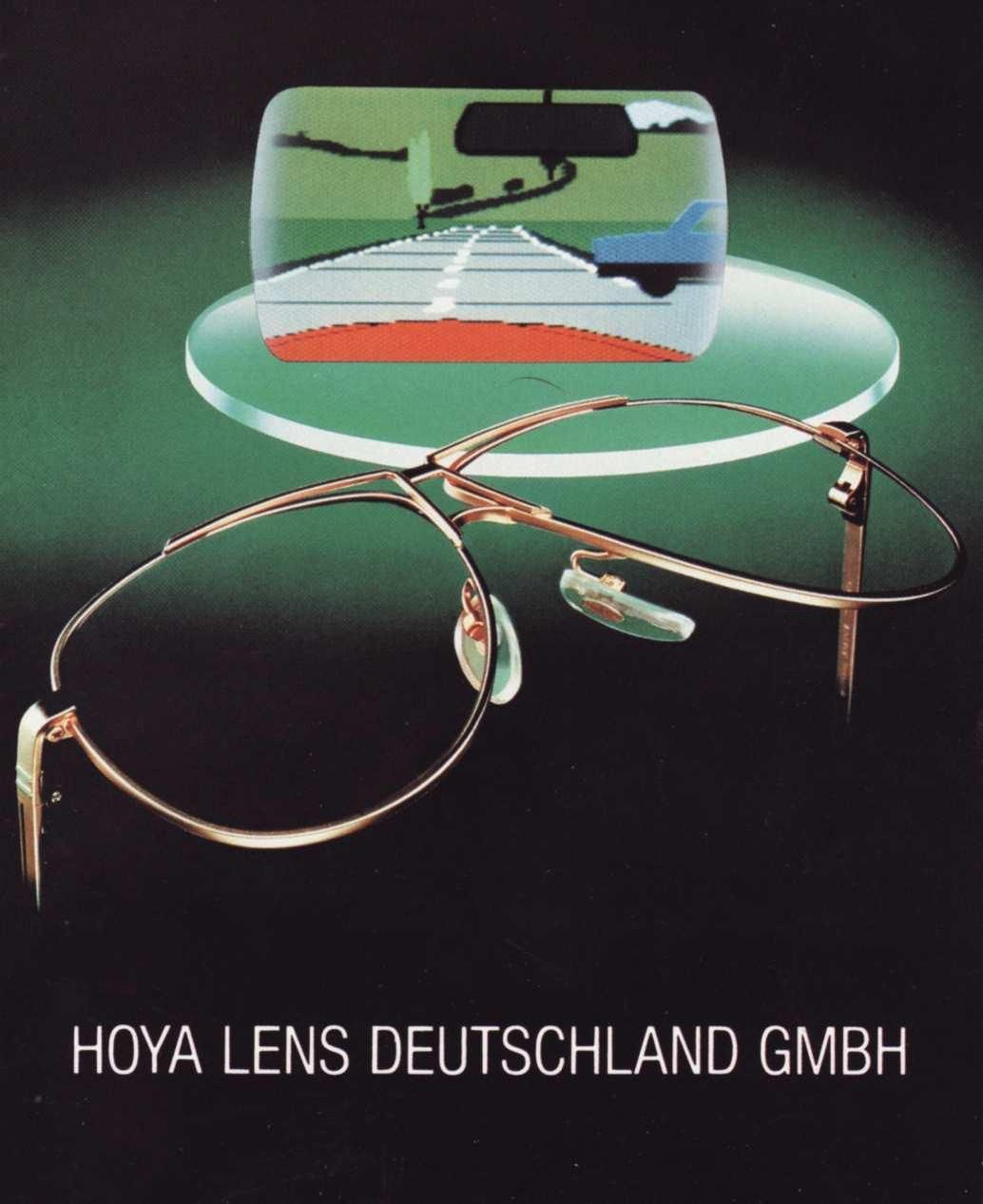
a glasses advert with N4 screenshot |
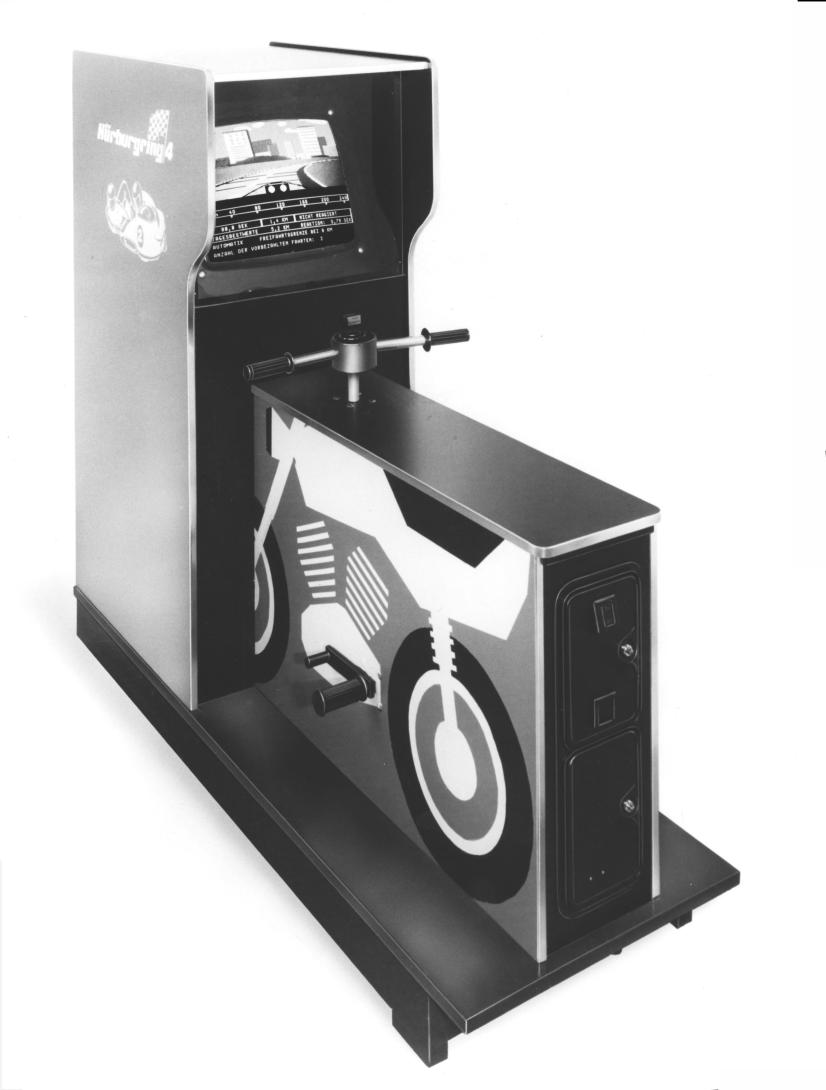 Nürburgring 4 Motorrad-Simulator
 |
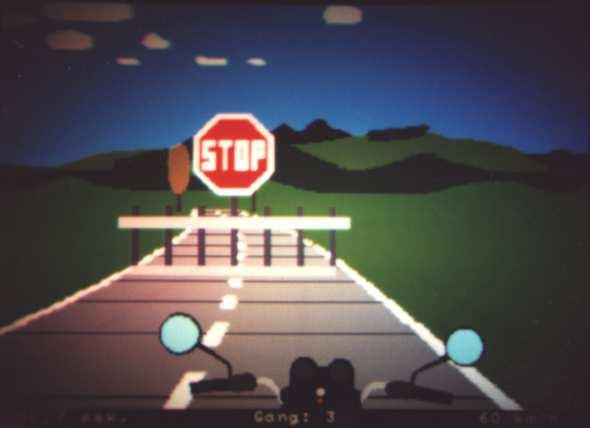
|
patents US4196528 + DE2703025A1 (link mode), DE3400518C1 (Power-Drive mech)
Unfortunately for Foerst Nürburgring arcade machines later than N3 there is barely any info about gameplay or technical capabilities. Also patents don't help, so my conclusions may be inaccurate. With later models the transition to serious driving simulators seems blurry, so there were likely many specialized custom software variants, and it is unknown if they used eproms and could be configured through DIP switches or menus for each location, or if the machines even booted from floppy disks or datasette to ease updates.
 |
 A
strange N4 spin-off was the "Märchenland-Lokomotive" (fairytale-land
locomotive) - a closed cockpit machine designed for young children, driving
a steaming locomotive on its track through a colourful fairyland. There
were no score/number displays on this kiddie ride; instead of steering
wheel it apparently had 4 buttons and a knob. I am not sure about controls
- likely it could only change speed and perhaps switch tracks. Crossties
and track sides were drawn of horizontal segments those may have been a
scanline effect. A
strange N4 spin-off was the "Märchenland-Lokomotive" (fairytale-land
locomotive) - a closed cockpit machine designed for young children, driving
a steaming locomotive on its track through a colourful fairyland. There
were no score/number displays on this kiddie ride; instead of steering
wheel it apparently had 4 buttons and a knob. I am not sure about controls
- likely it could only change speed and perhaps switch tracks. Crossties
and track sides were drawn of horizontal segments those may have been a
scanline effect. |
The network link mode patent DE2703025A1 even has a German priority date of 1977, which hints that Foerst implemented it (likely in professional simulators) much earlier.
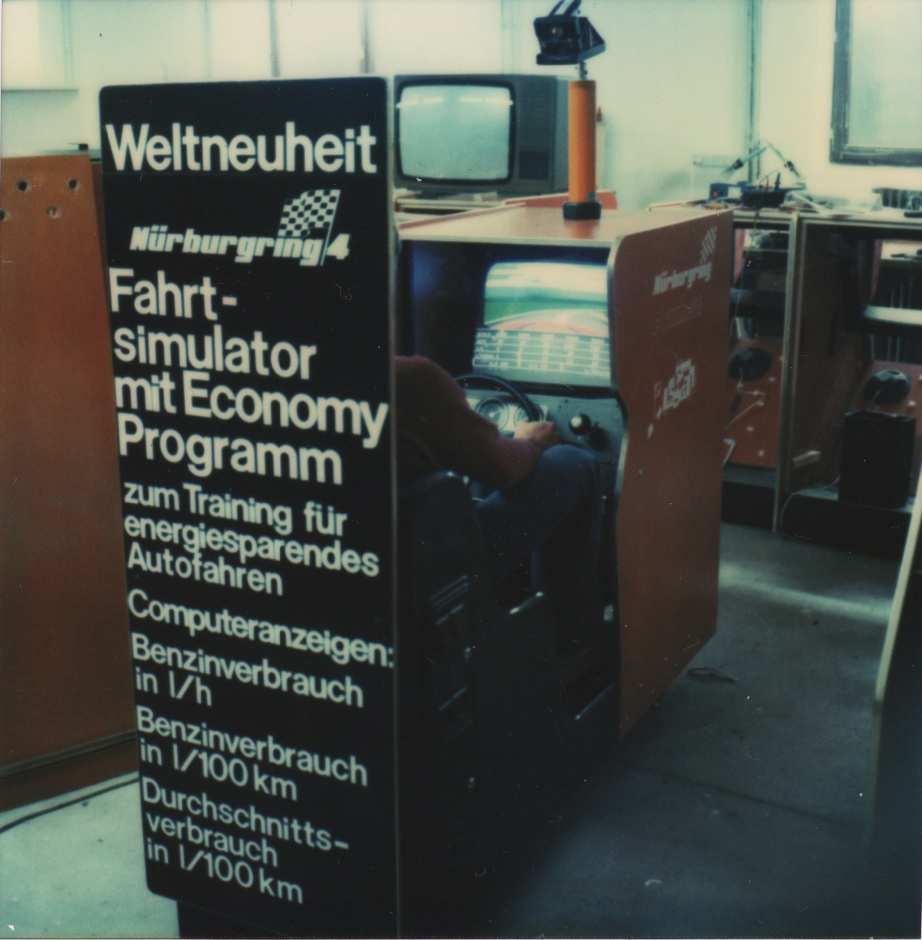
Interesting is that Foerst developed in 1982 an eco-driving training software based on official VW Golf motor parameters to teach energy efficient driving in a stick shift car. It became part of several driving simulators and got reviewed in the media. Later efficient driving became part of the legally required lessons in German driving schools.
I consider such skill driving challenges much more exciting than pushing the pedal to the metal in car race games. E.g. in the Hard Drivin variant Street Drivin I learned to finish the "Super Stunt Track" without use of brake (which initially in MAME was defunct). I would love to see more drivesim games with fuel gauge instead of countdown timer, and tasks like getting through a steep up and down winding mountain track before your fuel runs out, or grotesque emergency scenarios with flat tyres, failing brakes, stuck reverse gear, loose overheavy or topheavy cargo, nitroglycerin transport on bumpy roads, natural disaster rescue etc. When they talked on TV about new driving simulators with realistic physics to train unexpected situations, as a kid I always awaited such things to happen, but beside car chase games they made nothing. Modern driving games have become way too unimaginative.
 |
 |
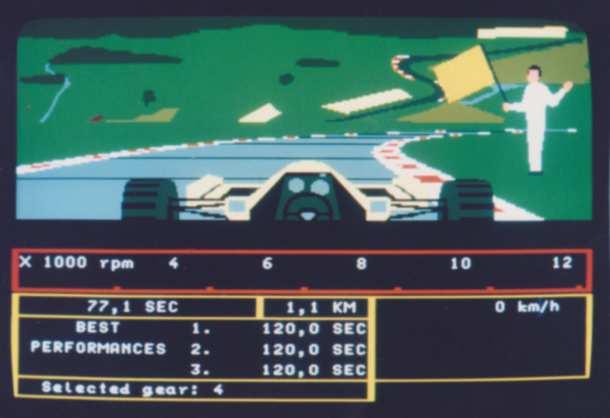 |
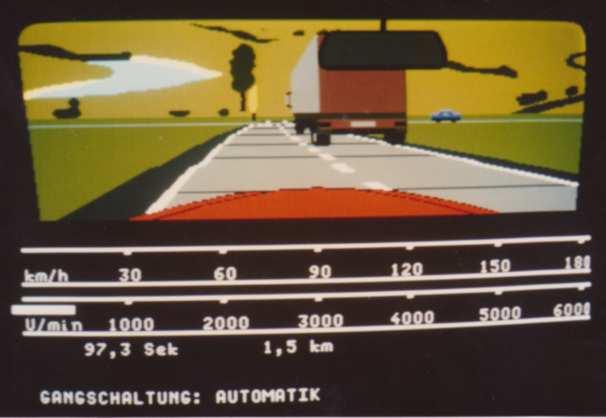
N5 seems to have the same black horizontal lines on the road like N4 (unless photos were misplaced in documents). It is hard to distinguish both. Possibly there even was a hardware upgrade in existing cabinets. I don't know the frame rate, but apparently this had polygon graphics quality close to Hard Drivin already in 1983. |
3D polygon truck |
parallel roads |
drunk tunnel vision simulation |
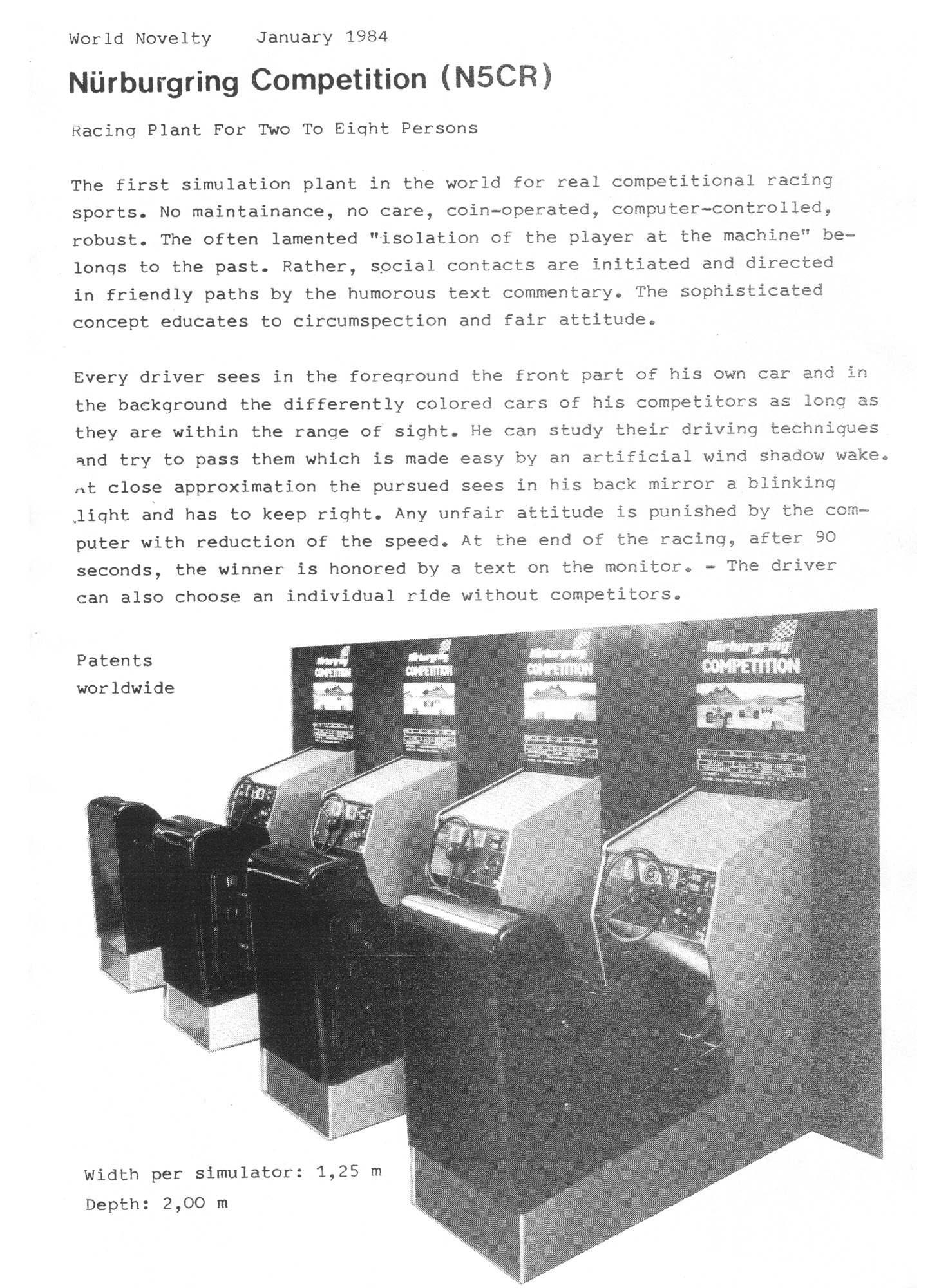
N5CR simracing cabinets |
linked N5 Formel 1 machines |
 |
 |
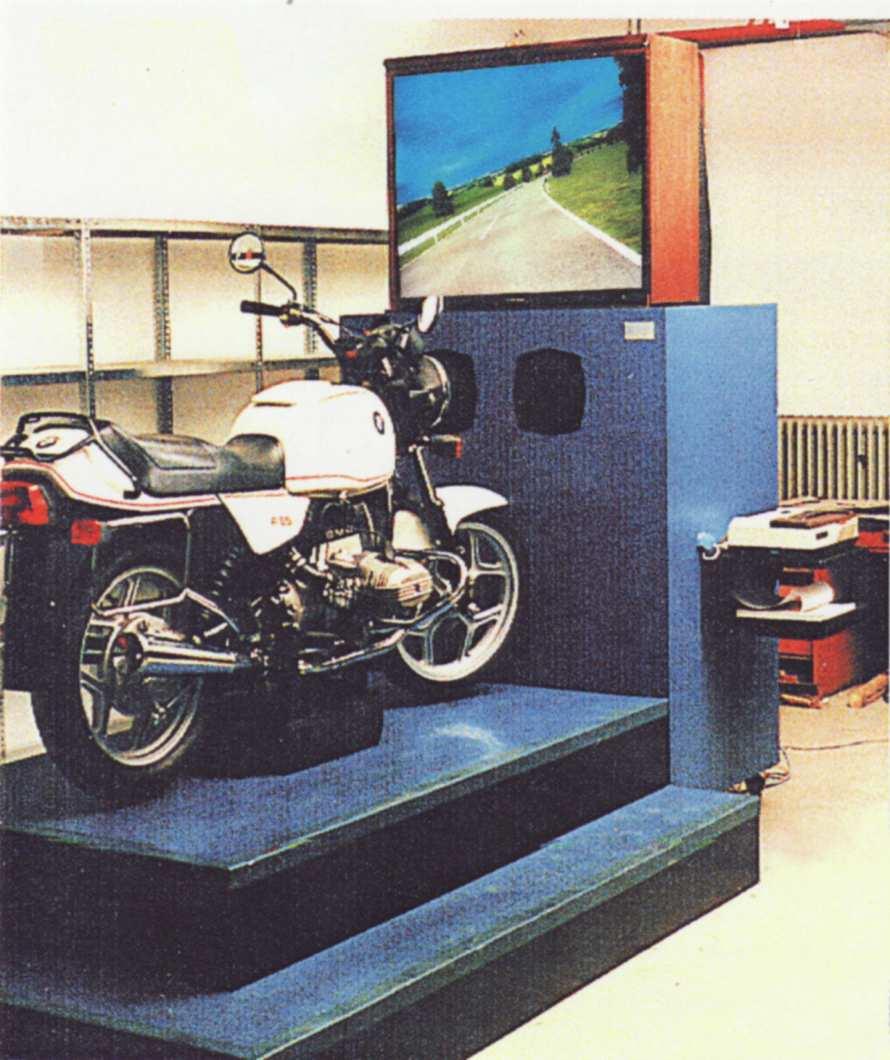 |
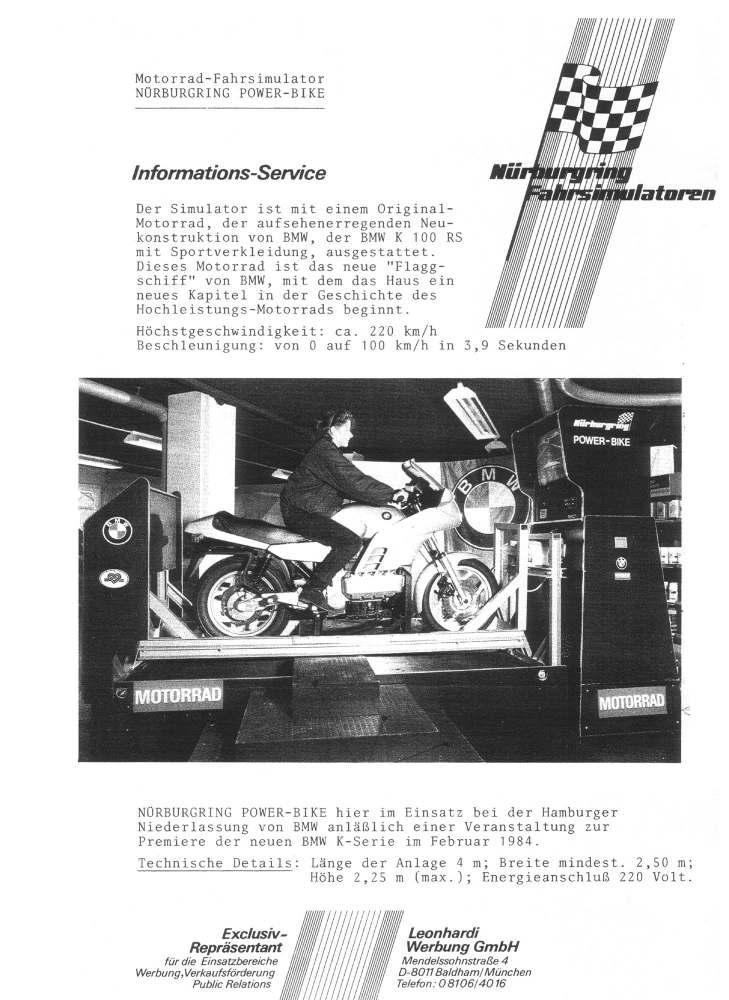
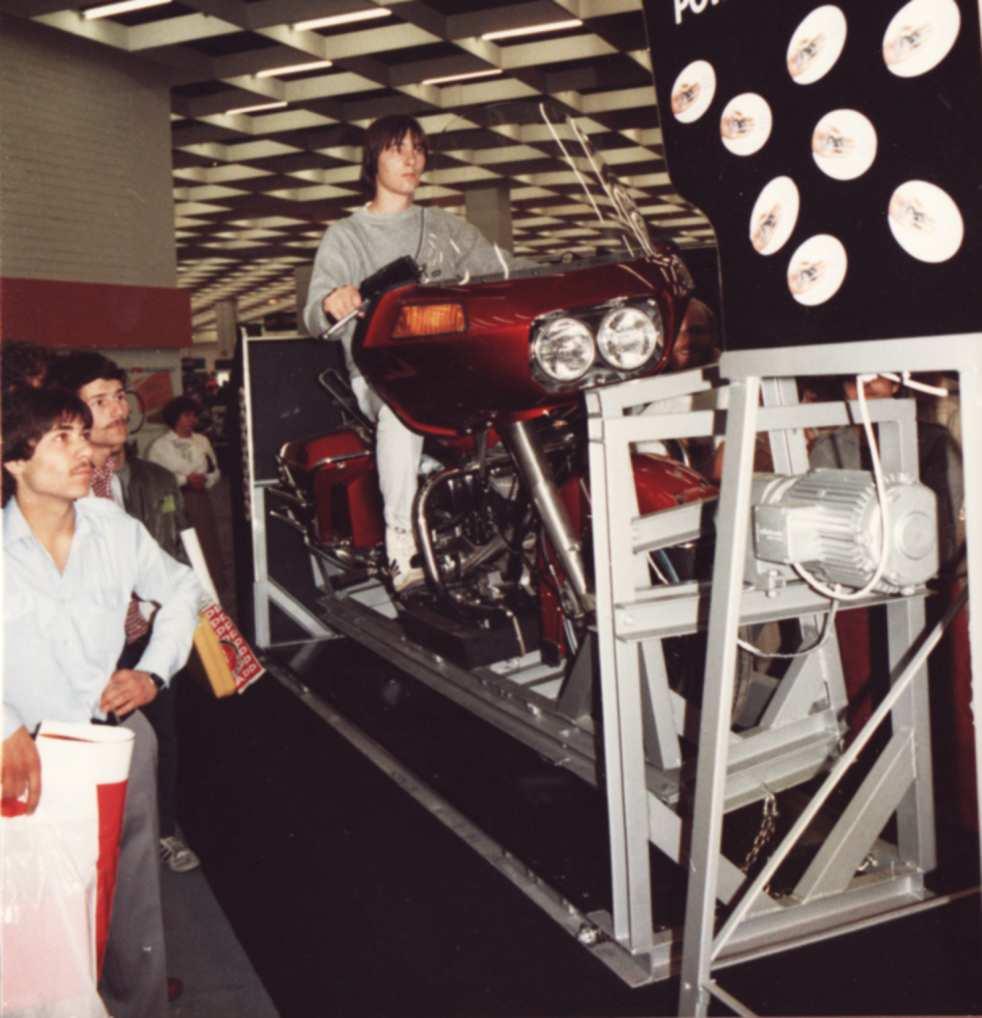
The "Power-Bike" of 1985 had a real BMW K100
RS motorcycle mounted on a moving platform that responded like real on
body balance (patent DE3612383A1, DE361238C2?).
The screen graphics of the blue one looks newer; so it may be a later upgrade. |
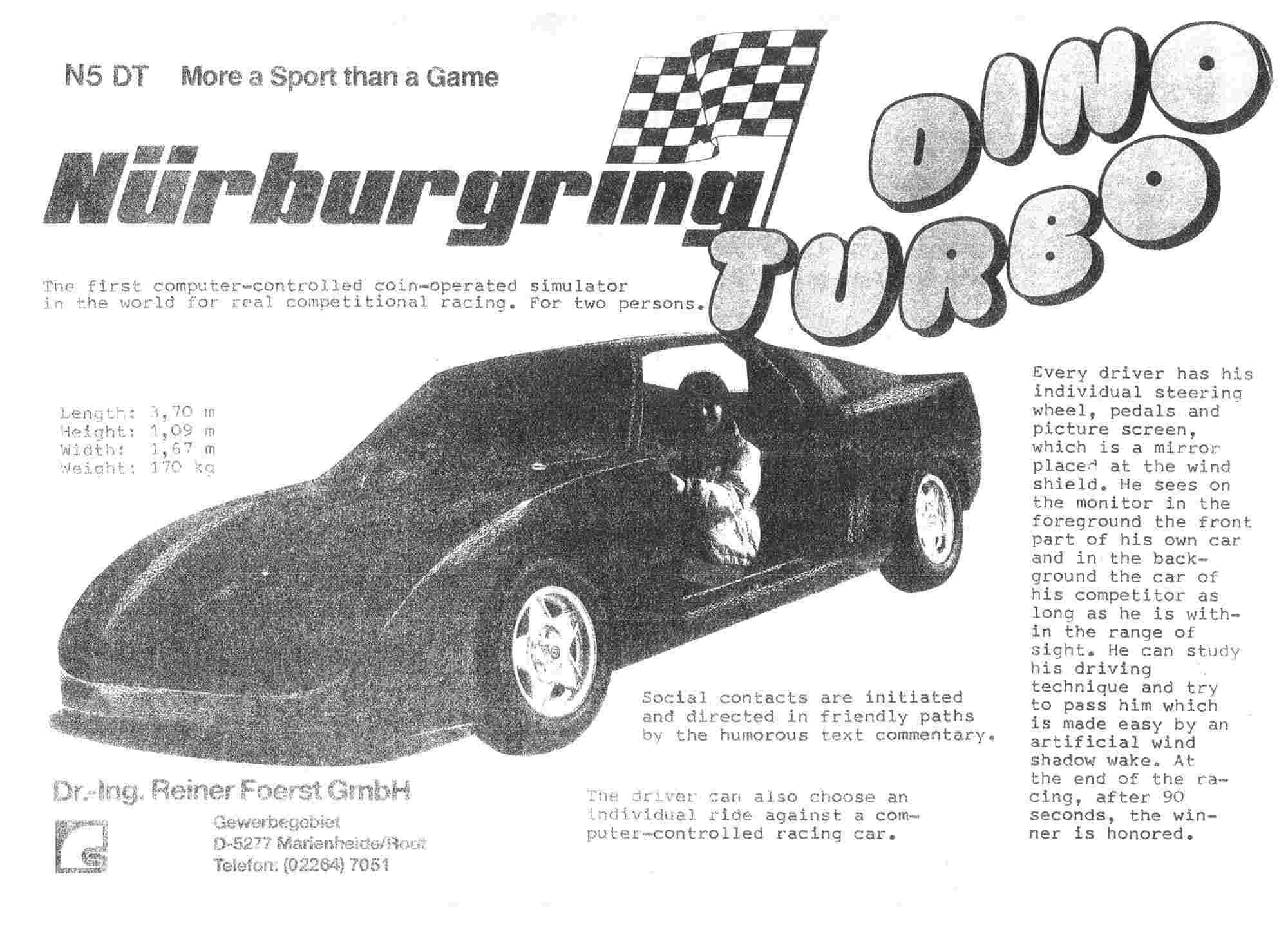 |
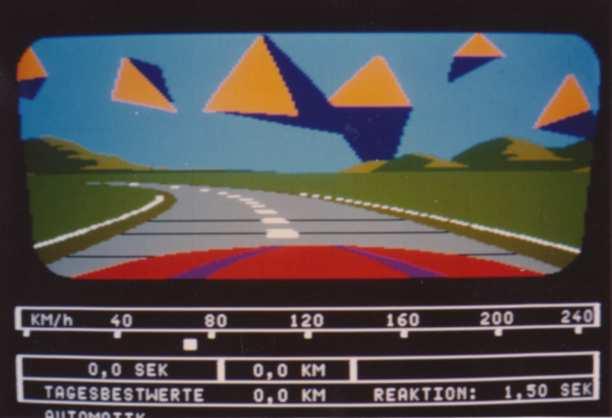
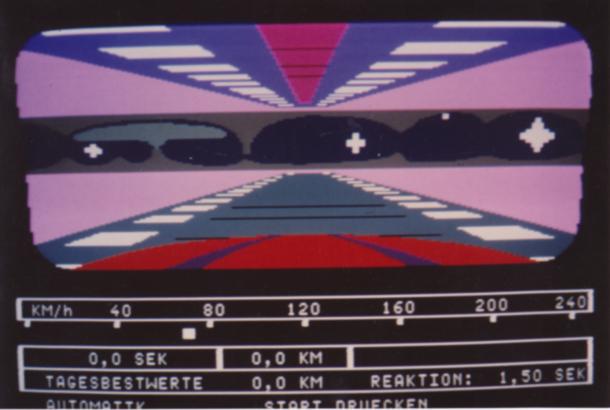
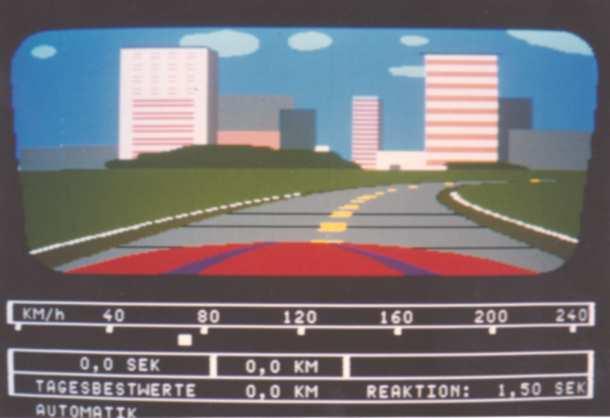
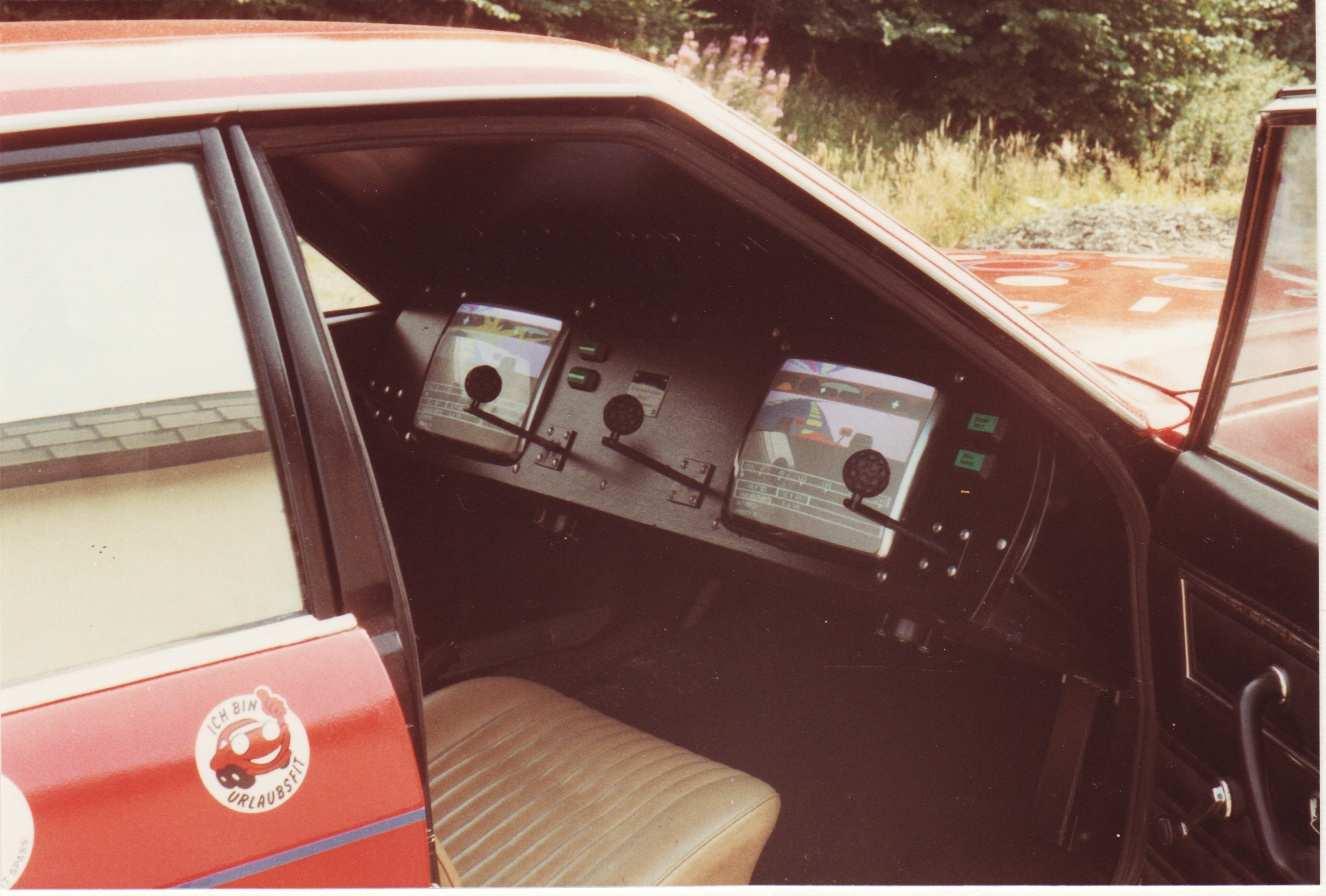
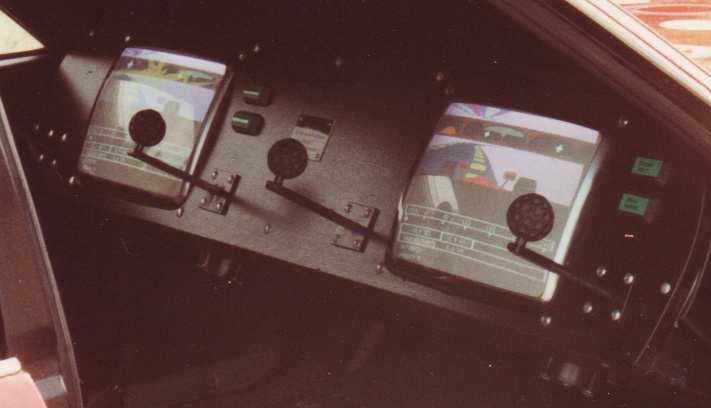
The Dino Turbo N5 DT was a single piece, built into a real car (looks
like a Pontiac?) with dual dashboard containing 2 CRT screens mirrored
through the windshield and controls for 2 player competition in a 90 seconds
race. Also 1 player vs. computer was possible.
In 1985 there was also a car themed "Dino Turbo" pinball machine by Geiger; it is unknown who came first. |
 |
 |
 |
the Spacecar |
 |
But possibly these were just prerendered (possibly run-length encoded) 2D shapes, those moved and zoomed like sprites in the (even later) Sega OutRun, which also creates the illusion of perspective changing trucks by switching between different 2D sprite versions depending on the view angle. This unique graphics engine also looks like if it supported filled 2D curve objects (e.g. for car hood, mountains, clouds etc.). The later Foerst patent DE3816544A1 of 1988 (possibly used in N6 hardware, also see there) describes a sophisticated GPU with hardware accelerated filled contour draw including arc of circle segments and hardware-based sprite-like priority. Apparently objects could have a left and right contour (each a linked list of lines and circle segments in something like polar coordinates?) between those the fill took place. But in that patent are no earlier priority dates mentioned, so the implementation in N5 may differ (possibly software) despite the principle looks related.
Patent DE3301704C2 of 1983 describes a H-stick shifter with force feedback motor and crunching gear noise to simulate realistic tactile interaction with a clutch pedal. That nasty little gadget would have taken sim driving down the uncanny valley where no game has gone before.
Compared with Namco, Sega or Atari Games the Foerst company was tiny. With only 15 employees they had created something extraordinary that so perhaps only could take place in the car obsessed Germany. In 1986 there was a contract between Dr. Foerst GmbH to license their know-how to NSM Bingen, which had been the biggest German arcade machine manufacturer, intending large scale production of commercial racing simulators. This resulted in a 1 million DM lawsuit, which was won by Foerst with the help of the Gauselmann group (a big German arcade operators company).
German youth protection insanity
In total yet over 1000 machines of different kinds were built. As a franchise, Dr. Foerst leased 200 of them to public places like shopping centers and cinemas, which caused high operating costs. Despite the German Traffic Safety Council rated these driving simulation machines as recommended for traffic education and thus pedagogically valuable, an insane German youth protection law in 1987 outlawed the placement of any kinds of coin operated gaming devices in public places accessible to minors - treating them like gambling or brutal adult-only gore videogames. So they had to be removed and most were scrapped because they were considered outdated and hence unsellable. That's how Germany's square establishment illtreats its most innovative inventors.
Without the rather standardized coin operated games, the business depended on making single-unit and small series machines, those mostly were rented to customers and had very high development and servicing cost, and often were all the time on travel in a carny-like way. So the Foerst company several times got into financial trouble but survived (also thanks to governmental support).
(The last arcade machine in a German public place I remember was an Atari Pole Position cockpit in a Horten shopping center in Bremen, that survived in the toy department until about 1988(?). I think in a Brinkmann electronics store for a short time stood an Outrun cockpit even later. In times where children now can quickly waste a fortune in smartphone games at home or any place without getting stopped, the still in force public arcade machine ban is a law right out of Idiocracy.)
professional simulators
Beside those arcade machines, the Foerst company makes particularly special purpose driving simulators for research, trade shows or fairground attractions. So they made demonstrators for new car safety features (like ESC), or campaigns to teach eco-driving to conserve fuel or illustrate not to drive drunk (simulated by increased input lag and reduced viewfield). Often these were large and include parts or fullsize actual vehicles on moving platforms those by high cost or temporary need typically were only for rental and not sold.
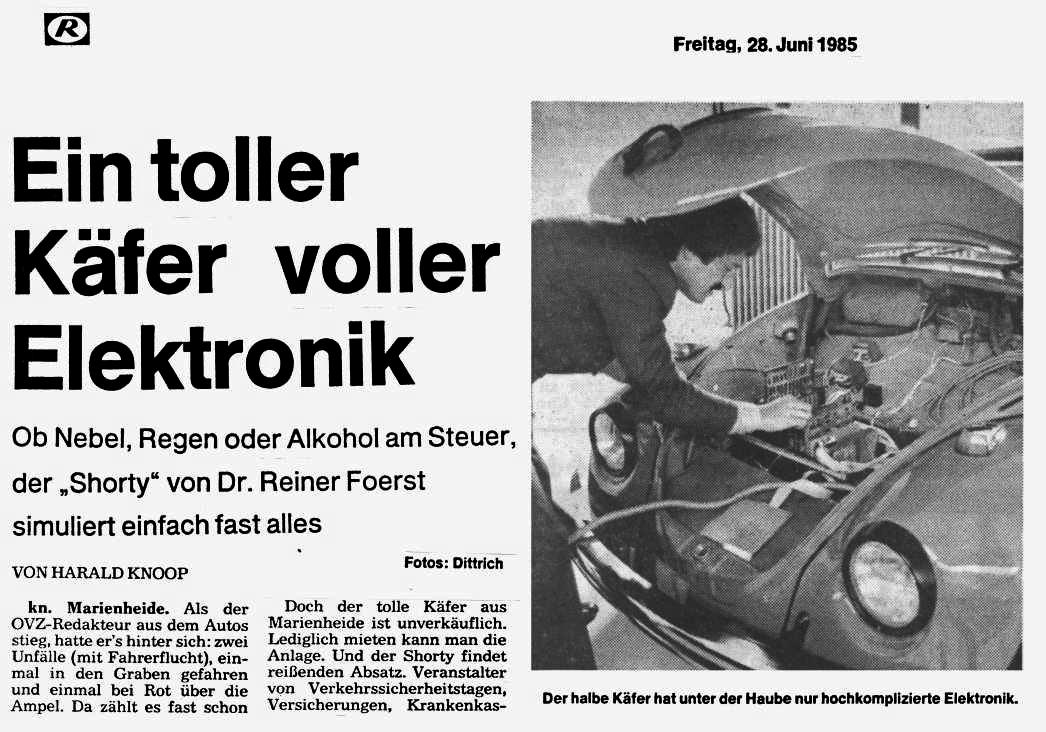 E.g.
in 1985 they created a platform with real motorcycle (Power-Bike)
that steers through curves realistic by body balance. And there was this
half VW beetle full of electronics, for simulating e.g. the risks of drunk
driving, that went on tour for driving safety campaigns, car insurances
etc. The newspaper headline "Ein toller Käfer" alludes to Herbie
movies and "Dudu" - a German-Swiss precursor of Knight Rider.
E.g.
in 1985 they created a platform with real motorcycle (Power-Bike)
that steers through curves realistic by body balance. And there was this
half VW beetle full of electronics, for simulating e.g. the risks of drunk
driving, that went on tour for driving safety campaigns, car insurances
etc. The newspaper headline "Ein toller Käfer" alludes to Herbie
movies and "Dudu" - a German-Swiss precursor of Knight Rider.
Like church organs, most of these larger simulators are single-unit productions, often custom built for one location or at least heavily customized in hard- and software. And they get destroyed or recycled into something else once their job is done or the hardware defective or considered outdated. Automobiles turn into classic cars; their simulators just into e-waste. Who knows, may be that with rise of simracing gamer community this will change and they someday become the new cat's meow hipsters paying fortunes for like now for Apple I computer originals. Unlike arcade games, serious simulators (not only huge ones) seem to have no real lobby for preservation, but are seen as an absolute nerd topic. They come and go into nowhere, barely leaving traces.
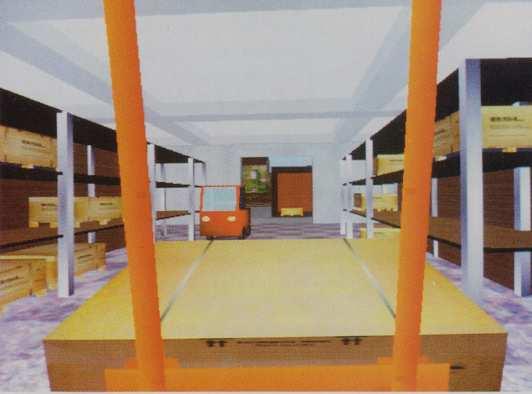
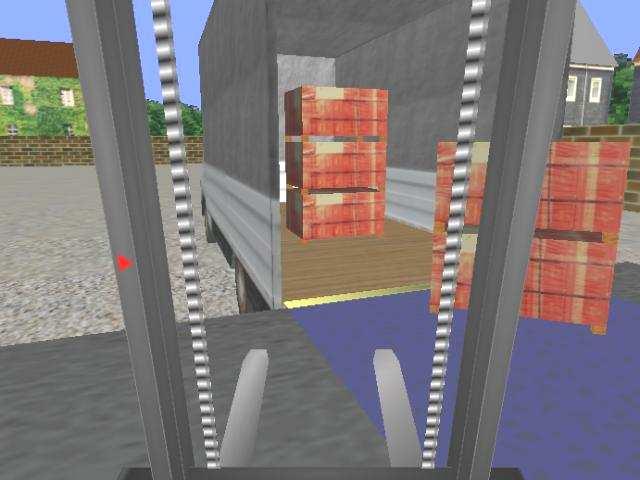
The employed graphics computers could be surprisingly complex. So in
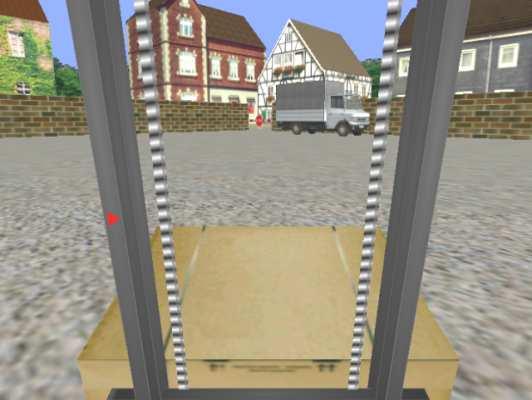
1985 Foerst developed a forklift simulator, which
block diagram shows a row of multiple video generators to draw each 2 of
the shelves etc. (in polygon graphics), which was a parallel computer in
a rack full of 128-pin cards made from 30-pin custom LSI chips.
 And
an ambulance simulator of 1995 with real car employed an SGI Onyx
with Reality Engine 2. These were computers for several 100'000DM. And
an ambulance simulator of 1995 with real car employed an SGI Onyx
with Reality Engine 2. These were computers for several 100'000DM. |
 |
Amiga inside! Who on Earth needs "Peloton" bike!? |
 |

 |
 |
 |
 |
 |
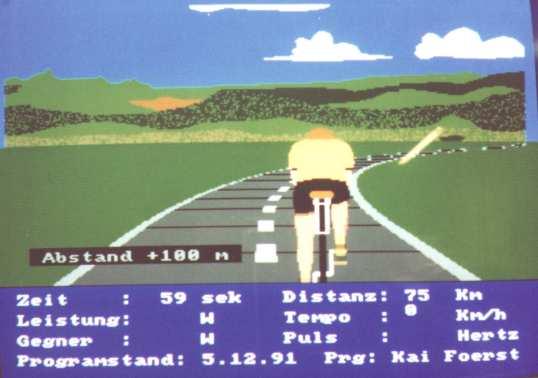
patents DE4212788A1, DE4226776A1 (with games), DE4415256A1 (torque control),
DE4222665A1 (powered by pedaling)
In 1984 in the USA, Rick Moncrief was head of the Applied Research division of Atari Games. He planned to make an affordable driving training simulator with realistic controls and car physics based on arcade technology. Together with Max Behensky, Erik Durfey, Jed Margolin, and Stephanie Mott they developed a machine that in 1989 became Hard Drivin (more about this here). The retail price of 10000$ (as much as a car) was still too high for driving schools, but it became a successful arcade game, while Nürburgring fell into oblivion. Before this, Atari Games built the professional car chase training simulator AMOS. It is unknown how far a rivalry between Foerst and Atari was still going on.
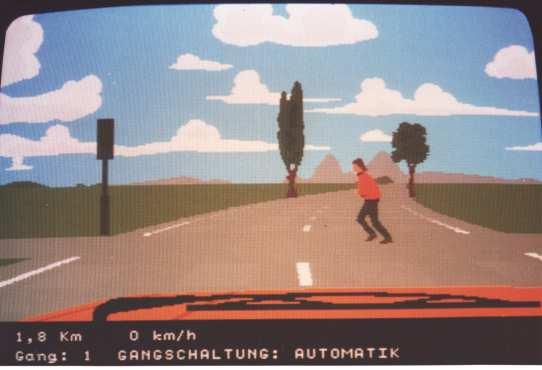
smooth curvy objects zoom |
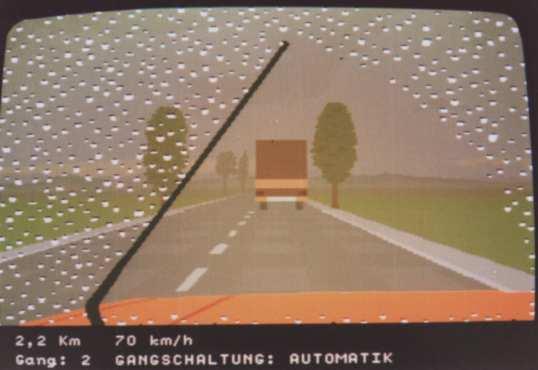
rain |
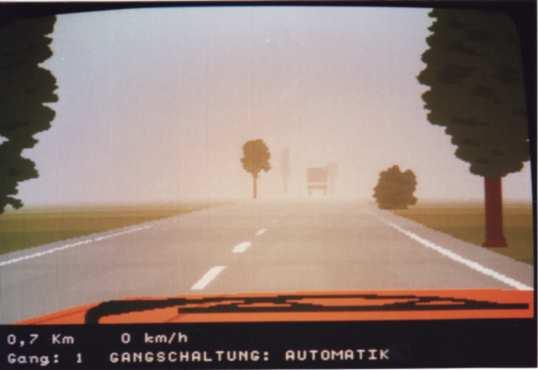
fog |
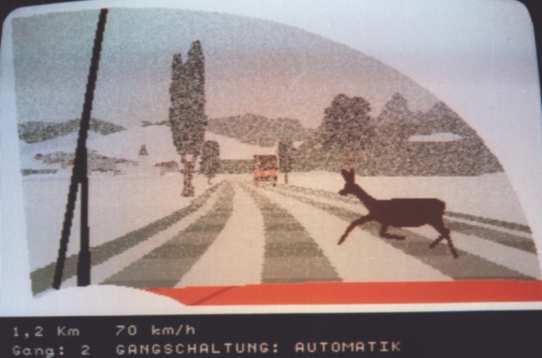
snowy here - avoid the deer |
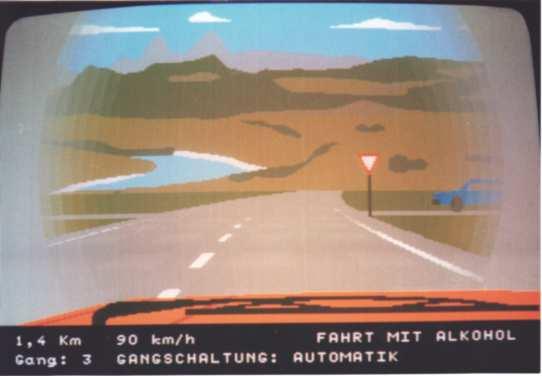
drunk driver's tunnel vision |
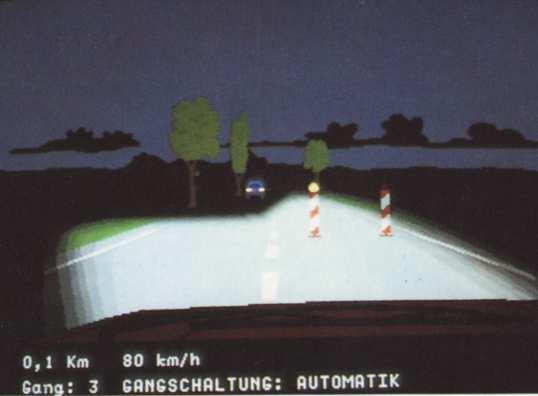
headlight illumination |
| For 1986 the weather effects and hardware accelerated arc segment rendering were outstanding. I guess it had the colour lookup table upgrade. Germany could do highend IT; this was workstation quality realtime graphics at its best. | ||
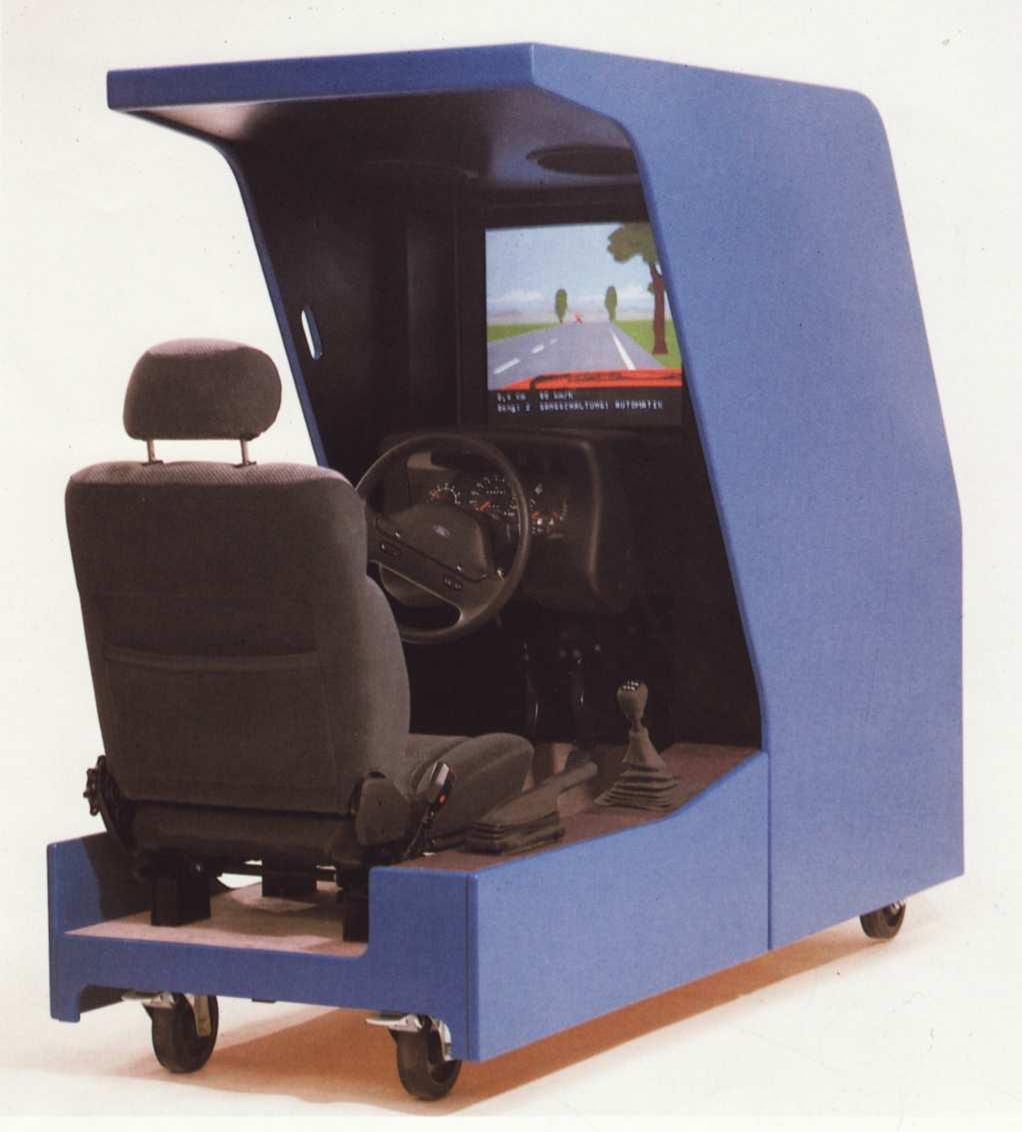
N6 S: (cockpit with car seat and blue case, 1985?)
N6 ?: CAR (Computer Aided Risksimulator, simulating drunk driving,
1987?)
patents DE3816544A1 (GPU with line/area fill)
But here likely ended the arcade era, so N6 was meant for professionell simulators only (often focussing on physiological experiments, those needed smooth rendering to identify subtle changes). I am not aware of any arcade games of its era having such effects. Likely this GPU technology was way too expensive.
C'est ne game.
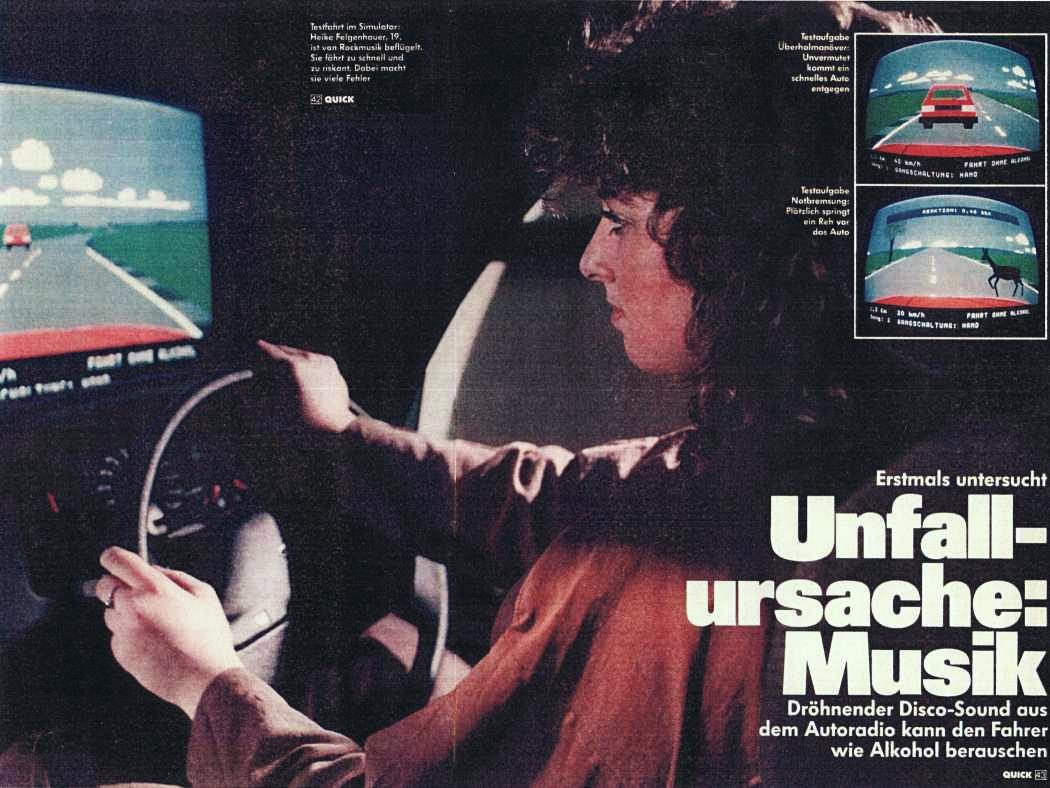
old low colour version (1988, Quick) |
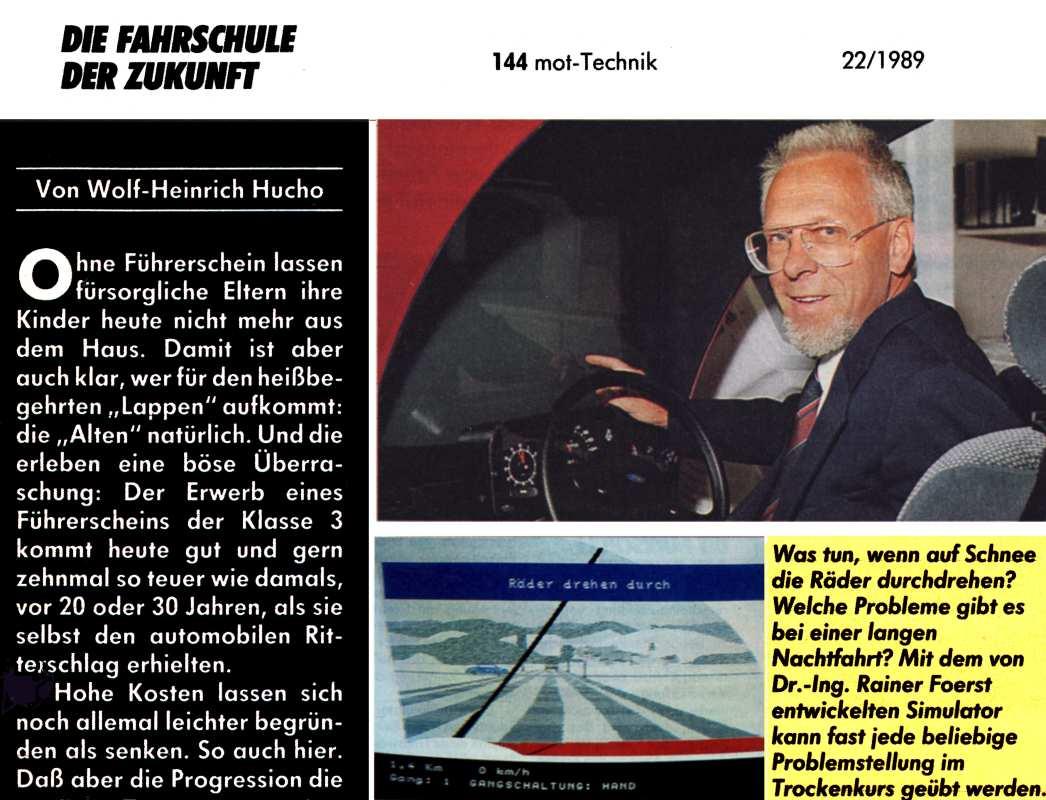 |
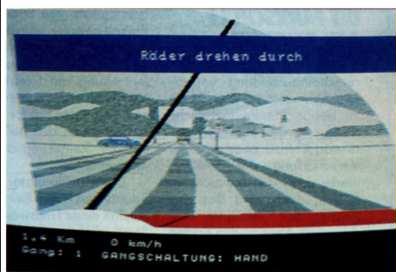
snow on windscreen (1989) |
 |

(1996, Taxi magazine) |
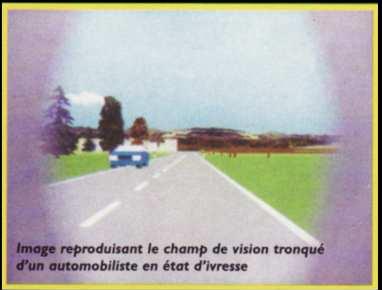 The
3 screenshots obviously show different generations. On the machine is N6,
lower right unknown (another N6 upgrade?, N7?), upper
left likely N8. The
3 screenshots obviously show different generations. On the machine is N6,
lower right unknown (another N6 upgrade?, N7?), upper
left likely N8. |
| A Swiss magazine article of 1989 about driving school future stated that the simulator's video system had 10 MByte memory while 1 MByte was standard for PC, and that it had a "very musical" noise generation for synthesizing the car and environmental sounds. The use for driving schools was still experimental at this time and no sufficiently automated lessons for teacherless training built into the scientific machine. | |
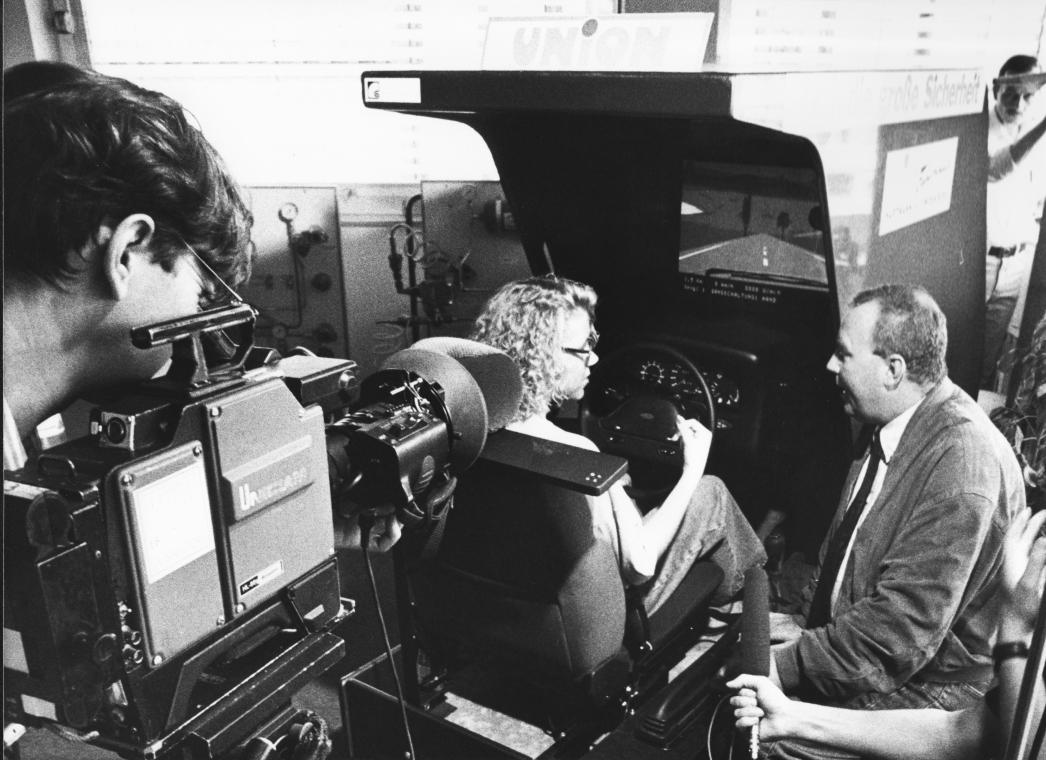 N6 training simulator in a driving school (1990)
 |
Strange is that the colourful screenshots are marked 1986 while the text indicates 1988, which is possibly an error because for 1986 the graphics (although untextured) would have been outstanding, and the N6S is even listed as 1985. This is an Area 51 moment, because in arcades there were no such effect quality until about 1990 (weather in Sega Rad Mobile) and got outperformed only by the PlayStation 1 era with its massive use of textures. The arcade game with most similar visual style was perhaps Taito "Air Inferno" of 1990, although I think its "Taito Air System" GPU (introduced 1988 in the flight sim "Top Landing"?) was less powerful despite it had some transparency, rounded shapes and colour gradients.
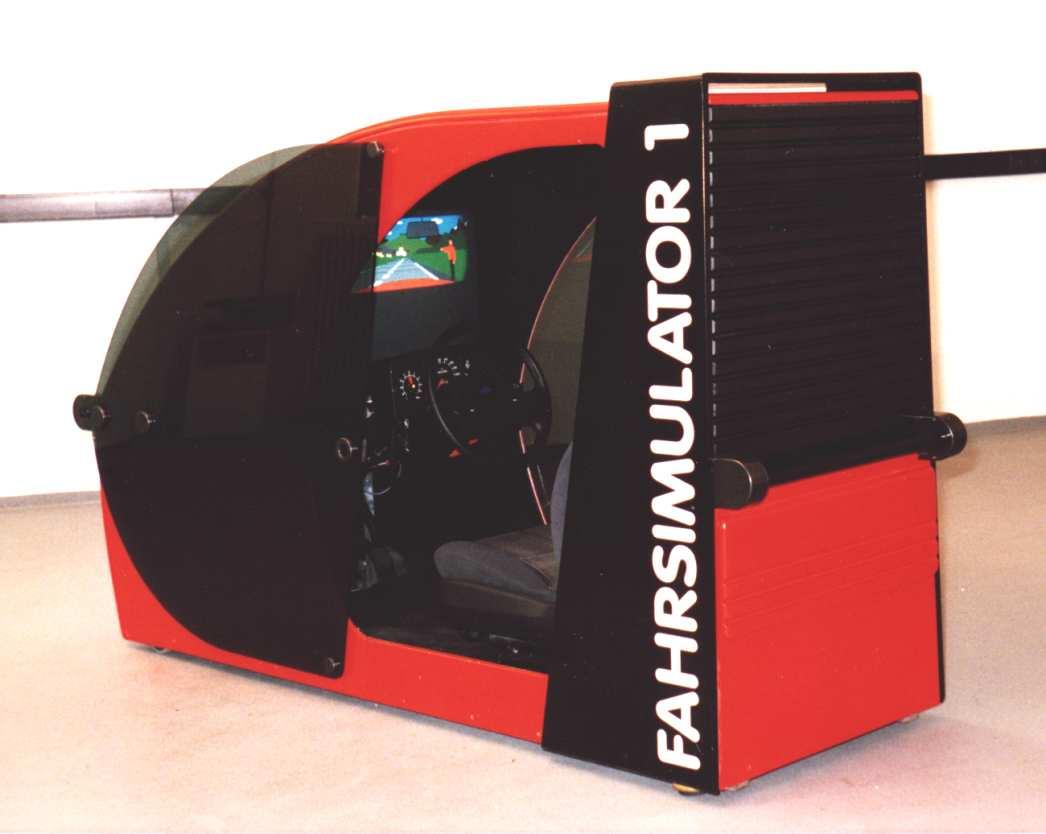 |
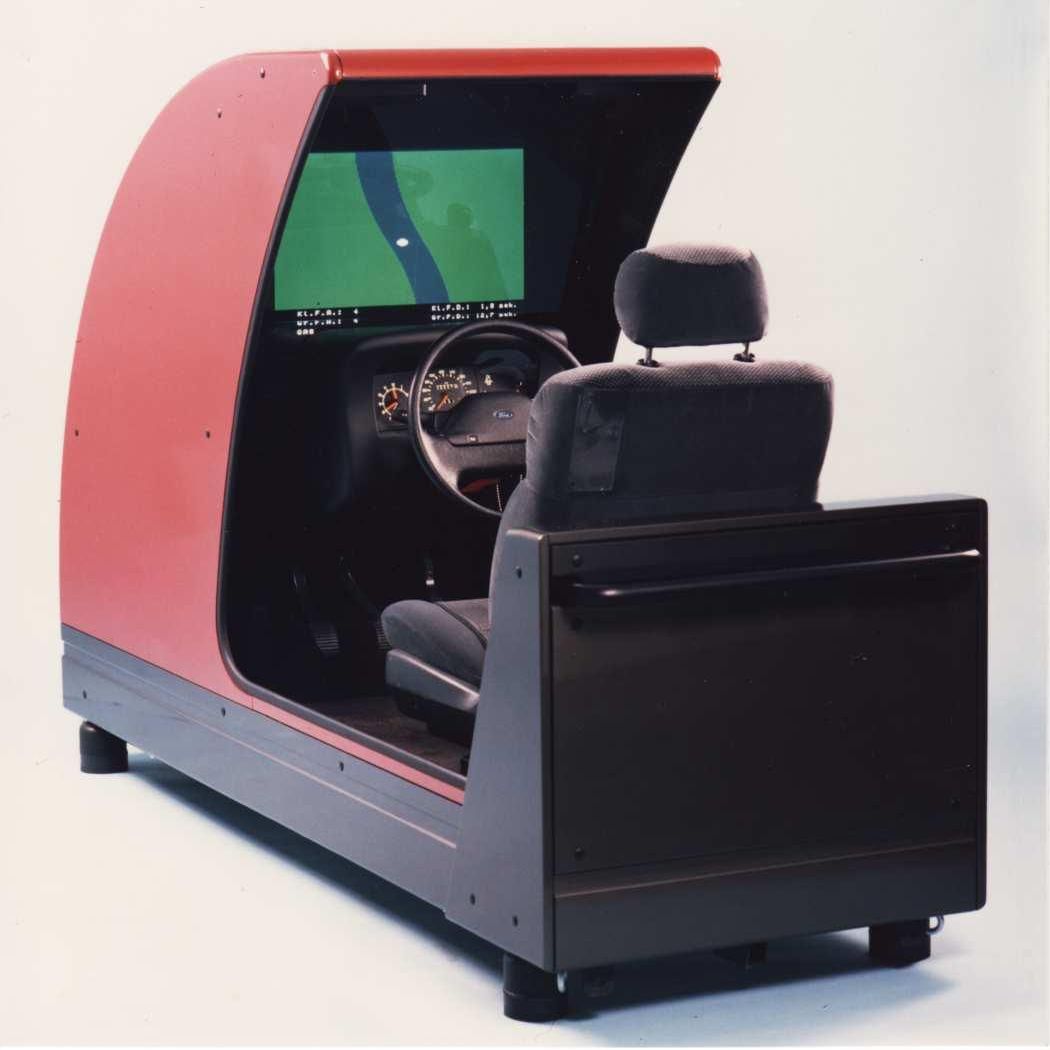
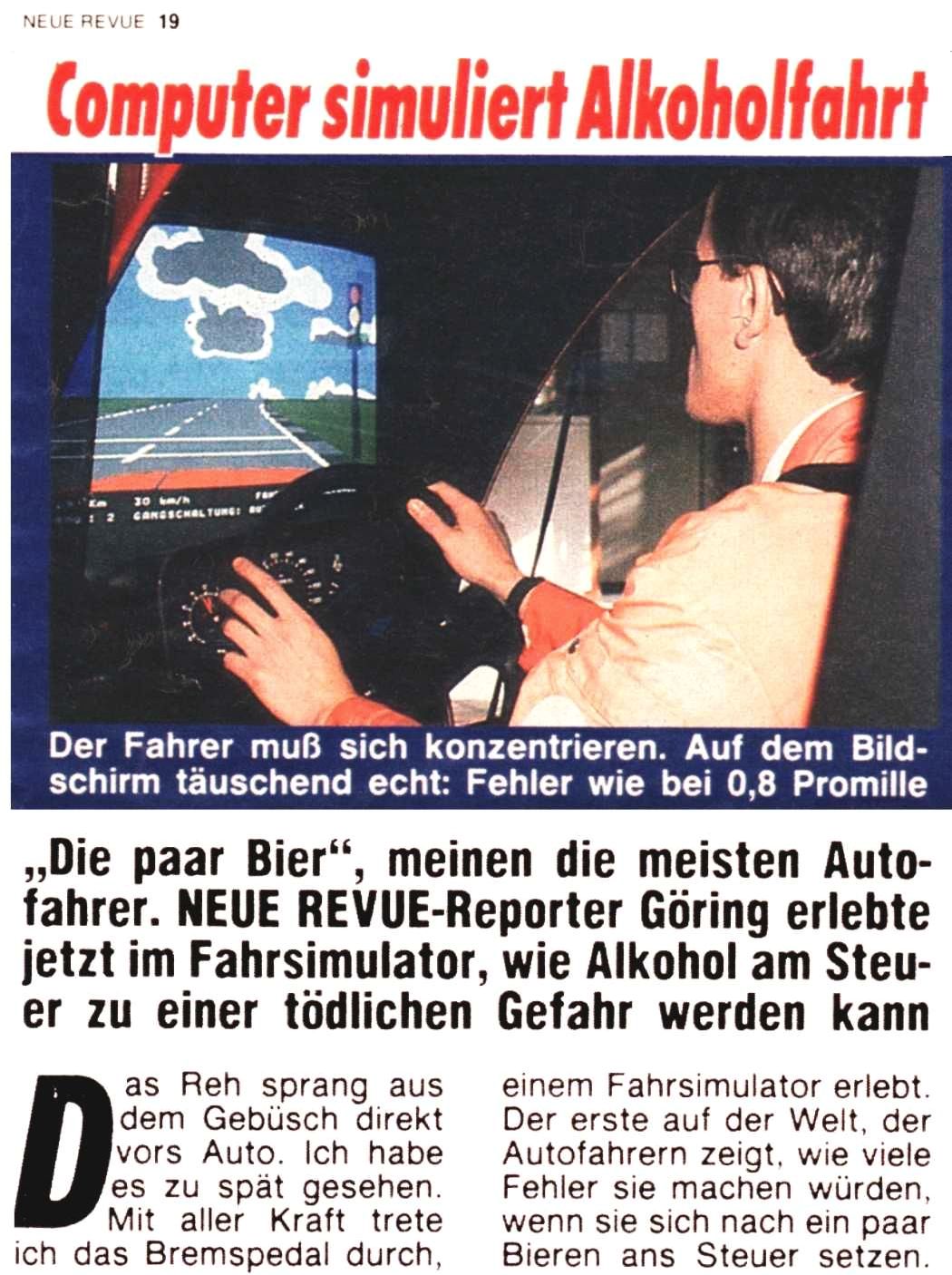
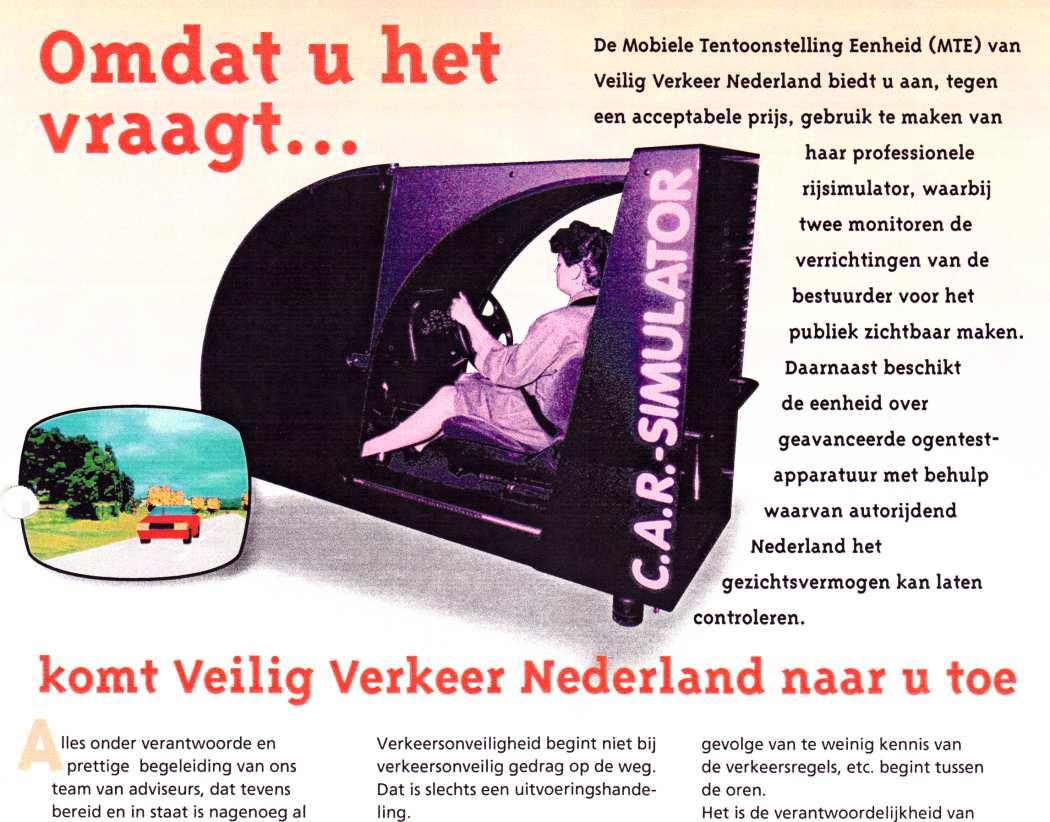
Prototype of C.A.R. (Computer Aided Risksimulator),
simulating drunk driving (1987). Its less colourful graphics looked more
like N5, so this was likely without the later colour
lookup table.
right: Driving fitness SENSO tester for the KfV Wien (1990) |
 |
(1987) |
(1998, insurance advert) |
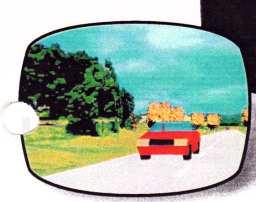 |
This C.A.R. machine uses texture mapping, so its hardware likely came later. |
Interesting is that Foerst argued that his driving simulator technology
would be cheapest on the market. However Atari Games in 1988 released
the Hard Drivin
platform 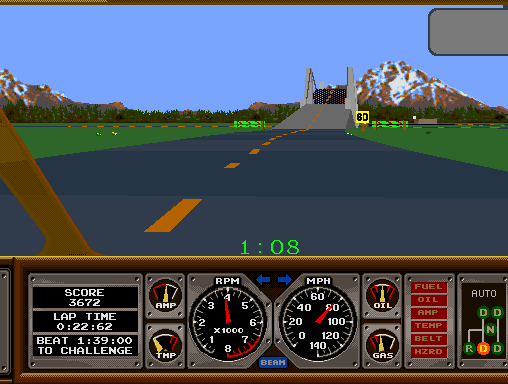 made
from much fewer parts, that originally was planned to become the ultimate
low-cost simulator for places like driving schools. But for the price of
a car it still failed to sell there and so ended in arcades, although a
professional version with multiple linked cockpits got known as the AMOS
("A.G.C. Mobile Operations Simulator" aka "Atari Games Police Training
Simulator"). The Foerst company wrote in its history that it took until
2000th before itself could offer equipment affordable enough for average
driving schools. made
from much fewer parts, that originally was planned to become the ultimate
low-cost simulator for places like driving schools. But for the price of
a car it still failed to sell there and so ended in arcades, although a
professional version with multiple linked cockpits got known as the AMOS
("A.G.C. Mobile Operations Simulator" aka "Atari Games Police Training
Simulator"). The Foerst company wrote in its history that it took until
2000th before itself could offer equipment affordable enough for average
driving schools.
Atari Games patents: WO1992002917A1 + US5269687 (driver training), US5354202 (link mode), US5474453 (level editor, opponent AI), US5005148 (scrolling dashboard) |
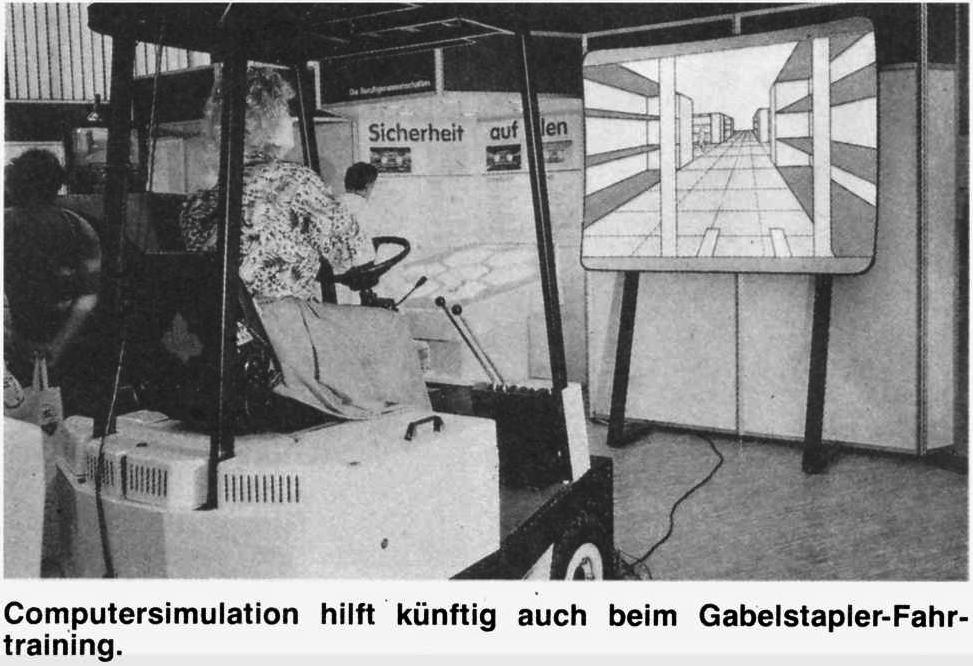
(photo of 1990, Impuls magazine) |
This highend computer employed 8 parallel working 32bit CPUs "Thomson MOS EF9367" with arithmetic coprocessor combined with custom highspeed surface renderers. The block diagram shows a row of 8 video generators those each draw a fixed part of the 3D polygon graphics (e.g. each 2 of the shelves etc.), in a rack full of 128 pin cards made from 30 pin custom LSI chips.
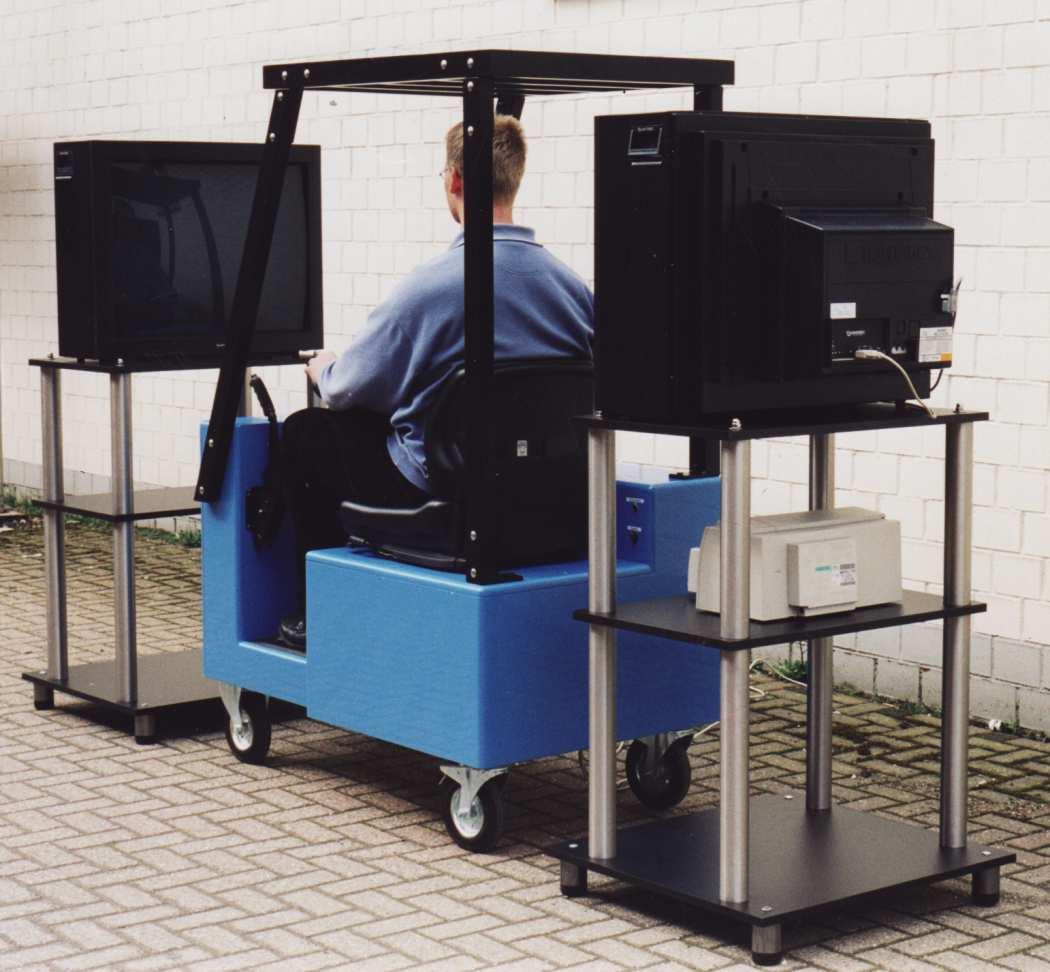 |
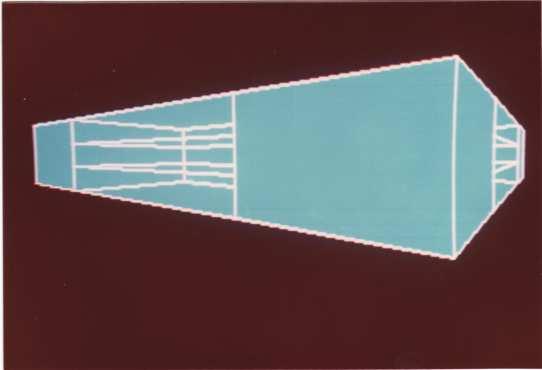 The forklift sim of 1985 needed more CPU power.
 |
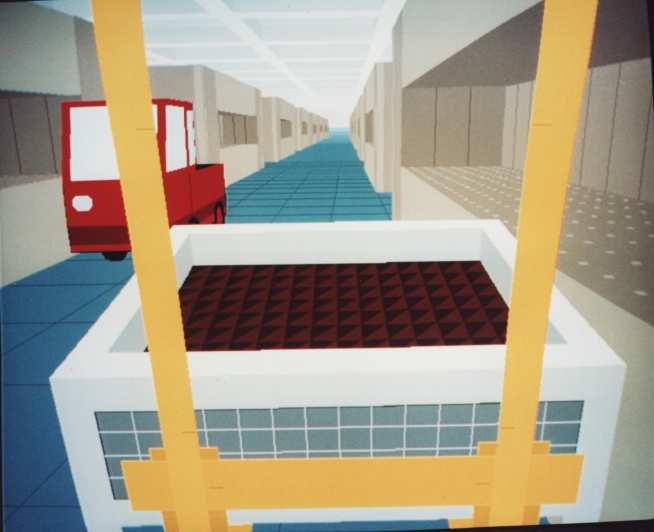
upgrade of 1992 |
patents DE3816543A1 (3D polygon GPU), DE4114103A1 (motion seat mech)
The online versions of the patents are text-only. The company history shows a block diagrams of the graphics hardware and of a sprite collision algorithm to simulate the interaction between forklift and transported cargo. But there are no simulator screenshots of early N7. Even the newspaper photo of 1990 looks like a fake illustration. It is unknown if the costly N7 hardware was ever used for simulating other vehicles than forklift and perhaps replaced N6.
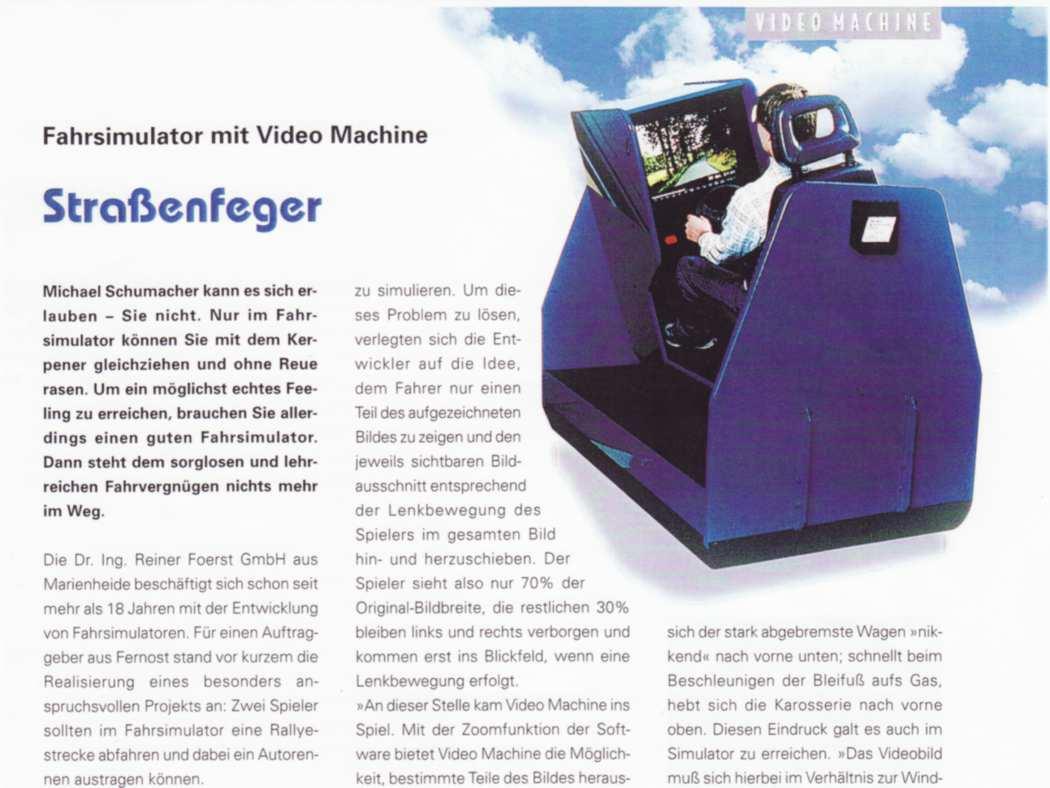
(1994, Faszination) |
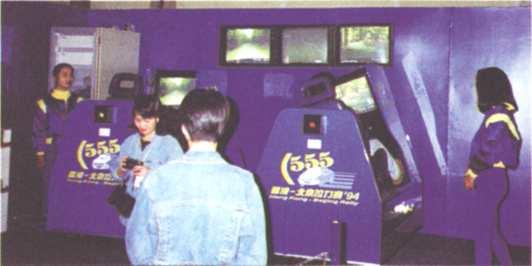 dual N9 ralley simulator in Hongkong (1994)
 |
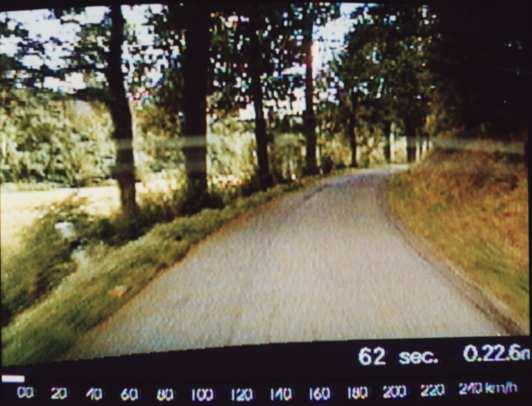 |
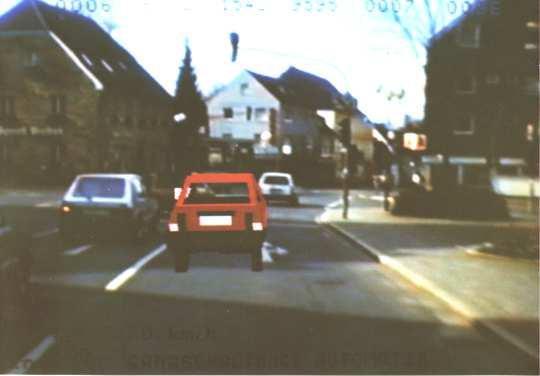
video image with CGI car (from FDR simulator?) |
N9: Ralleysimulator (motion sitdown with tilt mechanism)
patents DE4102176A1, DE4105963A1
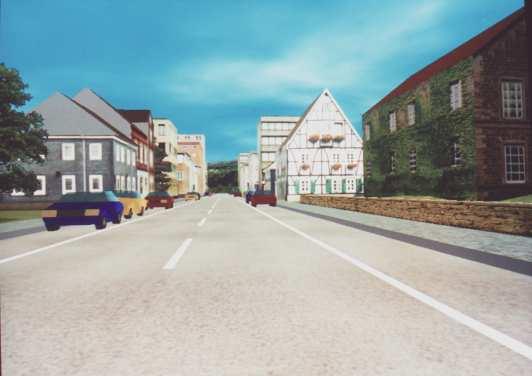
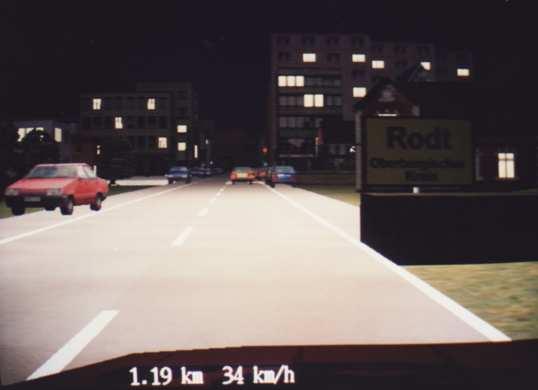
The N9 Ralleysimulator used in front of a wall with 3 TV screens for spectators 2 blue painted motion cabinets in the style of Nürburgring Power-Slide. So it may be that cabinet parts were converted from those recycled arcade machines. Apparently underneath was an additional mechanism for pitch axis motion during brake and acceleration. The machine went on tour in China for a cigaret advertising campaign. According to a Kölner Stadt-Anzeiger newspaper article, the narrow curvy 2.5km long road had to show no other traffic, no road signs and was filmed in Oberberg (Germany).
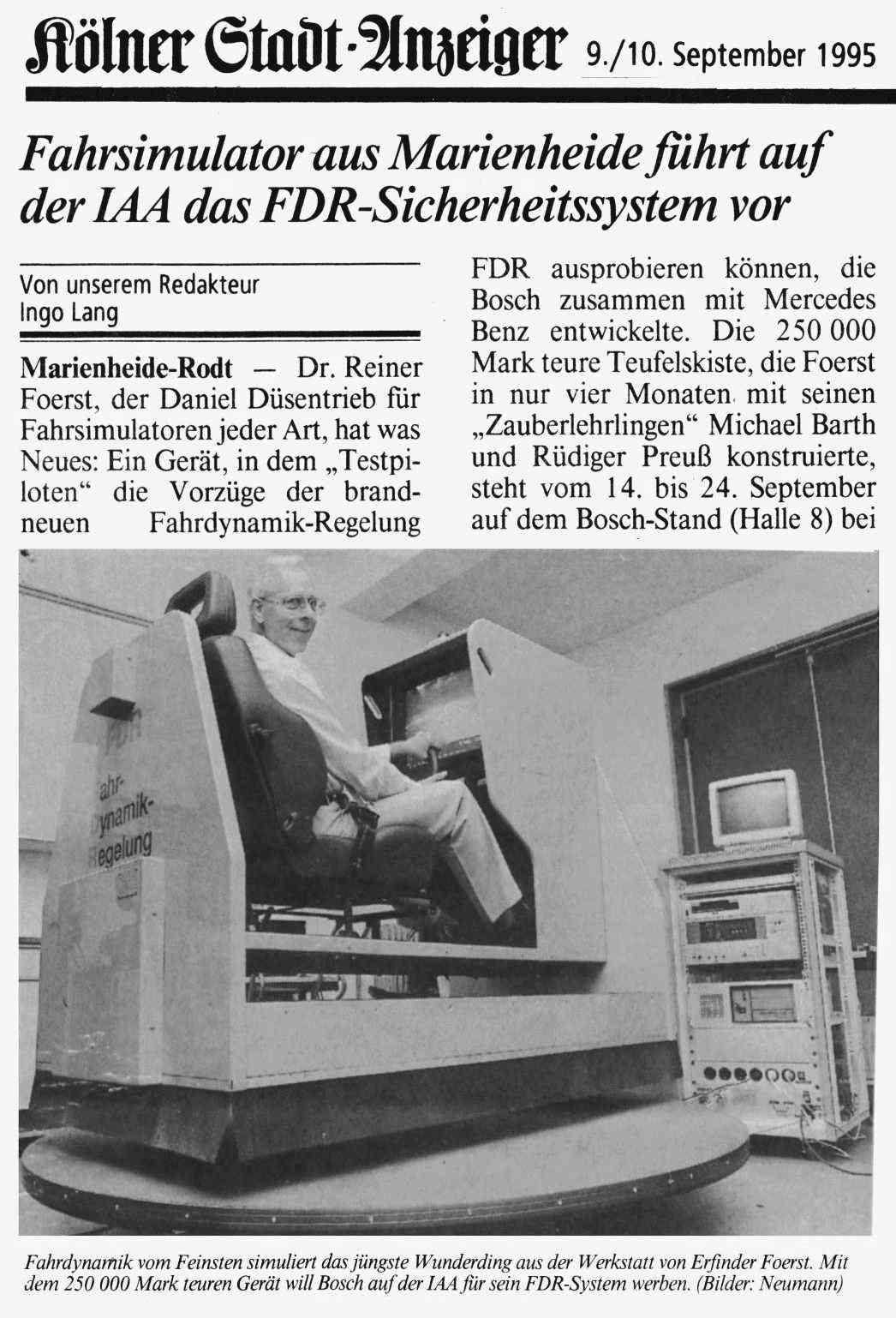 |
In 1995 a special simulator with the same tilting cabinet on additional
swivel disc was shown on the IAA (International Automobile Exhibition)
and a "Der 7. Sinn" TV docu to demonstrate the benefits of the Mercedes
ESC precursor "FDR". Remarkable for arcade history is, its motion cabinet
combined both the Nürburgring Power-Slide and Turn-Table mechanism
with pitch axis (almost like in VW-Fahrsimulator).
Development of single-unit productions with scientific special software
can be very expensive. So the cost for this custom built small machine
was 250'000DM.
The Kölner Stadt-Anzeiger appreciatively called the inventor a Gyro Gearloose who with his 2 sorcerers apprentices created a new "devil's box". |
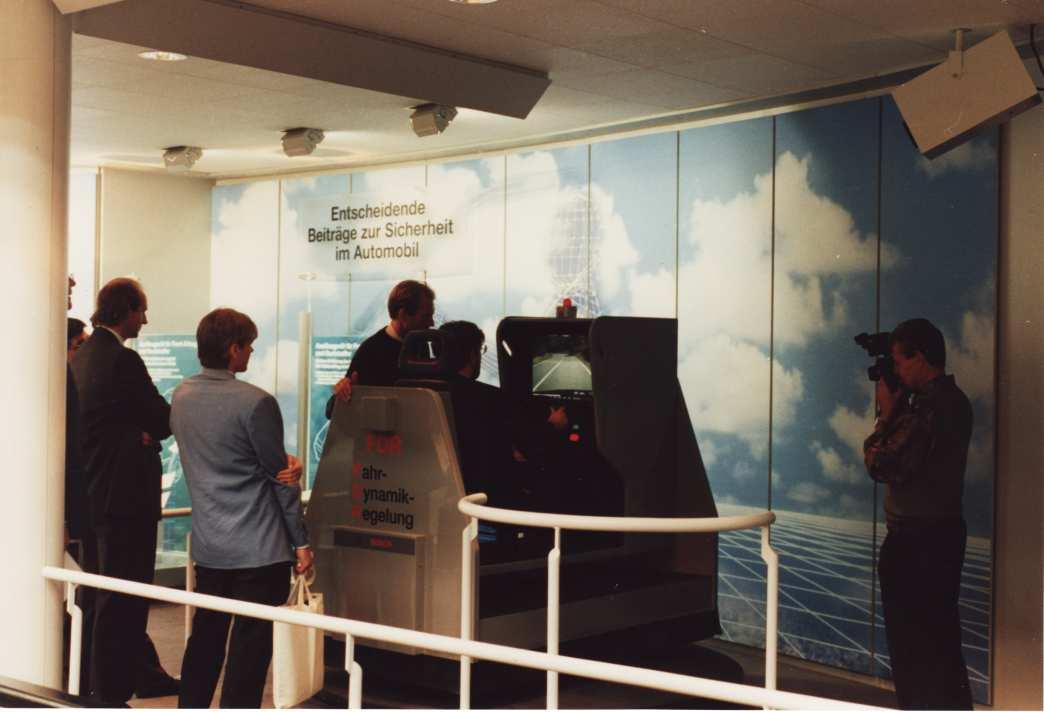
FDR simulator on IAA 1996 |
Already in 1954 a film reel based crude predecessor of such a concept had been tried in the driving simulator arcade machine Auto Test by Capitol Projector, which suffered even worse of too static gameplay.
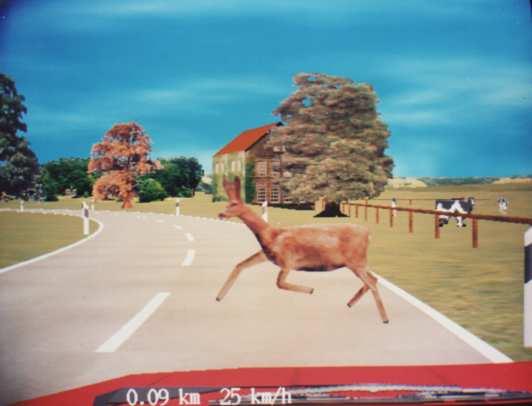 |
 |
 |
 |
 |
 |
 |
|
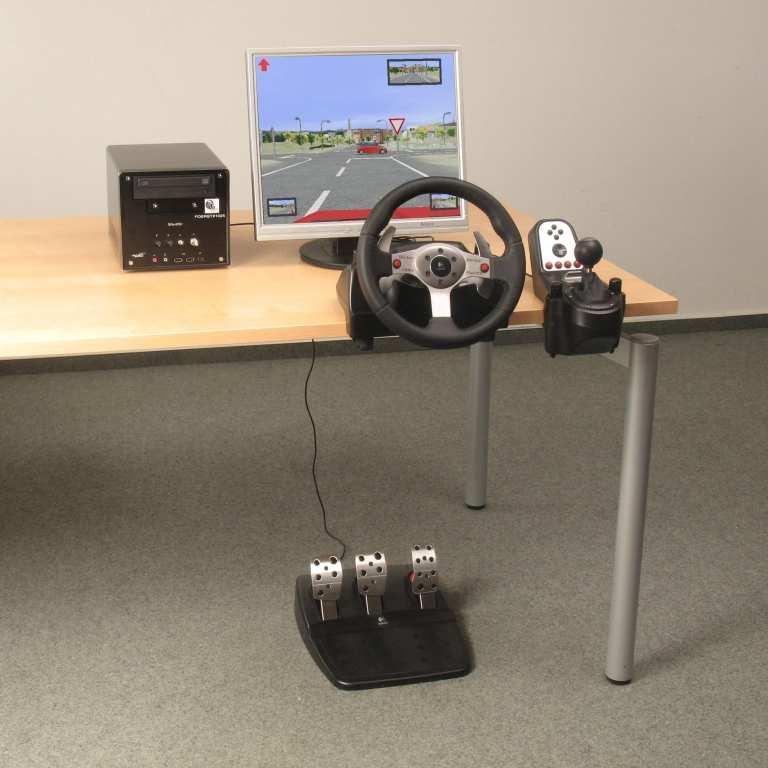
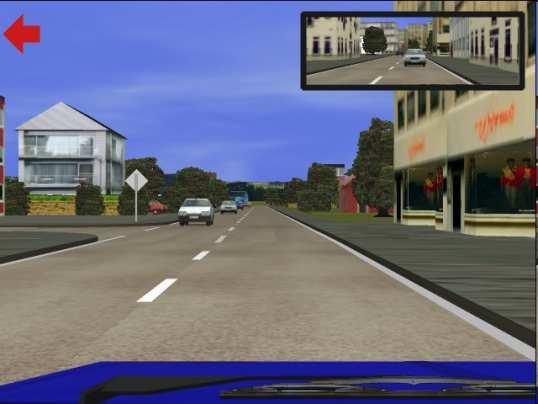
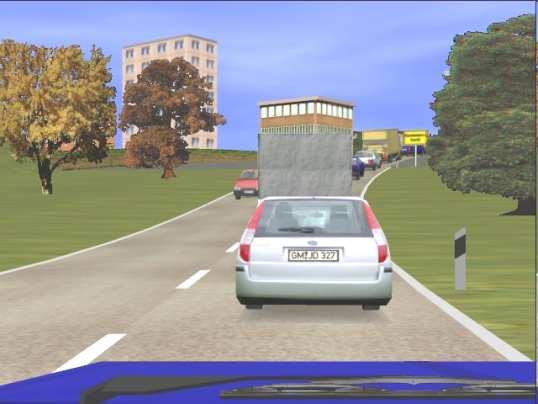
The result was named N10, then renamed F10 because the verbal association with "Nürburgring" was since long time pointless. At least here ends the mystique of elusive supercomputer driving simulator hardware.
 |
 |
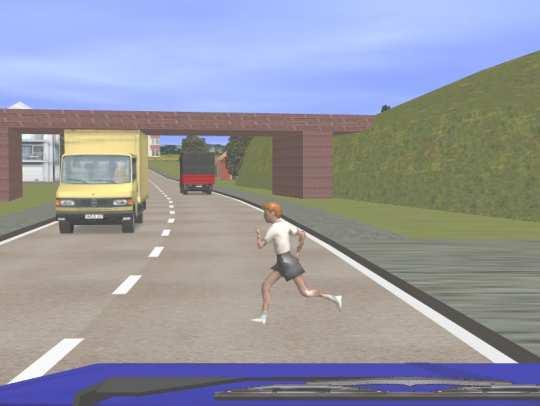 |
The Foerst company still puts much work into better mechanical motion parts to improve the experience and reduce cyberspace sickness caused by those big screens. And they make training simulators for special vehicles like trucks, forklifts, ambulances and all that. Driver training saves lives. But in a nutshell it stays PCs mixed with car parts as a working horse to do a job. The magic is gone. That's all, folks.
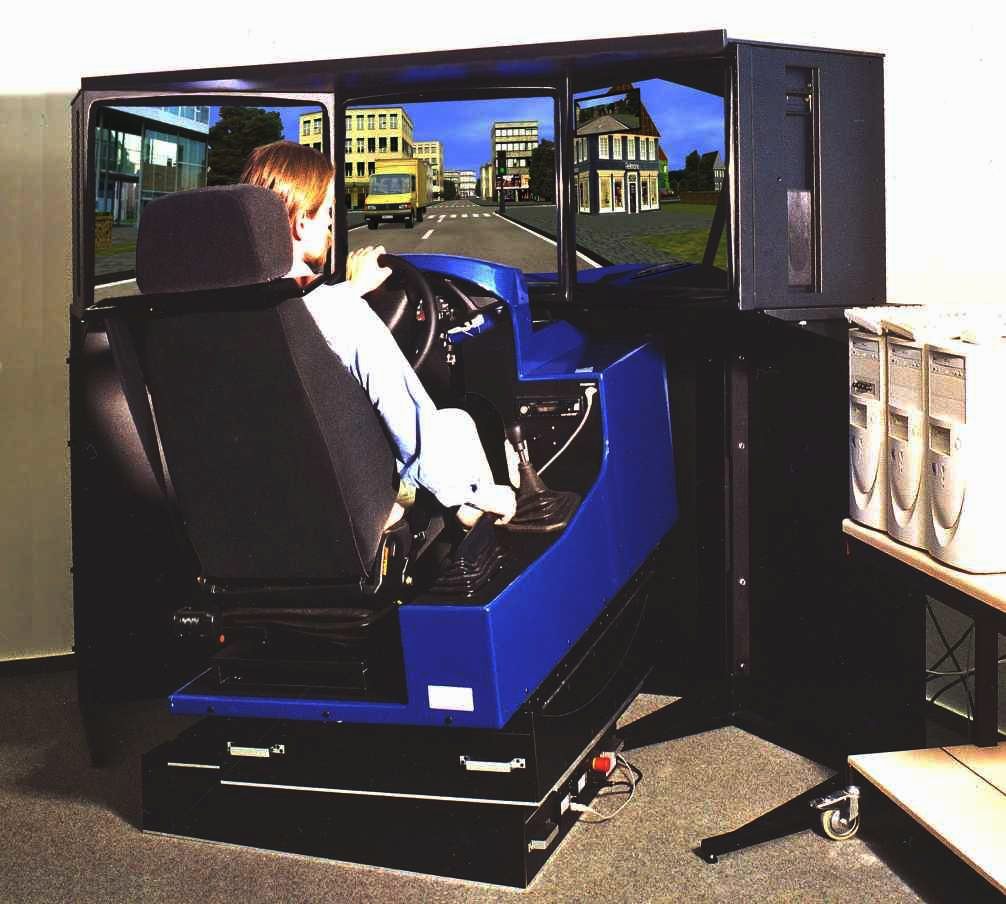 |
E.g. this "Tutor" motion cockpit of 2002 had 3 CRTs in 4:3. The software apparently ran on 3 desktop PCs to the right. Variants of this modular system were built with larger (projection) or fewer screens. The motion box underneath is a separate module. |
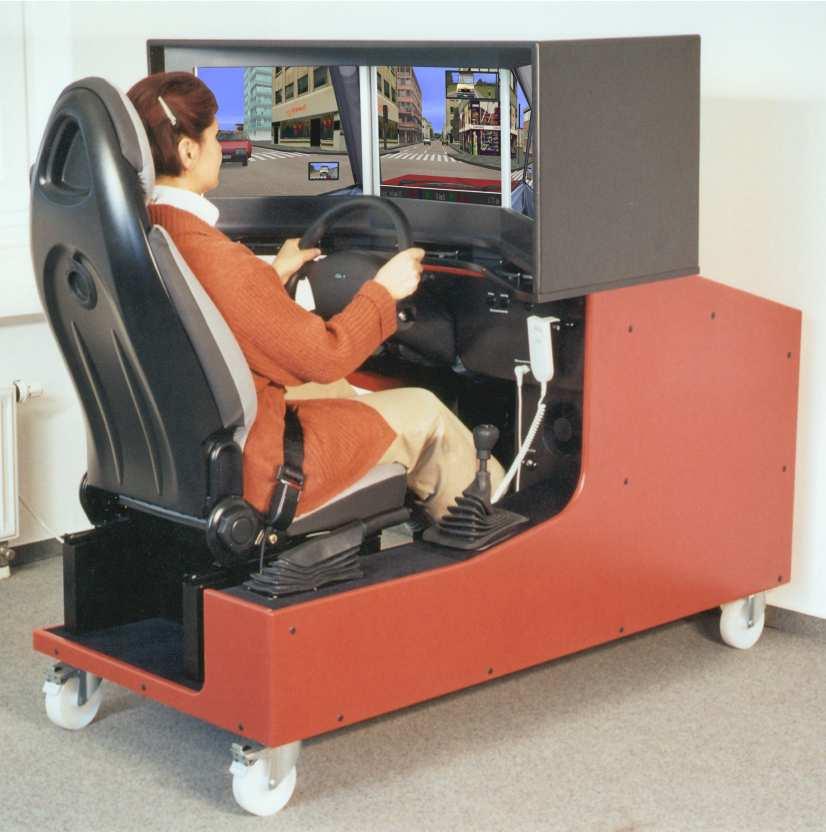 |
Car driving simulator F10PT-3/L19 "Trainer" (made in 2003) was one of the first with flatscreens. The cabinet looks like upgraded from CRT. Monitor cases on later models were flat. | 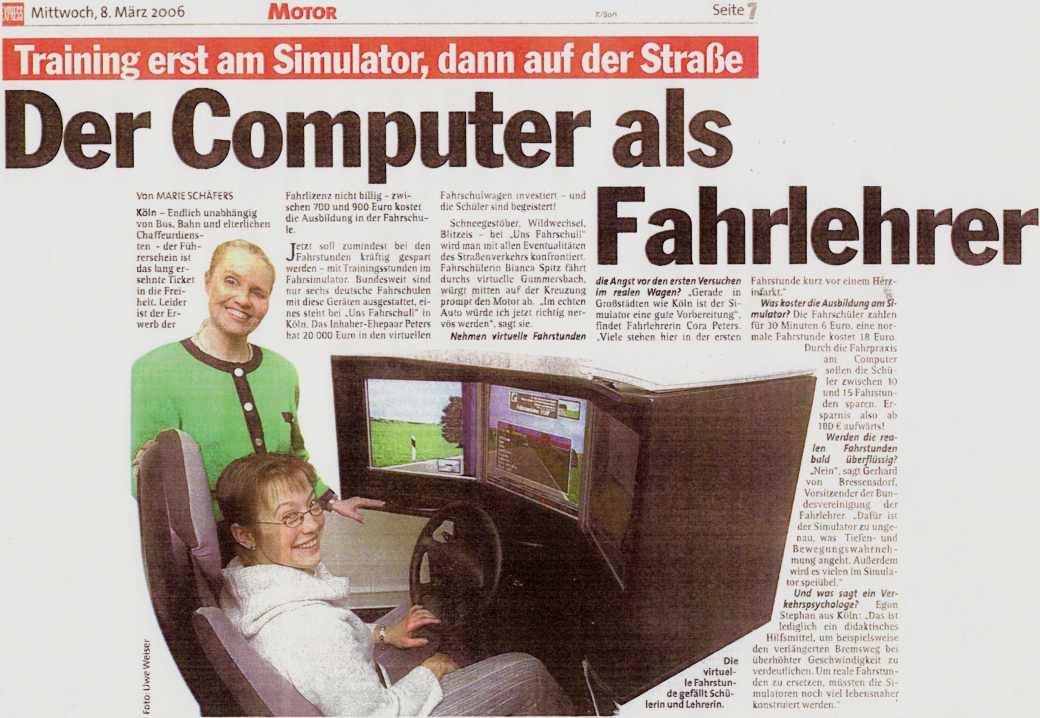 driving school training (2006, Motor magazine)
 |
 Particularly
in Japan also other arcade machine companies made simulators for driving
schools. So Namco since 1990 developed several models in cooperation
with
Mitsubishi. Their Eunos Roadster Driving Simulator had
lead to the groundbreaking arcade game Ridge Racer and the Mitsubishi
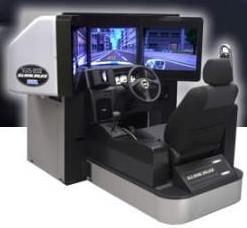
DS-series machines for driving schools. And in 2002 there was the Sega
Driving Simulator (photo). Particularly
in Japan also other arcade machine companies made simulators for driving
schools. So Namco since 1990 developed several models in cooperation
with
Mitsubishi. Their Eunos Roadster Driving Simulator had
lead to the groundbreaking arcade game Ridge Racer and the Mitsubishi
DS-series machines for driving schools. And in 2002 there was the Sega
Driving Simulator (photo). |
But the graphics quality of serious simulators nowadays tends to be clearly below modern console games. Who in 1990th could have thought of that!? One reason is that simulators for scientific reaction tests are specified to deliver strictly constant framerate and latency to guarantee comparable research results, so framerate drops are not allowed (which excludes many popular game engines). Training simulators can intentionally use unrealistic graphics to reduce scare of accidents. And not least most are programmed by scientists, not big budget game companies with huge CGI teams. Perhaps fully autonomous cars will end the need of driving schools and their simulators, and it is uncertain if cars have a future at all. Will mankind someday replace them with a more civilized kind of mobility? Otherwise nowadays there is specialized simulator software with very high photorealistic graphics quality (e.g. CARLA) for training the AI of autonomous driving, because AI needs to be trained with the best realistic pictures to function in real world situtations. So we've come full circle, where drivesim graphics needs to be cutting edge again. And simrigs are repurposed for remote steering of real cars in control centers for semi-autonomous rental vehicles and taxis.
The world of driving simulators is strange. Big ones are usually custom
made, often including a real car or parts of it. These can be tremendously
expensive scientific research aparatusses. Otherwise also exist very botched
things, tinkered by hobbyists from a severed scrap car wreck with dashboard
and old PC with cheap projector or big TV for use in driving schools or
just amusement. Youtube is full of such installations (particularly from
less wealthy countries) those would be worth to make an illustrated book
about. But thats a different topic, and in a world where motorsport simulators
are commonplace, people need to remember how this all had begun.
It is unknown how many Nürburgring arcade machines still exist. Apparently a "Nürburgring Power-Slide" (N3 P) stands in the Computerspielemuseum Berlin (computer games museum of Berlin, Germany). On flickr a person "videogamescgi1" uploaded detail photos of a "Nürburgring 1" (N1) including screenshot and PCB rack (same on "Ultimate History of Video games" site), those look fresh and suggest that it survived in collector's hands. With professional simulators it is hard to guess if some still rot in the cellars of driving schools or science labs, or if as leasing or rental items they all got recycled by their maker or converted with modern electronics. Unlike Pac-Man or Pole Position they are nerd stuff with no lobby. It would be exciting to emulate at least the graphics engine of the early models - and be it only for art purpose.
Unfortunately no game of the Nürburgring series has been revived in MAME yet. Although by modern measures it was rather boring to play, particularly Nürburgring 1 would be of highest historical significance, because it was the world first 3 dimensional car racing videogame ever. I also would love to see others emulated. And while N3 was less advanced than Pole Position (no opponent cars etc.), it came earlier and thus was the first 3D car racing game with a road in multi-colour raster graphics. But also generations N4 to N6 or perhaps N7 need to be documented and preserved - as works of early CGI art and witness that German engineers not only build cars but also created finest high grade computer graphics, and under slightly different circumstances could have outacted Atari in making the most realistic driving games. - So stop smalltalking about greatness of Picasso, Koons or Lagerfeld (those contributed nothing useful). It's technology that helped to make humankind clever. In this dark streaming age of dying internet such history needs to be told.
Foerst driving simulators since 1976
https://www.foerst-simulators.com/en/
Firmenhistorie - FOERST Fahrsimulatoren
https://www.fahrsimulatoren.eu/images/pdf/Foerst-Firmenhistorie.pdf
This 31MB tome is the German language company history with many pictures, newspaper articles and screenshots.
Foerst GmbH, Historie
https://youtu.be/GRVQLAQ5kZg
video on Foerst's Youtube account.
Spielhallenautomat: Nürburgring (1986)
https://youtu.be/eUXwbjjn3IM
video of Nürburgring 3 about arcade machine ban (German youth protection law).
In this forum thread I wrote more about Foerst Nürburgring tech
and history:
https://forums.bannister.org/ubbthreads.php?ubb=showflat&Number=121096#Post121096
These are detailed articles about Foerst Nürburgring and early driving simulators:
Meet The Doctor-Engineer Who Basically
Invented The Modern Racing Game (Jason Torchinsky)
https://jalopnik.com/meet-the-doctor-engineer-who-basically-invented-the-mod-5906386
VW Invented First-Person Racing
Video Games And They Don't Even Know It (Jason Torchinsky)
https://jalopnik.com/vw-invented-first-person-racing-video-games-and-they-do-1671618942
The First ‘Realistic’
Computer Animation Was A Drive Down A Highway In 1961. Here’s A Look
(Jason Torchinsky)
https://www.theautopian.com/the-first-realistic-computer-animation-was-a-drive-down-a-highway-in-1961/
Video Game Museum in Berlin (photo of Nürburgring 3 Power-Slide)
https://dewiki.de/Media/Datei:Video_Game_Museum_in_Berlin_(45946031421).jpg
Ultimate History Of
Video Games - Nürburgring 1 & 3 [archived]
https://web.archive.org/web/20231220083200/https://ultimatehistoryvideogames.jimdofree.com/nurburgring-1/
https://web.archive.org/web/20231203151535/https://ultimatehistoryvideogames.jimdofree.com/nurburgring-3/
The Golden Age Arcade Historian - Update On Reiner Foerst's Nurburgring
https://allincolorforaquarter.blogspot.com/2012/10/update-on-reiner-foersts-nurburgring.html
The history of racing games
https://historyofracinggames.wordpress.com/about/
https://historyofracinggames.wordpress.com/installment-three/
https://historyofracinggames.files.wordpress.com/2007/06/014a-nurburgring-1.pdf
https://historyofracinggames.files.wordpress.com/2007/06/014b-n3-standup.pdf
https://historyofracinggames.files.wordpress.com/2007/06/014c-n3-tiltswivelstandup.pdf
https://historyofracinggames.files.wordpress.com/2007/06/014d-n3-barclay-n4-bike-n4-sitdown-s.pdf
https://historyofracinggames.files.wordpress.com/2007/06/014e-n5-bikecompetitiondinoturbo-s.pdf
https://historyofracinggames.files.wordpress.com/2007/06/014f-1976-night-driver.pdf
This blog-like website has much info about early racing games, including excerpts of arcade prospects of Nürburgring and related arcade machines. Unfortunately it is somewhat messy and very hard to search because everything is on PDF pages.
The Arcade Flyer Archive
https://flyers.arcade-museum.com/
Mercedes-Benz archive
https://mercedes-benz-publicarchive.com/
some info about the historical "Daimler-Benz-Fahrsimulator" (use the search bar).
Die künstlichen Wirklichkeiten
/ Computer simulieren die Welt - Dokumentation von 1986
https://youtu.be/DR4jARQo8Q0
Beiträge zur Informationstechnischen Grundbildung: 1. So tun
als ob [SWF 1989]
https://youtu.be/r-2uGClSZFQ
Daimler-Benz Driving Simulator (hardware of 1994)
https://youtu.be/U6L1AsCsOSU
Daimler-Benz-Fahrsimulator videos.
The Rise & Fall of Vectors (Part 1)
https://www.gooddealgames.com/articles/Rise_Fall_Vectors.html
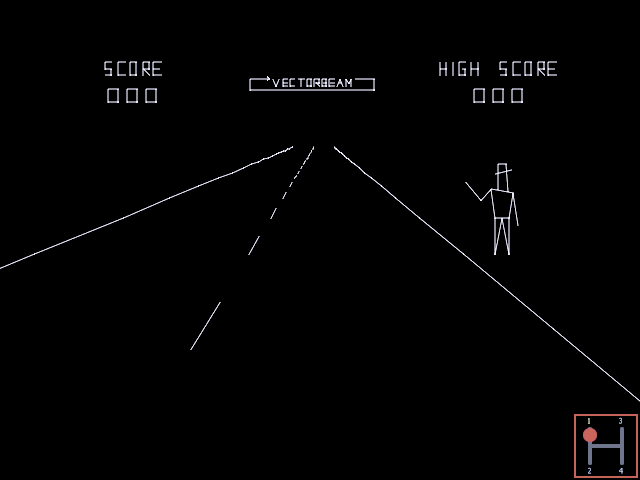
about Vectorbeam's Speed Freak arcade game.
Handbook of Driving Simulation for Engineering, Medicine and Psychology
(preview)
https://api.pageplace.de/preview/DT0400.9781420061017_A23978396/preview-9781420061017_A23978396.pdf
includes a chapter about driving simulator history (with some grainy B/W screenshots of unidentified hardware).
The Work of Nonfiction: Simulator Games in Germany [PDF]
a great thesis text by Derek Thomas Price about the German simulator
gaming subculture, with some notes about Foerst Nürburgring 1.









.jpg)