 |
 |
|
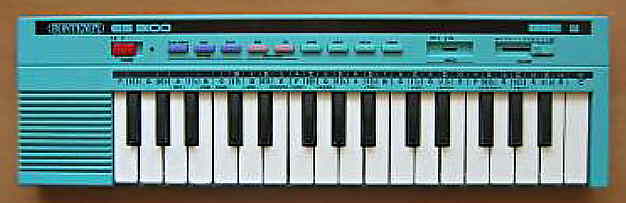
With these keyboards Bontempi tried to obviously compete with Casio PT-1. Sound and features are very similar like this VL-Tone variant, however they sound harsher by digital aliasing noise and the CPU is full of strange quirks and glitches.
|
|
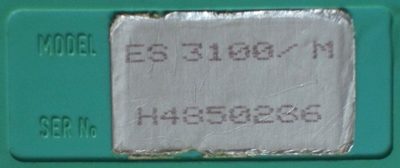
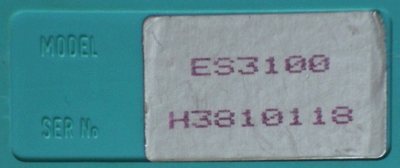
| important: The sequencer controls only exist in model variants with "/M" ( = "memory") on the bottom sticker (name on panel is the same). Versions without use these 4 buttons for the OBS preset sounds and the left slide switch as vibrato on/off. | 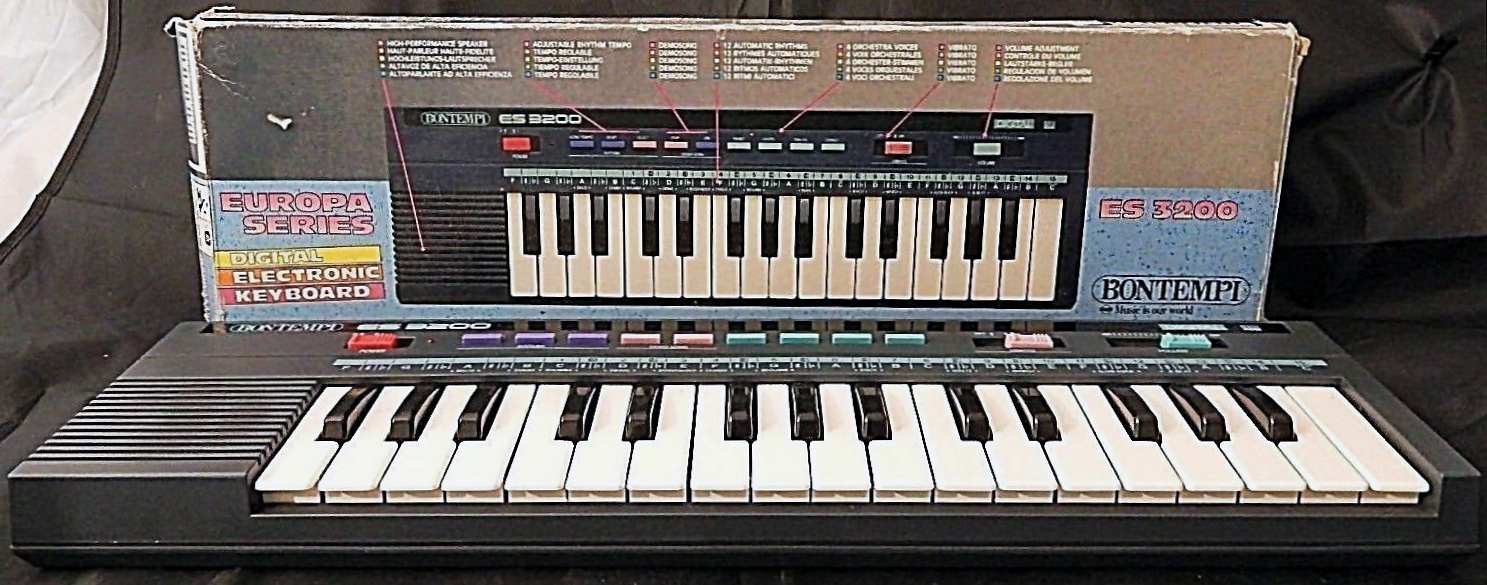 The ES3200 without M (old eBay photo) strongly differs.
 |
 |
 |
shiatsu codes:sequencer play: Press "reset" + "clear" simultaneously, then release "reset" first, to make the sequencer play the recorded melody automatically in a loop. Use tempo buttons to set tempo. demo glitch: Press "one key play" button during demo steps the demo faster forward. Holding it down, plays the demo with half speed (rhythm speed stays normal). preset sound glitch: Moving the preset sound slider with held keys plays notes louder. button glitch: Pressing multiple buttons simultaneously plays strange tones and demo tune variants with partly varying volume. trill glitch: Holding any key and trilling a 2nd key toggles between both notes. rhythm select: Any rhythm can be also selected by its corresponding key in a different keyboard octave.
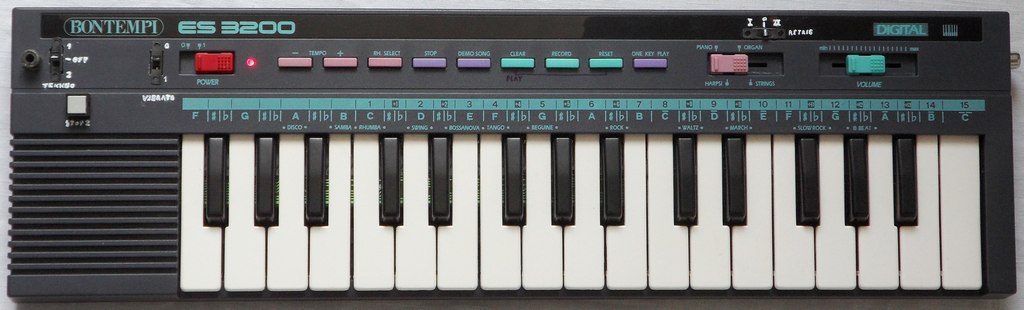
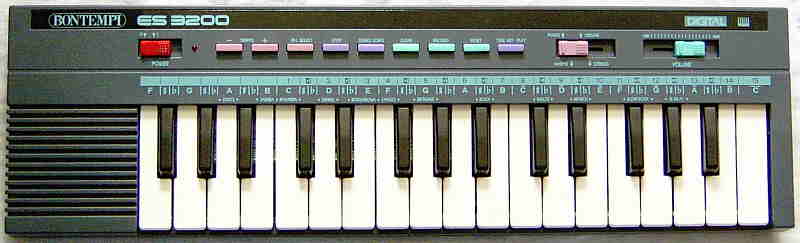
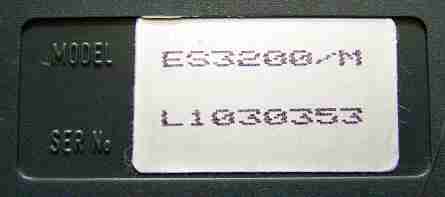
The ES3200/M has grey case and features volume and tempo controls. It is technically identical with Bontempi ES 3100 and combines the best of both ES 3100 models. So it has real tempo +/- buttons and sequencer. Only the vibrato switch was omitted (vibrato is always on). The control panel layout exactly corresponds to ES 3100/M with some additional controls, so it was likely a more expensive version. While the model name on my ES 3100/M is directly printed on the plastic case, the ES3200/M has a shiny plastic sticker for this. On the bottom sticker stands "MODEL ES3200/M" and "SER No L1030353". The rhythm tempo can be set very low, but not really high. The "reset" button here does not reset rhythm tempo to default.
The preset sounds are made from grainy digital waveforms with plenty of DAC aliasing noise. The 'piano' is a static waveform (timbre resembles squarewave) with decay envelope and percussive attack; 'harpsi' is the same with a harsher waveform. 'organ' sounds harsh and thin; it has a slow attack phase (poorly imitating a thin harmonica timbre or metal pipe organ rank). 'strings' has the same envelope with the (duller) waveform of 'harpsi'.
The rhythms are made from high blip, low blip and a snare made from shift register noise. They resemble very much Casio VL-1, but sound fatter and a bit more natural like woodblock or clave hits. Possibly there is more analogue circuitry involved, because the blips knock woody. Also the rhythm patterns differ.
The sequencer behaves bizarre and was likely intended to play the sequence
only step by step with the "one key play" button and not automatic by itself.
The "reset" button restarts the sequence from the 1st note. I still could
not find out what the "clear" button was genuinely intended to do, since
I don't have the manual. But pressing "reset" and "clear" simultaneously
and releasing the "clear" button last makes the sequencer play the recorded
melody automatically in a loop (including pauses). The timing resolution
is very coarse (note lengths semi-random) and in CPU version 100384C even
plays way too slow, which is likely the reason why Bontempi did not document
it. In this mode no manual play is possible, but you can step faster to
the next note by quickly pressing the correct key (was this a key lighting
algorithm?). Holding "one key play" makes the sequence run at changed speed
and adds sustain to notes ('harpsichord' retriggers attack); apparently
parts of the envelope get retriggered independent from the main tempo oscillator
(like in an analogue step sequencer with envelope speed out of sync). In
instrument variants with tempo control the sequence speed can be changed
with it, which causes sometimes strange phrasing. Press "stop" or "reset"
to exit. During normal operation "clear" behaves like "stop" (stops the
rhythm). Pressing "record" and then "clear" without entering notes produces
a semi-random long note sequence of old memory contents; apparently this
overwrites the end mark and so makes it play the entire memory. This sequence
can not be played automatically with the above trick (1st note repeats),
i.e. likely some end markers prevent this. The count of notes the sequencer
can store seems to vary between a dozen and over 60 (overwriting the oldest
ones?), depending on the played sequence, which makes me conclude that
either some kind of simple run length compression algorithm sorts the note
bit code by likelihood (like in Yamaha PlayCard System), or a bug
accidentally erases the memory when certain note combinations occur. The
box text of the variant
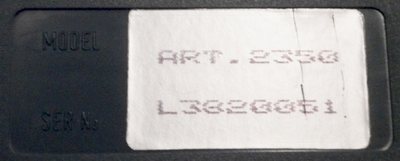
Antonelli DEK-2350
claims it holds 63 notes.
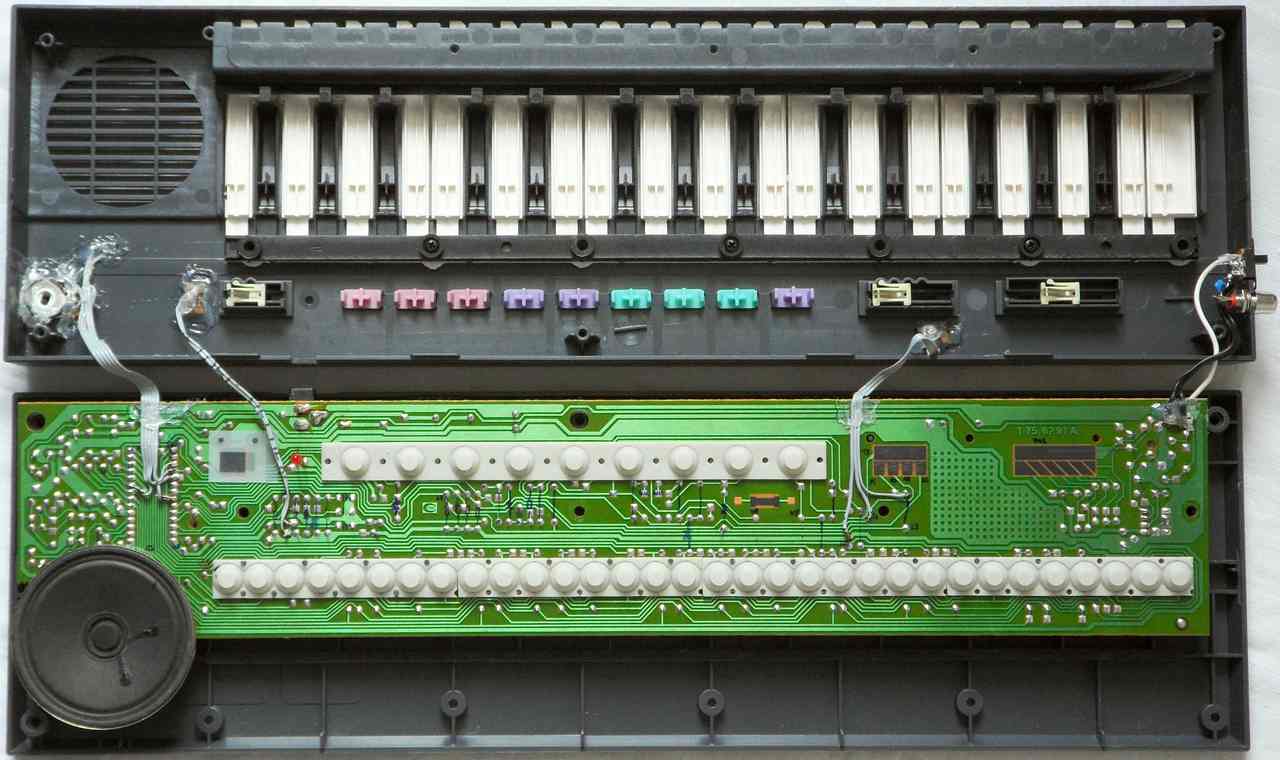
hardware detailsThe Bontempi ES 3200/M is based on the single-chip CPU "TAI4589A, 100384B, MON32H, RCA Z 927" (28 pin DIL).important: All Bontempi ES3100 and ES3200 variants are based on the same CPU and only differ in PCB wire bridges and omitted standard components (for button latch and vibrato). Versions with "/M" (memory) on their bottom sticker have enabled sequencer. Those without reuse its buttons for preset sounds and the slide switch for vibrato on/off. CPU revisions have different glitches, thus useability of hidden features (eastereggs) may vary.
My ES3200 version has the bottom sticker ending with "/M" which apparently means "memory", because on eBay I saw a different ES3200 without sequencer, that looks like a grey ES3100 (sequencer buttons reused as 4 OBS preset sounds and that slide switch as vibrato on/off).
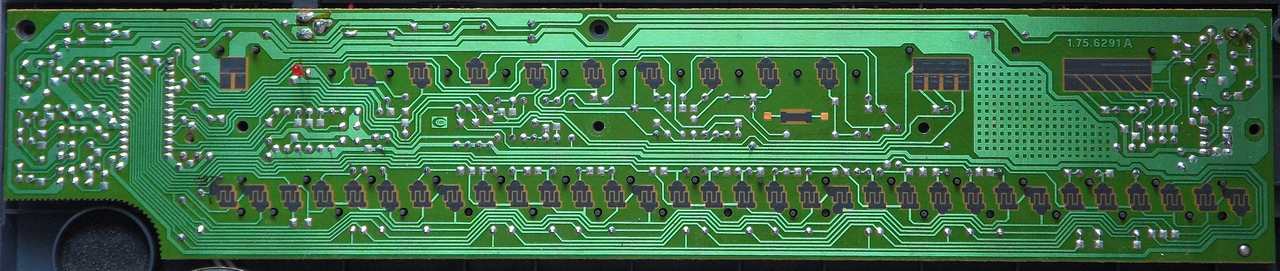
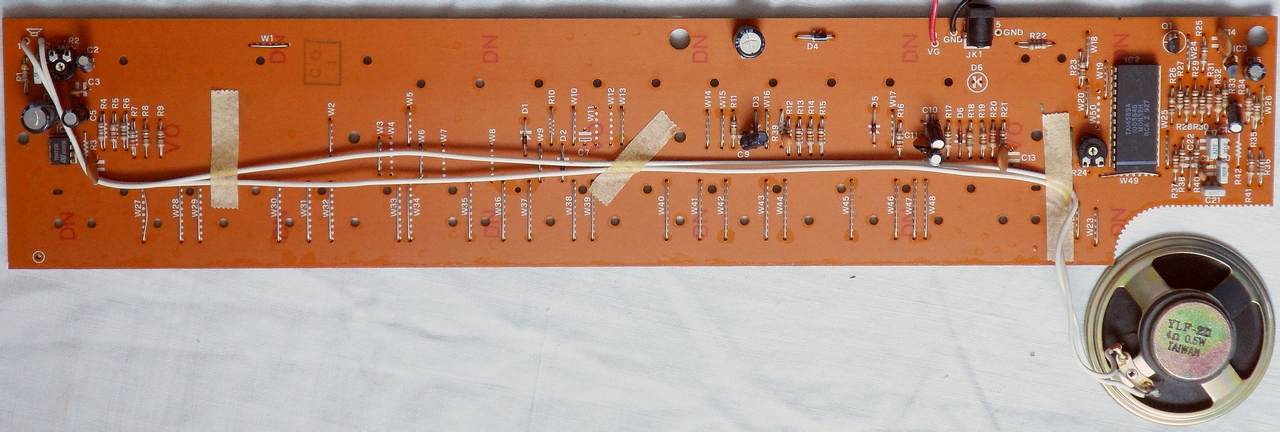
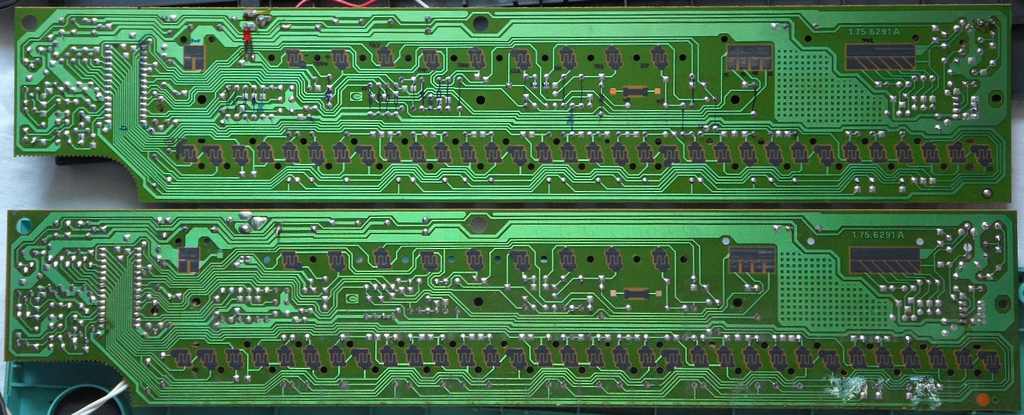
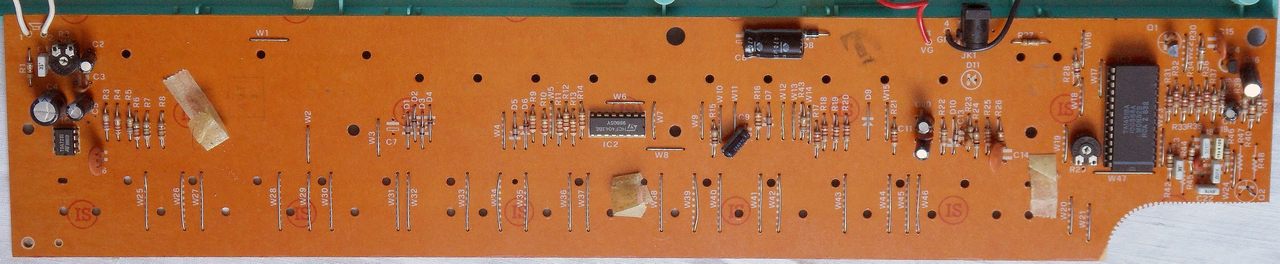
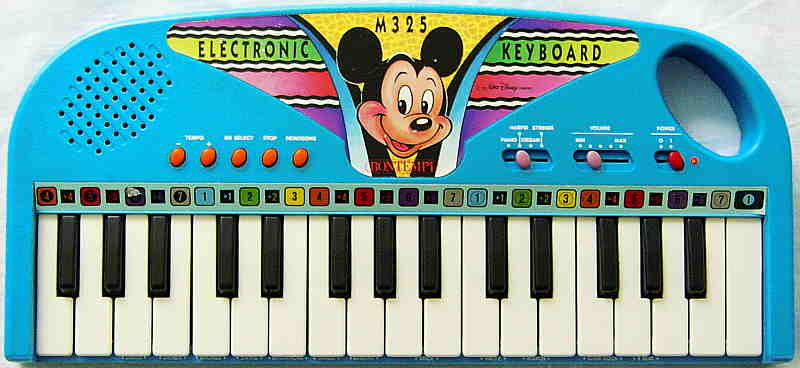
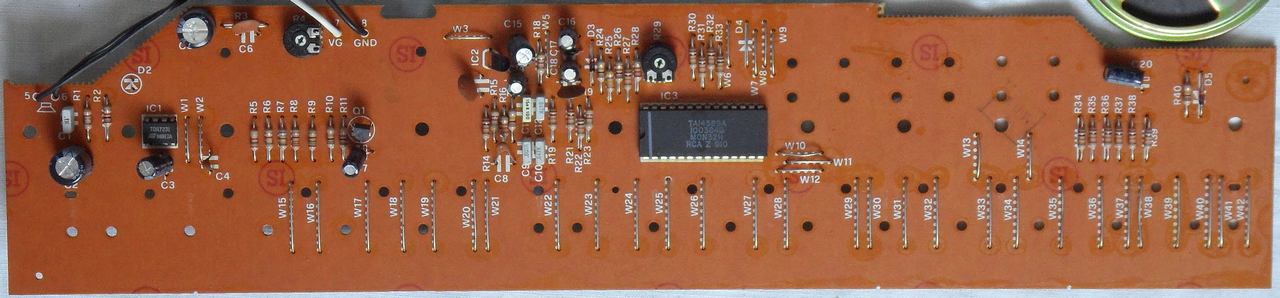
Traktor sent me photos of his specimen, which CPU name ends on "RCA Z 906". I suspect that the ciphers behind the "Z" are likely a serial number. He wrote about it (slightly edited by me): "Now I can tell you that the primitive hardware seems awkward to me - the keyboard matrix (out?) pins are all separately connected to +5V though separate (pullup) resistors. Voice 3 is default, it's switch is just unconnected, so the other voices need a locking switch. The clock is set by a trimmer edge + resistor to +5V, and trimmer center to ground through capacitor. Vibrato pulse (pin 27) is smoothed by a capacitor against ground + some resistors and goes to that trimmer's center. The first and the last pins are GND. Pin 5 is +5V Pin 26 is only connected to +5V through a resistor and else goes nowhere, when unconnected i don't see any changes. Pins 2, 3, 4 are separate outputs for snare noise, drum and main voice correspondingly, all they go to an amp through some primitive filters, i tried to white down the schematics. Snare filtering is easily modifiable by interacting with the drum part of the filter. I don't know what pin 24 does, but it's connected to +5V by a diode and a resistor in parallel and to ground by an electrolytic capacitor."Bontempi M325 has a different PCB layout with vibrato but no sequencer buttons (nor unused button contacts). Mine has CPU "TAI4589A, 100384B, MON32H, RCA Z 910". The PCB of my ES3200/M has solder holes for several unused wire bridges, those were apparently designed to rewire the button layout in other keyboard models. (Shorting them with wires only makes mess, because other bridges would need to be omitted to do something useful.) The installed bridges for panel buttons are the same like in ES3100/M. Attention: After dismantling these instruments, they can be only successfully re-assembled in a zero-gravity environment ;-) because always either the plastic buttons or PCB and rubber contacts fall out depending on its actual position. To prevent this, use a strip of adhesive film from outside to hold the buttons in place while closing the case. volume control & tuning trimmer ES3100/M and Antonelli DEK-2350 lack tuning trimmer and volume control, and particularly the latter yells way too loud. While the volume slide switch contacts on the PCB are still there, it would be mechanically complicated to remake this switch. (You would need to install resistors 6 R4..R9 and trimmer R2, and remove R3.) Much easier is to replace the wire bridge at "R2" (ES3100 has 4.7k) with a potentiometer. In ES3100/M and DEK-2350 the clock speed is set by resistors R24 (150 Ohm) in series with R19 (1.5k). Replace R24 with an 1k trimmer and R19 with an 1k resistor (like in ES3200/M) for tuning control. Of course you may also install here potentiometers for pitch control. Regard that the oscillator is not DC controlled. Thus there is an HF signal of about 3.5 MHz on these lines; adding touch sensor contacts would output unhealthy EMF. sound generatorThe 4 preset sounds combine 3 waveforms with 2 envelopes:
The volume envelopes are linear; the 'piano' envelope decays faster during its percussive attack. The 'organ' envelope has slow attack and release phase. The main voice waveforms looks strangely jagged, like made of falling ramp sections. Removing the filter capacitor reveals that the DAC output of the CPU is very spiky and has gaps (0V?) between these tines, those are 7 times as wide as the tines. Each waveform is 32 steps (tines) long and likely 16 steps high (on my analogue oscilloscope hard to see). Technically this seems to be a kind of timeslice DAC, because percussion waveforms have a gap during the (slightly narrower) main voice tines, but only while the main voice is sounding. (The gap disappears when no note is played.) But unlike a normal timeslice DAC (e.g. by Yamaha), the gaps are not output at a fixed fraction of the clock frequency, but of the note pitch (32 notches per wave period), which was likely done to simplify the monophonic main voice hardware, and perhaps also to reduce disharmonic overtones. Never the less, there is still very much DAC aliasing noise that makes the timbre quality much worse than small Casio or Yamaha keyboards and rather resemble My Music Center. The monophonic blip percussion engine was obviously inspired by Casio VL-1. The percussion consists of 2 clave-like plain squarewave blips and a snare-like hiss made from shift-register feedback noise ('Po', 'Pi' and 'Sha' in Casio language). Also here none of these can sound at the same time, thus snare is truncated by claves at fast tempo. Unlike VL-1, their decay envelope is completely linear (no sections), made from a large number of (about 96?) steps, and the duration of all 3 percussions is the same. vibratoThe vibrato in ES3200/M is implemented a little strange. The vibrato pin of the CPU outputs a 6Hz squarewave, that is pulled through a 22k resistor in series to a 100uF lytic to GND. And because the resistor controlled clock oscillator is current sensitive (howls when CPU outputs get shorted), apparently the wobbling current through the CPU indirectly modulates clock rate and hence pitch when the vibrato pin toggles hi and low. (Install a switch to disconnect CPU pin 27 to disable vibrato. You may also connect that pin through a resistor and capacitor directly to clock for deeper modulation.) ES3100 has a slide switch to disable vibrato (instead of a preset sound slider - it even still has 4 carbon contacts despite only 2 are used). The cheapish ES3100/M lacks the cap and resistor and hence has no vibrato at all.keyboard matrixThis keyboard matrix of Bontempi ES3200/M was analyzed by me. The matrix is full of unused places and doublets those partly make strange sound glitches. So I suspect that it was implemented as a kind of address lookup table, with an internal task switching speed related to the active output row. Hence inputs at a line at wrong time (when it was not expected by the software) write e.g. a register while a different task is active and so garble timbres and envelopes (but no lockups), which makes it very interesting for circuit-bending. This all resembles a bit Hing Hon EK-001, thus I am not sure if the CPU is a microcontroller at all, or rather an ASIC made from gate logics. Only the outputs 18 and 19 have duty cycle 1:1; the rest (containing keys) has shorter pulses, which hints that they are handled by a different task or subroutine.
The input lines are active-low, i.e. react on GND. Any functions can be triggered by a non- locking switch in series to a diode from one "in" to one "out" pin. The matrix out pins are high resistance when not in use, which was likely
done to save battery. Inputs have 10k pullup resistors. The 'demo' button
is wired through a 100uF capacitor parallel with 100k resistor to produce
only a short pulse; if wired directly, the demo will keep rapidly restarting
as a buzzy noise so long its button is held down, because this is not prevented
in software.
In this CPU doublets often produce different distortions or grainy textures (like zipper noise) due to timing variations, and thus don't sound exactly like their original, which may be useful for circuit bending. The inputs 20..22 occasionally trigger {'demo', 'tempo-', 'stop'} when connected with outputs 13..16, which is likely yet another strange timing bug. I did not list these as doublets, because they are trivial and don't work reliably. Things those trigger 'demo' seem to also act as 'tempo +'. This all may be related to jitter from mains hum through test cables, because the matrix is not only high resistance. That is to say, this matrix is excessively timing sensitive, thus any additional capacitance by too long cable or too high current can mess things up. In ES3200/M, ES3100/M and M325 the preset sounds are selected by a locking 4 position slide switch; its open position defaults to 'organ'. In ES3100 and likely ES3200 (models without sequencer) an additional quad NOR R-S latch IC "HCF4043BE" (16 pin DIL) buffers the 4 push button inputs to simulate a 4 position slide switch because the matrix layout is not designed for OBS preset sound buttons. The buttons {'piano', 'harpsi', 'strings'} pull each an R input hi (those else are lo by 22k pulldown resistors); the corresponding Q outputs go to matrix inputs {23, 21, 22}. The 'organ' button has 3 diodes to the S inputs of those 3 latches (latch 4 is unused with S and R grounded), and because the entire matrix is active-low (negative logics), this button clears all 3 matrix lines (simulating the empty 3rd slide switch contact). To behave like a switch, one matrix output goes to the OE pin (with 1k pullup) to keep all Q outputs at high resistance until it pulls lo. (I verified the switch-like behaviour on analogue oscilloscope.) Very strange is that here pin 18 instead of pin 19 is used, despite the matrix normally uses pin 19 to select preset sounds and will make nonsense when pin 18 is connected directly through a diode. So I conclude that the tiny delay of the additional flipflop is compensated this way. After power-on (not reset) mine starts in 'strings' mode.
Wiring a switch or button through a diode to 9->18 or 9->19 mutes the main voice output, and (with rhythm on) instead modulates the percussion waveforms with it, resulting in bizarre tekkno sound loops those change timbre (not pitch) depending on the played note. The rightmost 8 keys play here each a different tekkno pattern, while the others play the same pattern (i.e. 9 in total) with possibly subtle timbre changes. The effect is somewhat similar like the buzzy combined waveforms of EK-001, but here changes percussion instead of main voice. Both matrix places sound slightly different. Holding more than one key down plays a normal note (at wrong pitch) instead; key release sometimes turns it into a metallic clang. On oscilloscope the modulated clave waveforms look chopped and their decay envelope like rapidly retriggered at sound frequency. It is hard to identify what is exactly going on here, but I suspect that the unexpected matrix input writes a sound register or causes some kind of bus collision while a wrong task (rhythm instead of main voice) is processed, or an interrupt service routine grows too long by handling too many button inputs at once and so gets out of sync with the timeslice DAC, throwing a wrench into realtime waveform processing. I recommend to connect pin 19 through a diode to the center pin of a 2 position slide switch with open intermediate position; connect the ends to pin 18 and 19 to select 2 slightly different timbres (activating both simultaneously won't work anyway). Set the switch to intermediate position for normal play. Because the tekkno mode makes other strange sounds (notes stutter or turn into buzz) when connected through high resistance, I recommend to additionally install a potentiometer (I used a 25k trimmer) into the line to the center pin to make it adjustable. In position 1 (pin 18) cranking the pot gradually up will first turn keyboard notes into disharmonic digital buzz and alternatingly toggling wrong notes, then play a stuck A#3 note during pauses and finally start 'rock' rhythm. Played notes now turn percussion into tekkno buzz patterns (somewhat resembling grainy "wokachika" funk accompaniment or lofi acid house imitation). Position 2 (pin 19) behaves similar without stuck A#3. The tekkno patterns can be nicely modulated (restarted etc.) with the "stop2" distortion button (diode 22->17, see below), thus it is a good idea to place it near the pot and switch to reach both with one hand. Also other buttons (e.g. "rhythm select") and keys can be held down for sound variations. Holding 2 keys usually plays notes instead of tekkno noises. This all behaves very glitchy in creative ways without permanently locking up (you can always press "stop" if demo or sequencer turns on).
Wiring a switch through a diode to 21->17 or 23->17 adds the 'piano' envelope to the 'organ' and 'strings' preset sounds and makes them retrigger at about 2Hz (like slow mandolin ring). Both matrix places distort timbres differently (kind of zipper noise). The upper 6 keys are not affected. Regard that tempo +/- buttons won't work properly in this mode (pin 21: ignores, pin 23: responds too fast). I installed here a 2 position slide switch with open intermediate position. Connect both ends to pin 21 and 23, and the center pin through a diode to pin 17. Use intermediate position for normal play.
Wiring a switch through a diode at 22->17 (I used a button) not only stops rhythm ('stop' doublet 'stop2'), but also distorts the main voice when held down. Various other doublets introduce distortion too, which has likely to do with things running out of sync. pinout 100384xThe "TAI4518A, 100384A, MON32B, RCA Z" is the CPU of my Bontempi ES3100, which may be oldest and has various bugs (buggy tekkno mode, unuseable sequencer). The "TAI4589A, 100384B, MON32H, RCA Z" (28 pin DIL) is the CPU of my Bontempi ES3200/M, ES3100/M and M325 (works quite ok). The "TAI4780A, 100384C, 274 Z" is the CPU of my Antonelli DEK-2350 (sequencer playback mode is way too slow). So I conclude that "100384" is the general type (software?) number and the suffix letter indicates revisions. The "TAI4..." may be the hardware name of the chip.The CPU has a monophonic main voice (apparently 4-bit waveforms, each 32 steps with linear envelopes) and monophonic blip percussion (2 plain squarewave blips + snare made from shiftregister feedback noise; all use the same linear decay envelope). Clock rate is controlled by a resistor against +Vs, that can be modulated by the vibrato pin. The IC supports 32 keys through a keyboard matrix with 8 outputs and 10 inputs (many unused places cause glitches) and has a simple sequencer (record & one key play). The sound is output through 3 pins {main voice, claves, snare} fed in turns by a timeslice DAC, which switching frequency is 32 times the main voice note pitch. This pinout was analyzed by myself (with some tips by Traktor).
All pin names were chosen by me (inspired by Casio naming convention) and
may change if I find schematics, thus do not depend on them.
CPU version differencesIn my ES3100 (CPU "100384A") the tekkno mode crashes the percussion envelope generator, i.e. the envelope gets stuck at maximum volume and does not decay anymore. So it plays rhythms of steady staccato beeps and hisses instead of percussion; even with rhythm off it keeps beeping at 'Pi' pitch until hardware reset. (Unlike in Penrod AJ-430, this stuck envelope bug can not be fixed by reducing CPU supply voltage.) Also its unused sequencer "one key play" matrix place seems to bounce rapidly when it attempts to play sequencer contents (producing random note order). When sequencer replays from rom (note mess after reset or demo) it does not bounce, so I suspect bus data collision or such things. Also the sequencer "reset" (not hardware reset) often starts the playback mode (needs no simultaneous "clear" button press), so this was possibly the original purpose of this matrix place. Even the unused "tempo +" seems to behave a bit bouncy. (I am not sure how much of this was by hum picked up by test cables or hand jitter when touched with probes.)Its early CPU revision "100384A" apparently shows a behaviour difference
to versions B and C of my other models. Thus I conclude that Bontempi
had produced a large number of buggy CPUs and therefore designed the feature
reduced ES3100 particularly to make use of them while skipping those faulty
functions. Likely an even older CPU version ("100384" without suffix letter?)
exists with not even working "tempo -", hence the ES3100/M case lacks this
button. I haven't entirely compared all functions of all versions against
each others, but these are the most obvious differences:
When not mentioned otherwise, the following examinations are based the CPU "TAI4589A, 100384B, MON32H, RCA Z 927" of my ES3200/M. The letters "RCA" raise expectations of the mythical room sized tube synth & sequencer prototype "RCA Victor" of 1950th, but I doubt that this IC was made to reimplement any parts of it. The main voice is output as narrow spikes with only 1:7 duty cycle (sounding thin with glassy DAC aliasing noise); the rest of the time slot (or all when no note is played) is used for percussion. The audio outputs have higher resistance during pauses (visible with pulldown resistor test). This IC is full of glitches and particularly the sequencer is ridiculously buggy and hence a negative example how not to design a chip. It is unknown whether this cucumber is a microcontroller at all. I yet found nothing with that pinout, and that is to say, despite all those glitches it is hard to crash (I had to clamp reset pin to +Vs for powerdown shitshot tests), and crashes only produce combinations of known functions (e.g. demo song stopped with rhythm on, keys still muted and demo on 'one key' button, or with pin 26 disconnected sometimes ended in standby mode) but no random behaviour. (Other small single-chip Bontempis tend to play all kinds of random noises and stop recognizing key and button presses when deeply crashed.) This makes me conclude that either the software is fully rom based with hardware restricted address space and tiny ram or Havard architecture (particularly it can not execute its sequencer ram as code) or crash prevention technology (watchdog timer, reset by unknown opcodes), or the thing is an ASIC entirely built from logic gates and binary counters instead of a software controlled CPU. The clock rate at pin 25 was measured by analogue oscilloscope, which may be inaccurate. It also strongly dropped pitch, so with the tuning trimmer I could only rise it until note 'C' fell on 'B' (measured 3.3 period MHz). Thus the real frequency (multiplied with 523.251 / 493.883) would be 3.532 MHz. Pin 26 has a pullup resistor, despite nothing bad happens when removed. However when pulled lo during reset (may happen by mains hum), the CPU will not start nor produce clock frequency (matrix outs have high resistance, audio outs 2.5V). It seems to do nothing in this mode. When pulled high during reset it will start again. I suspect this was either a test pin (needs external clock input to do something?), an unused HALT pin (that gets disabled by software after successful reset) or even a standby pin to be used with an electronic power switch. (If the latter, possibly an APO feature was planned to conserve battery, but the needed timer was not implemented and so remained unused. The corresponding "power off" button would need to pull pin 26 lo together with pin 24 (reset); the "power on" button would only pull pin 24 lo. Of course also the connected amp IC would need to be switched off by a transistor.) Pin 1 is wired to ground 0V. When desoldered, it outputs a complex spiky waveform at clock frequency with tines of varying height, those may be a test signal or simply HF dirt by varying power consumption. The desoldered pin 1 also causes the matrix out pins to output higher pulses, those (also in normal mode) contain a HF signal at clock frequency with varying spike height. Bizarre is that by its density the spike pattern on analogue oscilloscope forms a vertical greyscale bar. The gaps between pulses have high resistance and thus show a curve of mains hum and environmental HF dirt, which looks almost like a funky videosynth picture. So I first thought this was a gimmick designed by the programmer, but the tiny memory of early 1980th chips rather suggests that it is caused by varying current depending on the count of simultaneous hi bits accessed from memory or such things. E.g. the bottom height of the signal has some pulses those disappear when sequencer is set to 'record' mode. Pulling pin 1 hi through 100 Ohm resistor (not recommended, may damage CPU by overload when operated for longer) crosstalks claves into the snare output (but only changes timbre with their DAC output capacitor removed). The keyboard matrix inputs are extremely timing sensitive. E.g. in the non-M ES3100 (CPU "TAI4518A") even connecting an oscilloscope to pin 18 makes the 'piano' and 'harpsi' envelope of held notes retrigger. (The flipflop IC needs a fairly low resistance 1k pullup resistor at pin 18 to work properly.) So I expect that inside this CPU the matrix inputs are multiplexed with other functions (e.g. sound hardware registers) on an internal bus that does not disable input pins while those other signals are active. Only the outputs turn off, but inputs with wrong timing (e.g. by capacitance or external ICs) produce data mess by bus collisions. (Thus it may even be possible to hack the sound generator by an external microcontroller that feeds matrix inputs with precisely timed data to write registers directly.) The matrix outs are open collector (only pull down) and chopped by clock frequency, which may be result of this (and certainly emits bad EMF). That the strange tekkno mode of ES3200/M changes timbre when connected through high resistance (potentiometer) may hint that matrix ins get not even buffered by latches to stay in sync with internal data processing, so either analogue signal levels reach deeper parts of the circuit, or (likelier) slow signal transition times act like a delay and so screw up timings. |
The demo melody "For Elise" plays with waltz rhythm that starts after its first bar. The melody cycles through all 4 preset sound, but you can also make it manually cycle by pressing "demo" again. Holding "one key play" makes the demo pause or change speed and run out of sync with the rhythm. The result seems to vary with sequencer contents; e.g. sometimes a low note occurs before the tune repeats.
A successor with similar case and polyphonic 50 sound bank was released as Bontempi ES 3300 (different hardware like KS 4400, with awful digital aliasing noise and absurd distorting percussion).

 |
 |
 |
(old eBay photo) |
 |
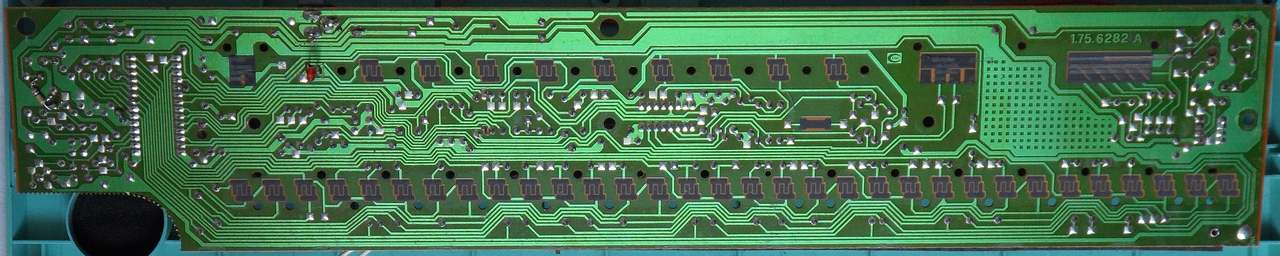 |
I really don't understand why Bontempi made this different crippled version, despite the model 1 case layout was already prepared for the ES3200/M. Stupid is that there is only a "tempo -" button but no "tempo +" (i.e. only 8 steps accessible); instead there is a genuine "reset" button, which stops rhythm (with dull popping noise) and resets tempo to default. For assigning the preset sounds to 4 OBS buttons, this model even has an additional latch IC, which for sure didn't make manufacturing cheaper. By hardware analysis I expect that they had accidentally produced a large number of faulty CPUs, and so as an emergency measure designed different ES3100 models to work around their specific buggy functions, followed by desperate attempts of bugfixing later CPU revisions (which at least in the sequencer playback mode remained fruitless).
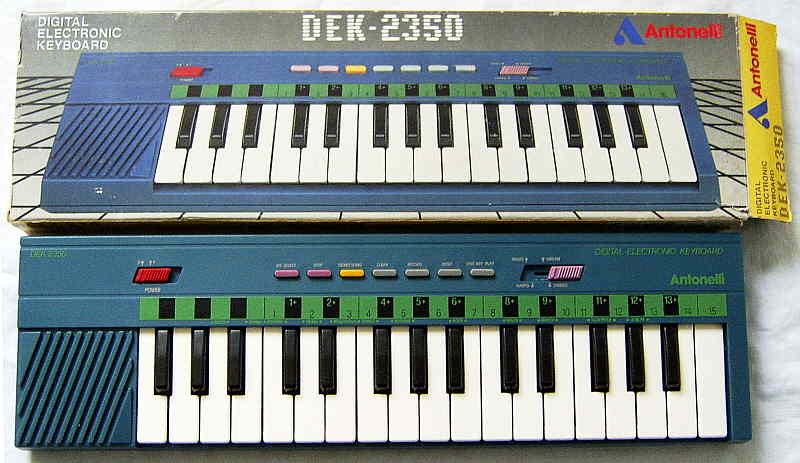
This very rare keyboard is technically identical with Bontempi ES 3100/M and differs only in the case design, which is blue with slanted instead of straight sliders. Apparently Antonelli simply re-branded Bontempi hardware; even Bontempi's characteristic "made in Italy" logo with the rastered Italian boot still exists at the case bottom of the DEK-2350.
Unfortunately it yells ear tormenting loud and has no volume control. The CPU of mine is yet another variant "TAI4780A, 100384C, 274 Z 9023" (socketed 28 pin DIL, bottom text "9ELF0, D4592"). Its undocumented sequencer playback easteregg plays here way too slow, but tekkno mode works.
(old eBay photo) |
 |
 |
 |
| removal of these screws voids warranty... | ||
 |
 |
|
|
|