|
CTK-200 | songbank keyboard with interesting lo-fi wavetable sounds |
This beginners keyboard from 1994 (embossed case date) resembles a fullsize Casio MA-130, but has a changed preset sound set with more sample timbres and a SongBank of 40 demos.
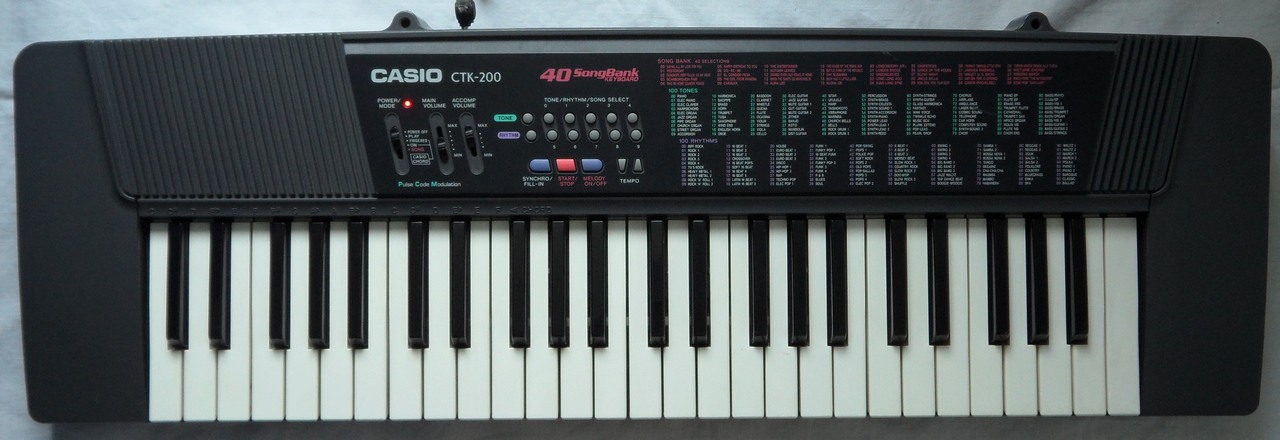
Technically this is a late relative of the nice Casio CT-840, so it has the higher polyphony and sample resolution, but it is so crippled that it lacks all its interesting features and can e.g. not even layer 2 preset sounds, because instead of 'tone edit' there is only a 'melody on/off' button to mute the main voice of the demos. The sample percussion sounds thin and hissy (I prefer the grainy MA-130), and also many changed preset sounds are no improvement at all, because it lacks e.g. the legendary 'brass ens' and 'elec organ' and instead has some strange sampled organ timbres with e.g. nasty beeping keyclick. So most sounds lack the reedy chorused squarewave appeal that makes the original sound set special. Also the rhythm set was changed. So for a keyboard collector or Casio fan it is a nice addition to the classic SA-series (non-midi) PCM sound palette, but not a must-have (IMO the original sounds better) and no replacement. At least it shows Casio's change from complex synthesized to hi-res sample based sounds, because this hybrid sound set (which also exists in some other SongBank keyboards) still features both.
Very annoying is that (when unmodified) 4 of the 5 volume steps yell way too loud (a flaw I only knew from horrible Yongmei transistor tooters or late 1980th Bontempi trash).
 |
 |
 |
 |
 |
Panel functions are grouped by alphabet letters. |
The preset sounds resemble the classic CT-840 (and MA-130) sound set, so I mainly discuss here the differences because many were exchanged with more eh "realistic"(?) timbres those IMO are no improvement but only sound more establishment. Various timbres sound less hollow and were shifted an octave down (likely to support 61 keys). Some ensemble timbres now grow duller during attack and then brighter (I call this here 'v-envelope'), ending in a slow kind of tremolo. Many others got a slow irregular LFO texture (resembling 4-operator FM ensemble timbres of Yamaha Portasounds or Fujitone 6a).
The 'elec piano' dropped an octave. 'elec clavier' is like the former 'funky clavi' without the slightly howling attack. 'harpsichord' dropped an octave and lacks the chorus effect (more natural). 'elec organ' sounds more like a pipe organ; it lacks vibrato and dropped an octave. 'jazz organ' got an octave lower, less hollow and has an awful whistling keyclick (like acid house VCF resonance) in lower octaves. Also 'pipe organ' is less hollow, less percussive and an octave lower. 'church organ' formerly sounded electronic (squarewave-like) with percussive attack; the new version is duller like a wooden organ pipes. The 'harmonica' has a beating 6Hz. instead of 1Hz LFO modulation. 'brass' is a variant of former 'brass ens' has the v-envelope and less chorus and reverb. Also 'horn' has v-envelope (sounds like a french horn). 'trumpet' got less harsh with delayed 5Hz brightness LFO. The 'saxophone' has delayed 5Hz vibrato. 'wind ens' lacks chorus and got thinner and duller; it is only an envelope variant of 'english horn' without reverb. 'oboe' sustain was shortened. 'clarinet' became more nasal (realistic?, less sweet and squarewaveish); the slow attack in bass range suggests a sampled attack phase. 'whistle' lacks the delayed vibrato and has only a little sustain instead of long reverb. Also 'flute' has sampled attack and sounds more nasal. 'violin' sounds a bit thinner and got a faster amd brighter delayed 5Hz vibrato. 'strings' got much duller and hollower (kind of oh-chorus) with slow LFO texture and less sustain. 'viola' is a harsher version of 'violin'. The 'cello' dropped an octave and got harsher (less saxophone-like). 'elec guitar' got way less percussive without reverb and now rather resembles a bright e-piano. The formerly dull 'jazz guitar' got much brighter. 'mute guitar 1' is brighter than the former 'mute guitar' (likely now sampled); 2 is hollower (banjo-like). 'gut guitar' is a classic acoustic guitar (sampled). 'zither' sounds bright with chorus like 'mandolin' (without ringing, more sustain). The 'banjo' dropped an octave and got harsher (sampled?) without chorus. 'koto' is a bright picked string. The 'dist-guitar' has a somewhat saxophone-like timbre with delayed 5Hz tremolo. 'marimba' doesn't ring anymore and has less reverb. 'bells' sounds cleaner (more metallic, less porcelain-like) with more sustain (release phase) and shorter held note sustain. 'rock drum 1' sounds 4 keyboard percussions {base, snare, close cymbal, tom}; '2' is {base 2, snare, close cymbal, open cymbal} and 'percussion' is {lo cowbell, hi cowbell, clave, rimshot} 'synth-brass' sounds an octave higher with blocky LFO texture instead of slow phasing. 'synth-sound 1' resembles a nasal distorted funky e-bass; '2' is a flute timbre with percussive attack, blocky LFO texture and reverb. The 'synth-piano' got a slightly earlier echo and decays slightly faster. 'power lead' is a less nasal variant of the former 'synth lead'. 'synth lead 1' resembles a saxophone with semi-percussive attack and delayed 5Hz vibrato; '2' has a duller horn- or ah-voice-like chorus timbre with blocky LFO texture. 'synth-reed' is no chorused squarewave organ anymore but resembles a tenor sax with delayed 5Hz vibrato. 'synth-strings' sounds less harsh (was hollow accordion timbre) and plays an octave higher with blocky LFO texture. 'fantasy' got a bit brighter (less reedy). The 'musicbox' ignores key press duration and resembles bright glass bells or a glockenspiel. 'plunk extend' got slightly woodier. 'airplane' has slightly shorter sustain (ends before first pitchbend occurs, i.e. more melodic). 'ambulance' now plays in a chromatic scale instead of quatertones (more melodic). In 'laser beam' the 2nd timbre "drills" much hollower and thinner and way less crunchy and scary. It may be the algorithm scratches on a different waveform loop sample or internal antialiasing has changed. 'cosmic sound' seems to decay a bit faster (the random behaving algorithm is hard to verify). 'choir' is a duller version of 'chorus' with blocky LFO vibrato texture. 'piano ep' = 'piano' + 'elec piano'. 'flute ep' = 'flute' + 'elec piano'. The brass ens' has nothing common anymore with the famous cold squarewave phasing timbre, but became a hollow boring sample timbre with delayed 5Hz vibrato. 'trumpet flute' is another boring honking ensemble sample timbre with blocky LFO texture. 'cathedral' is no cacophonic mixture of pipe organ chord and bells anymore, but now combines 'pipe organ' and 'choir' in a quite harmonious useful way. 'trumpet sax' layers what the name suggests. 'hpscd organ' layers 'harpsichord' and 'pipe organ' (without chorus). 'violin vib' got a faster delayed 6Hz vibrato. Also 'flute vib' vibrato got faster, reverb is gone and both flute and vibraphone were replaced with (brighter) samples those make the bass range decay slower. 'choir ens' = 'choir' + 'power lead'.
There are no pure 'bass' sounds anymore. (In CT-840 the 3 available bass sounds were always keysplit with percussion, which was perhaps impossible to implement due to bank switch problems by larger high resolution samples.) The split sound 'bass/piano' is with wood bass (the piano has dropped an octave). 'bass/vib 1' = split elec bass + 'vibraphone'; '2' = with wood bass. 'bass/brass' = with slap bass. 'bass/trumpet' = with wood bass. 'bass/organ' = split elec bass + 'jazz organ'. 'bass/guitar 1' = wood bass + 'jazz guitar'; '2' = with 'gut guitar'. 'bass/strings' = with wood bass.
The chord in CTK-200 got a louder knocking organ keyclick and stronger
bass voice (or ust dropped an octave?). The percussion samples sound brighter
with higher sample resolution. The rhythm set strongly differs from CT-840,
which accompaniments I find much more inspiring by its lots of different
(although lofi) percussion. The newer instrument is not bad, but its sound
and rhythm set should be only considered a companion for the real thing,
because it lacks so much of the character and cheesiness of original SA-series
timbres.
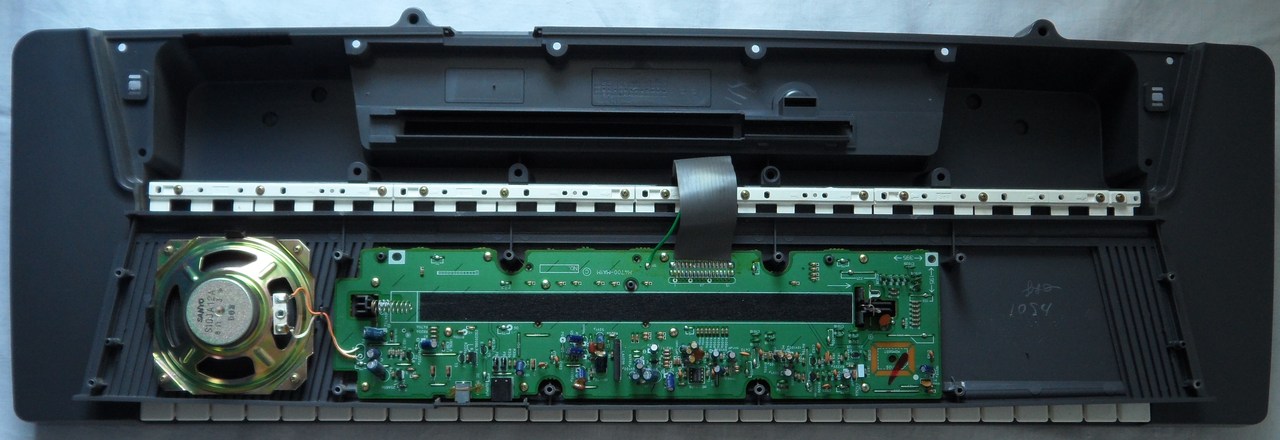
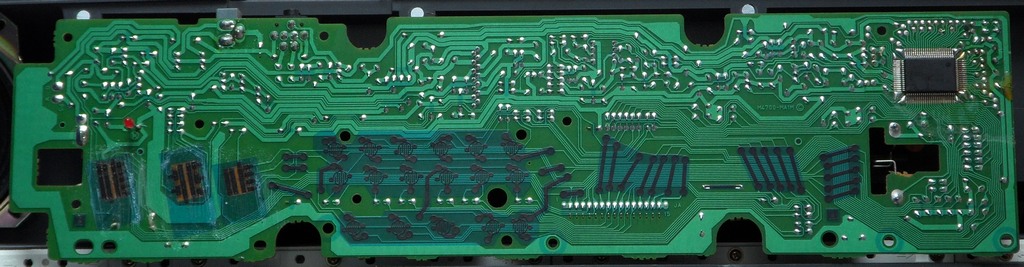
circuit bending detailsThe Casio CTK-200 is based on the single-chip CPU "OKI M6567-11", which is similar like the "M6567-04" of CT-840, but has various omitted features (e.g. no ROM-Pack, DoReMe-Guide and melody guide support) - likely to save rom space for 40 demo songs and higher resolution samples. The power amp is a "LA4598, 4D5" (14 pin SIL). The op-amp "Mitsubishi 5218A, 3Z03R" (PCB label M5218APR) seems to be used as a noise gate (concluded from CTK-450 service manual) to fight static digital noise (which works better than in MA-220). The power amp is a "Casio LA5668N, 284" (10 pin SIL).
volume control fix The analogue master volume control simulates a potentiometer through a 5 step slide switch on carbon traces and a nearby voltage divider chain of 4 resistors (R470 Ohm, R820 Ohm, R1, R1.5). Unfortunately all but the lowest step are way too loud. To fix this, solder a resistor (I used 560 Ohm) from the right end of said "R1.5" resistor to GND (e.g. at the wire bridge between the 10V220µ capacitor and transistor T2). Theoretically the slide switch and voltage divider also may be replaced with a real potentiometer (roughly about 3.79k, so 4.7k likely works) for stepless volume control. keyboard matrixThe pinout of the 15 pin ribbon cable JA is:KO0, KO1, KO2, KO3, KO4, KI2, KI3, KI4, KI5, KI6, KI7, KO5, KO6, KO7, KO8 I examined this keyboard matrix by myself, based on the Casio CTK-450
service manual and my analysis of MA-220.
While many eastereggs are identical, other features were omitted. This
matrix is likely generic for all M6567 based keyboards with >15 demo songs.
The input lines are active-high, i.e. react on +Vs. Any functions can
be triggered by a non- locking switch in series to a diode from one "out"
to one "in" pin.
I also tested if an additional fixed matrix diode can change the general behaviour (e.g. reduce the count of available demos or enable drumpads) but found nothing. Thus all other variants likely have a different software number. |
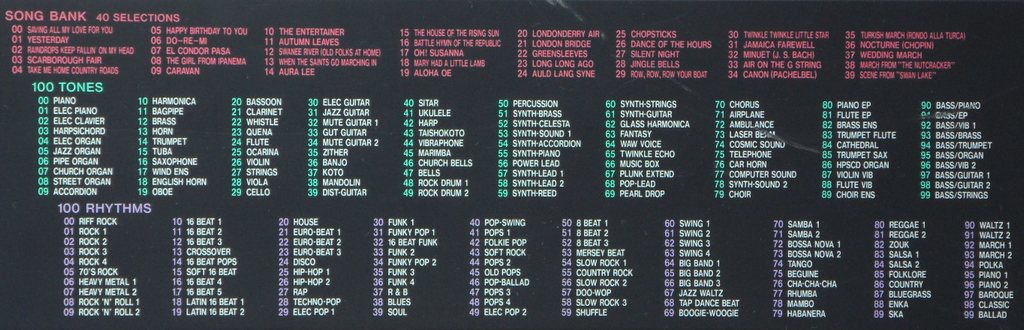
The instrument has 40 nicely arranged (but partly quite short) demo melodies, those main voice can be muted with the 'melody on/off' button. The melodies are:
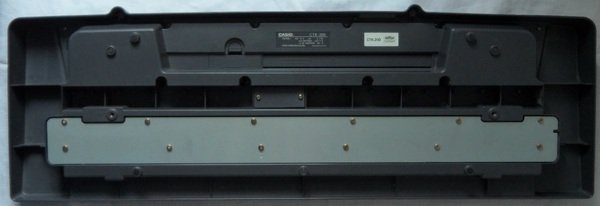
| removal of these screws voids warranty... | ||
 |
 |
|
|
|