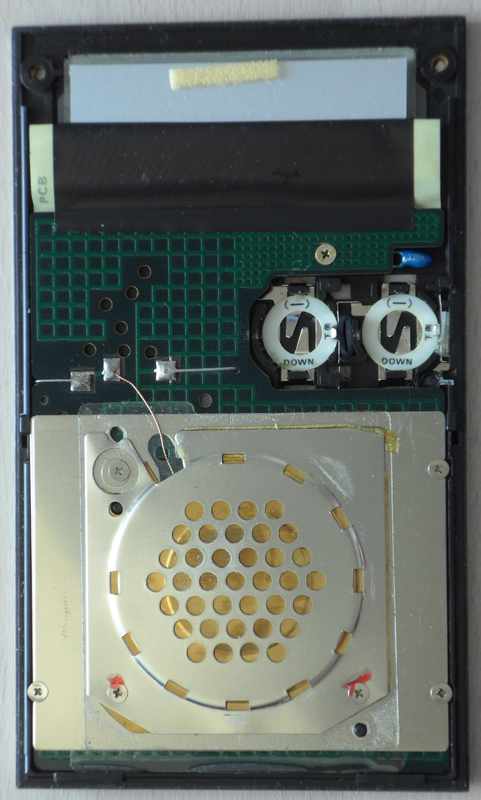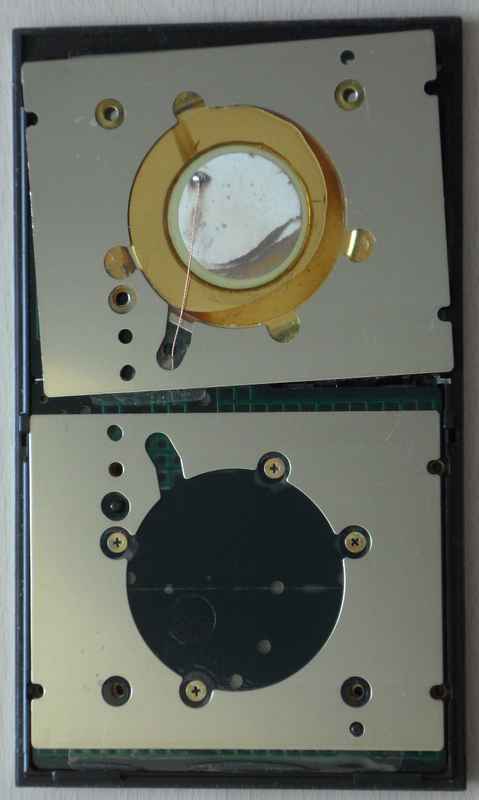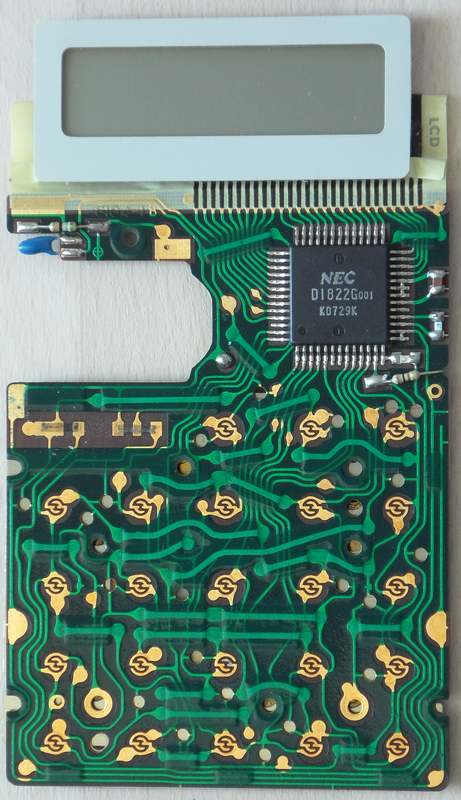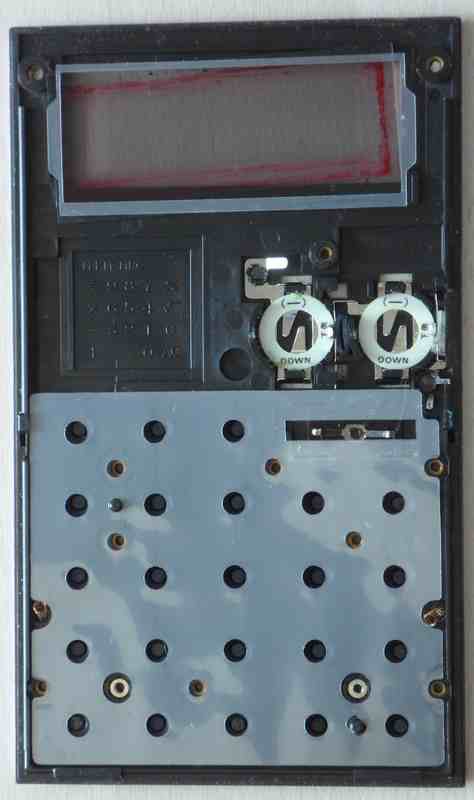
These Casio musical calculators without clock are technically as similar like different versions of Pocket Operator. I.e. they only differ in software and LCD layout, but case and even PCB are completely identical. Apparently this invention was also marketed as the Tune-Alator, because an ML-733 (seen on eBay) came with some pages of The Houndsditch sheet music, labelled "Tune-Alator-Sheet ™" and "for use with Casio Musical Calculators". While the clock equipped models (see Melody-80 for general info) were fairly expensive highend gadgets, those without clock had simplified hardware (different CPU) and were offered cheaper.
Apparently some internet moneymakers nowadays offer them as a 1980th cult toy for moon prices (several 100$). Do not fall for this! They are not such rare and often go on eBay for way less.
 |
 |
 |
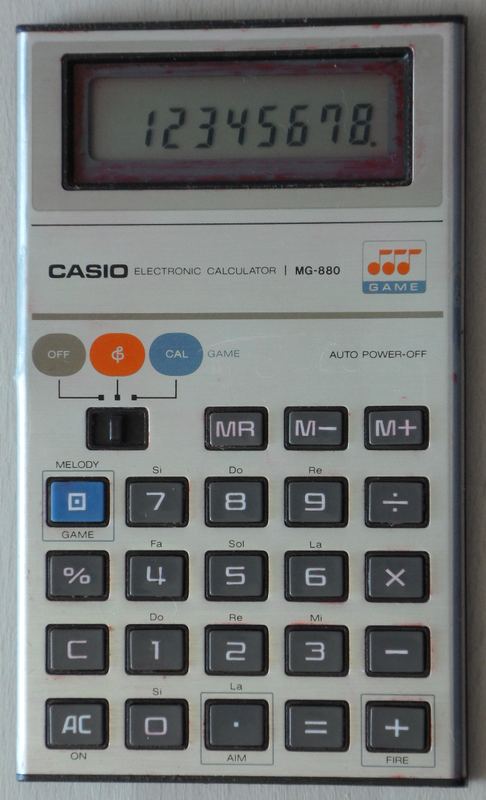
In music mode the cipher buttons and dot act as piano keys. Other buttons play a blip. The calculator is pretty basic; it can not playback results as a note sequence. Strange is that the "AC" button even erases the calculator M+ memory; it also is cleared by power-off or starting the game. The non-game twin ML-833 does not clear it (only manually by pressing 'MR' twice), which makes me conclude that this was done because the game occupies the same register as ram and hence erases calculator memory.
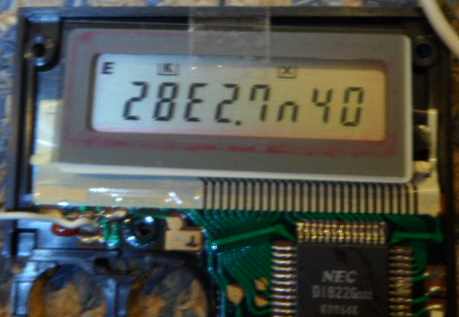
The blue button plays in music mode the demo melody (displays "3 bars"
character), but in calculator mode it starts the "Number Invader" game,
which is a very abstract skill game without graphical LCD. You see a sequence
of enemy objects (ciphers '0'..'9' and 'n') slowly scrolling from right
to left. You have to prevent these reaching the leftmost digit (your base).
For this you cycle with the "." (aim) button through all 11 symbols until
it matches on of the visible enemies and press "+" (fire) to eliminate
it. So you basically have to repeatedly push "." fast enough and press
"+" when they match before the row advances to the right. The 'n' is the
ufo, which brings bonus points. Digit 8 (leftmost) is the currently aimed
character. Digit 7 is a row of up to 3 stacked horizontal lines,
those indicate how many lives are left. After each level they are refilled
to 3. When all lives are gone, it displays "GAME OVER".
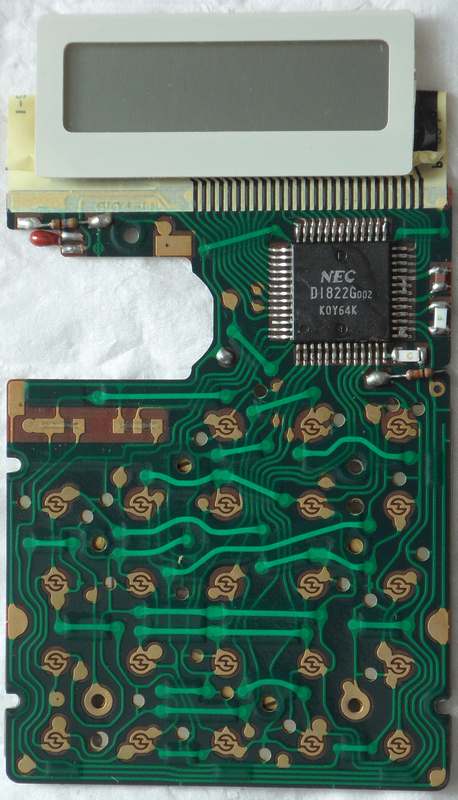
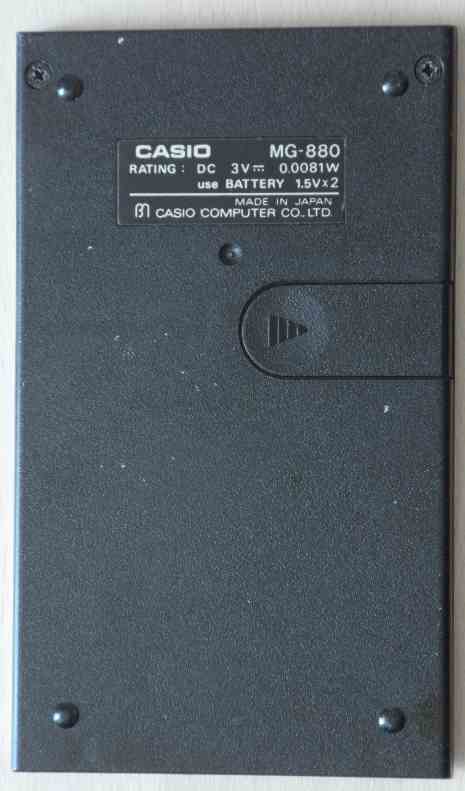
hardware detailsThe Casio MG-880 is based on the CPU "NEC D1822G 001", which directly drives the piezo speaker.
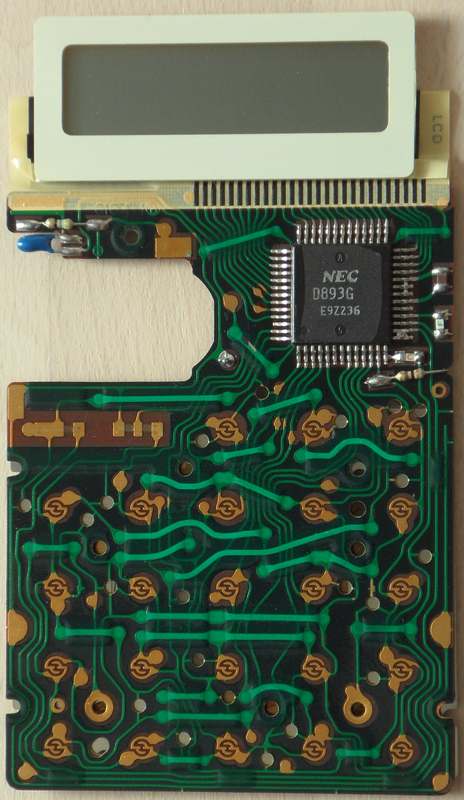
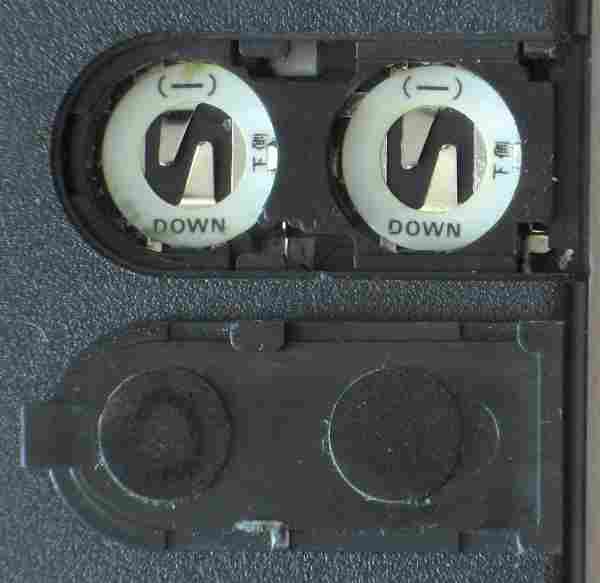
note: To open the case correctly, first remove battery lid and both bottom screws. Then slide the bottom vertically down and lift it off. (Do not pry.) The PCB is held by additional screws under the speaker. Regard that there are 2 different screw lengths (long ones go through metal). There are 2 tiny springs (touching +Vs for shielding) and 2 tiny nuts underneath. (Don't loose these.) The piezo speaker dangles on a thin wire and needs at least one of the 2 nuts with screw installed as pole to make it sound. Fortunately the LCD has no metal bracket an can be easily lifted out together with the PCB. Do not damage the LCD foil cable. The specimen from eBay was pested with orange permanent text marker paint, that made buttons stuck, so I had to take all buttons out; washing plastic parts in water with detergent was not enough, so I had to scrape the button holes with screwdriver to make them fit again. Despite I thoroughly cleaned the separate LCD polarizer foil with isopropanol and cotton swab, it still has orange paint residues at its rims. caution: The LCD foil cable is fragile. Never pull at it (it may snap off) nor sharply fold it (carbon traces crumble off). Handle it with extreme care. (If the cable comes loose at an end, install an adhesive foam rubber strip to press it on.) Inside the case is an embossed button layout plan of Casio ML-831 (has squareroot, no game) which hence apparently was designed first and contains the same PCB with CPU "NEC D893G". The green PCB is dual layer with coated silver(?) paint bridges crossing traces at the same side. The back has only a grid pattern (shielding?). Very unusual is that the black rubber keymat is completely conductive (some kOhm across its ends) and not only the spots under keys, so it needs a thin plastic foil spacer with holes for each key to insulate the rest. The clock rate (roughly 65 kHz?) is set by a resistor (not DC-controlled, lower = faster). keyboard matrixThe keyboard matrix of this monophonic instrument has no diodes. Interesting is that this one is active-low, which hints that its CPU is even less related to VL-1 than other musical calculators. The only 4 input lines hint to a simple 4-bit architecture. The only eastereggs are a 2nd 'AC' (which does not stop the melody nor can powers the calculator on) and power off button.
The input lines are active-low, i.e. react on GND. Any functions can be triggered by a non- locking switch in series to a diode from one "in" to one "out" pin. Interesting is that pin 15 outputs only 1 pulse during each button press,
i.e. (likely to save battery) the slide switch 'CAL' position is only polled
when needed. The power switch is a pin outside the matrix which powers
on by a lo pulse and off by a hi pulse. The slide switch feeds it from
supply voltage. In 'CAL' position it stays open, hence the device does
not turn on unless switched to 'music'.
pinout D893G, D1822GThe "NEC D1822G xxx" (52 pin SMD, pins count anticlockwise from the lower left, xxx = software number of internal ROM) is the 4-bit CPU of the musical calculators Casio MG-880 and ML-833. The "NEC D893G" is a pin compatible older (likely software) variant used in ML-831. The CPU supports a segment LCD (27 pins) and a keyboard matrix with 8 outputs and 4 inputs. The monophonic plain squarewave (1:1) tone generator has digital decay envelope (7 steps? = 3-bit DAC). Through an internal bipolar amplifier it can directly drive a piezo speaker.(Important: All pin names were chosen by me - inspired by the
naming convention of the D1867G
in Casio VL-1. Unlike there,
I have kept the voltage naming convention positive, because polarity of
keyboard matrix and particularly test pins are active-low, which indicates
that this CPU strongly differs from relatives of Casio
VL-1.)
When not mentioned otherwise, all pins were measured in MG-880 but behave the same in others. The clock rate is controlled by a resistor from pin 17 to 16. Estimated on my analogue oscilloscope at pin 17 is about 65.4 kHz (squarewave), but touching with probe reduces note pitch by a bit less than 1 semitone. (In ML-831 I measured 68 kHz, which may be by resistor tolerance or scope inaccuracy.) Touching pin 16 (ramp-like deformed squarewave?) reduces pitch more, which hints that this is input. Connecting both pins with a resistor strongly increases pitch. The desoldered pin 14 is NC (internally not connected); it has high resistance, no reverse diode and also finger hum on oscilloscope does not change waveform contact with the probe. The unused pin 6 is hi and in ML-831 and ML-833 outputs one lo spike during any button press. It is not a matrix out; connecting to inputs does nothing, thus this was likely a keypad test pin. In MG-880 it appears to be an unused input; it stays hi and can be pulled lo through e.g. an 1k resistor, which does nothing. The LCD display signals are made from 4 voltage levels those have no external reference pins. Also the unused pin 50 shows LCD waveform. Pins 20 and 21 are test pins (wired to +Vs) and make interesting glitches when desoldered and pulled lo (keeping them open does nothing). Pulling 21 lo shows segment mess on LCD and writes garbage into ram. I saw in ML-833 that this outputs on matrix pins 51, 52, 1, 2 each a 15-step multipulse (15 data bits?) that changes every time I pull 21 lo. Pins 3, 4, 5 stay hi. In MG-880 the resulting crash sometimes ends up in the middle of the game (also when not in CAL mode) or has nonsense characters in display buffer or M+ memory. Sometimes it beeps until button press (at random pitch). Interesting is that pressing a button repeatedly plays beeps every n-th press (a short bit pattern depending on the button?) which may output internal status bits (like the error beep of a PC mainboard), but the rest seems to be random. Pin 20 is similar but turns LCD off after about 1s (may speedup internal APO counter, sometimes a continuous beep keeps sounding). In ML-833 here power turns on again (performs reset) after disconnecting/ pulling pin 20 hi. While 20 is pulled lo, most matrix outs turn hi, but pin 5 turns randomly lo or hi. But all this behaviour is less spectacular than e.g. in ML-85, which hints that there is only little software involved. It may be that the entire CPU is made from gate logics, because the behaviour mainly shows parts of its normal functions. Particularly I found no hints to hidden melodies or games in ML-831 ot ML-833. Only the character set seems identical. The 4-bit hardware has likely 16 characters {"0".."9", space, "-", 2 bars, 3 bars, "n", "E"), of which "E", "n" and "2 bars" are normally only used by MG-880. The rated power consumption on the type plate of MG-880 is 0.0081W, while ML-833 is 0.006W and ML-831 is 0.0058W. It is unknown if this is caused by technical CPU differences or only how the software uses it. |
According to the Liquid Crystal website, some (likely late) MG-880 specimen have the case back embossed ML-831 label under their MG-880 sticker.
A very rare thick white plastic version of this calculator came out as Casio MG-660, a smaller and slimmer version as MG-890 (1981) and a credit card size version as MG-770. A modern successor was released 2018 in Japan as Casio SL-880.
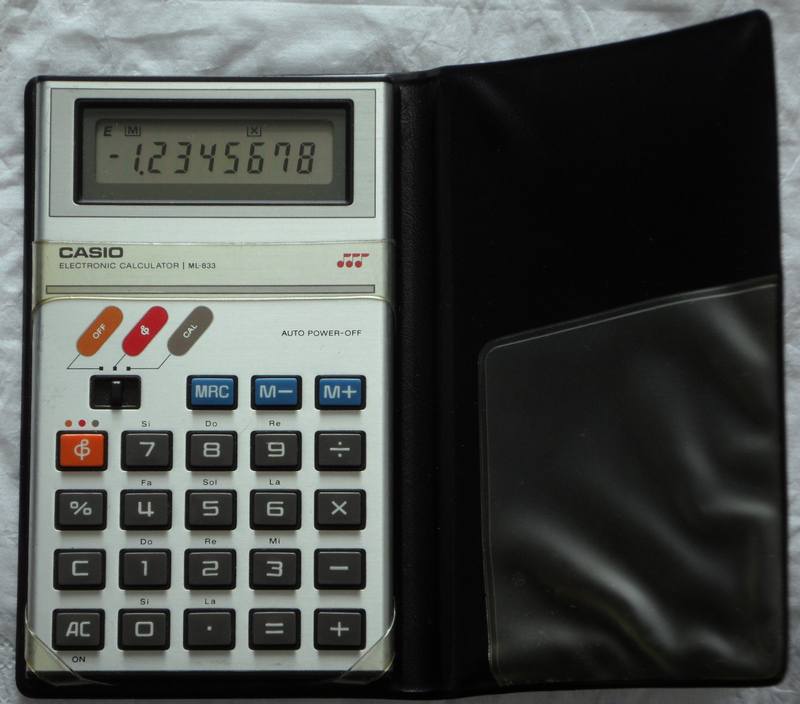
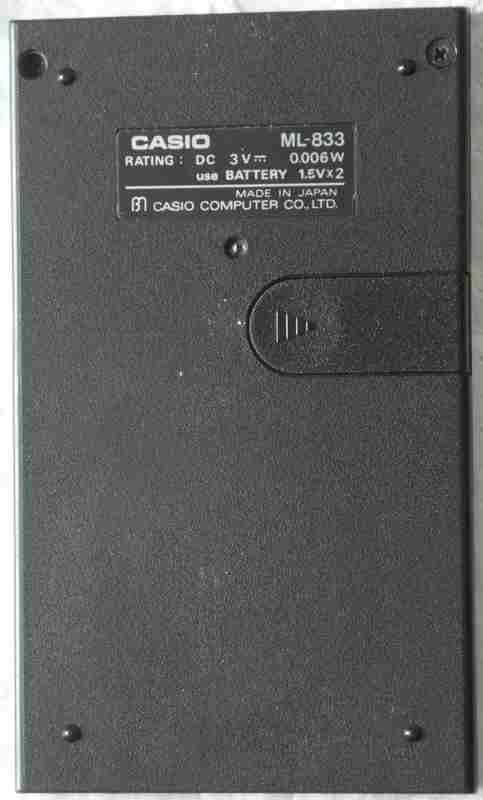
hardware detailsThe Casio ML-833 is based on the CPU "NEC D1822G 002". PCB and case are identical with MG-880 (they only differ in software number and LCD panel), thus for hardware details see there.
keyboard matrixThe keyboard matrix of this monophonic instrument has no diodes. PCB wiring and behaviour are identical with MG-880, thus all changes are in software. The only eastereggs are independent 'MR' and 'MC' calculator memory buttons, a 2nd 'AC' (which does not stop the melody, nor can powers the calculator on?) and power off button.
The input lines are active-low, i.e. react on GND. Any functions can be triggered by a non- locking switch in series to a diode from one "in" to one "out" pin. Pin 15 outputs only 1 pulse during each button press, i.e. (likely to
save battery) the slide switch 'CAL' position is only polled when needed.
Pin 6 here behaves similar but does nothing when connected to inputs, thus
it is likely a test pin. The power switch is a pin outside the matrix which
powers on by a lo pulse and off by a hi pulse. The slide switch feeds it
from supply voltage. In 'CAL' position it stays open, hence the device
does not turn on unless switched to 'music'.
|
A smaller and slimmer ML-833 version came out as Casio ML-733 (of 1985, I own one).
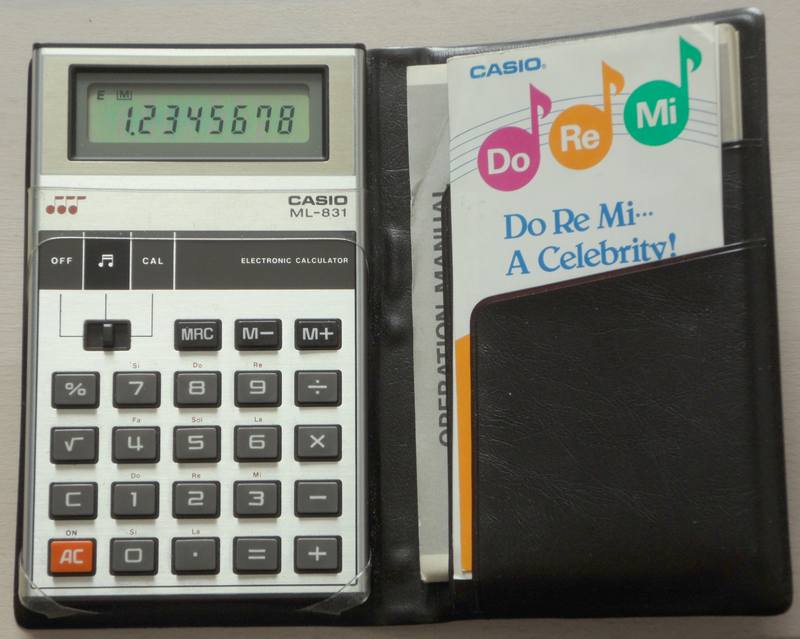
This calculator was also released as Casio ML-832 (ssen on eBay).

Unlike Casio musical calculators with clock (e.g. Melody-80),
this one behaves a little crude and e.g. blanks the LCD during playback
of calculator results, which hints that the implementation was somewhat
experimental and a little unpolished. Also the higher note key "+/-" button
easteregg does not exist in later models.
hardware detailsThe Casio ML-831 is based on the CPU "NEC D893G". PCB and case are identical with MG-880 (they only differ in software number and LCD panel), thus for hardware details see there.
keyboard matrixThe keyboard matrix of this monophonic instrument has no diodes. PCB wiring and behaviour are identical with MG-880, thus all changes are in software. The most interesting eastereggs is a "+/-" button that plays a higher note key. There are also independent 'MR' and 'MC' calculator memory buttons and a power off button.
The input lines are active-low, i.e. react on GND. Any functions can be triggered by a non- locking switch in series to a diode from one "in" to one "out" pin. Pin 15 outputs only 1 pulse during each button press, i.e. (likely to
save battery) the slide switch 'CAL' position is only polled when needed.
Pin 6 here behaves similar but does nothing when connected to inputs, thus
it is likely a test pin. The power switch is a pin outside the matrix which
powers on by a lo pulse and off by a hi pulse. The slide switch feeds it
from supply voltage. In 'CAL' position it stays open, hence the device
does not turn on unless switched to 'music'.
|
The most bizarre variant with same case is Casio ML-840
(of 1985, squareroot, no melody button), which lacks "M+", "M-" but still
has an (hence useless?) "MR" button. (I don't know if this was built-in
by accident or perhaps even the "+/-". An eBay vendor claimed the
button resets the calculator and plays a tone, but I found no further info
about it.) A slimmer ML-831 variant came out as ML-860. A credit card size
variant was likely the "Music Card" Casio ML-720 (of 1985).
| removal of these screws voids warranty... | ||
 |
 |
|
|
|