 Casio
DJ-1
Casio
DJ-1digital children keyboard with voice changer
| Casio
DJ-1 |
RAP-1
digital children keyboard with voice changer |
 |
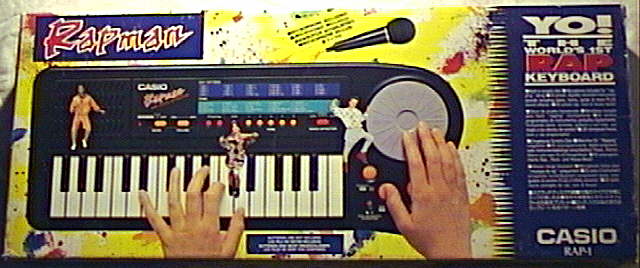 |
This keyboard was also released as Realistic Rap-Master.
 |
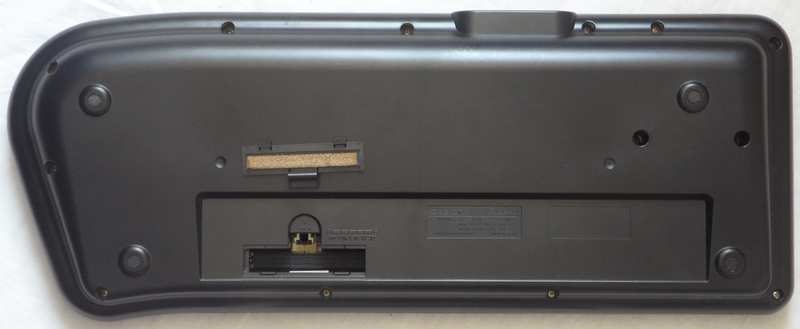 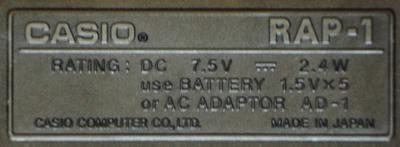 |
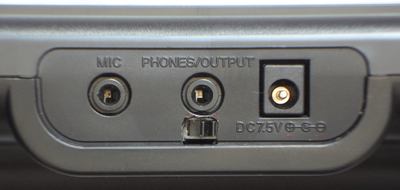 |
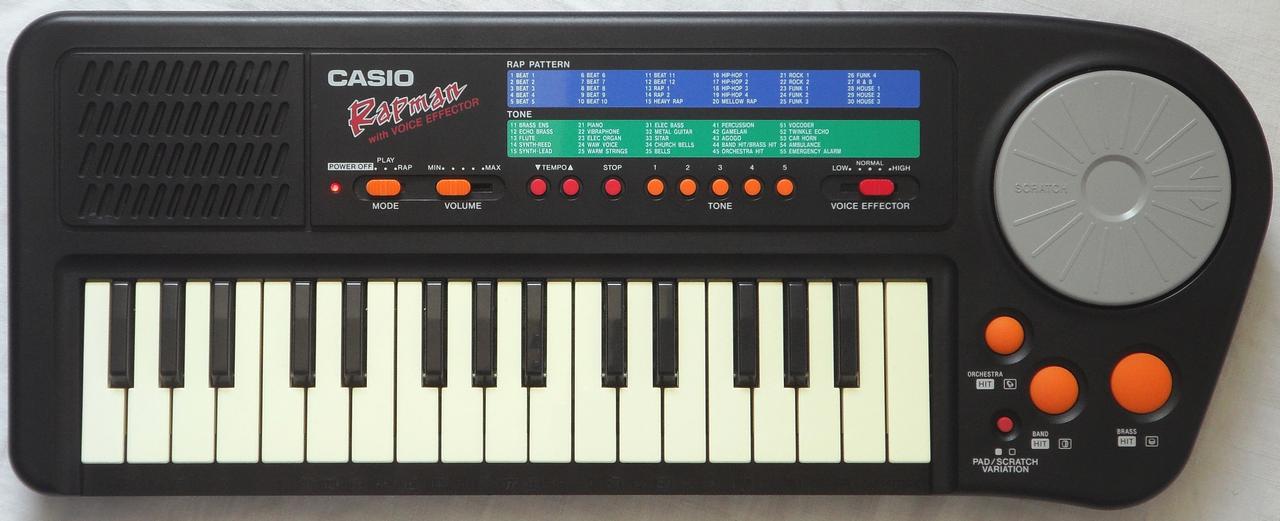
The preset sounds are based on classic SA-series, but some are special. "echo brass" resembles the known "brass ens" with echo. "flute" is "whistle" with less reverb. "synth reed" is duller. "piano" resembles here "synth piano" (less percussive, Rhodes-like). "vibraphone" has here less sustain. "percussion" is {scratch 1?, scratch 2?, clave?, hihat}. "gamelan" sounds a semitone lower. "agogo" can be played melodic and resembles a toy piano. "band/brass hit" and "orchestra hit" are grainy lofi versions of a sound that was somewhat overused in that era (e.g. by Michael Jackson and in techno). "vocoder" is that granular sound from the scratch disc in decaying and looped with additional echo. The siren sounds "ambulance" and "emergency alarm" here have a chromatic key scaling and so can be played melodically.
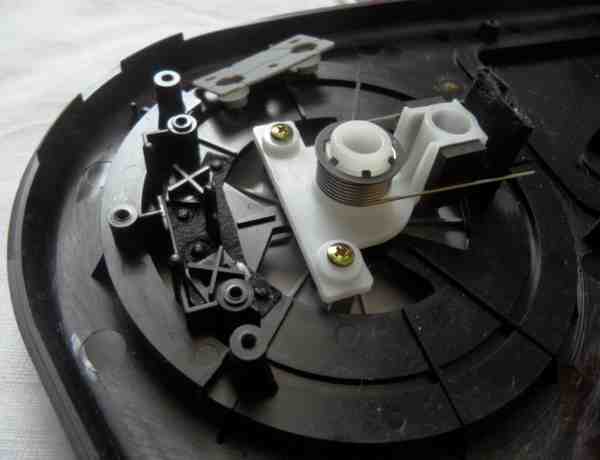
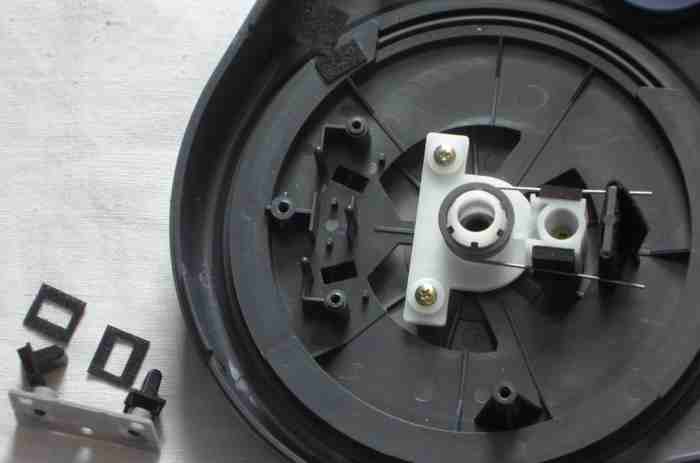
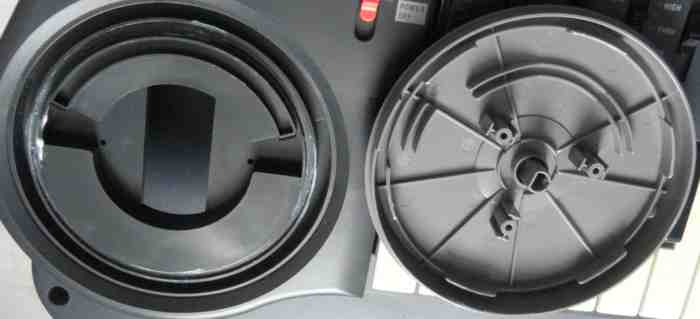
The rhythm set differs from the usual SA-series. It is focussed on rap/ hip hop stuff, and some patterns contain fixed key accompaniment. To enable rhythm, the power switch has to be set to "rap" position, which makes the main voice monophonic. Operating any drumpad or scratch disc mutes rhythm for the rest of the bar. Like with most toy keyboards, the scratch disc is fake; it is spring loaded and does not more than pushing on 2 buttons (1 per direction).
The voice changer pitch-shifts the microphone input and has a grainy
digital lo-fi timbre.
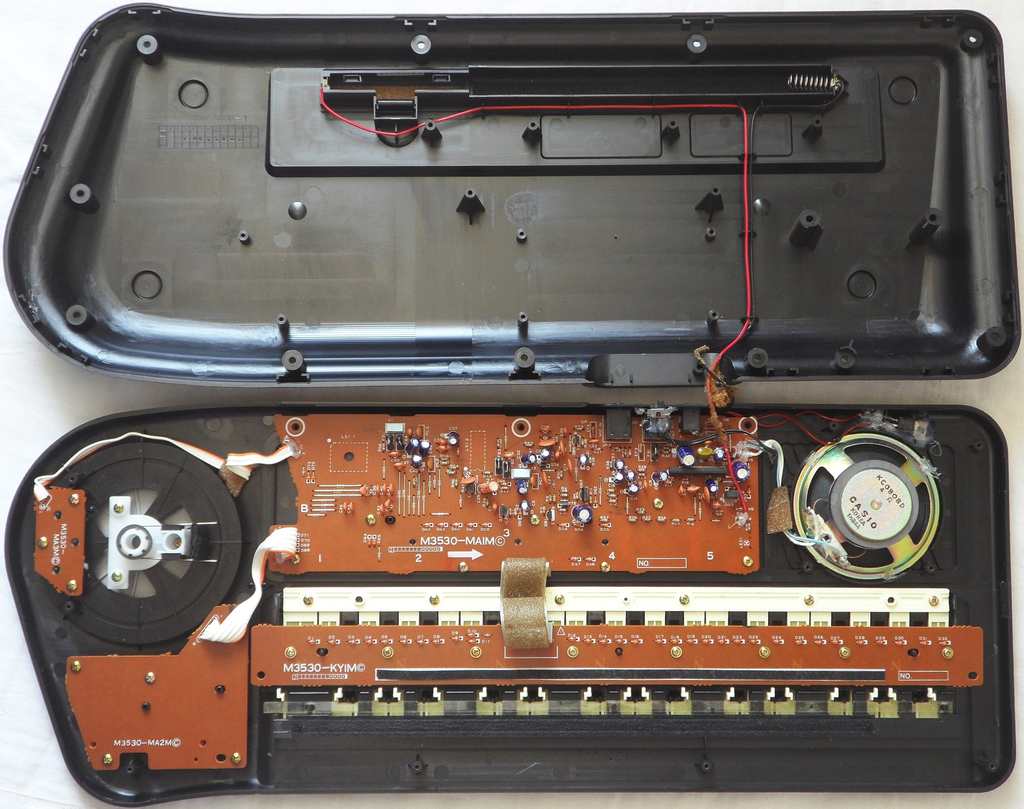
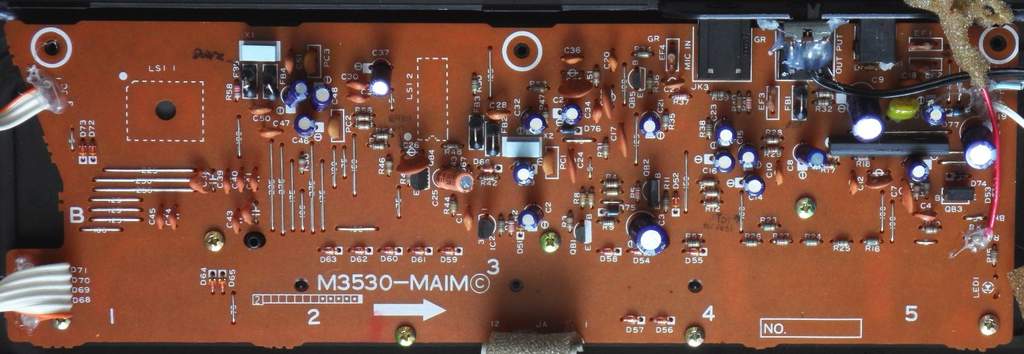
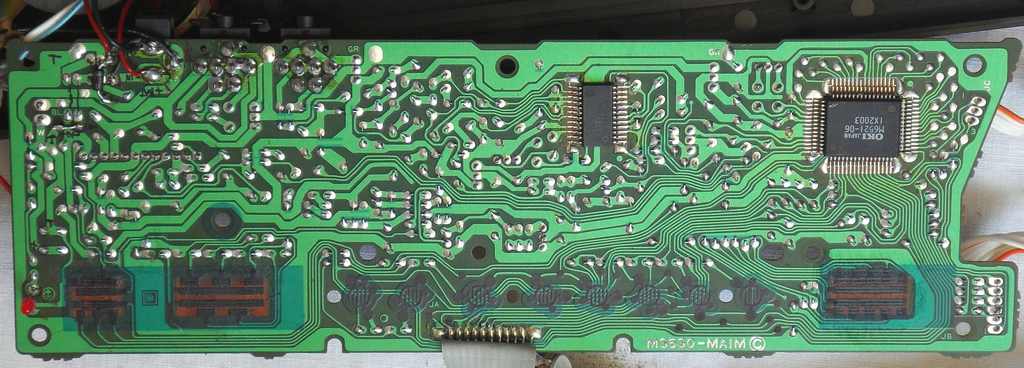
circuit bending detailsThe hardware contains a voice changer IC "OKI M6322" that is clocked by its own 4 MHz crystal and runs independently from the CPU "OKI M6521-06" (crystal clocked at 21.725 MHz).
The behaviour that the only 3 note polyphony is reduces to 1 when rhythm plays (no matter whether the selected rhythm makes use of the 2 occupied melodic voices) is a sign of very poor software design. The CPU type "OKI M6521" hints that it is a close relative of the Casio PT-88 hardware with changed internal ROM, which makes me conclude that the "rap" mode is genuinely nothing else than the PT-88 "auto play" mode that without connected ROM-Pack uses the internal SongBank memory, which here contains instead of songs 30 endless loops as preset rhythms. Only the "demo" (i.e. cycle through all songs) on the last key seems to be disabled. Because 3 polyphony channels are statically assigned to ROM-Pack playback, only 1 remains for the main voice. Also that hitting any drumpad mutes the rhythm track for 1 bar perfectly matches PT-88 behaviour. keyboard matrixThe Rapman RAP-1 is obviously derived from Casio PT-88 hardware, so the layout is very similar. 5 cipher buttons, 3 drumpads, glitchy "melody guide" variants and 2-note polyphony mode can be added.This matrix was analyzed by myself with the help of service manuals
of Casio ML-2, ML-3, ML-1.
The input lines are active- high, i.e. react on +Vs, thus any functions
are triggered by a switch in series to a diode from one "out" to one "in"
pin.
The LED matrix pins LY# and LX# are not used in this instrument, but they still seem to work like in PT-88. On oscilloscope there is much activity particularly in "rap" mode before selecting a rhythm. The PT-88 in this situation shows a walking light running from left to right. eastereggs 5 additional cipher buttons can be added (corresponding PT-88 ciphers are in "[ ]") to select more sounds, but many cipher combinations (often with KI2) are mute. 3 additional drumpad buttons at KO4->KI5..KI7 play rimshot, base, snare. But these are anyway reachable through the pad variation button and nothing special. In variation mode the pad at KO4->KI5 sounds "echo brass" and the other 2 stay mute. The "rap" mode of RAP-1 technically corresponds to "auto play" of PT-88. So the rhythms and fixed-key accompaniments are actually internal songs those repeat in a loop. The other keylighting stuff exists too, but behaves glitchy. The "melody guide 2" (without waiting) seems to be just like "rap". The "any key" mode waits on key presses to step through patterns, but behaves very glitchy. It is in a kind of keyboard drumkit mode that plays on each key a different percussion or short synth sound, but depending on the pattern, some keys sound only when pressed multiple times. The rightmode key ("demo") starts the first rhythm in normal mode (like "rap"; you can exit with "stop"). The "melody guide" seems to do the same. (I didn't examine details.) In RAP-1 there is a fixed diode soldered at KO7->KI7 (located near the "tempo -" button) that enables its 3-note polyphony. It is only sensed during power-on (see PT-88), and removing it reduces polyphony to 2 notes. It is unknown why the polyphony isn't 6 notes; possibly Rapman for each channel layers 2 internal subvoices to sound thicker, or occupies more CPU capacity for higher sample playback resolution. shitshotTouching clock pins makes all kinds of bizarre crash noises. Also a shitshot on the power supply line (e.g. simply by battery wiggling) works. My RAP-1 needs 1 second without power to fully reset (which may be also result of my voltage regulator stuff), which makes it particularly sensitive to such tricks.pinout M6322The "OKI M6322" (24 pin SMD) is the voice changer IC of Casio Rapman and DJ-1. The documented IC (datasheet OKI MSM6322) contains an 8-bit ADC and 9-bit DAC and is clocked with 4MHz. Speech pitch can be adjusted in 17 steps by 1 octave down or up. It has an internal microphone preamp. The preamp and filter pins need external discrete components.Most interesting is that pitch control in 17 steps is much finer than
the 5 step slide switch used in these instruments. The IC can be wired
to either use a 4-bit combination (e.g. locking switch contacts) or simply
2 buttons (up/down) for pitch select. The mode is set by wiring pin 6 hi
or lo.
|
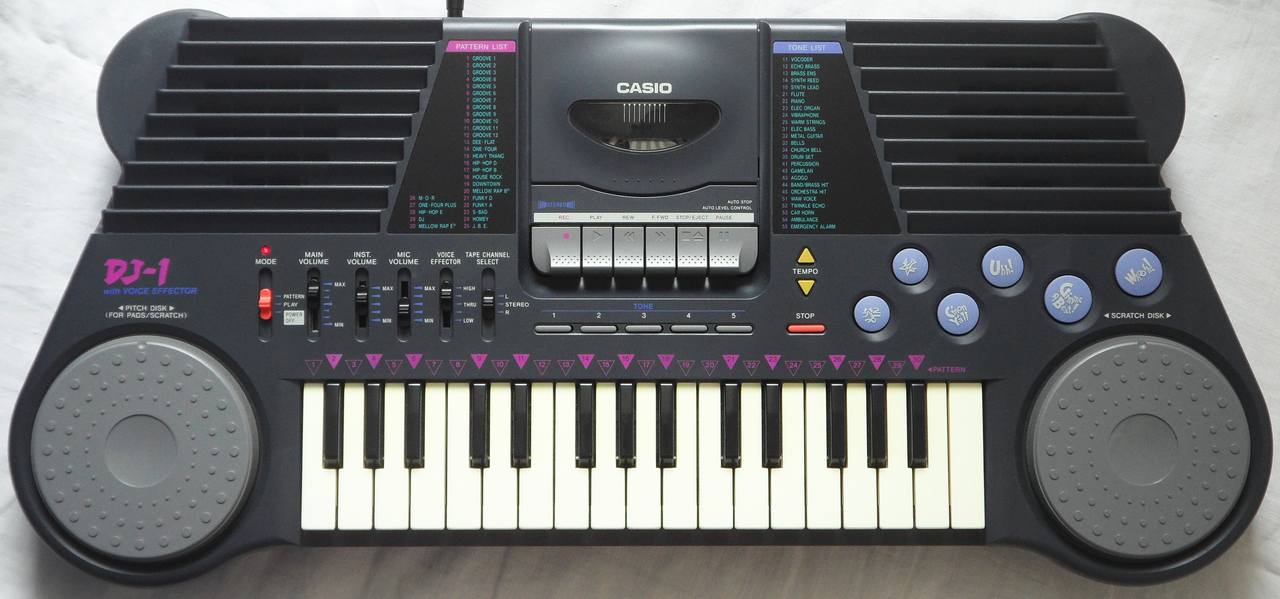
In the Rapman series Casio also released a boring belt- mountable rhythm/ scratch sound toy without voice changer named RAP-10. A much bulkier Rapman-like keyboard (with cassette recorder) was Rap Studio RAP-2 that is better known as Casio DJ-1. A blatant RAP-1 knockoff was the First RAP-2 (similar case and accompaniment, no voice changer, squarewave sound + short rap/ percussion samples).
 |
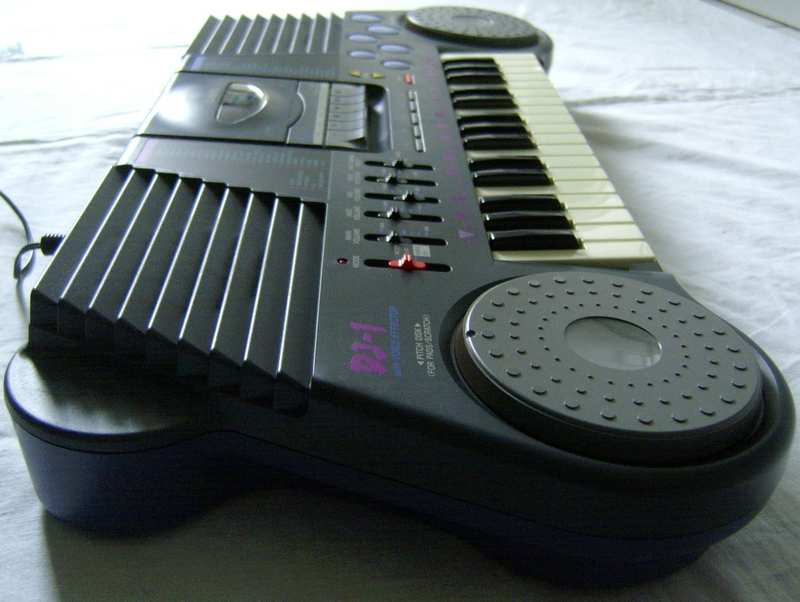 |
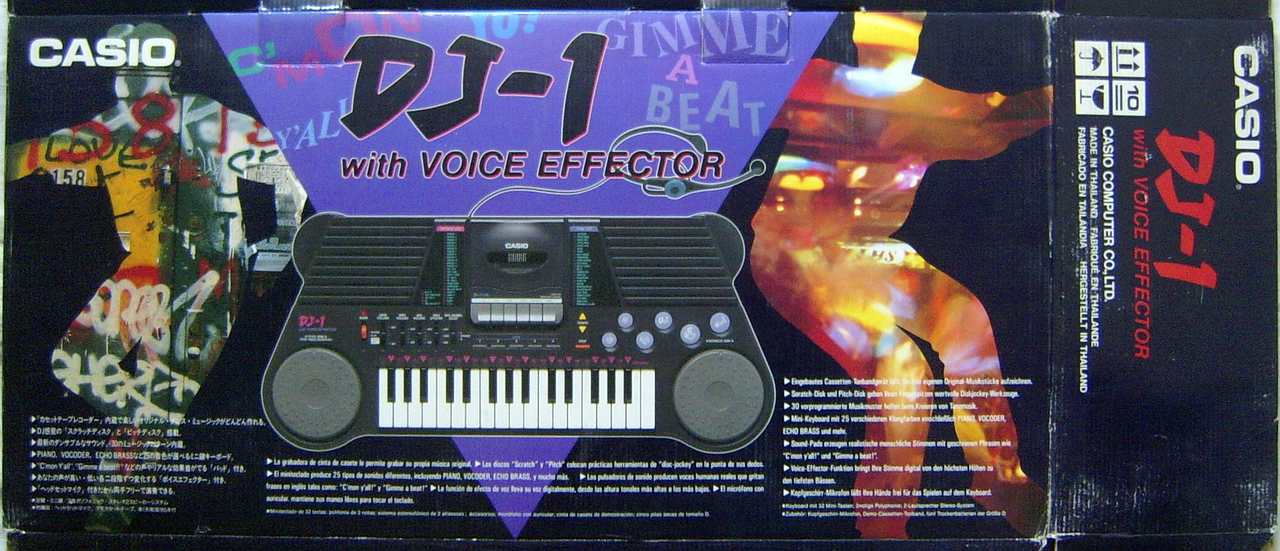
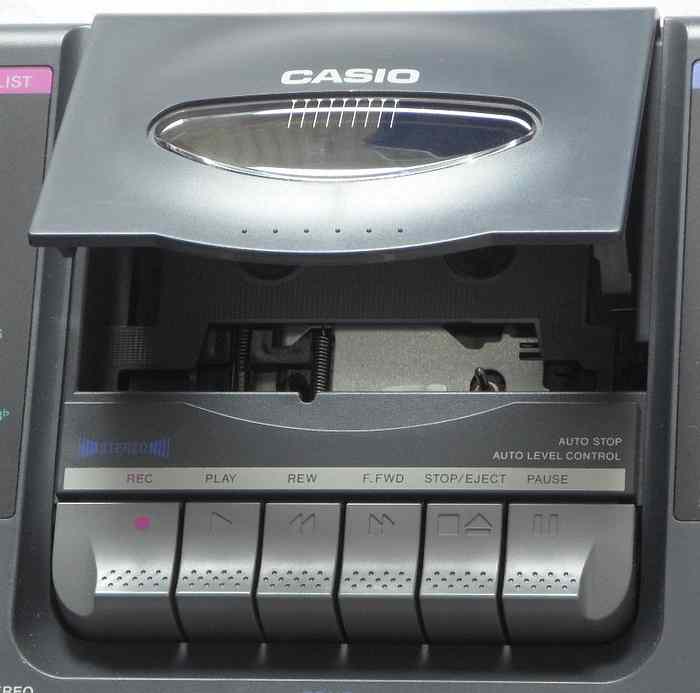
This instrument was also released as Casio Rap Studio RAP-2.
 |
 |
 |
 |
 |
 |
 |
 |
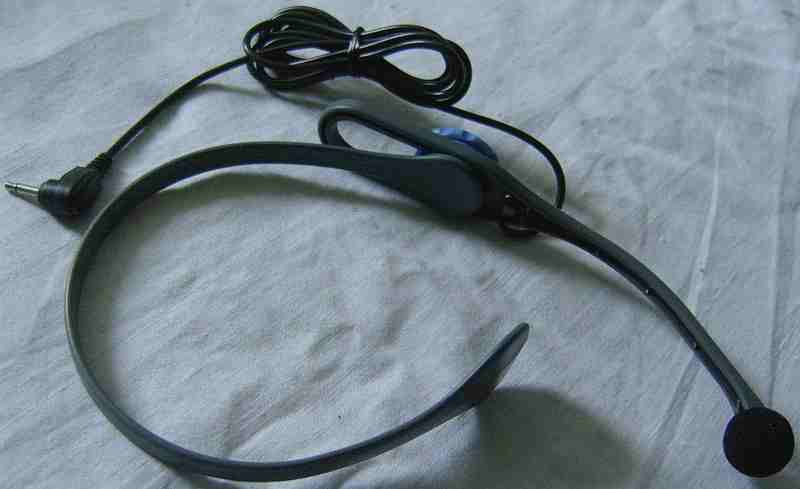
The preset sounds are based on classic SA-series, but some are special. The sound set is almost like Rapman RAP-1, but in different order. It powers on with "vocoder" instead of "brass ens", and canceling the last musical reference to hippie era, instead of "sitar" it got a 2nd drumkit "drum set" (several pitches of {base, tinny toy drum (timbales?), shaker 1, shaker 2}). Unfortunately nothing can be assigned to pads or scratch disc, which is also caused by bad hardware design, because to implement pitch control (left scratch disc), pads and right scratch disc are handled inside a self-contained sound IC that is too primitive to communicate with the rest.
Like in RAP-1, the rhythm set is focussed on rap/ hip hop stuff, and some patterns contain fixed key accompaniment. To enable rhythm, the power switch has to be set to "pattern" position, which makes the main voice monophonic. Operating any drumpad or scratch disc mutes rhythm for the rest of the bar.
The 6 effect pads and each direction of the right scratch disc trigger
each a preset sample sound. Holding it retriggers the sound. The left scratch
disc changes the pitch.
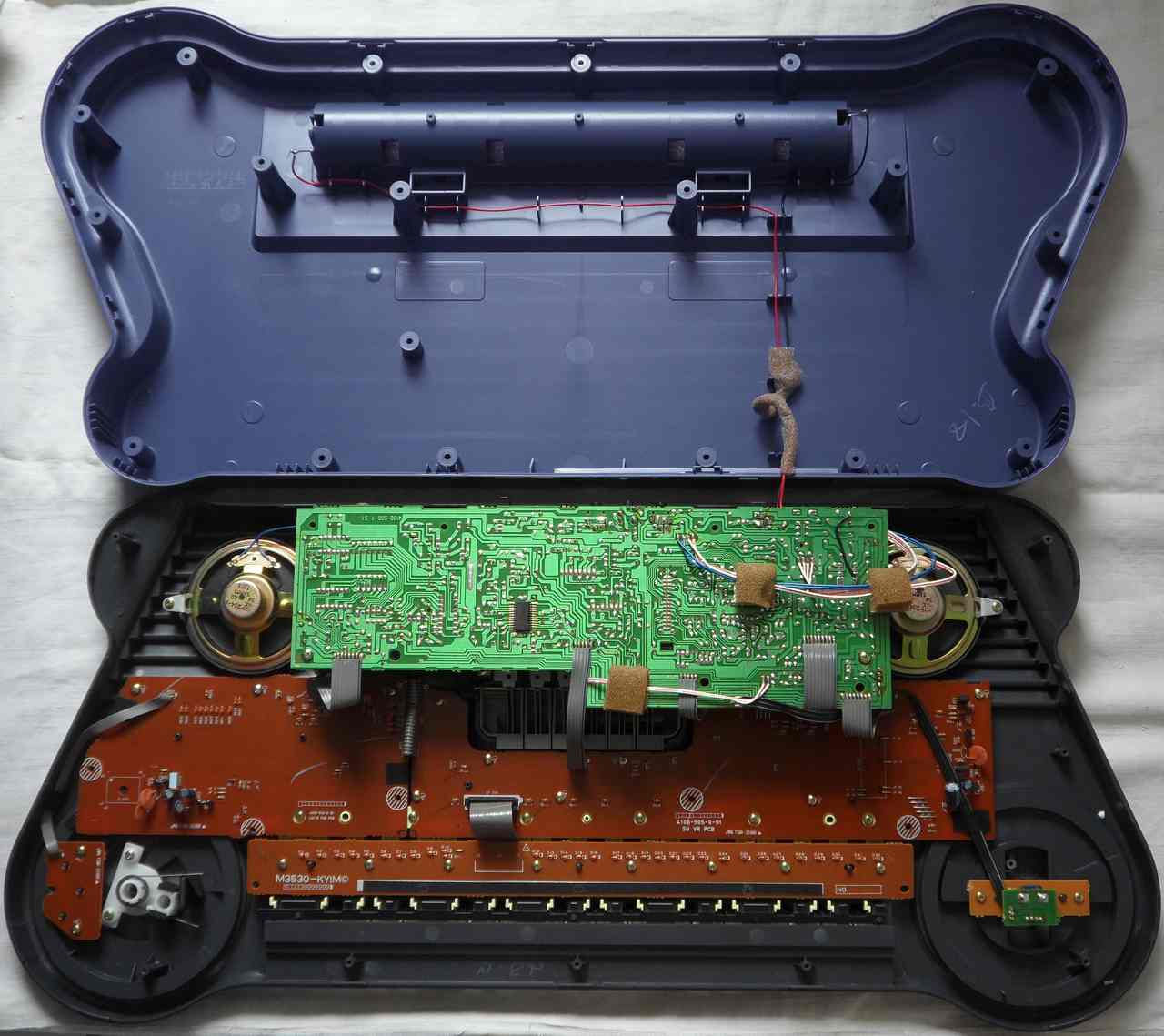
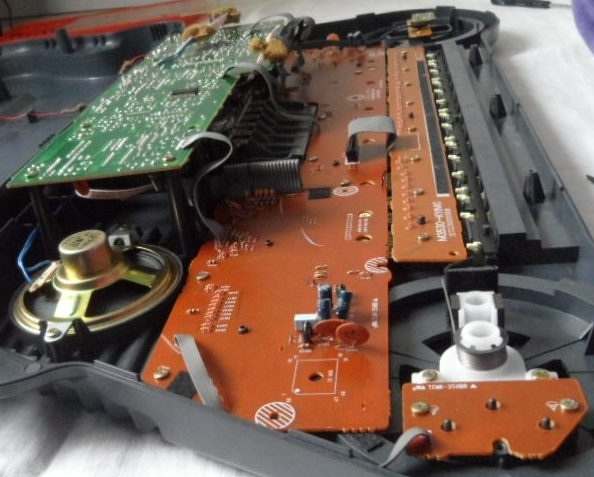
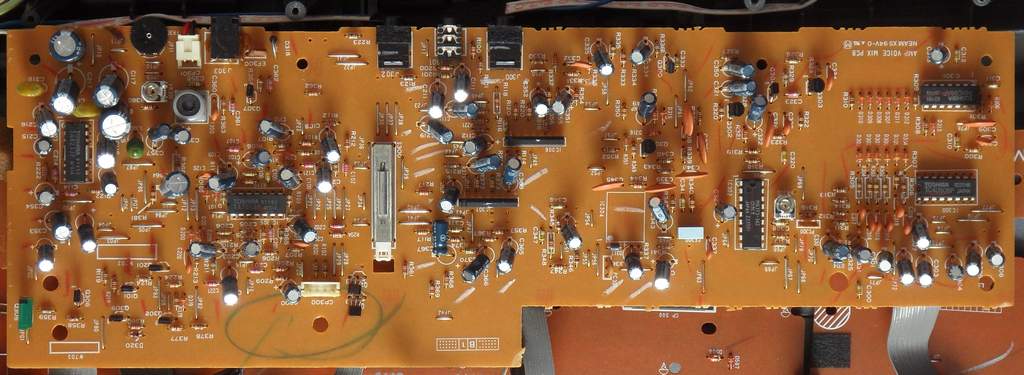
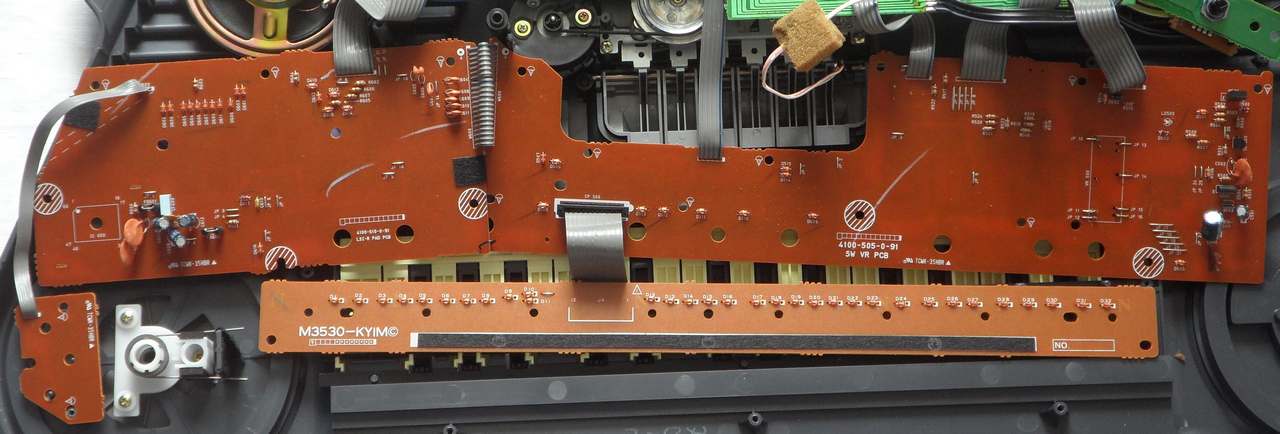
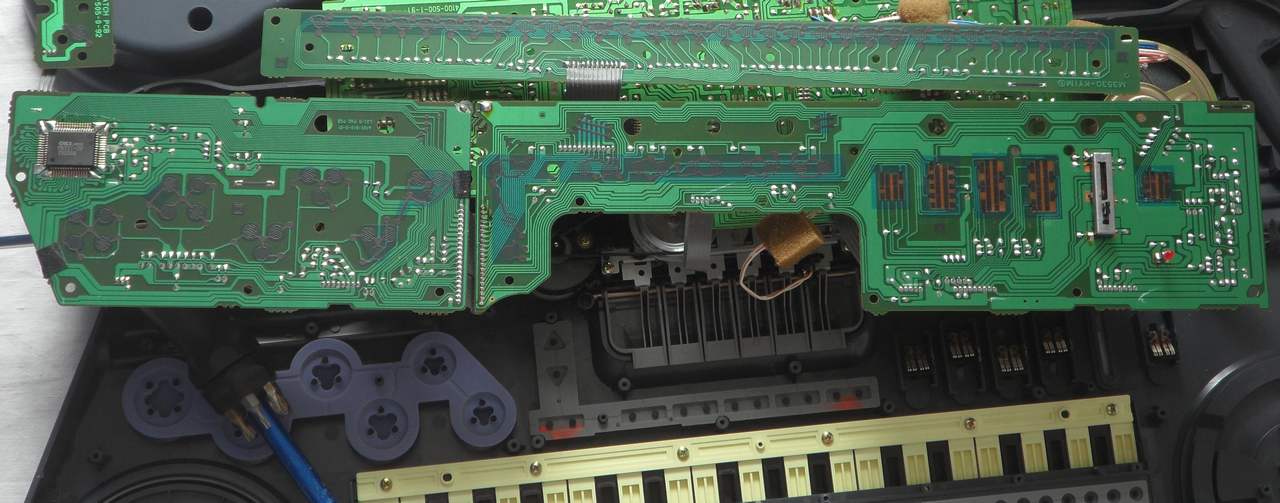
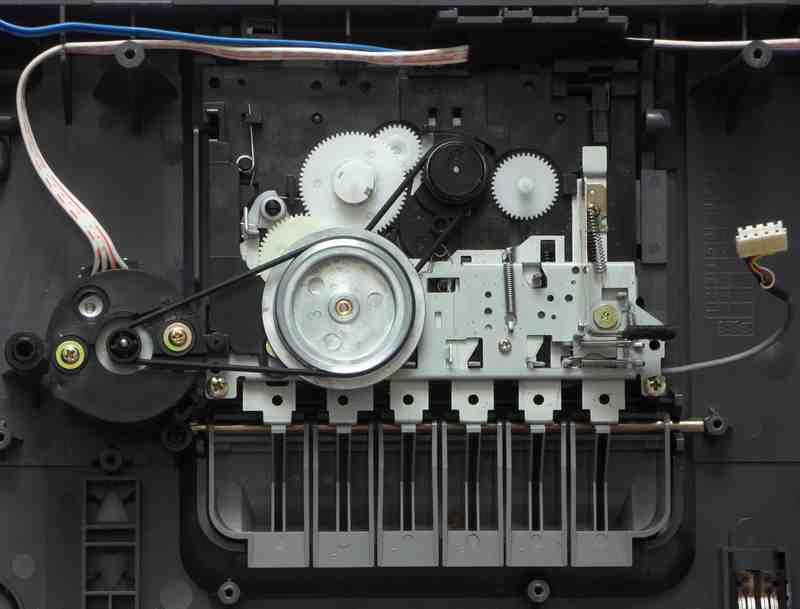
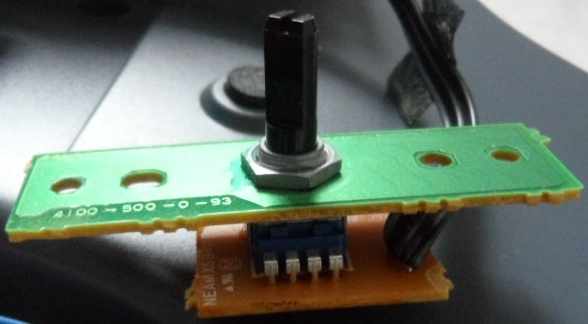
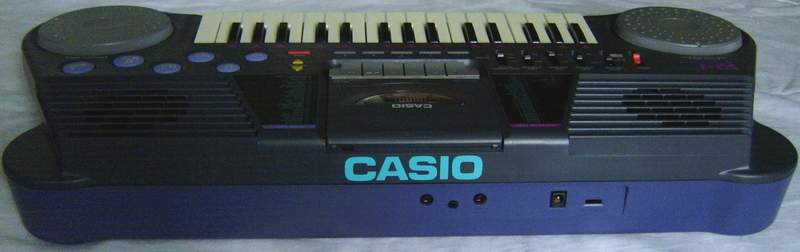
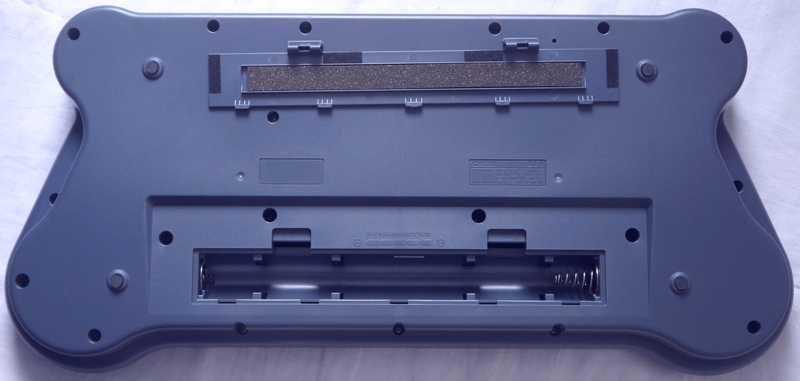
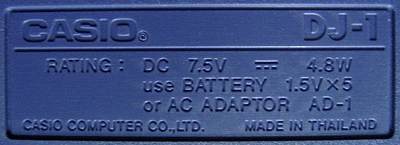
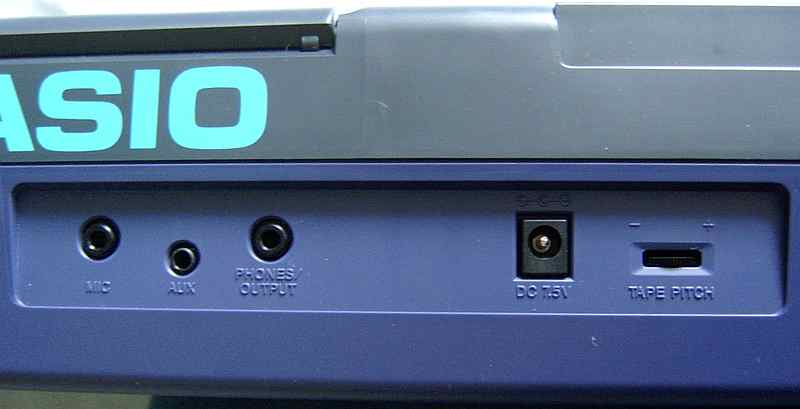
hardware detailsThe Casio DJ-1 is built around the CPU "OKI M6521-09" (crystal clocked at 21.725 MHz). But drumpads and right scratch disc are handled by a selfcontained sound IC "OKI M6373-342" that has no digital connection with the rest. Its clock rate is controlled by the potentiometer of the left scratch disc. Also the voice changer IC "OKI M6322" is clocked by its own 4 MHz crystal and runs independently.
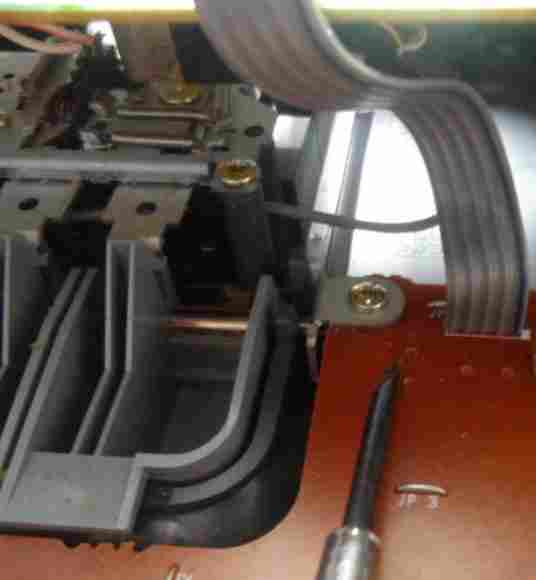 The
hardware is fairly complicated with much cable mess inside, but most of
the analogue section is occupied by the cassette recorder. To reach the
main voice CPU, only unscrew the left PCB; you don't need to dismantle
the rest. If you need to flip or remove the center (analogue) PCB, the
cassette drive cables are too short. But you can unscrew its leaf switch
("play" contact) and unplug the tape head cable on PCB without desoldering. The
hardware is fairly complicated with much cable mess inside, but most of
the analogue section is occupied by the cassette recorder. To reach the
main voice CPU, only unscrew the left PCB; you don't need to dismantle
the rest. If you need to flip or remove the center (analogue) PCB, the
cassette drive cables are too short. But you can unscrew its leaf switch
("play" contact) and unplug the tape head cable on PCB without desoldering.
The drumpads IC OKI M6373 was used in a similar way in Casio PA-31. The behaviour that the only 3 note polyphony is reduces to 1 when rhythm plays (no matter whether the selected rhythm makes use of the 2 occupied melodic voices) is a sign of very poor software design. See Rapman RAP-1 how it is implemented in a surprising way. keyboard matrixThe keyboard matrix is identical with RAP-1 (see there) and so has the same eastereggs.While the DJ-1 effect pads and scratch disc are not connected to the CPU at all, as eastereggs you can still find from RAP-1 the native 3 drum-/-effect pads, fake scratch disc and 3 inofficial drumpads with variation button. 2 of their percussion sounds differ. In variation mode and inofficial drumpads instead of rimshot there is a tinny toy drum (or timbales?). The cowbell has been replaced with a much duller and weaker variant (like muffling a cowbell with hands); I am not sure if this shall be a woodblock (it's still rather metallic), bongo or just a residue by replaced internal waveforms. The sound is not part of the 2 keyboard drumkit modes. pinout M6373The "OKI M6373-xxx" (18 pin SMD, xxx = software number of internal ROM) is originally a documented mask rom speech synthesizer IC (datasheet "OKI MSM6375/4/3/2-XXX"), that was used in Casio toy-like instruments to play preset samples on drumpads and fake scratch disc. It uses 4-bit ADPCM and has a built-in 12-bit DAC. It can be controlled by a host CPU through a digital protocoll or run standalone ("SW interface", e.g. when wired to drumpads). In CPU mode it can work 2-note polyphonic and has volume control, and additionally it contains a beep tone generator (8 tones,4 durations). But these features are likely controlled by internal ROM and can not be accessed externally. The 3 clock pins can be wired in different way, depending on use of a crystal or RC oscillator. Of this IC exist variants with different ROM size and with 24 pins.M6375-xxx = 1 Mbit
|
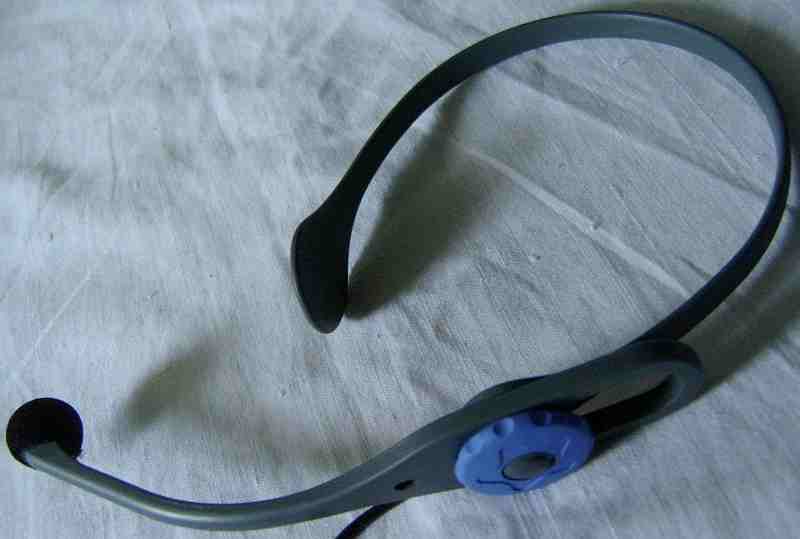
If you enjoy these keyboards voice changer, also look out for the great
Casio
VA-10, which is a synth-like small home keyboard with digital effect
processor for the internal keyboard sounds and monophonic microphone input
(stereo reverbs, pseudo- vocoder and much other strange digital stuff).
The sound quality is not really better than Rapman, but way more
versatile and polyphonic.
| removal of these screws voids warranty... | ||
 |
 |
|
|
|