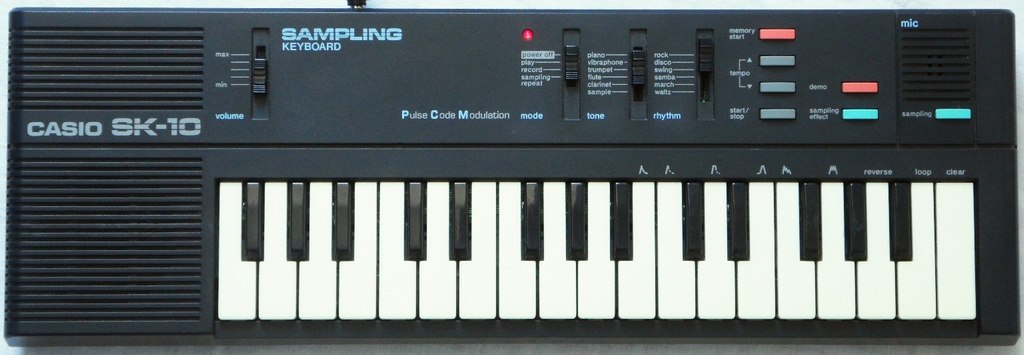
This mini keyboard from 1987 (embossed case date) was basically a simplified toy variant of the wonderful Casio SK-1. Unfortunately it has way less features; there are only each 6 preset sounds, rhythms and volume envelopes on it, and sample memory is only 0.6s. It has also nice Disney cartoon theme demos and the bizarre "sampling repeat" mode, which continuously picks up the first noise it hears and plays a randomly selected jingle from it.
Unlike SK-1, it has neither synthesizer nor accompaniment, nor a portamento button etc., and there is only a record/ playback sequencer instead of the complex 3 track sequencer. At least you can play to it. Strange is that the user interface and main voice samples correspond to Casio SK-8, but it has the same particular blip percussion like the SK-1. The rhythm patterns resemble none of them.
 |
 |
 |
The 6 main voice preset sounds correspond to the same sounds on Casio SK-8. They are based on medium resolution samples and sound quite natural. When no sample is in the memory, it plays the "pipe organ" timbre of SK-8 instead.
The sampler can store one low resolution sample. After pressing "sampling", it records 0.6s from the internal microphone and then indicates its success by playing a fanfare of the just recorded sound. (The SK-8 plays only an open cymbal instead.) The "reverse" effect takes some seconds (indicated by knocking metronome and cymbal) computing time.
When the "mode" slide switch is set to "sampling repeat", it will immediately record the next noise it hears and play one of 16 randomly selected preset jingles from it. (Some also include percussion.) After its finish it listens again and so on. (You can not play keyboard in this mode, and auto power-off is disabled.) This concept strongly resembles a certain type of interactive electronic art installations, those continuously modify and play back the sounds of the museum visitors to interact with them. It is certainly also interesting for fans of alleatoric instruments. When you switch back to normal "play" mode, the last sample from it stays in the memory.
The sequencer can record all notes, sound changes and rhythms. To record
a sequence, set the mode switch to "record" and press "memory start". So
far no rhythm is running, it will play a metronome now. You can now play
your sequence. Also preset sound and rhythm changes will be recorded. To
finish, press "start/ stop" or set the mode switch back to "play"
mode. To play your sequence, press "memory start" in "play" mode. It will
now play the sequence in a loop; you can even play another voice (but no
rhythm) to it on the keyboard and you can retrigger the running sequence
at any time with "memory start" or change the tempo. To stop it, press
"start/ stop".
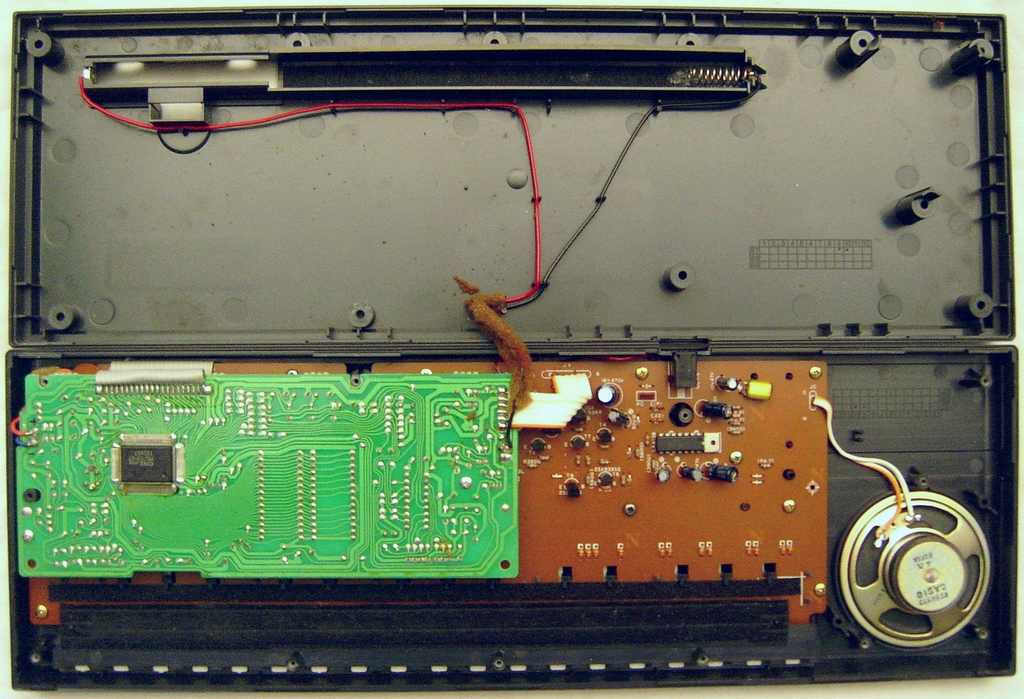
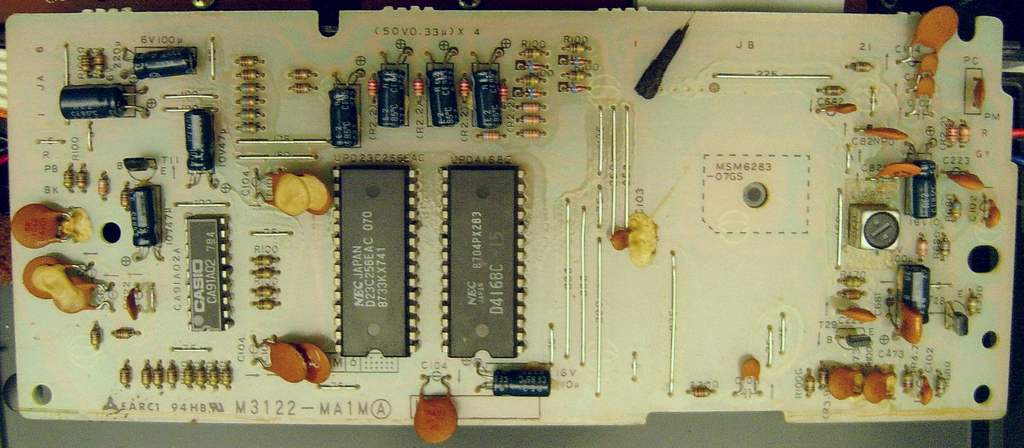
circuit bending detailsThe Casio SK-10 has multi-chip hardware based on the CPU "OKI M6283-07" with additional 32 KB ROM "NEC D23C256EAC 070" (I dumped it) and 8KB DRAM "NEC D4168C -15". The VCA IC "CA91A02" merges each waveform output with the corresponding envelope signal.
keyboard matrixThe matrix layout has strong similarities with Casio SK-8 but the matrix eastereggs are rather boring. It contains 16 empty places and several doublets, which makes me conclude that much SK-8 stuff was removed from the 32KB ROM to make the long demos and jingles fit. There is even a completely unused matrix out (pin 65 KO11 has signal but does nothing).
The input lines are active-high, i.e. react on +Vs, thus any functions
are triggered by a switch in series to a diode from one "out" to one "in"
pin. All unknown function names and in/ out numbers in this chart were
chosen by me. Despite sliders, the preset sound and rhythm places need
no locking switches. I had written down the rhythm order wrong and forgot
to mark which were doublets; I later fixed these by panel PCB photos. In
'sampling repeat' mode most matrix outs are turned off; only KO9 stays
pulsed. In 'power off' mode the CPU is so hum sensitive that touching KI1(?)
will turn it on.
eastereggs:There is an additional rhythm (foil cable pin 17->7 when rhythm slider in intermediate position) and the 'pipe organ' preset sound can be still selected when it is replaced by the sample (foil cable pin 12 ->6 when sound slider in intermediate position). A sample pad (unused solder pad at CPU pin 68 KO8 through a diode -> foil cable pin 5) can be added to trigger the sample like a drumpad. Connecting that solder pad to foil cable pin 2, 3, 4 instead plays a fixed 'organ' tone, which makes me conclude that the CPU was originally designed to support 4 samples. |
The 4 demo melodies of this instrument are:
Another case variant of the SK-10 was released as Casio SK-2
(with 2 speakers, but lacks "flute" preset sound by omitted button). Apparently
a toy variant with blue Casio
EP-20 case was released as Casio EP-30 (with "Kermit
the Frog" logo, green sharp keys, seen on Retro Thing
site).
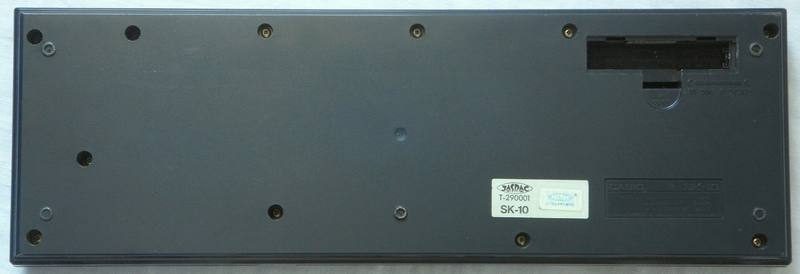
| removal of these screws voids warranty... | ||
 |
 |
|
|
|