 |
 |
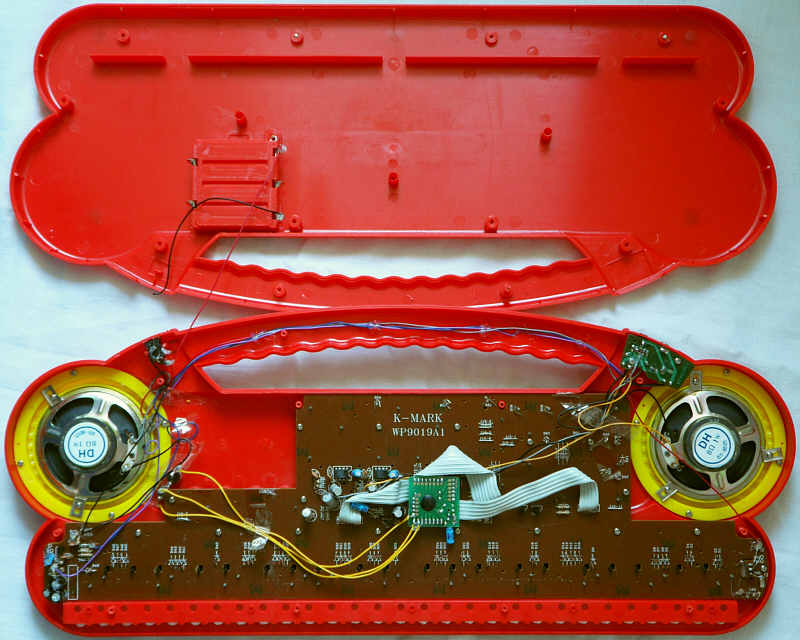
| K-Mark
WP9019A1 |
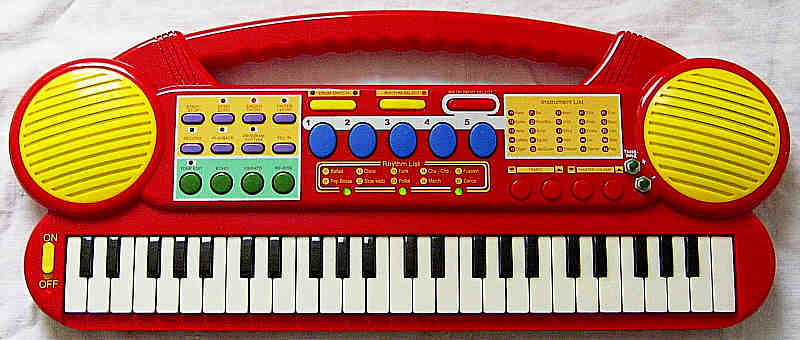
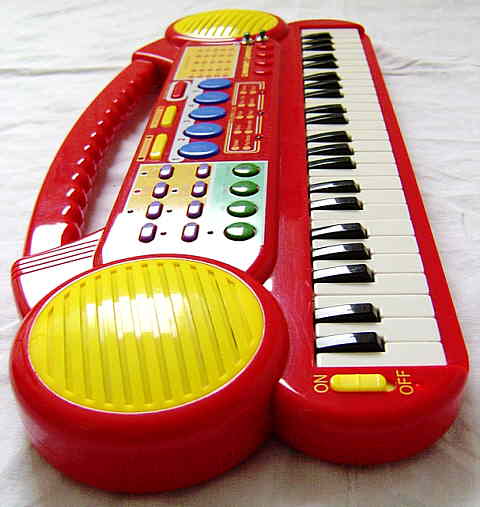
small keyboard with 49 mini keys, programmable rhythm and accompaniment |
Although this pretty red mini keyboard looks like one of the many My Music Center successors, the sound quality is much higher and it has 49 mini keys with 4 note polyphony, real accompaniment, programmable rhythms and sounds based on quite natural medium resolution samples featuring an astonishingly realistic piano.
|
|
 |
 |
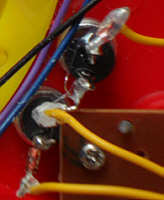
polarity protection diode added, AC- adapter jack polarity corrected. transpose +/- buttons added.
The effect sounds of this instrument sound way less extreme than with the Sankai, which makes them more standard but also more boring. The "echo" is like with Sankai, but the vibrato has only normal depth and doesn't howl extremely in the bass range. Also the "reverb" here adds only a mild and slow stereo symphonic effect which mainly consists of panning with a small dose of phasing but with a way less extreme detuned chorus component. To use the 3 effect buttons, here first the "tone edit" button needs to be pressed (LED lit, doesn't work with rhythm).
The rhythms here are selected by entering a numbers with the drumpads
and then pressing "start/ stop". The accompaniment is always turned off
when the rhythm is stopped with that button, but unlike the Sankai,
here a different rhythm can be selected without stopping accompaniment
by entering its number. Confusing is that the LED at the "rhythm select"
button is lit when a rhythm plays instead of indicating that this button
is currently selected (i.e. drumpads enter rhythms numbers). Here also
during rhythm most button presses make a beep, which is annoying during
live performance. The drumpads here offer 2 banks of each 5 percussion
samples (indicated by 2 LEDs) those can be used to program the user pattern
of the custom drummer. While the "tempo" LED of the Sankai doesn't work,
this instrument has even a chain of 3 green flashing LEDs (similar like
e.g. Yamaha MK-100 or Fujitone
6A) to indicate the rhythm bars.
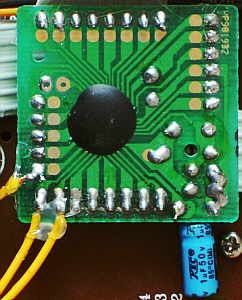
circuit bending detailsThe K-Mark WP9019A1 keyboard is based on the single chip CPU "P901982" (crystal clocked).
CPU pins count anticlockwise. from the lower left corner. The input lines are active-high, i.e. react on +Vs. Any functions can be triggered by a non- locking switch in series to a diode from one "out" to one "in" pin. synchro & transpose button The 'transpose' +/- buttons are connected from CPU pin 27 to pin 1, 2. An additional "synchro" button can be added from pin 27 to pin 8. |
The 2 demo tunes are nicely arranged. The first song is a western style ragtime/ charleston piano tune with violin. The 2nd seems to be "Polly Wolly Doodle" ("Hooray, Hooray - It's the Holi- Holiday" known from the pop band Boney M) with a jazzy oboe improvisation.
The direct predecessor of this instrument (same case but no accompaniment etc.) was apparently the Quelle 496.996 0 keyboard.
Question: Does anybody know the
original trade name of the K-Mark WP9019A1 keyboard? I saw this
apparently quite rare thing only a few times on eBay (I bought mine
before the Sankai 01504H), but yet never with a model name.
| removal of these screws voids warranty... | ||
 |
 |
|
|
|