|
|
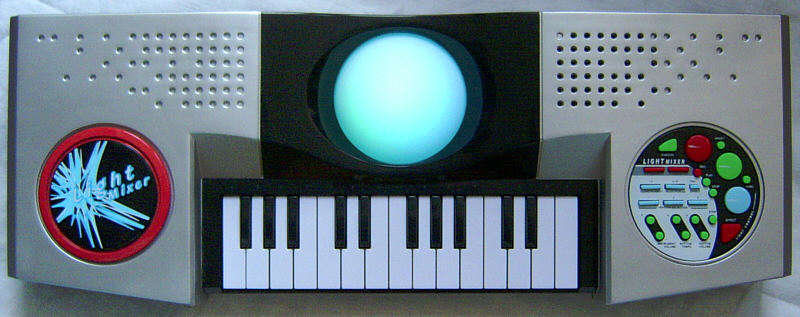
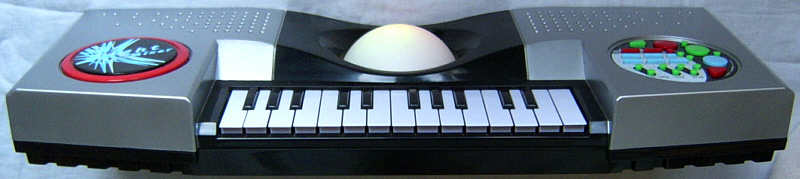
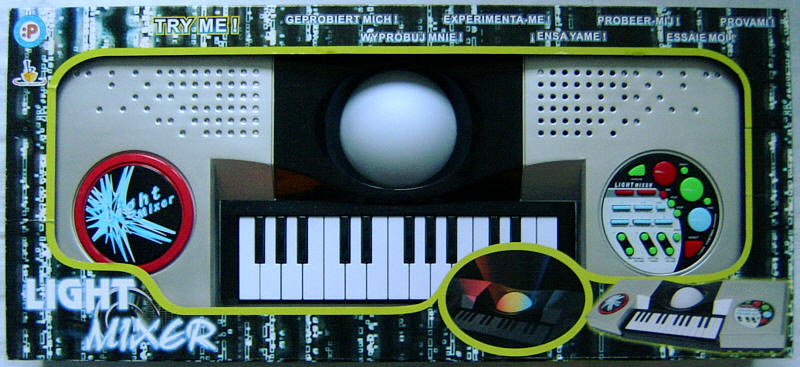
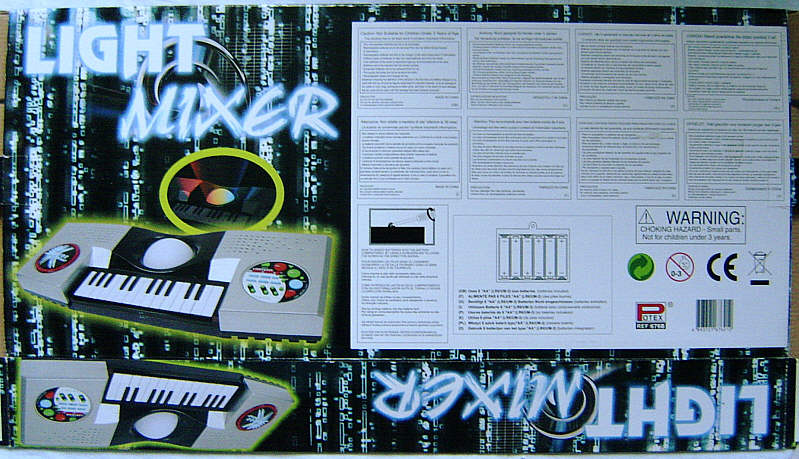
This is another stylish tekkno toy tablehooter by Potex; its sci-fi retro design looks straight like an item from the classic Star-Trek or Space Patrol TV series. It has many sound effect samples and lo-fi background preset music pattern loops, but the most spectacular feature is the RGB colour changer globe with many different programmable light effect modes.
 |
 |
Annoying is that the digital volume control responds quite course, can not be set really low and the instrument always switches itself on with a loud startup drum pattern as soon any key or button is pressed, which makes the so-called power on/off buttons pretty useless. Generally the user interface has some flaws and can totally lock up by pressing the wrong button. But the sounds are partly even fairly warm and bassy and include a couple of nice retro timbres.
 |
 |
 |
 |
 |
 |
 |
 |
 |
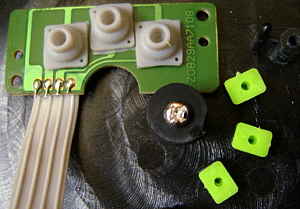
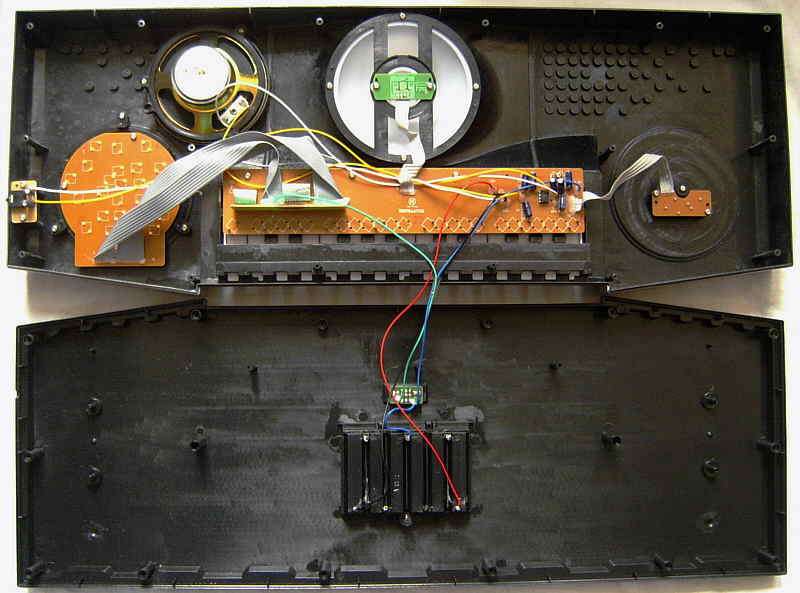
scratch disc contacts |
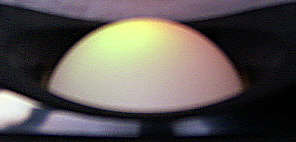
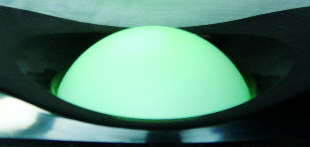
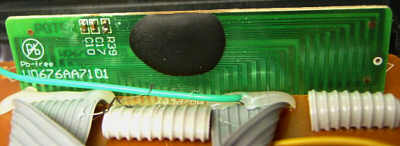
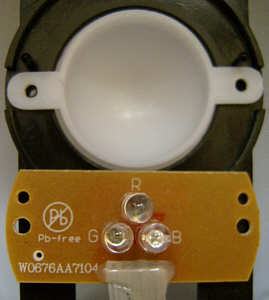 3 LEDs inside the lamp globe mix RGB light.
 |
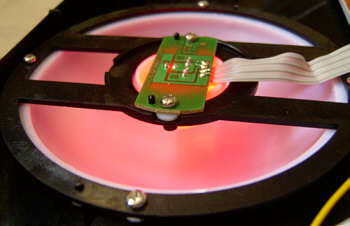 |
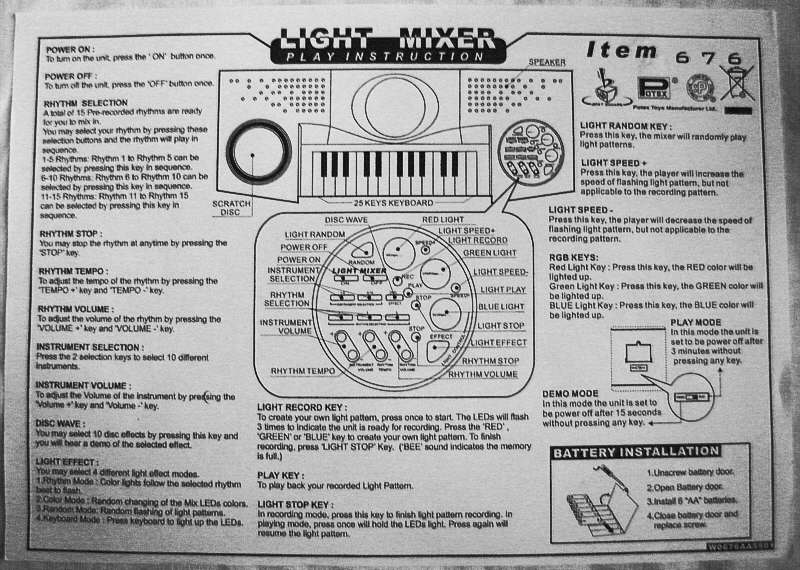
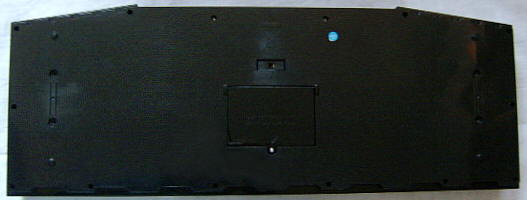
After power on or touching any(!) key or button, the instrument wakes up from standby with a drum pattern at full volume (that can be truncate by turning the scratch disc). On the case bottom is a demo/ play switch, but it only switches the auto power-off time between 16s and 3 minutes. A real power switch would have made much more sense. So long the instrument is on, the light globe flashes in all colours. The colours switch with about 4Hz, or in the tempo of the running rhythm when on, but it can be switched into several other modes. The loudspeaker makes some bass and sounds quite good for such a cheap sound toy; of course it rumbles a bit when loud, but I have heard much worse ones. Unfortunately their is no sound output jack, and all buttons beep or play the selected sound, which disturbs live performance. The beep even ignores volume setting and always stays fairly loud. Generally the user interface is no great design. Starting or switching any "rhythm" switches tempo and rhythm volume back to default (quite loud). Many preset functions are stepped through by a group of multiple buttons those each cycle through a subset of them. Unfortunately each button in the group invisibly remembers the previous item number it was stepped to - even when another button of that group was used later; this complicates the use, because each button does not always start with the same item. The CPU even completely locks up when you try to play a recorded light sequence after the instrument was powered off; you have to unscrew the battery cover and take batteries out to get it to work again.
The keyboard preset sounds are plain low resolution samples and sound quite bright, grainy and a bit thin. They are all quite short (maximum about 1s) and unlooped samples, have a key split zone in the middle and ignore key press duration. Nice is that when a key is trilled, each new note occupies a new sound channel, which produces a nice phasing sound and volume increase effect although this eats up polyphony. The sounds have only numbers instead of names thus all sound names were chosen by me. "piano" is an acoustic one. "orchestra hit 1" is a percussive major chord sound; it somewhat resembles a slap bass noise that was turned into a chord by a harmonizer. "string" is a synth chorus timbre that reminds to bee buzz, "jazz organ" is a dull electronic organ timbre with semi- percussive attack; lower keyboard half is more sonorous, while upper half sounds like plain squarewave with chorus. It sounds nicely antique, and the fixed note duration gives it a special trashy appeal. "synth meow" is a resonant filter sweep timbre that goes "meow" with slightly bubbling attack. "leaf spring" is a dull and resonant spring- like noise; it slightly resembles "frog" on Casio MT-60, although it is less dry with a duller bass range and somewhat reminds to a buzzing ruler on a table or a chirping locust. "e-guitar" is a distorted lead guitar timbre. "orchestra hit 2" is a string orchestra sound. "string down" is a squeaking kind of violin that pitch bends down. "buzz spring" is a more massive variant of "leaf spring", that reminds to a circular saw.
The "rhythms" are genuinely loop samples and include a lot of complex tekkno synth patterns. Setting rhythm volume low strongly reduces their bit resolution, which can be used as a sound effect. The "rhythm" pattern loops are:
1:
tekkno with fat base and "synth parrot voice"
tekkno with "a ahaa!" vocoder voice
funky e-bass + flute + drums
thin distorted drum kit snap
walking e-bass reggae pattern
eurobeat(?) with piano + e-bass
2:
piano + e-bass boogie (or bluegrass?)
fat latin breakbeat with drumrolls + quiet voice
acid house
fat tekkno beat + distorted TB-303 toot
eurobeat(?) disco loop with synth chorus
squarewave synth + bass + clap
3:
orchestra hit staccato + acid bass
distorted tooting e-guitar rock
oriental flute + drums + clap (jerks, breakbeat?)
distorted synth ring oriental tekkno + orchestra hit
warm C64 disco bass pattern
bright harpsichord + distorted latin percussion
The scratch disc can be switched through 10 preset samples using the "disc effect" button, but only the clockwise sound changes; the anticlockwise one stays "clap". Only when the clockwise sound "clap" is selected, the anticlockwise one becomes "synth ring". The presets contain beside scratch sounds various videogame- like laser zap noises.
The light mixer has 4 modes:
rhythm mode:
Colour switches synchronized with the rhythm (behaves like "colour
mode" with rhythm off).
colour mode:
Colour switches randomly at fixed speed.
fade mode:
Light fades between different colours and dark. The pulse width dimmer
algorithm flickers a bit and mixes a quiet grainy buzz noise into the sound
(which can be used as a tekkno sound effect).
keyboard mode:
Colour corresponds to the last played note; the keys from left to right
show alternatingly red, green, blue, red, green, blue and so on. The mode
behaves like "colour mode" when no key is pressed for 6s.
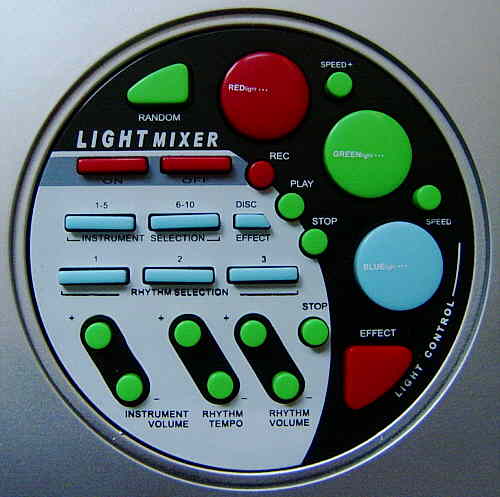 The
"effect" button cycles the mode through {fade, rhythm, colour, keyboard}.
Selecting the keyboard mode can be identified because the lamp goes out
for some seconds when no key is pressed. The "random" button makes the
light automatically toggle every 10s between fade and colour mode. The
tempo can be changed with the "speed" +/- buttons, and the "light stop"
button (the one below "play", not the "stop" button of the rhythm section)
can freeze the actual colour at any time; a 2nd press continues the effect.
By holding any of the 3 RGB light pads you can instantly change the light
colour to the one of that button; holding multiple of them mixes their
colours. The
"effect" button cycles the mode through {fade, rhythm, colour, keyboard}.
Selecting the keyboard mode can be identified because the lamp goes out
for some seconds when no key is pressed. The "random" button makes the
light automatically toggle every 10s between fade and colour mode. The
tempo can be changed with the "speed" +/- buttons, and the "light stop"
button (the one below "play", not the "stop" button of the rhythm section)
can freeze the actual colour at any time; a 2nd press continues the effect.
By holding any of the 3 RGB light pads you can instantly change the light
colour to the one of that button; holding multiple of them mixes their
colours.
To record a light sequence, press record. The globe will flash white 3 times. You can now enter your sequence in realtime with the light pads. (You can press multiple pads for mixed colours, but unlike in fade mode, there are no different brightness levels available. The memory holds only 8 steps and the pads sound a beep when the memory is full.) Press "light stop" to finish. Press "play" to start the light sequence in a loop. To stop it, press "light stop". Annoying is that the speed buttons don't work with the sequencer. Also the timing resolution is very coarse, which makes the result a little random. The only good thing is that all sound related keyboard functions (rhythm etc.) work well also in record mode. |
caution: Do not press "play" after
the instrument was switched off. Else it can lock up and you have to take
the batteries out to turn it off and get it to work again.
| removal of these screws voids warranty... | ||
 |
 |
|
|
|