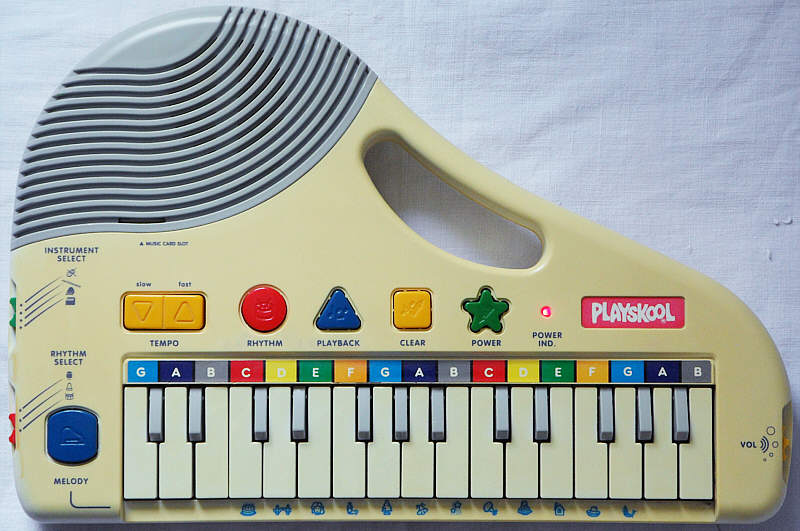
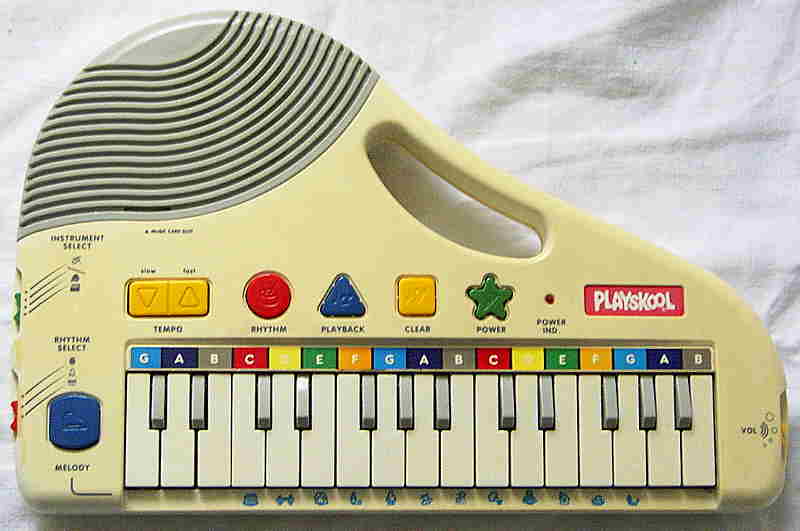
This monophonic toy keyboard from 1993 has nice POKEY rhythm and many sound similarities with the great Hing Hon EK-001. Unfortunately only 3 rhythms can be selected by hand, despite its demo tunes contain many additional rhythms.
 |
 |
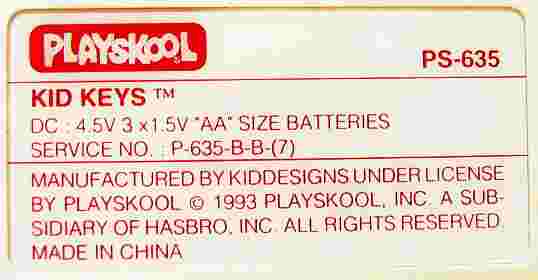 On
the type label stands: "Manufactured by Kiddesigns under license
by Playskool © 1993 Playskool. Inc. a subsidiary of
Hasbro.
Inc. all rights reserved. Made in China." On
the type label stands: "Manufactured by Kiddesigns under license
by Playskool © 1993 Playskool. Inc. a subsidiary of
Hasbro.
Inc. all rights reserved. Made in China." |
The percussion sounds very electronic and extremely impulsive and are best comparable with Atari POKEY chip sounds. They all use digital envelopes and either squarewave or shift register noise. The cowbell (squarewave with digital envelope and zipper noise) sounds like a bottle hit. The snare uses a very rough and impulsive hissing shift- register noise (like a historical videogame's MG shot), the hihat uses a quieter hiss. The base is just a quick fading squarewave. These percussion in spite of their basslessness sound incredible vigorous and are an as outstanding sound discovery as the nowadays so well known and everywhere imitated TR-909 base drum. They slightly differ from EK-001 by shorter envelope and duller timbre, which may be result of even lower envelope DAC resolution. Strange is that in rhythm patterns the accents of individual beats seem to change with tempo settings, i.e. individual drums turn louder or quieter in an irregular order, which is not proportional with the selected speed.
The 12 demo tunes use many additions rhythms, thus it may be possible to enable these also for manual play as keyboard matrix eastereggs. Likely it is at least easily possible to add a switch or potentiometer to disable the main voice during the demos to use their rhythm track as a drum machine. (I haven't analyzed the hardware closer yet.)
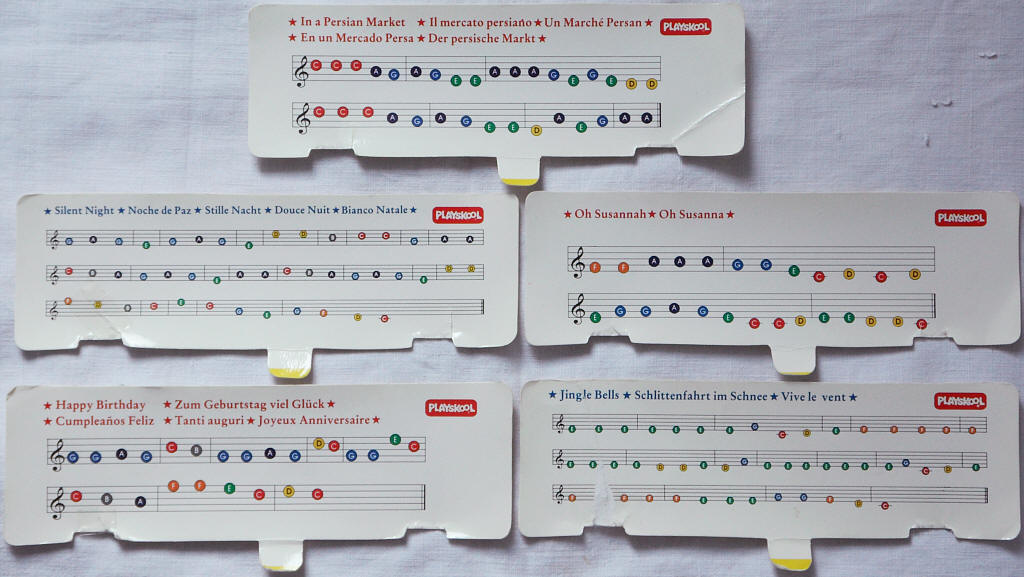
The 12 demo melodies are simple monophonic monotos (short melody loops) those employ the currently selected main voice sound but each of them has its own rhythm. Their primitive repeating sound style and song set resembles the melody IC of transistor tooters like Golden Camel-7A , so it may be that both chips were designed by the same people.
The demos are:
|
 |
 |
 |
The sequencer is a similarly banal thing like with My
Music Center, but in opposite to the latter this one is always
recording the notes you play (until the memory is full, but no pauses),
and it does not loose its contents unless "clear" is pressed. Even powering
off into standby mode (it has a button instead of a power switch) does
not clear the memory contents. The playback speed can not be changed with
the tempo control.
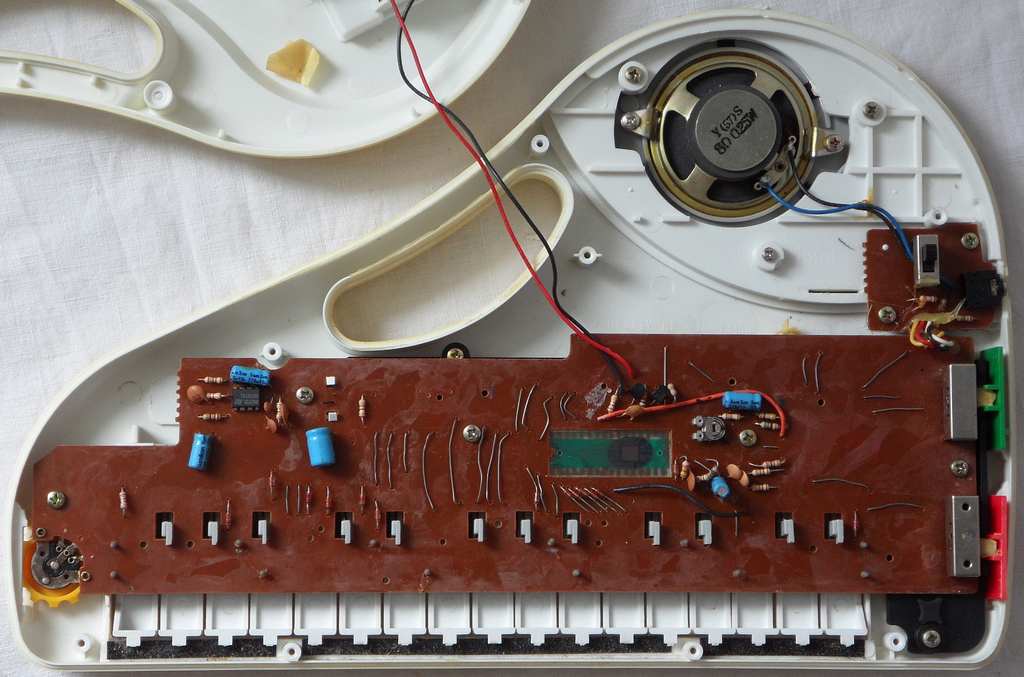
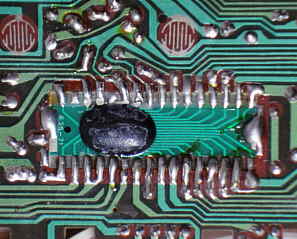
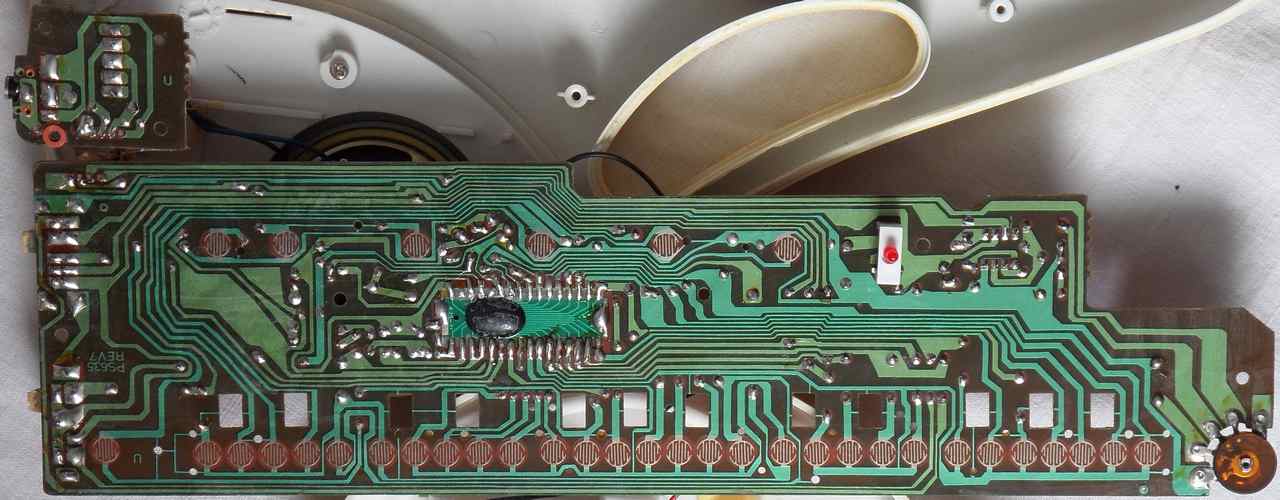
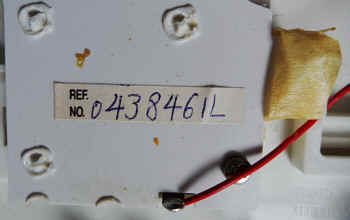
circuit bending detailsThe Playskool PS-635 is build around a single chip CPU. Mine (PCB revision "PS635, REV7") has a 32 pin DIL-shaped COB "635-21", but older versions have the same chip in a 40 pin DIL package "PWH635" with additional unused pins, those are even more interesting for modification. Thus if you want to buy one for upgrades, check the model plate at the case bottom. Mine has "SERVICE NO. P-635-B-B-(7)" and only 32 pins. Traktor ("T-150") told me that his 40 pin version was labelled "P-635-B-A-(7)".
Nick Santos sent me an e-mail with the following hardware tips about the Playskool PS-635, which apparently refers to the 40 pin version: "Although I am still in the experimentation and documentation stage of this bend I have found some promising bends. As you may have noticed, pins 10-26 seem to deal with they keys and buttons of this device. I saw that pins 10 and 12 were being used but pin 11 was conspicuously unused, I used some wire and probes and proceeded to connect pin 11 to the other key control pins with pleasing results pin 11 connected to pin 15, 16 17 or 18 will produce the kick, cowbell, loud snare and soft snare respectively. When pin 11 is connected to pins 21-26 it will produce lower pitch notes that were not included in the design. You mentioned that you would like to use the pre programmed rhythms and cancel out the main instrument voice, I have discovered how to do this as well. Connect the pin nearest the headphone jack of the capacitor nearest the headphone jack, to pin 1 of the instruments main chip, this will completely cut out the main voice and leave the rhythm (if you attach to the wrong pole of the capacitor a very faint main voice will remain) to do the opposite and strip away the rhythm from the songs connect the same pin of the capacitor to pins 5 or 6 of the main chip (it will also boost the volume).Traktor told by e-mail that there are plenty of additional hidden rhythm pattern variants. multipulse squarewave tone generatorWhile the technology is the same like in EK-001 (see there), interesting is that many multipulses differ. (I tried inverting and rotating, but they won't match.) So the 'piano' waveform is more complex, and the 'guitar' is less harsh and closer to an acoustic one. Some multipulses have a strange dot (short dropout to lo) in their hi section. I expect this artifact to be caused by restarting the address counter at the begin of the loop point. Thus I have visually rotated these patterns to shift the dot (marked ".") to their end. (Other multipulses likely have it at a lo section, where it stays invisible.) Because the patterns are complex, the exact section lengths are hard to see on an analogue oscilloscope. Particularly with 'piano' I am not sure, but it definitely differs from EK-001. The 'horn' is still a 3:5 squarewave, only inverted and here rotated to move the dot to the end. The 'banjo' also here has mandolin ring.What I identified as 'guitar' corresponds to 'piano' in MS-210B (see there) so it may be considered piano by the manufacturer. But IMO it sounds much more like an acoustic guitar than like the piano of EK-001 or an actual piano. The multipulse bit loops look like this:
On the PCB is a tuning trimmer that adjusts the clock rate. By a strange glitch the accents of individual beats in rhythm patterns seem to change with tempo setting, i.e. individual percussions sound louder or quieter, which is not proportional with the selected tempo speed. Because (unlike EK-001) each percussion generator channel here is shared by 2 sounds, it may be that at certain speeds the accent bit is read or cleared in wrong order and so affects wrong percussion sounds. It also may be related with binary interactions of internal counters, in a way that e.g. the percussion envelope decay counter at certain tempo settings gets decremented already before the first waveform bit is output, making that step in the rhythm pattern sound quieter. keyboard matrixIn opposite to EK-001, the keyboard matrix here also includes the piano keys itself and not only panel buttons, and there are lots of eastereggs. This matrix was based on the Yongmei MS-210B schematics and details corrected by me. The rhythms were identified by comparison with EK-001. All sounds were identified by ear and named after similar sounds of EK-001. The 'piano' setting of PS-635 seems to actually select the 'guitar' preset sound in the matrix, but it may be that the manufacturer messed things up since 'piano' in MS-210B (default after reset) is identical.Because I do not own the 40 pin CPU version, row C4 is a guess based on that schematic and what Traktor told by e-mail. Theoretically also in the 32 pin version it may be possible to simulate the missing C4 signal by using the rising edge of the previous matrix out lines (likely C3) to turn a flipflop on and the falling edge of the next line (likely C5) to turn it off. But I haven't tested this by myself, so there may be timing issues or other problems to solve to make it work. For adding preset sound switches, it is important to disconnect the
line (cut or desolder the bridge) of the switch to CPU pin C6, because
the slide switch has no intermediate open position and thus always shorts
nearby pins.
The input lines are active-low, i.e. react on GND. Any functions can
be triggered by a non- locking switch in series to a diode from one "in"
to one "out" pin.
important: Because pinouts differ among CPU variants, in the following I refer the keyboard matrix pins by their "C" ("columns" = out pins) and "R" ("rows" = in pins) numbers found in MS-210B schematics. These are CPU pin names, not capacitors and resistors!
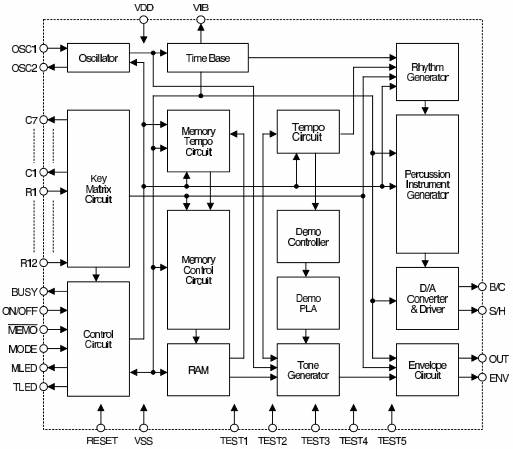
The sequencer is of little use, because it is always recording and so appends all played notes until memory is full, which is particularly annoying since it even keeps memory contents when powered off. Fortunately this behaviour can be changed. The sequencer memory write enable pin MEMO is connected to GND by a transistor (base pin through 10K resistor on BUSY pin) when the instrument is on. The transistor is there because MEMO apparently has to be set hi (or open) before power off, else memory may be overwritten with data mess. When open, played note will not be automatically recorded and also the clear button does nothing. Install a switch into the MEMO line (pin 7 of 32 pin CPU). So (with batteries inserted) you can keep a sequence in memory as long as you want. pinout PWH635, 635-21, 210, HT3421AThe LSI "PWH635" (40 pin DIL) and "635-21" (32 pin DIL-shape COB) are 2 package variants of the CPU of Playskool PS-635.The LSI "210" (32 pin COB) is the CPU of Yongmei
MS-210B, which is a rom variant of it. Only preset sounds, preset
rhythms and demo songs were changed, but behaviour stays the same. I later
found the datasheet of Holtek HT3421A ("41 Matrix Key Multi-Function
Piano with a Memory") of 1996-06-28, which is obviously a 40 pin DIL version
of the "210" and makes me conclude that this CPU was originally created
by Holtek. Their naming convention suggests that an alternative
name of the "PHW635" (different rom) may have been "HT3421" or had another
letter suffix. The Kiddesign - Barbie Music Center BE-630 (seen
on website, I don't own this) has drumpads and contains a different 34
pin(?) COB module (shape resembling 32 pin DIL with 2(?) additional pins
at its short ends).
Of the Playskool PS-635 I only own the 32 pin version "635-21", which has many pins omitted. So it lacks keyboard matrix out pin C4, VIB and both LED outs. My pin 15 has not even a trace to the chip and so is completely NC. My pin 7 (MEMO) seems to be sequencer memory write enable; it is connected to GND by a transistor (base pin through 10K resistor on the BUSY pin 10) when the instrument is on. The transistor is there because pin 7 apparently has to be set hi (or open) before power off, else memory may be overwritten with data mess. When open, played note will not be automatically recorded and also the clear button does nothing. Possibly a keyboard with 3 step slide switch was planned, that on positions 3 ('off') disconnects power and write enable. On position 2 ('play') it connects power to the amplifier, and in position 1 ('record') it additionally grounds the write enable pin. The use of that mode switch would work like in Casio VL-1. In MS-210B schematics I don't see that pin, but pin order corresponds to my PS-635. I later found in HT3421A datasheet that lo='memory' and hi='play' mode (needs locking switch). Pulling my unused pin 12 lo (tested through 1k resistor) switches power off after about 2..3 seconds. This is not by overload (I measured current), but likely an APO test pin that speeds up the internal timer counter for testing. Strange is that this pin (I name it TEST6) does not exist in any other version and is not even shown in the "HT3421A" die pinout (but there is enough space between pad 29 and 30 where I expect its position). The Playskool PS-635 of Traktor has the CPU "PWH635, 9136M" (40 pin DIL, seen on photo). "9136M" here may be a serial number, but because this is in the 9000th range, it also may be a chip type (e.g. an EK-001 CPU version is "9037" and the similar Superb Sound EK-210 CPU is "CIL-9038"). Traktor told me what his version's additional pins do. Regard that he is no electronics expert and has no oscilloscope, so his descriptions may be inaccurate. His pin 3 (TEST4) outputs pulses synched with the selected tempo. The audio he recorded from it (mixed with rhythms through a 100k resistor to the amp section) seems to be the internal step resolution (1/16?) of the rhythm patterns. Rhythms stops while pulled hi. Also pulling it lo stops rhythm, but first outputs some drum noises and makes all sounds change. Also touching with test cable triggers the same strange percussion timbre changes like the tempo control accent glitch. Shorting it with a clock pin through a resistor (which lowered pitch by a semitone) turns rhythm into strange jungle grooves. This makes me conclude that it is a tempo clock (test?) input that is internally connected to the tempo clock oscillator output (which speed is set by tempo +/- buttons). Perhaps this CPU was even originally designed to support here an external tempo oscillator (for tempo knob) but has that line bonded to an internal tempo oscillator (or enables that by software) to cut cost. So it might be possible to feed pin 3 with an external oscillator for freely adjustable tempo. But it may even be time multiplexed as a serial input to trigger internal functions in a certain order (like a keyboard matrix input), and so produces sound garbage when pulled lo. His pin 4 (TEST3) completely disables the sequencer (record and playback) while pulled lo. After release (pin open) playback works, but you have to press 'one key play' to make the record mode work again. The MLED led ignores pin 4, so it stays on also with sequencer disabled. (I conclude that this function was perhaps designed to disable the sequencer in CPU specimen with faulty memory to install them in keyboards without - much like Intel sold broken 4 core Pentiums as Dual Core etc.) His pin 7 (VIB) can be wired like in MS-210B, but the resulting vibrato is quite slow. So it may be that the CPU was originally planned for a higher clock rate. The HT3421A datasheet shows that at 512kHz clock rate the LFO is 4Hz. His pin 27 (TEST5) does nothing, but reverse diode test with DMM shows that it is internally connected. His pin 28 (TEST2) seems to activate a test mode for all kinds of functions. It apparently makes the 'one key play'(?) button cycle through different demos, notes, sounds, rhythms and tempos and even played sequencer memory with different preset sounds and together with percussion. When his pin 29 (MEMO) is pulled low, it starts recording into the sequencer. The last note played on the keys before enabling MEMO will become the 1st note of the recording. This can be prevented by pressing other sequencer buttons (e.g. 'one key play') before enabling it. HT3421A datasheet: "Connect this pin to VSS/VDD to work in either the memory or play mode." If hi or open, MODE switch toggles between play/memory. Touching his pin 30 with a test cable causes a very high pitched thin tone (self-oscillation??), that also interacts with the ENV pin (pulls it lo?). (I think this may be an internal analogue reference voltage for DAC or VCA that picks up keyboard matrix out frequency when touched.) The pin normally seems to be at about half supply voltage and freezes the sound when connected to ground 0V or +Vs. His pin 35 (MODE) is a memory write ('record' on/off) button input. It only works when pin 29 (MEMO) is not pulled low (e.g. open). So in the 40 pin version the locking MEMO switch is not needed to switch the sequencer on and off. After APO, this way recording is automatically turned off (with memory contents preserved). HT3421A datasheet: "Toggle select of play mode or memory mode. The system is in the play mode at power-on." In Yongmei MS-210B schematics the depicted circle (between B/C and VIB pin) stands for the empty hole in the COB PCB that is closest to the blob. It may be that this was originally meant to mark pin 1, but I consider counting anticlockwise from the corner after the biggest gap (with the screw between trace bundles) more logical as pin 1, thus the pin labelled "210" is pin 32. The VSS pin 30 (ground 0V) is placed here differently (skipping 2 pins), but the schematics shows a 2nd pin in its real place (where in PS-635 MEMO would be), i.e. likely the silicon die has multiple ground 0V connections or it was simply shorted with MEMO. I.e. in the "210" CPU unfortunately the MEMO pin was omitted (likely internally hardwired to ground), so its sequencer is always recording. Also the APO timer is still doing its job, despite by the missing /BUSY pin (how stupid is that?!) it can not turn off the amplifier. So there still is a slide switch and you additionally always have to press 'computer start' (aka 'on/off' button) to make the thing work. Possibly this chip was a pirated version of "PHW635" (with rom changed to enshroud this?), but the manufacturer did not know how to handle APO properly and so removed all pins he did not understand. |
A much better instrument with the same sound style is the Hing
Hon EK-001. Another monophonic instrument with multiple demos and
this sound hardware is the Yongmei MS-210B.
(Sorry, I initially confused its name with a wrong keyboard.) Someone e-mailed
me that another close variant was the Kiddesign - Barbie Music Center
BE-630.
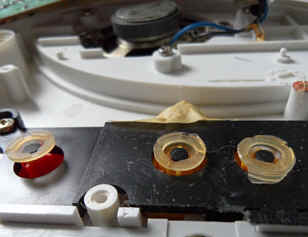
| removal of these screws voids warranty... | ||
 |
 |
|
|
|