|
|
|
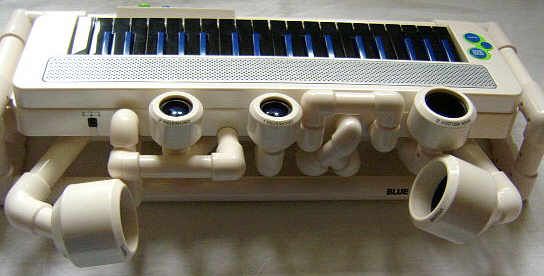
Is it a space station? Is it a robot? No it is Keyboard Experience. This unique designed midsize keyboard from 2006 looks very noble and has 6 active infrared hand gesture sensors for live percussion play. Unfortunately it turns out to be a disappointingly unflexible programmed plastic hype toy with only 9 preset sounds (2 of them detuned by several notes); instead of rhythms it has only 5 preprogrammed background music tracks, and the manual percussion mode has only one fixed drumkit that can be switched to a melodic tube drum voice. There is also a primitive sequencer and 5 nicely made classical music demos with individually mutable tracks.
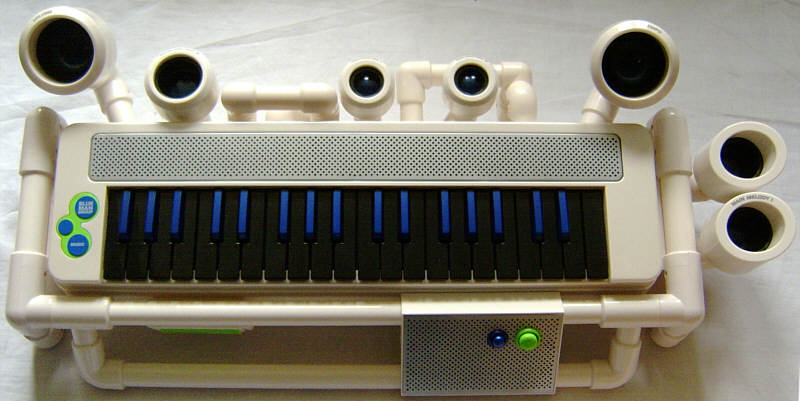
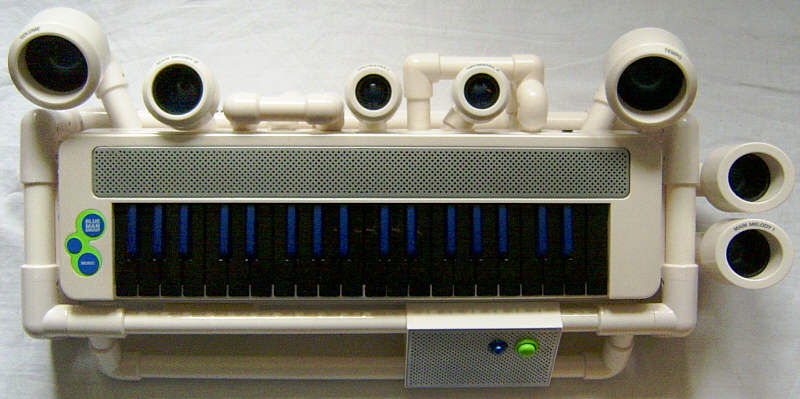
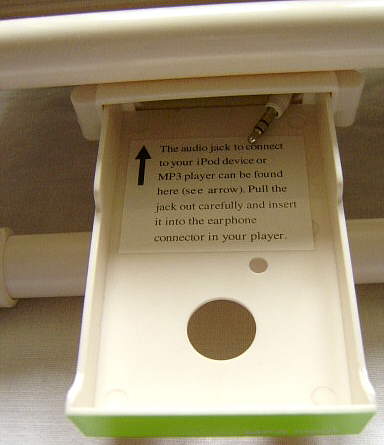
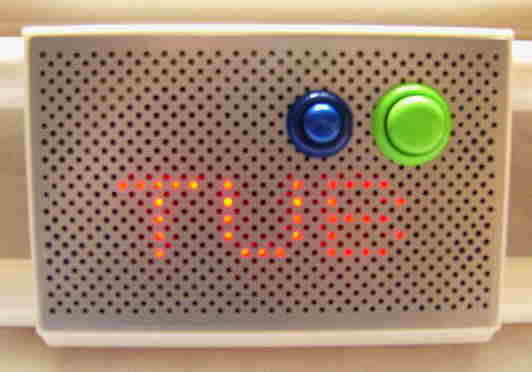
The case with its shiny metallic surfaces and hidden red dot matrix display looks like a wonderful performance synthesizer. The keyboard has nicely high polyphony and the hand gesture sensors respond faster and more precisely than with the Beat Square - AIR-Dance Mixer, thus you can nicely play well controlled drumrolls by waving with multiple fingers over them. All sounds are made from fairly high resolution samples and there is even an iPod- shaped tray for MP3 players. But this all helps nothing since it has way too few features and a poorly designed user interface. The speakers sound thin and a bit bassless.
The instrument was released by Toy Quest as a merchandising product of the music band "Blue Man Group". This rock band is famous for their stage performances with blue painted heads, blacklight effects and plenty of specially invented melodic percussion instruments made from large plastic pipe constructions, those obviously inspired the case design of the keyboard.
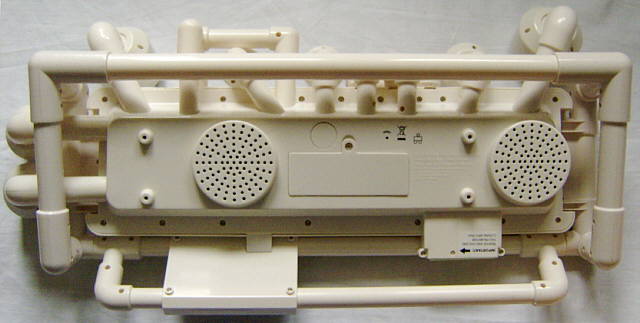
The case bottom writing of the keyboard says:
| © 2006 Blue Man Productions, Inc.
Manufactured under license by Toyquest, a division of Manley. TM & 2006 Toyquest, a division of Manley. LOS ANGELES; CA 90064 ALL RIGHTS RESERVED MADE IN CHINA |
Quote from the manual: "Your Blueman Group Keyboard is a true musical instrument. It's designed to allow you to use YOUR creativity to mix musical scores, write music, and even contribute your own musical flare to your favourite artist's recordings..."
Unfortunately the entire instrument concept looks like rather created by an advertisement department than by musical instrument designers, since nobody else would certainly come in mind to make nowadays such a lousy user interface with so few sounds and features. Regarding that already in the end of 1980th the Casio SA-series had a single- chip CPU with 100 very versatile wavetable preset sounds, and that ROM memory since then has turned some thousand times cheaper, the limited functionality of the "Keyboard Experience" makes technically absolutely no sense and constitutes an annoying waste of a beautiful hardware. IMO this product is much bigger fail than the once so hated "ET" game cartridge for Atari VCS2600. Thus do not pay too much for it; the initial German retail price at Conrad Electronic was insane 142.59€.
 |
 |
 |
|
 |
 |
 |
 |
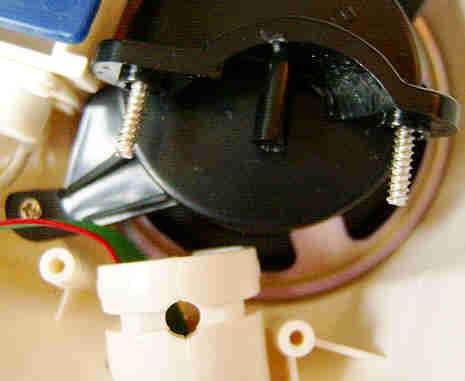 Cut
the center peg and add springs to make the outer arms rotate. Cut
the center peg and add springs to make the outer arms rotate. |
 |
 |
 |
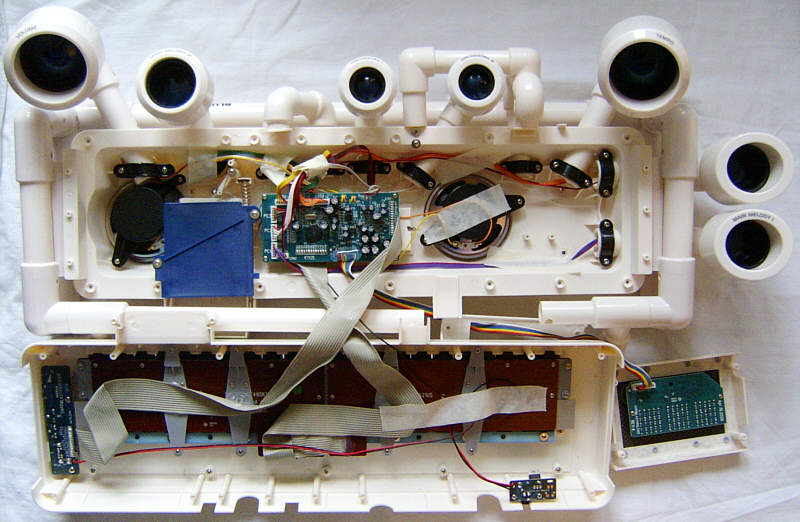
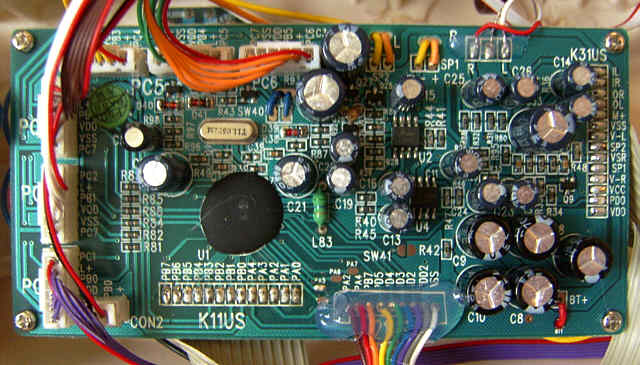
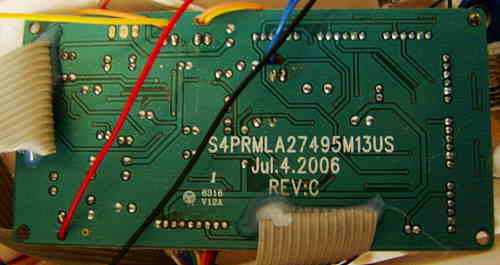
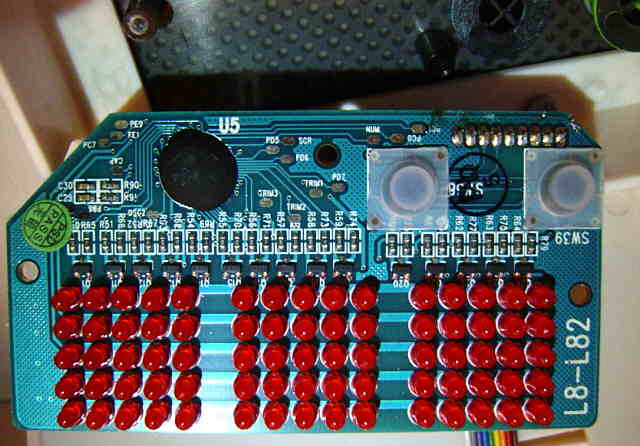
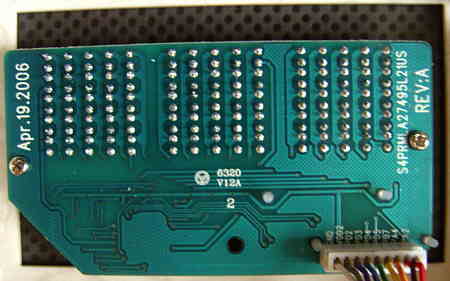
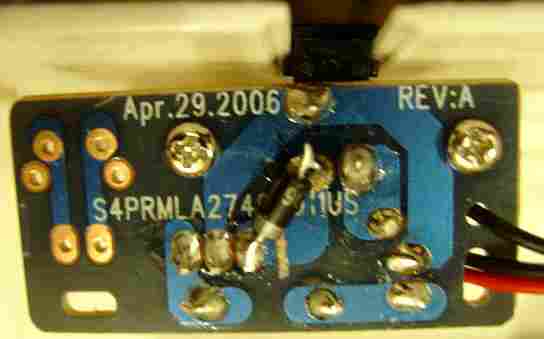
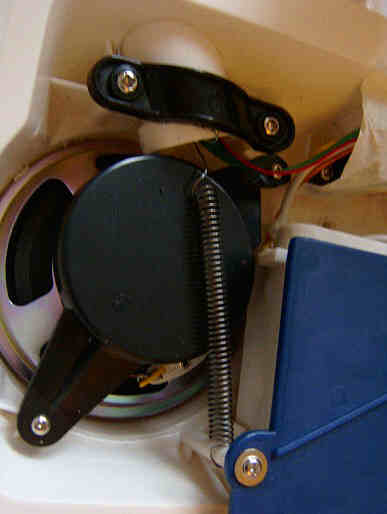
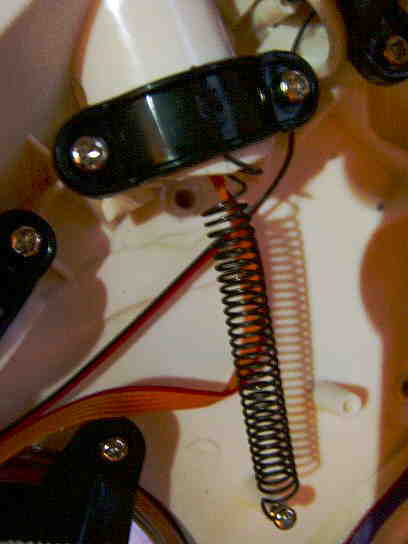
Annoying is that the 1.7mm power supply jack is too small for standard AC- adapter plugs, and it seems to drain batteries quite fast. Also the frame is not collapsible and the towering left and right rear sensor arms make the instrument so high that it didn't fit into my shelf. Thus I modified their fixtures with a pulling spring mechanism instead of the fixed cast plastic bolts to make them turnable. The case is hard to dismantle because it has plenty of partly hard to reach screws of different lengths and sizes, and the pipe frame is in the way when only the main case bottom shall be removed. For removing the bottom, you have to additionally remove at least the 6 screws those connect the frame to it, the 2 MP3 tray screws and the 4 front panel box screws. You now can carefully bend the front frame pipe away to free the case bottom out of this cage. The dual sided mainboard has the COB CPU directly bonded to it, is crystal clocked and contains various small SMD parts, which is unusual for toy keyboard hardware and makes modifications harder. The control panel PCB has an own display controller CPU (COB, directly bonded to it) and contains for each of the 3 digit 5*5 red 3mm LEDs (i.e. 75 LEDs in total). I yet only did a quick check of the keyboard matrix, but the only eastereggs I found were one or few additional lower note keys.
Bizarre is that there is a tiny reset button hole (only reachable by ballpen) at the case bottom, despite the instrument does not hold any data in memory when powered off, and the power switch seems to disconnect supply voltage anyway. Thus the hardware was likely designed for a different CPU or software version with more complex features. I would love to know what the original concept behind the instrument was, before its software was likely cut down into a bad hoax by any impatient boss to throw the half- baked thing on the market as soon as possible. The actual sensor placement looks much like designed for something very different, and I guess that also the holes in the plastic "lenses" were an emergency solution after a prototype refused to work like intended, since many IR remote controls with such transparent bluish covers function well without holes.
 |
 |
 |
| green button: | function: | blue button cycles through: | hand sensors: |
| DRU | drums (normal mode) | preset sounds {TUB, BDR, SMP, PIA, ORG, GTR, TRU, VIO, STR} | drumkit mode |
| DS1..DS5 | demo song 1..5 | '' | conductor mode |
| FRP | free play | background musics {RH1..RH5} | drumkit mode |
| REC | sequencer record | '' | drumkit mode |
| PLA | sequencer play | preset sounds | conductor mode |
The timbre quality of the main voice is fairly high, although the speakers sound quite thin and lack some bass. (With low battery they sound even thinner.) Despite their funky fantasy names, the preset sounds are quite establishment and some samples don't really match their name. The "Blueman tubes" (TUB) simply sounds like a muted e-bass with short envelope (slap bass?). Annoying is that it is detuned by 6 semitones ('C' is on 'F#'), which makes it badly usable. "Blueman drum" (BDR) sounds like an ordinary tom drum sample, that can be played at different note pitches. Also "Piano smasher" (SMP) is detuned by 4 semitones ('C' is on 'E') and sounds just like a distorted heavy metal e-guitar with slapping attack. The "piano" (PIA) sounds quite realistic and employs 6 key split zones. "organ" (ORG) sounds like a reed organ or accordion sample. "guitar" (GTR) is a thin sounding distorted lead guitar with delayed 4Hz tremolo. "trumpet" (TRU) is rather a tenor saxophone sample with delayed 4Hz tremolo. Also "violin" (VIO) has that delayed tremolo. The "strings" (STR) include sampled chorus vibrato and short reverb; they sound a little cold, but quite realistic.
In drumkit mode, the hand sensors 2..6 play realistic samples of {base, snare, open hihat, clap, open cymbal}. Sensor 1 toggles between this standard drumkit (DR1) and the Blue Man Group's typical melodic tube drums (DR2), those are tuned in a stupid order {B1, A#1, G#1, C#2, F#1}. This sample differs from the "Blueman tubes" preset sound; it decays a bit slower and sounds less thin. Great is that the sensors respond with very exact timing, thus you can play precisely controlled drumrolls by moving spreaded fingers over it; each passing finger re-triggers the sound exactly once. By closing the fingers, you can quickly change to play single drum beats.
In free play mode (FRP) , a music loop (mislabelled "rhythm") plays in the background like a fixed- key accompaniment. However there is no tempo control in this mode and you can not even switch the current preset sound, because the blue button cycles through the background musics (RH1..RH5) instead, and selecting another mode turns off the background music, thus you have to choose the preset sound before entering free play mode.
background melody loops:
demo songs:
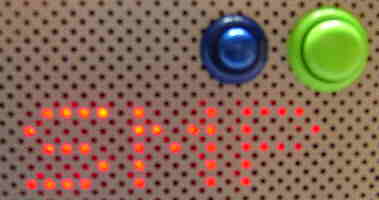
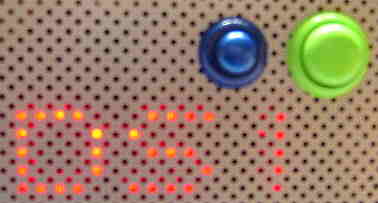
The hidden self test mode is activated by holding the blue and green
button together during power on. The display shows "KO2". With the blue
button you can now cycle through multiple menu points and select them with
the green one.
| blue button: | function: | green button cycles through: |
| KO2 | self test activated | - |
| LED | LED test | all matrix display rows ("-") & columns ("|") from top to bottom and left to right (all digits simultaneously) |
| IR | infrared sensor test | - Hands over sensor tubes light their green LEDs. |
| AUD | audio test tones | {1K, 400} plays sine wave tone at 1000Hz or 400Hz, which can be stopped by pressing "C1" key. The tone fades in and out with a short envelope. |
| VOL | volume test tone | {MAX, MID, MIN} plays tone at 3 different volumes, stopped with "C1" key. |
| INT | internal sound generator test | {PIA, ORG, GTR, TRU, VIO, STR, DR1, DR2} The corresponding sample sounds twice a second like an alarm signal. |
| (TUB) | self test exits | Instrument re-starts in normal mode (DRU) and selects preset sound "TUB" by the blue button press. |
When in "INT" mode of the self test the green button is held while pressing the blue one, the self test returns to "KO2" instead of exiting.
It is really a pity that there is no synthesizer feature. Not even all samples from the demos are available as preset sounds. Why does nobody make a 100 sound bank with synth functions like the great Casio VL-Tone 1?! And then some parameters realtime controllable through the sensor tubes could have made a really great keyboard instead of such an overpriced plastic hype. To avoid messing up the noble design, they could simply select functions through keyboard keys instead of additional buttons, with sounds sorted in groups. The given CPU would be certainly fast enough to handle everything so long no filter simulations draw additional power, but with wavetable synthesis even fairly similar sounds can be implemented cheaply. Also a realtime programmable tekkno drum sequencer would have been great and technically easy. It also wouldn't make the user interface too complicated - a single button to turn advanced features off (like with the Yamaha PSS-390 synth) is enough. It is only a matter of software, and ROM memory costs next to nothing today. Every educational toy laptop is nowadays full of different software functions, and nobody would buy one with only 4 functions only because it looks stylish. But with beginners keyboards they apparently still think they can fool customers, despite even Yongmei has started to add real 100 sound banks now even to their cheap tablehooters. Booh ToyQuest! - Look at Bontempi's Sprechendes DJ-Keyboard (talking DJ toy keyboard with genuine accompaniments and much more) to see how many functions at minimum a modern highend toy keyboard should have...!
But worst is that this tablehooter was advertised almost like Yamaha's Tenori-On - with the impression of having re-invented the way of making music by providing a revolutionary new tool of musical creativity - something that looks noble and in its versatility unestimatable - but doubtlessly somehow worth its money. So curious people those bought this "Keyboard Experience" for the initial retail price of 142.59€ must have felt like proud owners of a brand new pair of "white van speakers" - nicely looking trash sold overpriced as finest high-end audio equipment. I think someone should design a new circuit board for the thing - adding all the features that this keyboard does not have. Possibly a hacked MP3 player with colour LCD could become the heart of the system - the tray is already there, and specimen with more than enough flash memory can be found for 30€ on eBay. Putting some Linux into the thing and turning the sensors into proportional controllers could make of it a really nice little performance synth.
Another ToyQuest instrument of the same series was the toy drum
machine Blue Man Group -
Percussion Tubes. It has the same stylish white pipeline design
and iPod drawer, with a row of 8 towering sensor tubes (like organ
pipes) at the rear side, those can be also played with 2 special paddle
sticks. However it is fairly boring, since it was a similarly restricted
and overpriced hype toy like this keyboard.
| removal of these screws voids warranty... | ||
 |
 |
|
|
|