|
|
|
This is the drum kit to the stylish Blue Man Group - Keyboard Experience. It has the same unique case design and responsive IR gesture sensors, but is IMO even more boring than the latter.
 |
 |
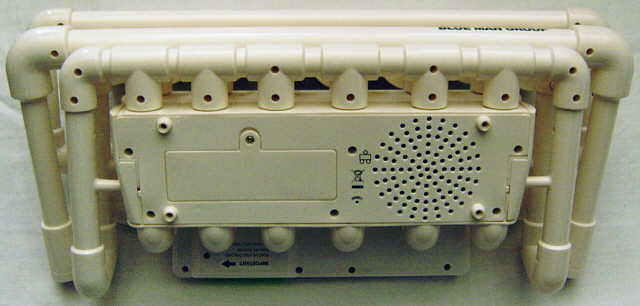
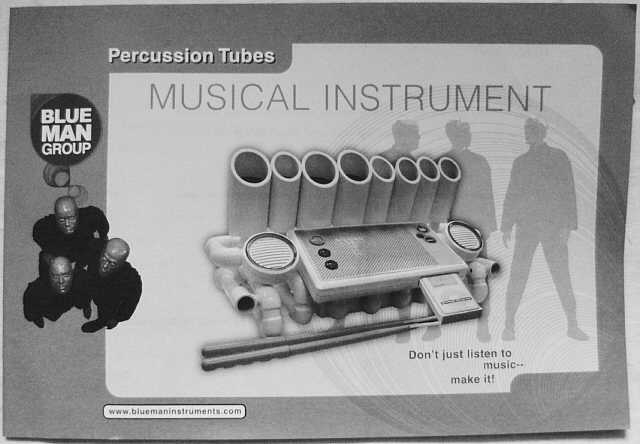
The instrument was released by Toy Quest as a merchandising product of the music band "Blue Man Group". This rock band is famous for their stage performances with blue painted heads, blacklight effects and plenty of specially invented melodic percussion instruments made from large plastic pipe constructions, those obviously inspired the case design of this thing.
The case bottom writing says:
| © 2006 Blue Man Productions, Inc.
Manufactured under license by Toyquest, a division of Manley. TM & 2006 Toyquest, a division of Manley. LOS ANGELES; CA 90064 ALL RIGHTS RESERVED MADE IN CHINA |
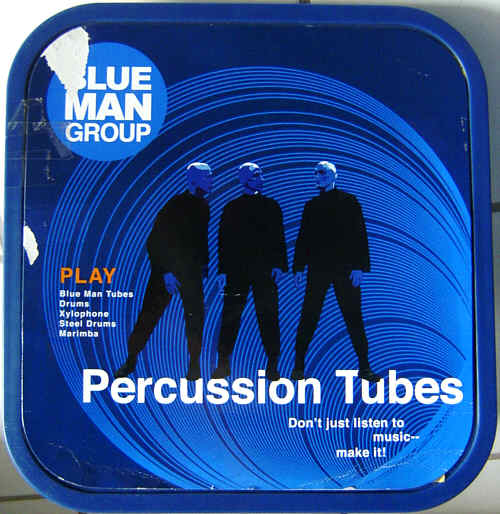
Quote from the manual: "Your Blueman Group Percussion Tubes is a true musical instrument. It's designed to allow you to use YOUR creativity to drum with musical scores and contribute your own musical flare to your favourite artist's recordings..."
Like with the keyboard, unfortunately the entire instrument concept looks like rather created by an advertisement department than by musical instrument designers, since nobody else would certainly come in mind to make nowadays such a lousy user interface with so few sounds and features. Thus do not pay too much. It's a pretty design object, but as an instrument it is boring. IMO the Beat Square - AIR-Dance Mixer is a much more exciting and versatile motion sensor rhythm machine.
 |
 |
 |
 |
 |
 |
 |
 |
 |
 |
 |
 |
 |
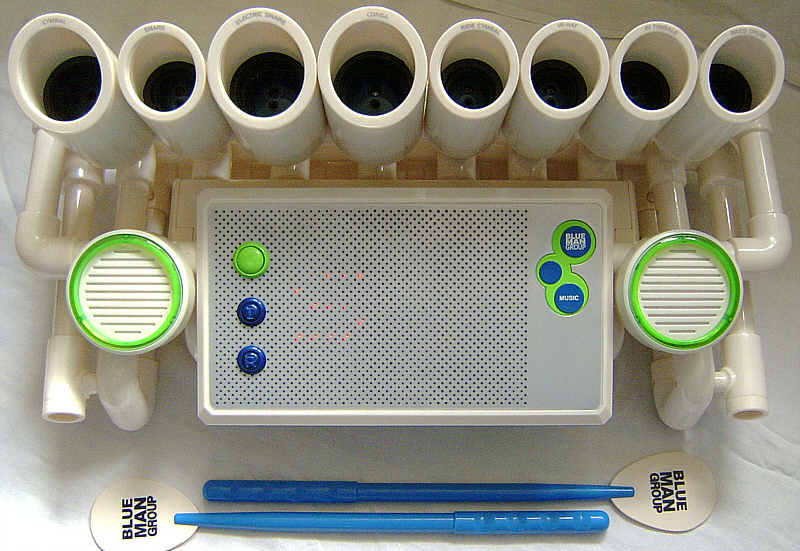
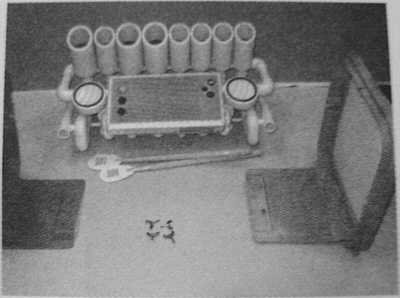
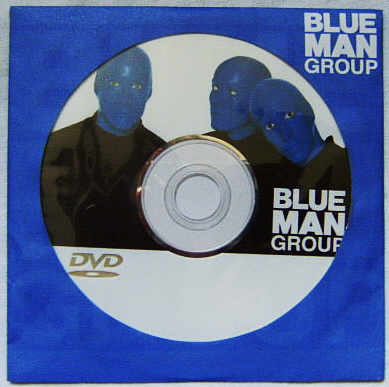
The towering row of 8 sensor tubes somewhat remind to organ pipes; their different sizes seem to have no logical meaning; the 3 bigger tubes are assigned to "cymbal", "electric snare" and "conga", while the base drum has only a small tube. Possible the bigger tubes to the left side should allude to pipe organs, despite here only 2 sizes exist. At the case front are 2 storage tubes for the drumstick paddles, but placing them there wastes much space because they stick 14cm out of them; placing them horizontally above the control panel makes much more sense. (I only worry that plasticizer from the paddle blades may attack painted parts over time when carelessly laid onto them.) The instrument was shipped with a Blue Man Group DVD. I haven't examined the hardware yet, but it is certainly similar to the Keyboard Experience, although it here has way less switch contacts and LEDs connected. Also here it includes the tiny reset button hole (only reachable by ballpen) at the case bottom, despite the instrument does not hold any data in memory when powered off, and the power switch seems to disconnect supply voltage anyway. Thus the hardware was likely designed for a different CPU or software version with more complex features. I really would like to know what the prototype concept behind this instrument was, and how many good features were killed by managers to cut cost or make it "easier" to play for novices.
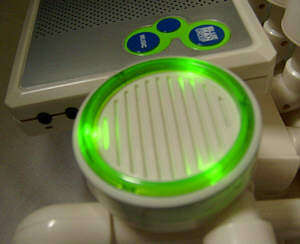
The hand sensors respond at about 7cm distance and only sense on/off (no analogue distance detection). The power switch to the left has 3 positions {try me, off, on} and its writing can be only seen from the side. In "try me" (demo) mode the sensors do nothing; only the buttons cycle alternatingly through shortened versions of the "rhythm" and demo tunes, while the green rings rapidly flicker. The instrument always starts in normal mode ("D") with drumkit sound. Annoying is that the 1.7mm power supply jack is too small for standard AC- adapter plugs, and it seems to drain batteries quite fast. Also the frame with the towering sensor tubes is not collapsible. With low batteries the sensors stop working properly; with mine the leftmost one fails first.
The user interface of the instrument is controlled through only 3 buttons
(green, "I" and "R"). The green one cycles through the main modes, while
"I" ("instruments") cycles through the preset sounds and "R" ("rhythms")
through the background patterns. After each button press, the dot matrix
display lights up to display a character for 4s and then goes out again.
In the manual the mode "F" is claimed to be used together with background
patterns or an MP3 player, but I found no behaviour difference to "D".
(It may be that "F" additionally enables the sound input plug; I haven't
checked this. But I guess it is just a useless relic from the more complex
Keyboard
Experience, where the corresponding modes "DRU" and "FRP" differ
in the function of its single blue button, which on "DRU" behaves like
button "I", while on "FRP" it behaves like button "R".)
| green button: | function: |
| D | drums (normal mode) |
| 1..5 | demo song 1..5 |
| F | free play |
| R | sequencer record |
| P | sequencer play |
| "I" button: | function: |
| D | drumkit mode |
| X | xylophone |
| S | steel drum |
| T | Blueman Tubes |
| M | marimba |
The "I" button alternatingly cycles through these preset sounds in normal and "riff" mode (where the letter flashes).
In "riff" mode the sensor tubes 2 to 6 play instead of individual notes each a trilled 4 beat pattern of the form "X & Y together, X, Y, X, ..." in a loop, where X and Y are 2 notes. With sensor 3 to 6 both notes form a duet, while sensor 2 plays 2 times the same note (i.e. X & Y = louder). Each trigger of a sensor plays its pattern so long it is held, but it always plays all 4 notes of a started pattern and does not truncate the rest when the touch is shorter. In drumkit mode the pattern consists of 2 toms of different pitch. The sensor 8 stays in "riff" mode always assigned to the base drum (without a pattern), while sensor 1 controls the tempo in a very awkward and unobvious way; holding a hand/ paddle over it slowly increases tempo (up to a fast purring ring or drumroll), while a short move over it switches back to normal. Hitting it very short seems to switch tempo sometimes even lower, but this behaviour is so random and hard to reproduce that it may be a glitch.
The timbre quality of the main voice is fairly high, although the speaker is a little dull and rumbling. On a kind of keyboard stand it would certainly sound better. The preset sounds are quite establishment and sound like expected, so I only explain the unusual one. In drumkit mode the "electric snare" is just a normal snare sample that sounds a little more tonal than the other one. The "hi timbale" is a tonal high drum (like a bongo) that decays a bit slower than others. The "Blueman tubes" (T) sounds like a muted e-bass with short envelope (slap bass?); it is also a little nasal like a banjo. Great is that the sensors respond with very exact timing, thus you can play precisely controlled drumrolls by moving spreaded fingers over it; each passing finger re-triggers the sound exactly once. By closing the fingers, you can quickly change to play single drum beats. With the paddle drumsticks the sensors respond a little earlier than with fingers. To pass a sensor without triggering it, simply hold the paddle vertically. When you hold it tilted, you can nicely play fast drumrolls by slightly shaking it. Its a pity that the manufacturer didn't add a 100 sound bank with each sound assignable to the tubes and velocity sensitive sensors.
With "R" you can select a music loop (mislabelled "rhythm") that plays in the background like a fixed- key accompaniment. The patterns correspond to the Keyboard Experience, but unlike there you can at least switch the preset sound in between, and when you select one with "riff" mode, you can even change the tempo by its tempo control (sensor 1). They have no separate volume control. Press the green button to quit.
background melody loops:
demo songs:
The hidden self test mode is activated by holding the green and the
"I" button together during power on. The display cycles through "P", [square],
"2". With the "I" button you can now cycle through multiple menu points
and select them with the green one. The "R" button plays a marimba sound.
| "I" button: | function: | green button cycles through: |
| P[square]2 | self test activated | - |
| L | LED test | all matrix display rows ("-") & columns ("|") from top to bottom and left to right, followed by the green LED rings |
| I | infrared sensor test | Hands over sensor tubes play their drumkit mode sounds |
| A | audio test tones | {1, 4} plays a buzzy distorted sine wave tone at 1000Hz or 400Hz. The tone fades in with a short envelope. |
| N | internal sound generator test | {D, X, S, T, M, D flashing, X flashing, S flashing, T flashing, M flashing} The corresponding preset sound plays twice a second like an alarm signal. The flashing ones are "riff" versions. |
| (blank) | self test exits | Instrument re-starts in normal mode (D) and selects preset sound "D" by the blue button press. |
When in "N" mode of the self test the green button is held while pressing
"I", the self test returns to P[square]2 instead of exiting.
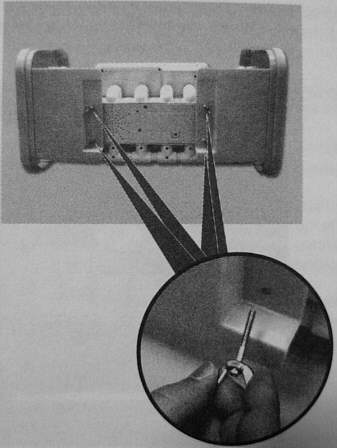
| removal of these screws voids warranty... | ||
 |
 |
|
|
|