![BONTEMPI Minstrel BETA [ß]](picts/Bontempi_MinstrelBeta_logo2.jpeg) |
analogue keyboard with nice
accompaniment & monophonic envelope |
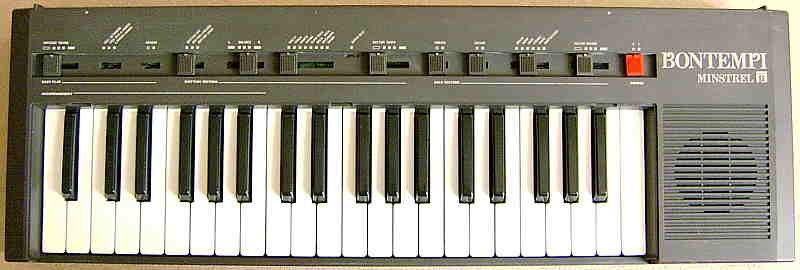
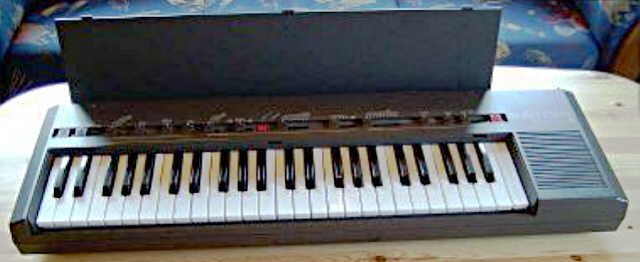
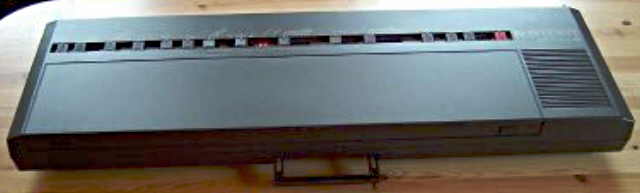
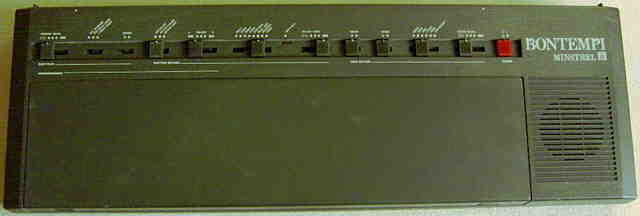
This ancient Bontempi keyboard has a lightweight grey plastic
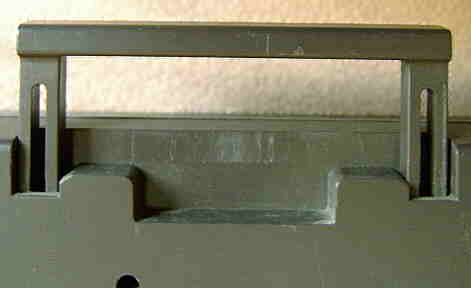
case with detachable keyboard lid and pull-out handle. I don't know how
old it is, but the analogue hardware looks like very early 1980th; it has
only a monophonic envelope (i.e. when in piano mode a key is pressed, any
held down keys play at full volume again) and sounds very home-organ-like.
The analogue drums distort but it has an astonishingly versatile accompaniment
with arpeggio.
A midsize keys version of this instrument with smaller case was released
as Bontempi Minstrel Alpha.
main features:
-
40 full size keys (with counter- springs and metal spring contacts - like
1970th home organs)
-
4 note polyphonic sound with monophonic envelope
-
6 preset sounds {organ, horn, oboe, strings, piano, harpsichord}
-
8 preset rhythms {waltz, tango, march, swing, slow rock, disco rock, bossanova,
samba}
-
vibrato and sustain switch
-
"chord memory" switch (chords are held after releasing their keys when
on)
-
switch {full keys, free bass & chord, single finger chord}
-
switch {rhythm off, r. syncro, r. start}
-
sliders for master-, rhythm- and arpeggio volume, rhythm tempo, balance
(arpeggio vs. rhythm)
-
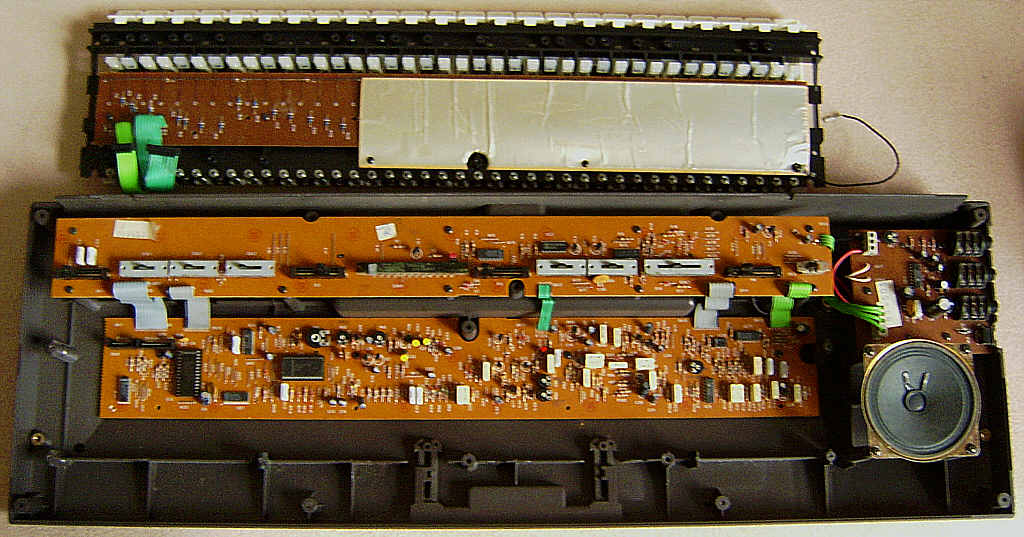
complex analogue hardware with multiple PCBs and many socketed ICs
-
analogue(?) sound generator with 4 main voices (monophonic envelope), 4
(?) chord voices + bass (own envelope) and arpeggio (own envelope?). Drums
are analogue and sound very distorted, hihat and snare are made from transistor
noise.
-
complex multi- chip hardware:
-
CPU= "National Semiconductor COP420-KPN/N, S/B 8335, 27430700" (28 pin
DIL, socketed)
-
sound IC= "AMI 8340WN, 27430520, Korea" (24 pin DIL, socketed)
-
amp IC= "SGS TDA1905, 88332" (16 pin DIL)
-
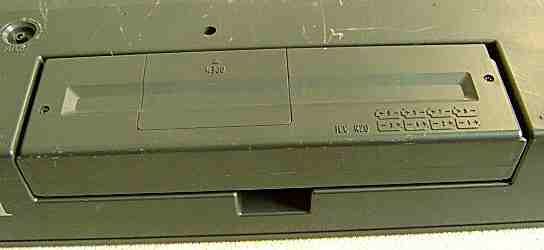
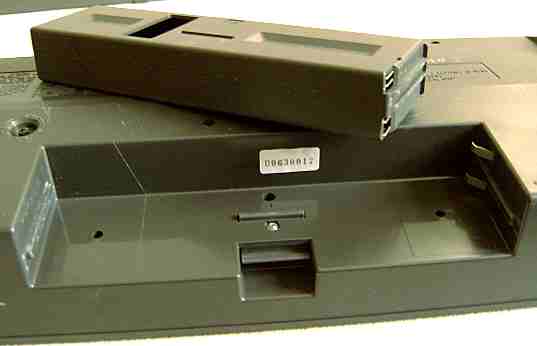
detachable battery tray for 8(!) A-size batteries (was replaceable with
a special AC adapter cartridge?) although the lightweight instrument draws
only little current and works even well with a cheap 300 mA power supply.
-
tuning trimmer at the bottom
-
headphone and AC adapter jack
 |
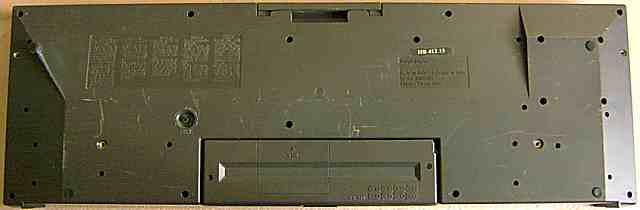 |
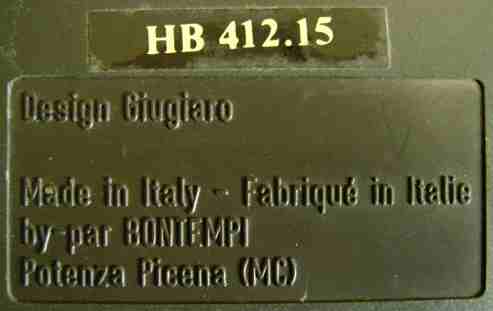
On the case bottom is a sticker "HB 412.15" and the following embossed
text:
| Design Guigiaro
Made in Italy - Fabriqué in Italie
by-par BONTEMPI
Potenza Picena (MC) |
|
 Someone
told me by e-mail that Guigiaro was a famous automobile designer from Turin
(Italy) who e.g. designed the Volkswagen Golf and the Panda
and Punto by Fiat (IMO all quite boring and way too rectangular
looking cars). His company is named
Italdesign. Someone
told me by e-mail that Guigiaro was a famous automobile designer from Turin
(Italy) who e.g. designed the Volkswagen Golf and the Panda
and Punto by Fiat (IMO all quite boring and way too rectangular
looking cars). His company is named
Italdesign. |
modifications:
-
too short drum envelopes re-adjusted.
notes:
What I particularly like with this keyboard is the very versatile accompaniment;
e.g. the arpeggio changes depending on how many chord keys are pressed
and whether it is in fingered or single finger chord mode. The accompaniment
accepts also any non- chord key combinations and can e.g. play a sequence
of the same note from different octaves etc. When "chord memory" is off,
the accompaniment falls silent by releasing the chord keys (in synchro
mode rhythm stops too?), which makes it possible to play with rhythms in
interesting ways. What I like less is the monophonic envelope in piano/
harpsichord mode and that of the only 6 sounds 2 (organ and horn?) sound
almost identical.
hardware details
The main CPU (connected with the keyboard) is labelled "~ S/B 8335, COP420-KPN/N,
27430700". I was told that COP420 was one of the earliest microcontrollers
- made by National Semiconductor with only 1KB ROM and 64 nibbles
4 bit RAM (verified by datasheet). The sound IC "AMI 8340WN, 27430520"
outputs at least arpeggio, bass, envelope signals and rhythm trigger pulses.
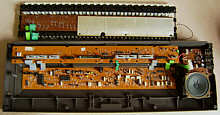
I yet couldn't find out how the main and chord sounds are generated.
(The keyboard stands in another city in my parents home where I have no
oscilloscope etc.) The waveforms seem to leave the soundchip somewhat encoded
or multiplexed, because by connecting an amplifier I hear only digital
pulses and the arpeggio and bass squarewave tones, but not the main and
chord voices. Possibly they are decoded by some 74LS in between or even
generated outside by something analogue; e.g. the oboe timbre is very different
from squarewave, but it also may be just a filter. I tried to replace the
mediocre speaker because drums distort a lot (sound like badly programmed
C64 drums), but it didn't help, thus distortion seems to be either intended
or a defect causes by clipping.
The rhythm slide switch has 4 unused positions (= rhythm off?). On the
PCB is much analogue stuff with these trimmers:
| trimmer |
function |
| R9 |
voltage? |
| R41 |
tuning |
| R42 |
pitch |
| R45 |
? |
| R80 |
hihat |
| R81 |
snare |
| R110 |
clipping? |
|
A longer 49 keys variant of the Minstrel Beta was the
Bontempi
Minstrel Delta. It was also released in a silver metallic version with
additional red button as Bontempi Master HB 424 and likely as Bontempi
X301. A Beta variant with red button was released as HB 414.
A midsize variant (polyphonic envelope, case like Minstrel Alpha
in white or metallic, I own one) was Bontempi Master HB 404. Most
variants were also made in white. Likely all "Bontempi Master" models have
newer hardware with polyphonic envelope and semi-metallic cymbal waveform.
| A Minstrel Delta variant with 10 preset sounds and red button was released
as Bontempi Minstrel Gamma. (Photos taken from eBay.) |
|
A supposingly quite similar 49 keys stereo variant of the Minstrel
was the
Bontempi ES4900 Stereo and the MRS 49 (which had
the same case style like the
Bontempi M40).
The same stupid monophonic piano envelope but much more features (e.g.
programmable drum & chord pattern) has the Bontempi Eclipse
(I own one). Another analogue keyboard with some similarities (and polyphonic
piano envelope) is the wonderful Bontempi
MRS 52/D. Large Bontempi ES series keyboards seem to be
the direct successors of the Minstrel series; even a fullsize 61
keys stereo keyboard was released as ES5800, which even had MIDI
but in spite of this still only 6 sounds and 8 rhythms like the Minstrel.
But in the ES series also simple mini keyboards like the ES3000
and ES3100 were made, those had
badly distorting digital sound of very poor quality.
.
| removal
of these screws voids warranty... |
|
|
 |

|
|
| |
back
|
|