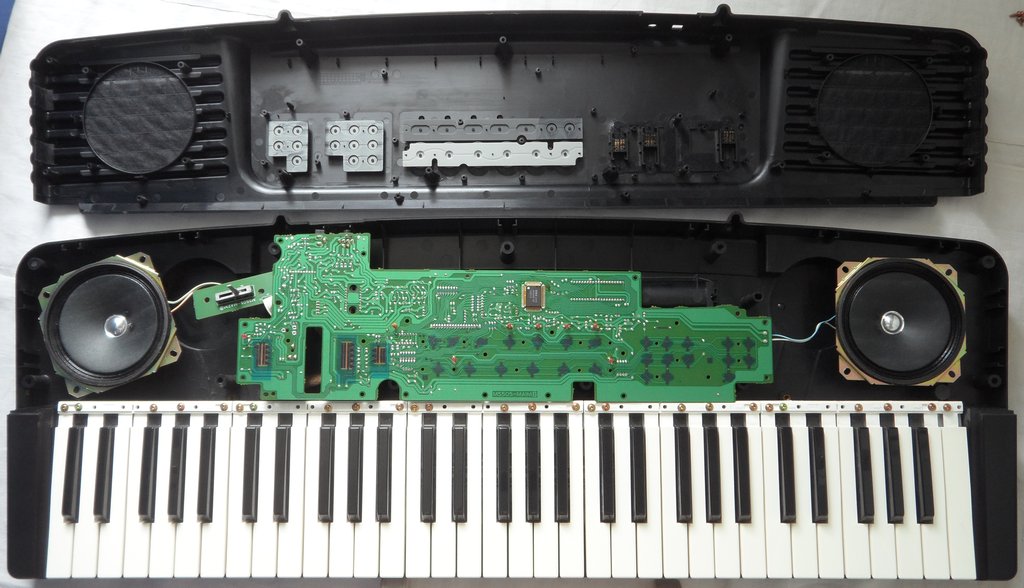
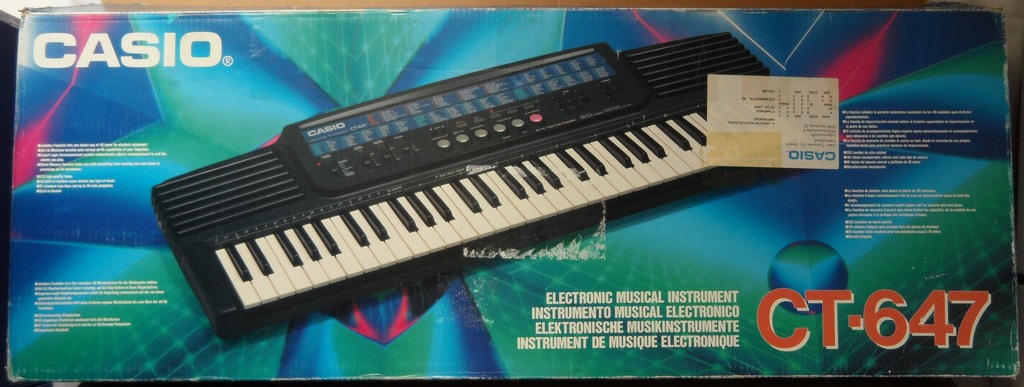
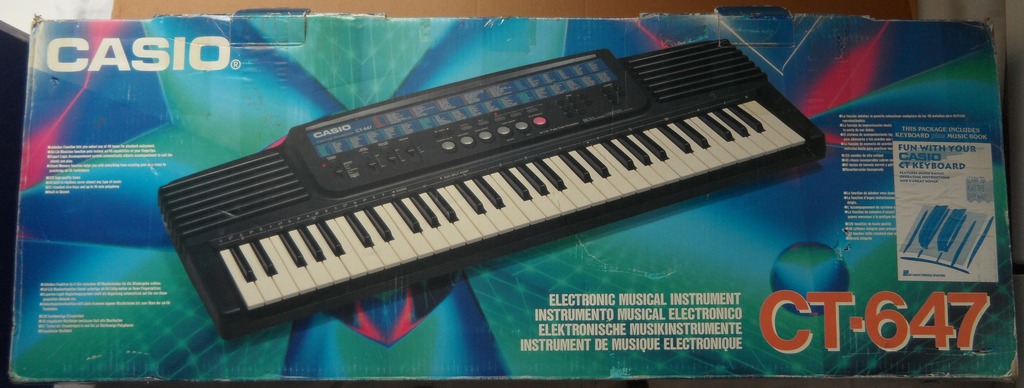
This keyboard of 1992 employs a strange hybrid between songbank and accompaniment named "Expert Logic Accompaniment", which is a single piece that Casio didn't use in different models.
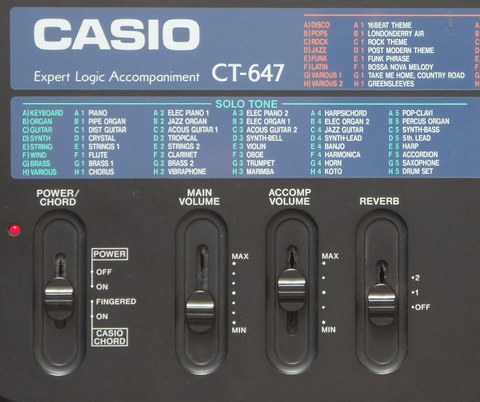
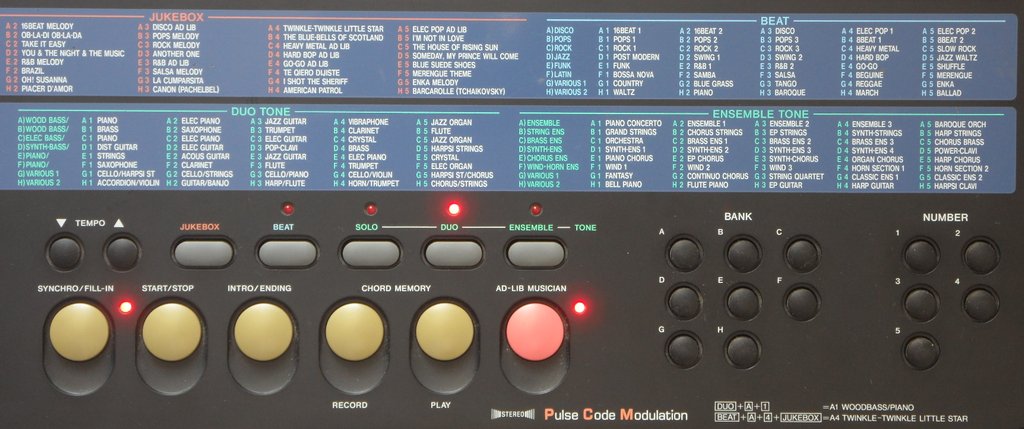
Its preset sounds and rhythms are sorted in a strange way that differes from other ToneBanks, so this is the only Casio keyboard with alphabet letter buttons. Each of the 40 built-in songs (here named "jukebox") corresponds to a preset accompaniment that can be seamlessly improvised to.
The stereo preset sounds are sample based and often more complex than in MT-750. Likely they reuse algrithms from the SA-series PCM engine softsynth for versatile modulations. Unfortunately this keyboard takes itself a bit too serious, having only establishment instrument sounds without any strange synth effect noises. There is also a keyboard drumkit mode and a simple chord sequencer.
Despite it remained unique, it was obviously no flop, since this model got re-released several times also as Casio CT-648, CTK-500, CTK-510, Concertmate 950 and Hohner PSK 41.
 |
 |
 |
 |
 |
Annoying is that preset sounds often exist in only one of the 3 main groups {solo, duo, ensemble}, like when the intrusive "Expert Logic" tells you: "I am the expert here and it's solely me who decides which sounds you are allowed to combine!" The 'duo' group contains preset sound combinations with keysplit, the 'ensemble' group with layered sounds. Most are sorted such that the letter button 'A'..'H' ("bank") selects the first sound and the cipher button '1'..'5' ("number") the second. So during live play you can switch between sounds in the same row or column by one button press, which only helps when your idea of which sound should be used next matches this stubborn keyboard, else the user interface gets into your way. The 3 main groups remember each their last selected preset sound when switching among them. But a generic keysplit and layer mode (and possibly registration buttons) would have been more useful.
 |
 |
quote from manual: "The Auto-Accompaniment system of this keyboard employs a revolutionary new system that is unlike anything ever before available on an electronic keyboard. Expert Logic Accompaniment is a totally new intelligent accompaniment system that makes real-time decisions about chord progressions. Based on key judgement logic, this system automatically selects and plays the appropriate accompaniment pattern to match the key of the chord progression being played. This means it plays different patterns for the same major chord depending on whether the chord is being used as a tonic or subdominant. The result is sophisticated accompaniment patterns that are musically logical all the time." Blah! - Sensing chord progression did Casio already in 1984 on their visionary CT-6000.
The "ad-lib musician" mode works like an Omnichord; it changes the available notes in right keyboard section to the currently played chord to enforce harmony. It can be used with the internal "jukebox" songs or normal accompaniment. quote from manual: "It adjusts the scale of the keyboard to play only the notes that match the chord being played by the accompaniment. This means you can press any key and stay within the correct scale for instant adlibs."
To properly select a song, press 'beat', a letter, a digit and then "jukebox". (If you press "jukebox" first, it starts wrong intermediate songs.) The songs are nicely made, although many have only generic names like "rock melody" or "post modern theme".
The simply chord sequencer can record and playback your chord track
in realtime. It has no edit and gets deleted by (auto-) power off.
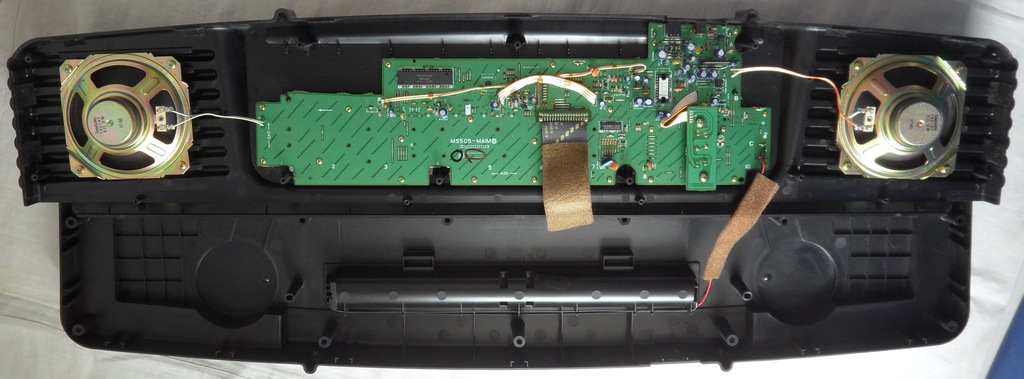
hardware detailsThe Casio CT-647 is built around the CPU "OKI M6566B-03" (crystal clocked at 43.45 MHz) with external 256KB ROM.
Internals of the accompaniment AI algorithm for chord progression are described in patent US4896576 and US5510572. keyboard matrixThis keyboard matrix is based on the Casio CTK-500 service manual. It seems very close to CT-647 athough the CPU name (but not ROM) differs. I expect that the matrix is the same. I haven't analyzed it by myself, so there may be unknown eastereggs.
The input lines are active-high, i.e. react on +Vs. Any functions can
be triggered by a non- locking switch in series to a diode from one "out"
to one "in" pin.
The panel LEDs are latched by a TC74CH174AP from CPU pins KO0..KO5 during a pulse on KO17. pinout M6566B(?), M6626The CPU "OKI M6566B-03" (80 pin SMD) is the CPU of Casio CTK-647. The "OKI M6626-01GS" (80 pin SMD) is the CPU of the almost identical CTK-500 and looks like a minor variant of it. (Confirmed by Revenant, who dumped the external CT-647 ROM. The -03 and -01 are software numbers of internal ROM.) No much is known about this chip, beside it contains 16-note polyphonic PCM sound generation with internal stereo DAC and external ROM. Likely it runs a versatile softsynth like in earlier Casio PCM keyboards (see SA-series).This pinout is based on the Casio CTK-500 service manual, which has
a pinout of "OKI M6626-01GS" and schematics drawing.
The external ROM address and data lines are wired 1:1 to the CPU pins of corresponding name. |
A CT-647 with changed case design and built-in CD-player came out as Casio KT-80 and in Japan with CD+G player as KT-90G. But Casio never made real variants with diffferent songs or other software changes. Possibly the way how in its chord AI songs and accompaniments got tightly intertwined (perhaps as terrible handwritten spaghetti code) made song replacement and bugfixing prohibitively costly, so Expert Logic Accompaniment remained a singleton.
Now in an age where cloud based AI has begun to analyze and produce
entire songs with singing, all instruments and video of the imaginary band,
it became just a historical artefact, that like chess computers witnesses
of a time where AI was less science than fiction. Fortunately this keyboard
is clever, not smart - offline and 100% app-free it will keep working even
after all cloud services have been shutdown.
| removal of these screws voids warranty... | ||
 |
 |
|
|
|