|
|
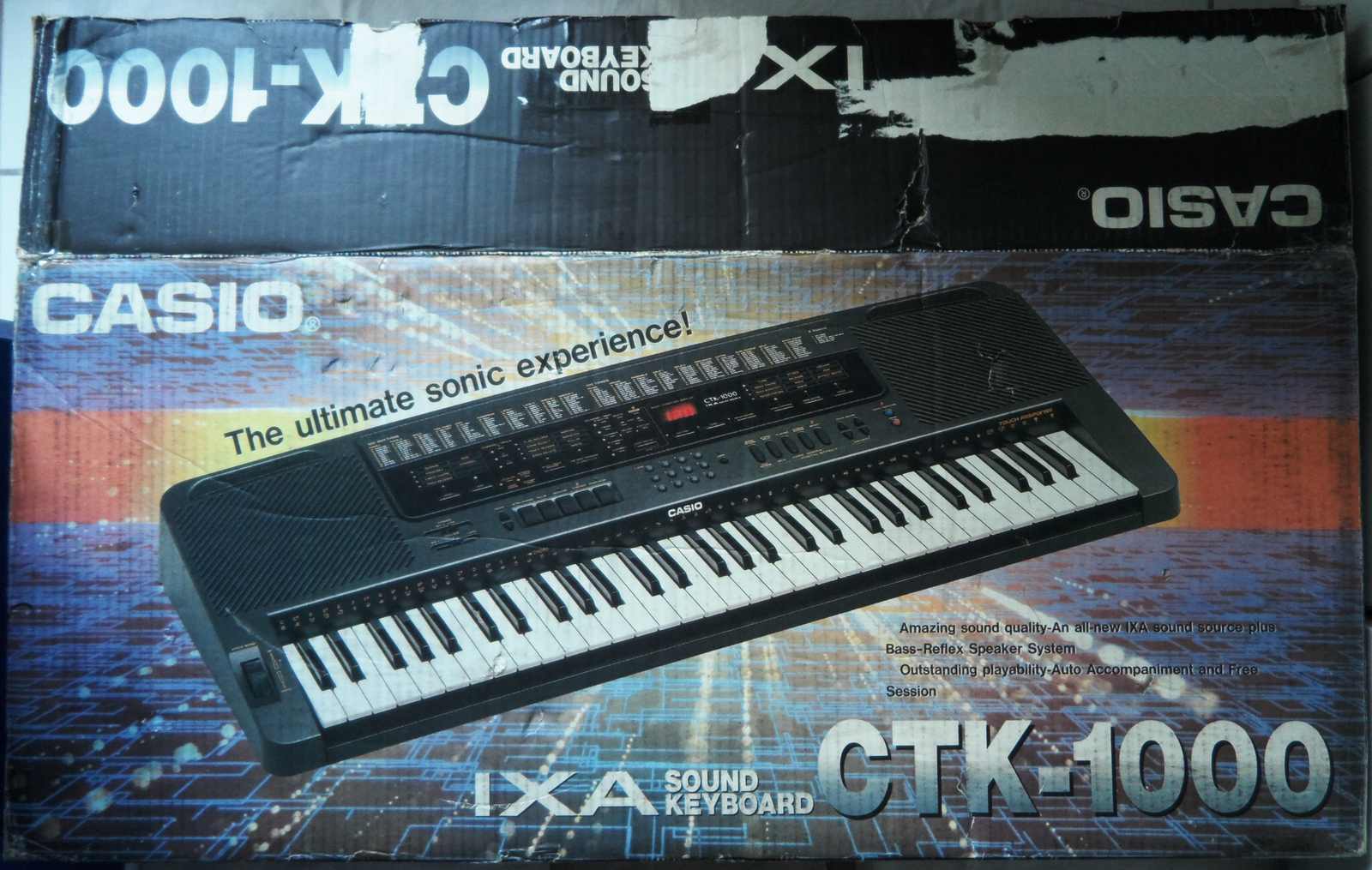
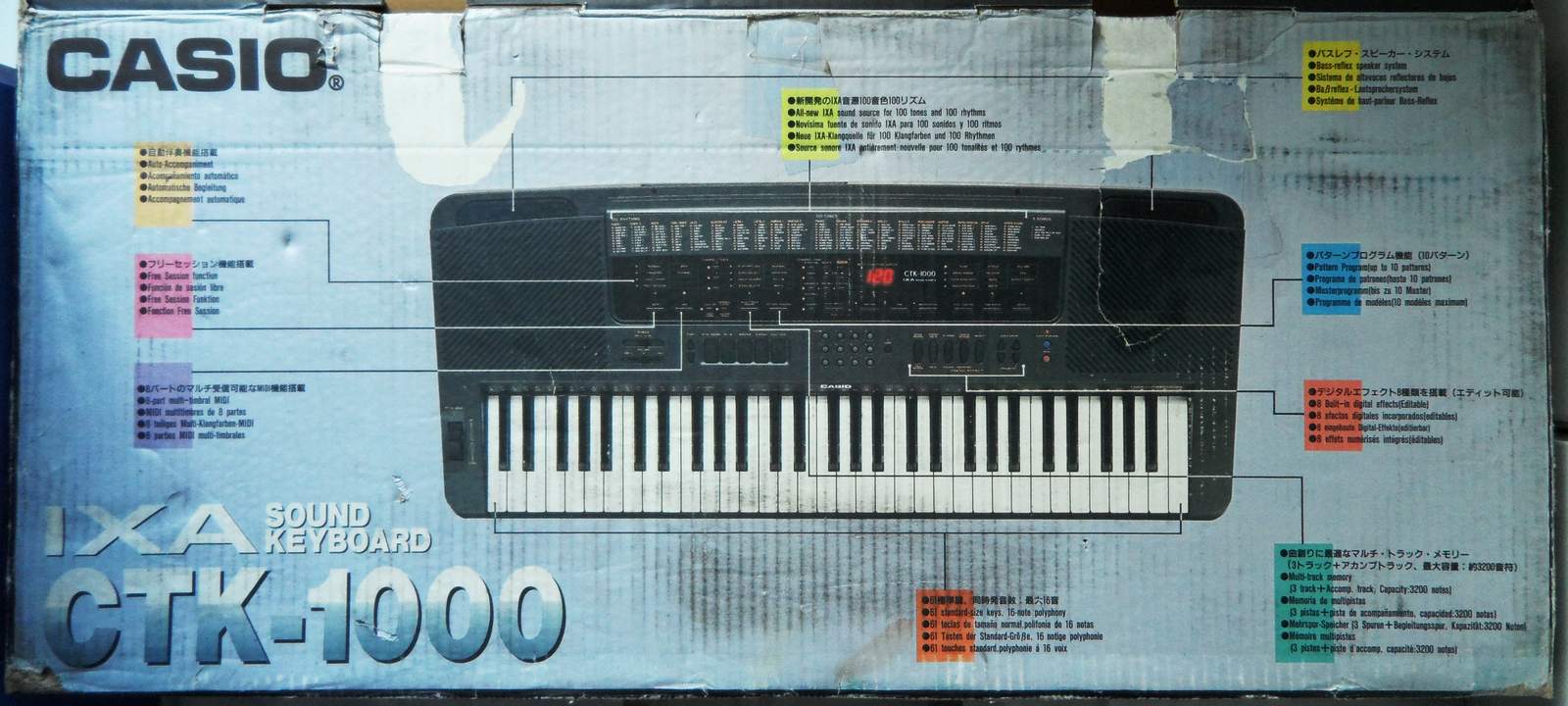
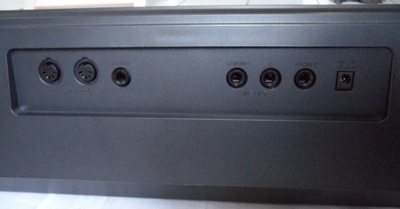
The CTK-1000 of 1993 was the first keyboard of Casio's CTK-series. It's IXA sound source combined first (and unfortunately last) time velocity sensitive keys and midi with Casio's synthesized PCM engine sounds.
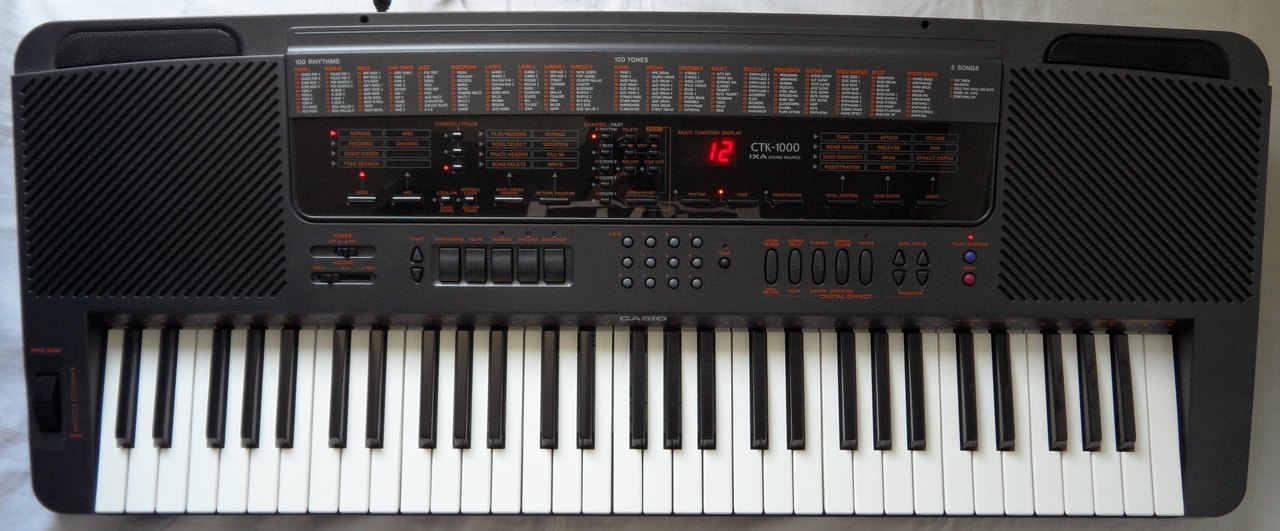
Thus many preset sounds are derived fom the classic SA-series softsynth and here first time can be played with velocity. They have 3 editable synth parameters and DSP effects those can be saved as user presets. Picked strings, organs and synth pads are very nice. It can sound like a warm analogue synth and is well suited for new age music. Annoying is that other sounds here got replaced with simple samples containing sampled vibrato and audible loop and split point, which just sounds cheapish and was no progress at all. There is complex accompaniment but no manual chord mode.
This keyboard is a mix of great features and lousy quirks. So the most terrible design flaw is that the contents of its seriously complex multitrack sequencer and rhythm sequencer have no means of external saving (not even sysex), thus everything is gone when batteries drain or memory needs to be overwritten. Many details suggest that Casio planned to make this into a much more professional instrument, but the CTK-1000 hardware remained one of a kind and was never used anywhere else.
 |
 |
 |
 |
 |
 |
The synthesized IXA presets respond nicely to velocity and not only turn brighter and louder, but partly into metallic and resonant distorted timbres (physical modelling?). Picked strings, organs and synth pads are very nice. It can sound like a warm analogue synth and is well suited for new age music. In any preset sound 3 synth parameters {wave, attack, release} can be edited and saved as user preset. Their values can be 1..9, where 0 is the default. The behaviour of 'wave' depends on the preset sound. IXA stands for "Integrated Cross-Sound Architecture"; possibly this should express that it includes both synthesized and sampled sounds.
What sucks is that many brass, string and ensemble timbres are only loop samples containing sampled vibrato, which of course changes speed with the note pitch until the next (well audible) split zone is reached; this rather resembles trashy 1990th Bontempi GM home keyboards or Potex sound toys than a serious synth. So this first CTK also marks the turning point of demise when 1990th big Casio keyboards did start sounding bad, because in the name of modernity they replaced more and more softsynth sounds with long boring samples. Only beginners keyboards (CA- and MA-series) kept them for a while, but in midi keyboards the good things disappeared.
Despite many DSP effects, there are no vibrato or tremolo settings;
instead many voices contain an annoying delayed vibrato that can not be
disabled. Obnoxious is also that there seems to be no easy way to play
in the chord section chords without rhythm or accompaniment. (May be you
can program this as a "style", but thats not what a keyboard should do.)
There is no key split mode except as part of some "split" preset sounds.
The entire thing somehow feels like an ill designed cross between Casio
MA-130 kiddy keyboard and a very serious workstation. Interesting
is that at least through midi (haven't tried) the sound engine is multi-timbrale
and there is a "local off" mode that may permit to route the keyboard input
through a PC to circumvent some design flaws (e.g. key split).
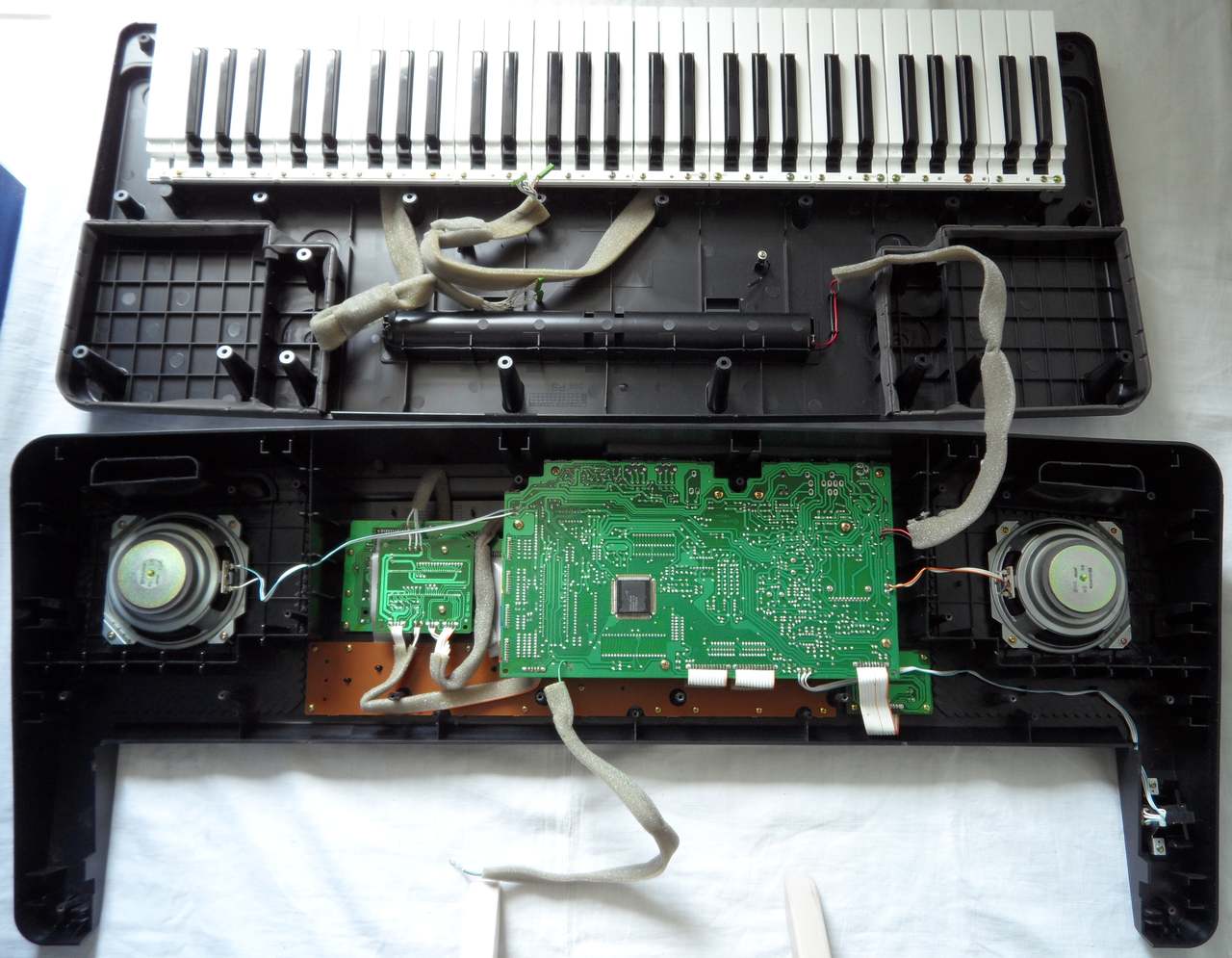
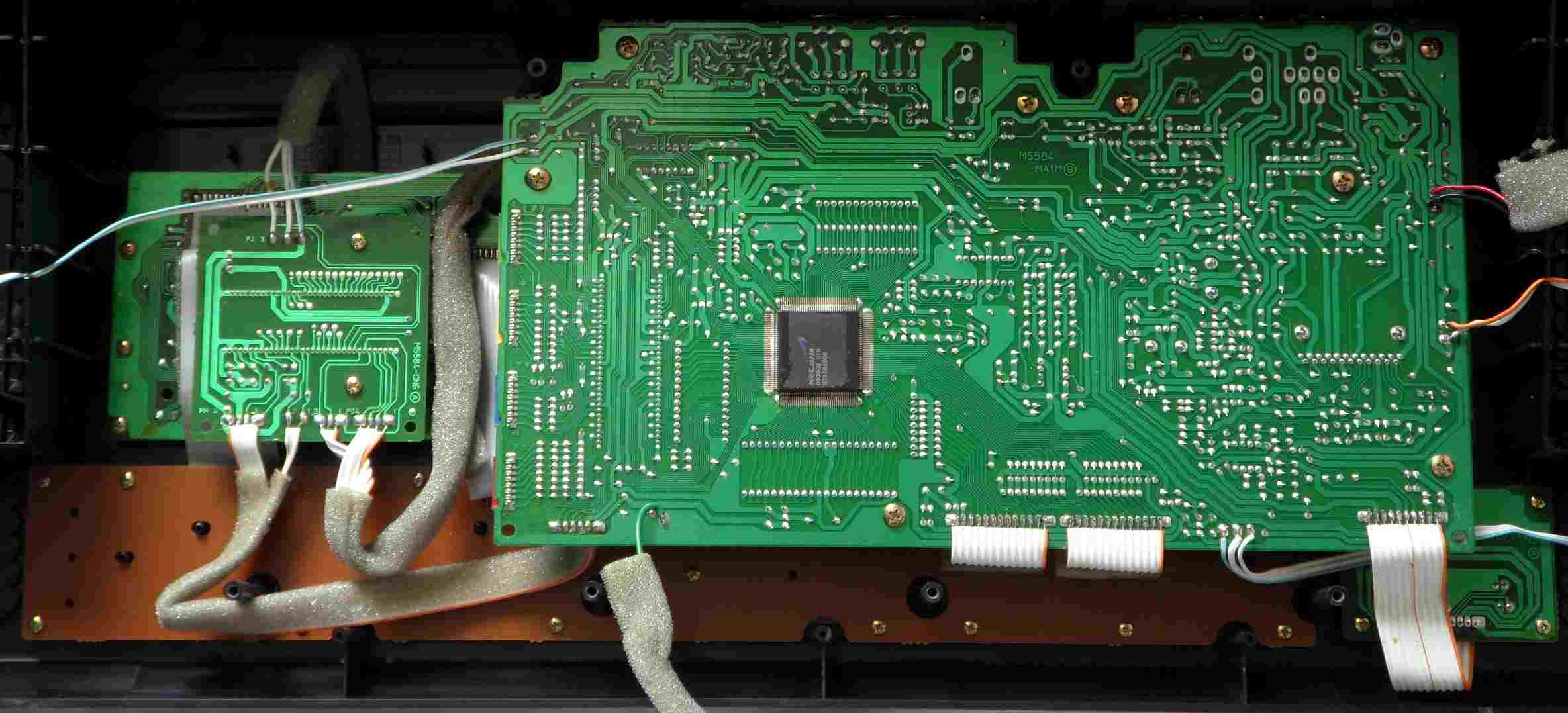
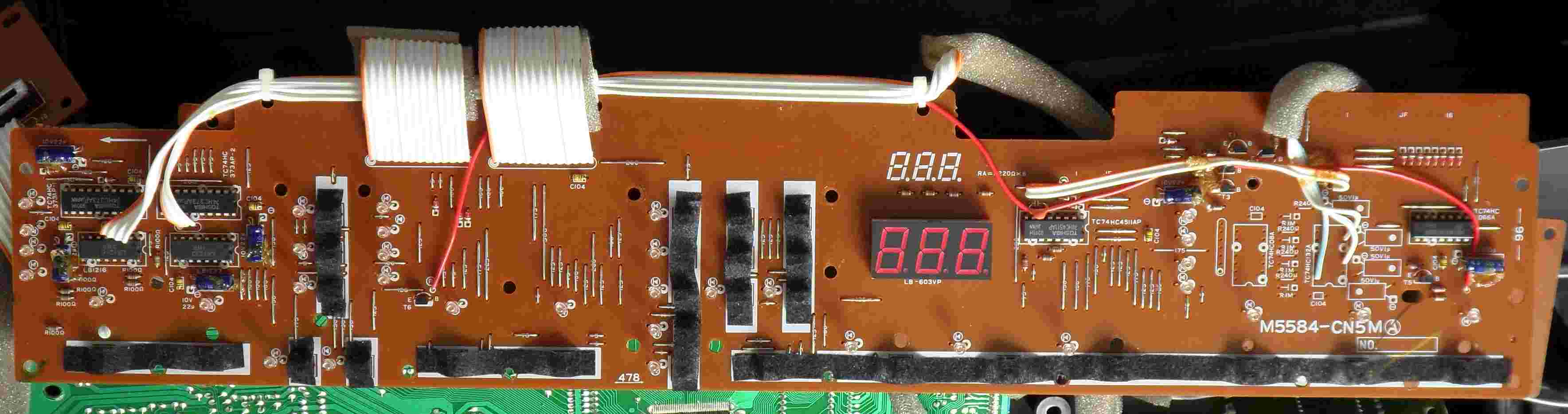
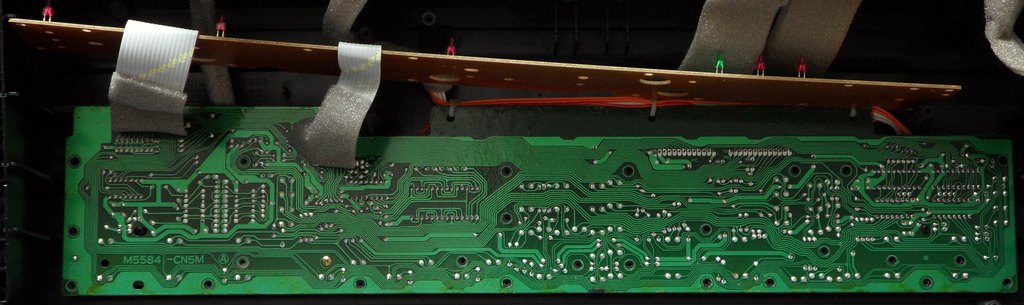
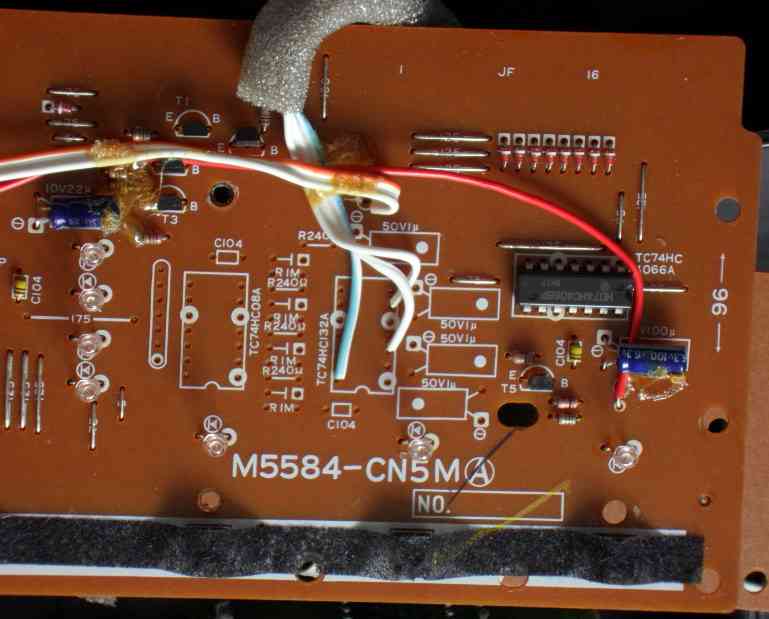
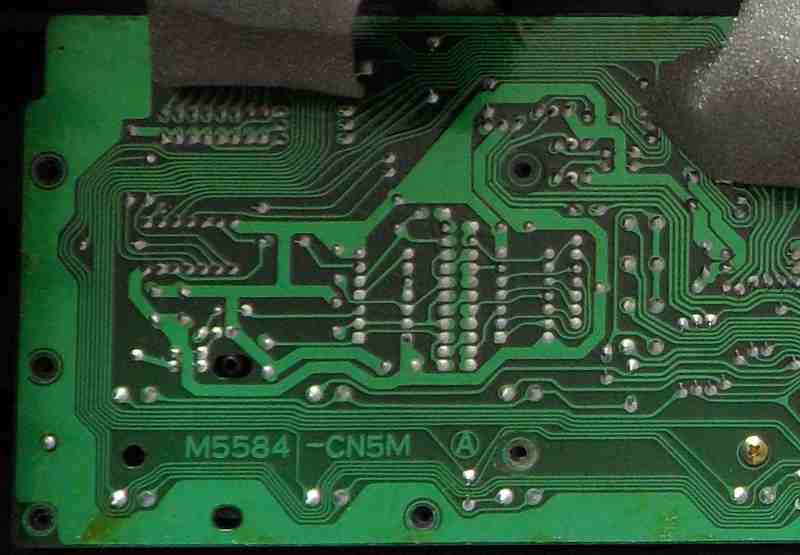
hardware detailsThe Casio CTK-1000 is buit around the main CPU "NEC D939GD 010" with DAC "NEC D6376CX", 32KB SRAM "NEC D43256AC-12L", 32KB DRAM "Sanyo LC33832PL-70" and 2MB ROM ("NEC D23C16000BCZ 065"). There is a panel CPU "NEC D78CP14CW" and keyboard velocity IC= "Casio HG52E35P".
The CPU "NEC D939GD 010" (20MHz) seems to be successor of the MT-540
CPU ("NEC D938GD 005",
120 pin SMD, 2.17248MHz), but unlike the latter it interfaces velocity
sensitive keys and parts of the control panel through 2 external large
ICs and uses most of its 160 tiny (non-BGA) SMD pins to access SRAM, DRAM
and 2MB ROM simultaneously (no shared bus) to increase throughput per clock
cycle. Despite high complexity it fortunately does not run hot and so neither
shortens its own lifespan nor that of the batteries.
Perhaps the panel CPU was also added to save computing time in the main CPU, which here has more sound glitches and irregularities than MT-540. E.g. effect buttons cause strange transient pop noises, the sample split zones are much more audible (i.e. lack interpolation) and the awesome complex algorithmic program loops synthesis sounds are gone. (I.e. the 'sound effect' preset consists here only of a bunch of very plain behaving loop samples.) Knowing that MT-540 was a high grade variant of the softsynth-on-a-chip (Casio SA-series), I guess that Casio threw a lot of goodies out of their algorithm to save computing time for the IXA synthesis, effect section and higher polyphony. The only special behaving preset is 'synth-lead 2', which stays always monophonic with portamento, which hints that there are many hidden synth parameters. The existence of a keyboard velocity IC otherwise is not strange; Casio CT-6000 and HT-6000 use them too, to free the main CPU from extreme timing requirements of sensing velocity. The effect section DSP in fact may be hardware (seen in Casio patents) and likely uses the DRAM. So it might be possible to install a microcontroller between CPU and RAM to edit further parameters or at least backup its content on persistent memory. It also may be that the strange D78CP14CW can be replaced with a programmable microcontroller to unleash hidden synth capabilities of this thing. |
There are 5 demo songs:
Despite superficial similarities with Casio
VA-10 (both from 1993), the ICs have nothing common. On eBay I
saw a workstation keyboard Casio CTK-711EX, that seemed to be an
even bulkier lookalike of CTK-1000. But it is based on a different chipset
(verified by CTK-711EX service manual) with different sounds (General Midi)
and features; its better variant CTK-811EX even had a diskette drive.
Nothing uses the same hardware platform, so the CTK-1000 remains unique.
Later velocity sensitive CTK keyboards are completely loop sample based
and lack the complex time dynamic behaviour of algorithmic sounds.
| removal of these screws voids warranty... | ||
 |
 |
|
|
|