CASIO
MT-210
  keyboard with warm timbres & versatile accompaniment

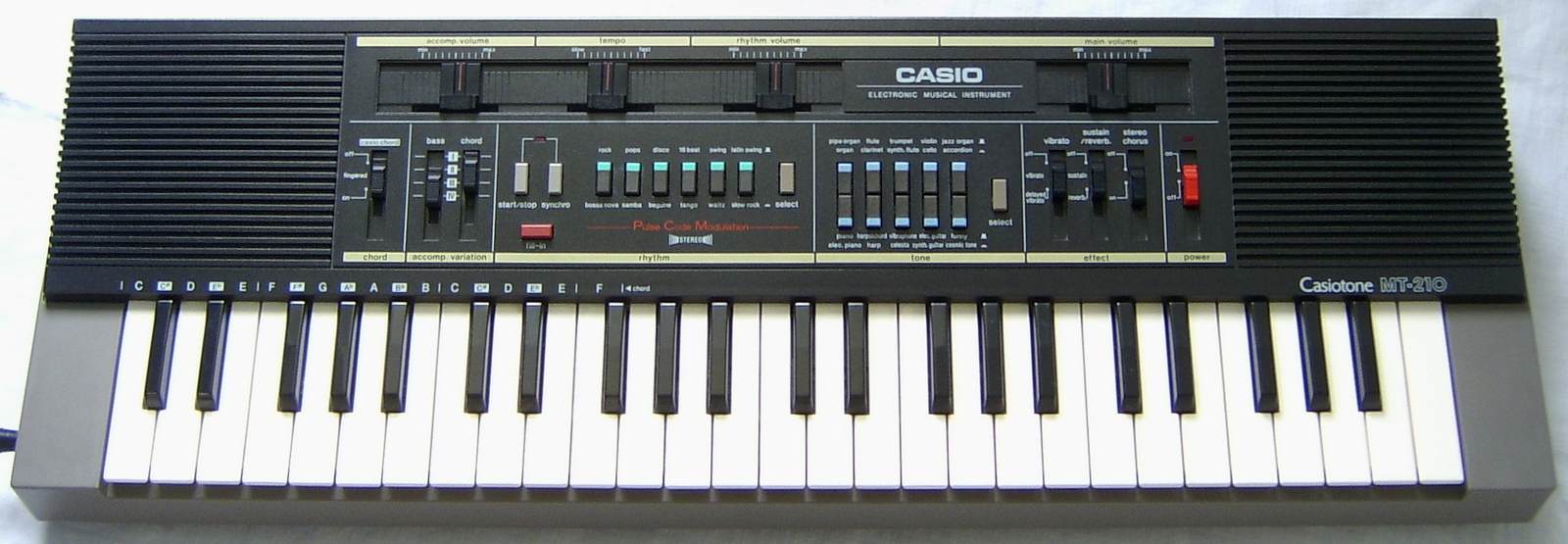
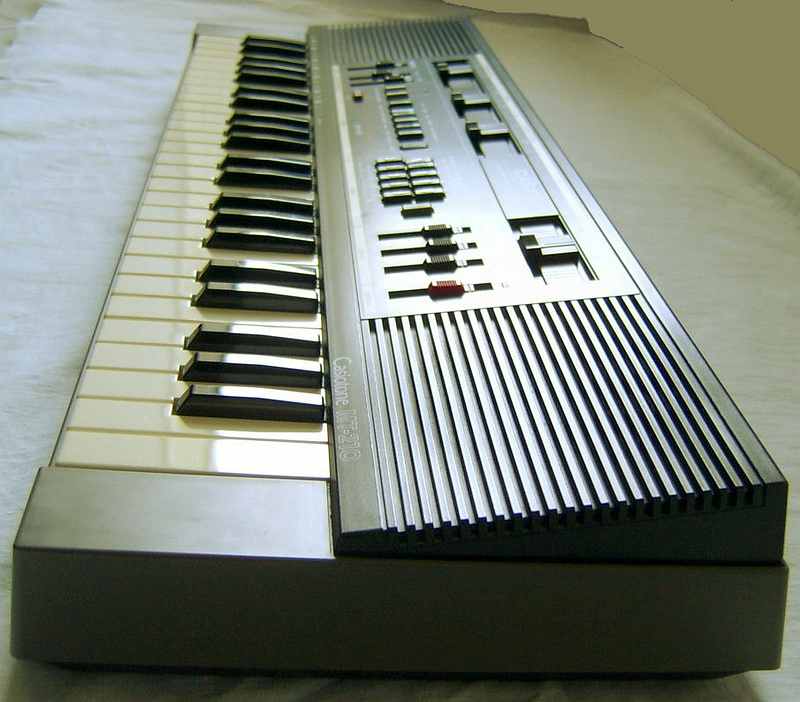
This keyboard was apparently a close successor of the legendary Casio MT-65. It has quite warm semi- analogue sound with versatile accompaniment and sample based percussion.

The user interface and behaviour is very similar like Casio CT-410V (i.e. neither arpeggio nor envelope switches) although it lacks the analogue VCF section and differs in some preset sounds. The main difference of its hardware is the sample based PCM percussion. Only cymbal and hihat are semi-analogue using a hissy semi-metallic waveform.

The Casio MT-210 was used to open a spacetime portal in the movie Masters of the Universe from 1987.

Due to strong similarities I only describe here the differences to CT-410V.
different main features:

eastereggs:

  • possibly everything missing from Casio MT-65 (has same keyboard matrix layout, see CT-410V).
  • modifications:

    notes:

    The instrument has warm semi-analogue Consonant-Vowel timbres for main voice and accompaniment; many have the characteristic buzzy bass range. Despite different CPU software number, most sounds and user interface strongly resemble CT-410V, thus I only mention some differences. 'cosmic tone' here rather resembles a bowed glass (or phone dial tone?). 'synth. flute' is a flute timbre with slightly percussive simple home organ envelope. 'synth. guitar' is duller and less percussive than 'elec. guitar' and resembles an e-bass.

    The here employed "Pulse Code Modulation" percussion engine knocks less woody than in other Casios. Mainly base, tom, high conga, low conga and handclap sound sampled. But cymbal and hihat sound too hissy - made from a static semi-metallic hiss waveform with analogue envelope and filtering. Likely also snare contains some analogue hiss. The bass voice of the accompaniment sounds warmer than in CT-410V due to different filters.
     

    hardware details

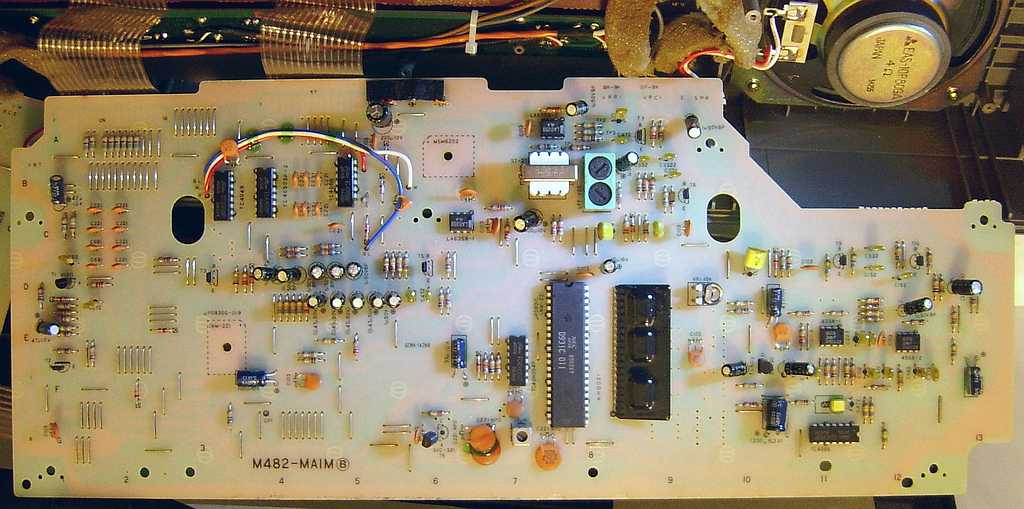
    The Casio MT-210 is built around the accompaniment CPU "NEC D930G 019" with main voice sound IC "NEC D931C 011" and percussion IC "OKI M6202-19".
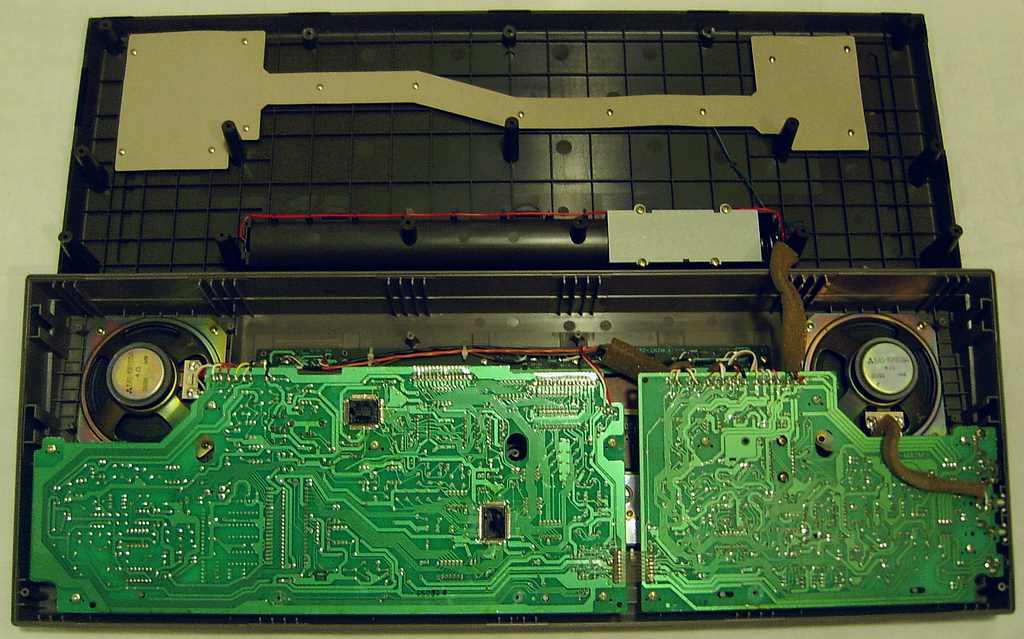
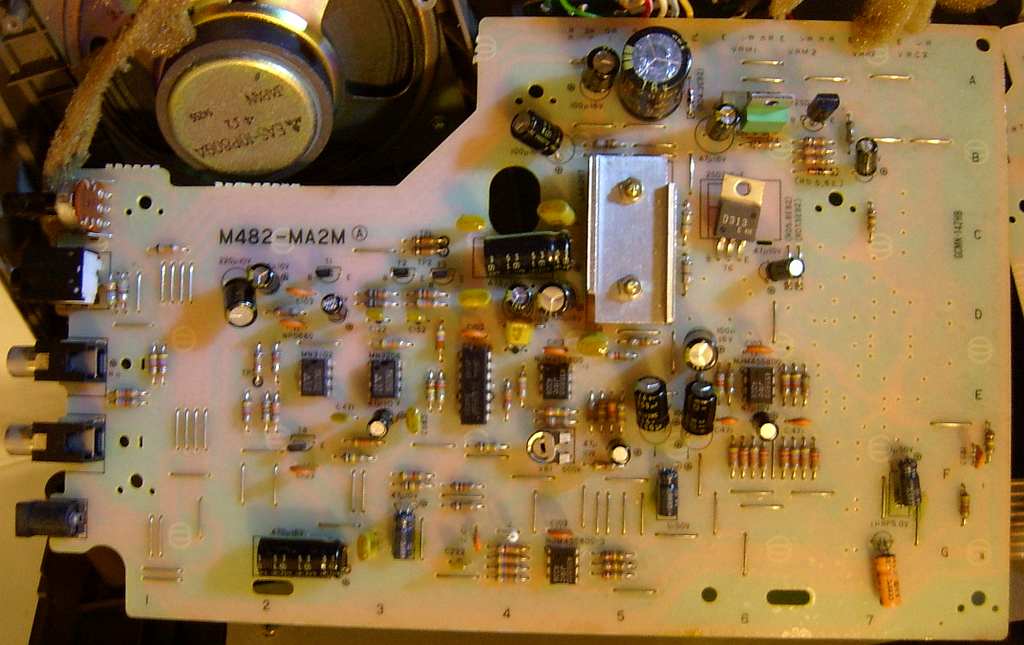
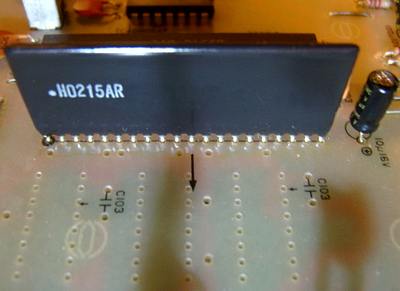
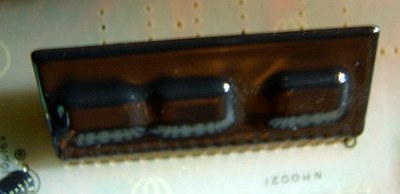
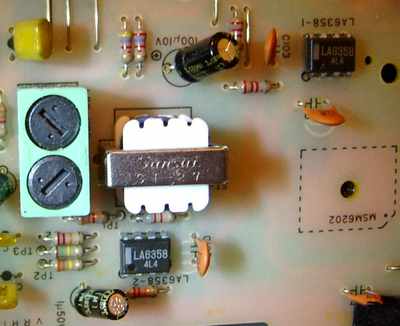
    Despite digital percussion, the MT-210 has complex multi-chip hardware on 2 large PCBs with many discrete components. The hardware strongly resembles Casio CT-410V (without the VCF section) and has a stereo chorus, but the software number of the D930G differs - likely because it drives the unique digital drum IC "OKI M6202-19" that Casio used nowhere else except in the fullsize version Casio CT-430 (of which I got a service manual PDF that consists only of schematics and parts list; page numbers look ok and the paper copy owner claims it is complete). Its output runs through 2 identical op-amps with a small transformer in between (likely to convert symmetric to asymmetric output), which may contribute to the special percussion sound. Hihat and cymbal are still semi-analogue, using discrete circuits with shiftregister noise from the D930G. The D931C uses here a DAC hybrid "HO215AR" (in parts list "NH0021"). Nearby are empty solder holes for 3 ICs and a pin row for a ribbon cable or shorter hybrid. Possibly originally a different DAC or more complex main voice filters were planned.

    keyboard matrix

    This matrix is based on Casio CT-430 schematics (shows no keys section). I haven't analyzed this matrix by myself, but beside the preset sounds "jazz organ" (KI5->KC10) and "violin" (KI4->KC10) the panel seems fully identical with standard MT-65 hardware (see CT-410V) despite the CPU software number differs. The outputs KC1..KC5 and KC8 are multiplexed with percussion data, that is read by the percussion IC during a pulse on pin 64.
     
    51 KI1
    50 KI2
    49 KI3
    48 KI4
    47 KI5
    46 KI6
    45 KI7
    44 KI8
     
    CPU pin
    in 1
    in 2
    in 3
    in 4
    in 5
    in 6
    in 7
    in 8
    in / out
     
    o
    C1
    o
    C#1
    o
    D1
    o
    D#1
    o
    E1
    o
    F1
     
     
    out 1
    52 KC1
    o
    F#1
    o
    G1
    o
    G#1
    o
    A1
    o
    A#1
    o
    B1
     APO disable
    C.
    memory
    mode
    out 2
    53 KC2
    o
    C2
    o
    C#2
    o
    D2
    o
    D#2
    o
    E2
    o
    F2
    C.
    casio
    C.
    fingered
    out 3
    54 KC3
    o
    F#2
    o
    G2
    o
    G#2
    o
    A2
    o
    A#2
    o
    B2
     C.
    manual bass
     C.
    arpeggio on
    out 4
    55 KC4
    o
    C3
    o
    C#3
    o
    D3
    o
    D#3
    o
    E3
    o
    F3
     
     
    out 5
    56 KC5
    o
    F#3
    o
    G3
    o
    G#3
    o
    A3
    o
    A#3
    o
    B3
     
    key hold
    out 6
    57 KC6
    o
    C4
    o
    C#4
    o
    D4
    o
    D#4
    o
    E4
    o
    F4
     C.
    memory
    octave down
    out 7
    58 KC7
    o
    F#4
    o
    G4
    o
    G#4
    o
    A4
    o
    A#4
    o
    B4
    transpose
    on
    transpose
    set
    out 8
    59 KC8
    o
    C5
    R.
    synchro
    R.
    start/stop
    R.
    fill-in
    O.
    envelope 1
    O.
    envelope 2
    O.
    select
     R.
    select
    out 9
    60 KC9
    O.
    pipe organ
    O.
    flute
    O.
    trumpet
    O.
    violin
    O.
    jazz organ
    O.
    bank switch
     
     
    out 10
    61 KC10
    C.
    bass 2
    C.
    bass 3
    C.
    chord 2
    C.
    chord 3
    O.
    sustain
    O.
    vibrato
    O.
    delayed
    vibrato
    O.
    reverb.
    out 11
    71 KC19
    R.
    rock
    R.
    pops
    R.
    disco
    R.
    16 beat
    R.
    swing
     R.
    latin swing
    C.
    arpeggio 2
    C.
    arpeggio 3
    out 12
    70 KC20

    All unknown function names and in/ out numbers in this chart were chosen by me. The input lines are active- low, i.e. react on GND, thus any functions are triggered by a switch in series to a diode from one "in" to one "out" pin.
     

    legend:

    "o"
    = keyboard key
    underlined
    = function needs locking switch (i.e. stays active only so long the switch is closed)
    R.
    = rhythm
    C.
    = chord
    O.
    = orchestra (main voice sound)
    orange
    background 
    = easteregg (unconnected feature)

    note: The shown eastereggs were only concluded from CT-410V and may be wrong due to different software number.

    pinout M6202

    The Drum LSI "OKI M6202-xx" (60 pin SMD) is the digital percussion IC of Casio MT-210 (and fullsize version CT-430). "xx" is the software number of internal ROM. This obscure IC was apparently derived from a speech IC for talking watches. It contains no hihat/cymbal sounds (the instrument produces them externally). The 2 internal DACs produce each one half of the waveform, those are sent through 2 identical op-amps (amplification=1) to both ends of a small transformer (looks like a converter from symmetric to assymetric). Most pins are unused.

    The CPU D930G 019 controls the M6202-19 through the matrix lines KC1, KC2, KC3, KC4, KC5, KC8 (through a driver) to lines A1..A6, and the same KC lines fed into a 6-input NAND with its inverted output to A0 and again inverted to a diode from A2. I.e. A0=hi while any of A1..A6 is hi. Each A# line has a damping capacitor to GND. It is unknown if these are actual digital data or simply triggers for individual drums. From CPU pin 64 (likely chip enable) there is an inverted signal to "LOAD".

    I have only schematics from an incomplete looking Casio CT-430 service manual, which beside some pin names does not explain anything. This IC uses negative logics, so voltage pins are not what their name suggests.

    I read in a forum that a version M6202-11 was used in Technics K200. In the OKI Voice Synthesis LSI Data Book of 1987 there is an amplifier IC OKI MSM1161; they mention that was for use in watches and specially designed to interface the MSM6202 speech synthesizer IC. Also pin names look the same. The book doesn't explain the 6202 but detailedly discusses the likely similar MSM6212, which pin names are blatantly similar although pinout differs. It uses ADPCM (compressed or uncompressed) with 288K ROM (40s, up to 124 words or syllables) and 10-bit DAC, running at 32768 kHz clock rate (typical for quartz watches) and indeed has address inputs.
     
    pin name purpose
    1    
    2 VSS ground 0V 
    3 TX CON (wired to VDD)
    4 S/P (wired to ground 0V) 
    5 SD0 adpcm data in? (not used)
    6 SD1 adpcm data in? (not used)
    7 SD2 adpcm data in? (not used)
    8 T2 test (wired to ground 0V)
    9 T1 test (wired to ground 0V)
    10    
    11    
    12    
    13    
    14    
    15    
    16    
    17    
    18    
    19    
    20    
    21    
    22    
    23   (wired to VDD) 
    24    
    25    
    26    
    27    
    28    
    29    
    30    
    pin name purpose
    31    
    32    
    33    
    34    
    35    
    36    
    37 SLB amplifier mode (wired to ground 0V)
    38 VDD supply voltage (+3V?)
    39 SLA amplifier mode (wired to VDD) 
    40 MSB dac most significant bit (not used)
    41 DAU dac upper half wave out
    42 DAL dac lower half wave out
    43 SPE speaker enable in (not used)
    44 VCK voltage doubler clock in (not used)
    45 LOAD chip enable (from cpu pin 64)
    46    
    47 A0 address (from AND(A1..A6))
    48 A1 address (from cpu KC1)
    49 A2 address (from cpu KC2 | diode to /A0)
    50 A3 address (from cpu KC3)
    51 A4 address (from cpu KC4)
    52 A5 address (from cpu KC5)
    53 A6 address (from cpu KC8)
    54 AC reset (from cpu pin 18)
    55 S2 (wired to ground 0V)
    56 S1 (wired to ground 0V)
    57 MAR (not used)
    58 VDD supply voltage (+3V?)
    59 /TX to crystal
    60 TX crystal 65536kHz 

    According to OKI Voice Synthesis LSI Data Book, many oddities of the M6202 likely originate from ultra-low power consumption for use in talking watches. DAU outputs the positiv and DAL the negative halfwave of the DAC. /MSB out = hi while DAL output is active. 

    The MSM6212 latches the address during a hi pulse on LOAD. It supports only up to 8.2 kHz sample rate (also 6,55 kHz, 4.1 kHz), hence Casio likely doubled the clock rate to increase timbre quality while halving the duration. According to its block diagram, pins SD0..SD3 likely can feed the ADPCM synth with external sound data. S/P controls a latch between ADPCM synth and DAC (to stop output?). T1, T2 are test pins.

    Casio used a successor of this chip family OKI M6373 for drumpad sounds in toy-like instruments.

    Another unique early Casio percussion IC is the HD61701 found in Casio CT-6000 (which has more and even grainier percussion sounds).

    A fullsize version of MT-210 was released as Casio CT-430.
     

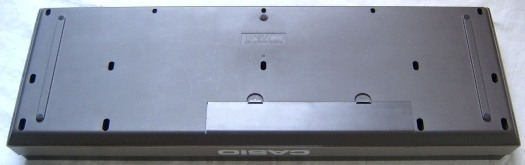
     removal of these screws voids warranty...    
    WarrantyVoid
    back to tablehooters collection
     
     
    back