
|
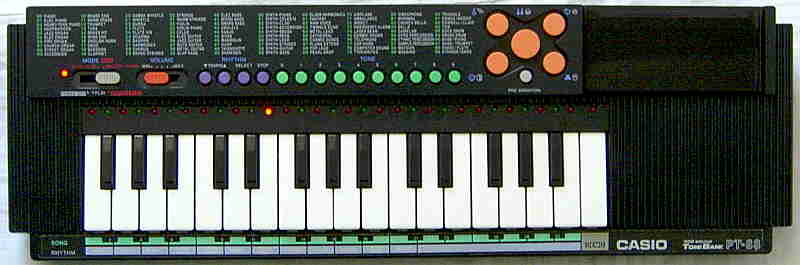
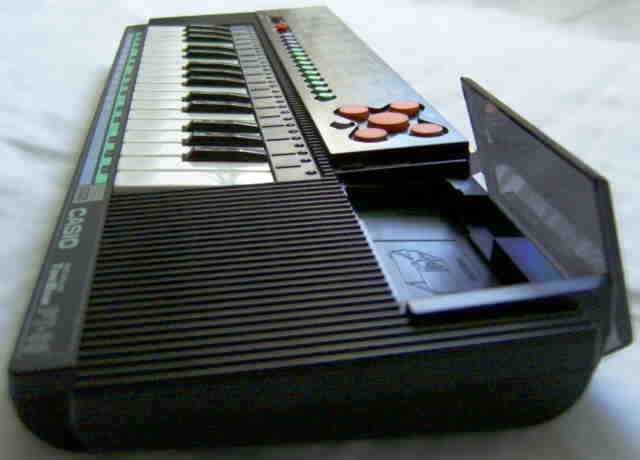
mini keyboard with ROM-Pack ? key lighting |
This is basically a Casio SA-1 with ROM-Pack slot and melody guide key lighting feature (LED row above the keys).
 |
 |
 |
3 drumpads addable (no new sounds). different melody guide (without waiting) addable. polyphony 6 notes addable (needs key diodes against note mess).
hardware detailsThe Casio PT-88 is based on the OKI M6521-02 CPU. This hardware strongly resembles classic SA-series but supports ROM-Pack and key lighting.
keyboard matrixThe key matrix is grouped by 8, while most bigger Casios have 6er groups. It supports 3 additional drumpads, a melody guide mode without waiting and can enable higher polyphony.This matrix was analyzed by myself and verified with service manuals
of Casio ML-2, ML-3, ML-1.
The input lines are active- high, i.e. react on +Vs, thus any functions
are triggered by a switch in series to a diode from one "out" to one "in"
pin.
In the LED matrix each LED is wired from an LY# to an LX# pin of the CPU. eastereggs 3 additional drumpad buttons at KO4->KI5..KI7 play snare, cymbal and low synth tom. In PT-88 these are anyway reachable through the pad variation button and nothing special. Strange is that the variation button plays on these pads 3 of the preset sounds (which resembles SK-series behaviour when no sample is recorded). The "melody guide 2" mode at KO7->KI2 works like the normal one, but the song does not wait until you play the correct note. Like karaoke it just plays the accompaniment of the song and the LEDs suggest what you should play, but it doesn't care if you don't. Like M6387 (classic SA-series) also M6521 based hardware can run in reduced polyphony mode, because in cheapened models key matrix diodes were omitted and the polyphony limited to 2 to prevent note mess. Connecting a diode at KO7->KI7 (sensed during power-on) enables 6-note polyphony mode. But to make it work properly, you will need to additionally solder 1 diode in series with each key. For technical details see here. pinout M6521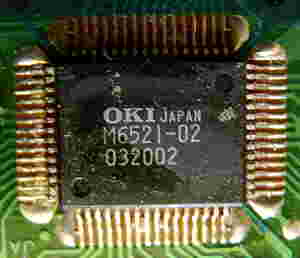 The
"OKI M6521-xx" CPU (pins count anticlockwise, xx = software number of internal
ROM) is a 60 pin SMD variant of the M6387
that (unlike older Casio keyboards) supports a matrix of key lighting LEDs
without the need of driver transistors. Each LED is wired from an LY to
an LX pin. The pins 51..58 can control the ROM-Pack
port. Without a ROM-Pack connected, the key lighting uses demo songs
from its internal ROM. Polyphony is up to 6 notes. Like M6387 it is clocked
at 21.725 MHz. The
"OKI M6521-xx" CPU (pins count anticlockwise, xx = software number of internal
ROM) is a 60 pin SMD variant of the M6387
that (unlike older Casio keyboards) supports a matrix of key lighting LEDs
without the need of driver transistors. Each LED is wired from an LY to
an LX pin. The pins 51..58 can control the ROM-Pack
port. Without a ROM-Pack connected, the key lighting uses demo songs
from its internal ROM. Polyphony is up to 6 notes. Like M6387 it is clocked
at 21.725 MHz.
The versions of "OKI M6521-xx" ("xx" = software number of internal ROM)
differ in demo songs, rhythms and sound set.
This pinout was concluded from the service manual of ML-2 (which uses
no ROM-Pack), SK-8 service manual and wiring
of the PT-88 PCB.
In PT-88 the unused CPU pins 47, 49, 50 stay hi and 48 stays lo. |
Midsize key variants of this instrument (polyphony 4 notes) were released as Casio PT-380 (polyphony 6 notes, microphone), as PT-480 (different case, additional "voice changer" +/- buttons, sold in Spain and Poland?). Another rare version (voice changer, 8 additional effect pads, case and concept resembling PA-31) was Casio PA-81 (as Japan version PT-580). A Japanesse midsize variant with 3 flashing metronome LEDs and "Do Re Mi Guide" (see CT-840) was Casio PT-680. (I don't know if due to sing samples it uses a M6567 CPU like in CT-840, but the panel layout looks like a PT-88 variant.)
A successor of this hardware class (no ROM-Pack slot) was Casio
ML-1 and ML-2.
| removal of these screws voids warranty... | ||
 |
 |
|
|
|
