Casio
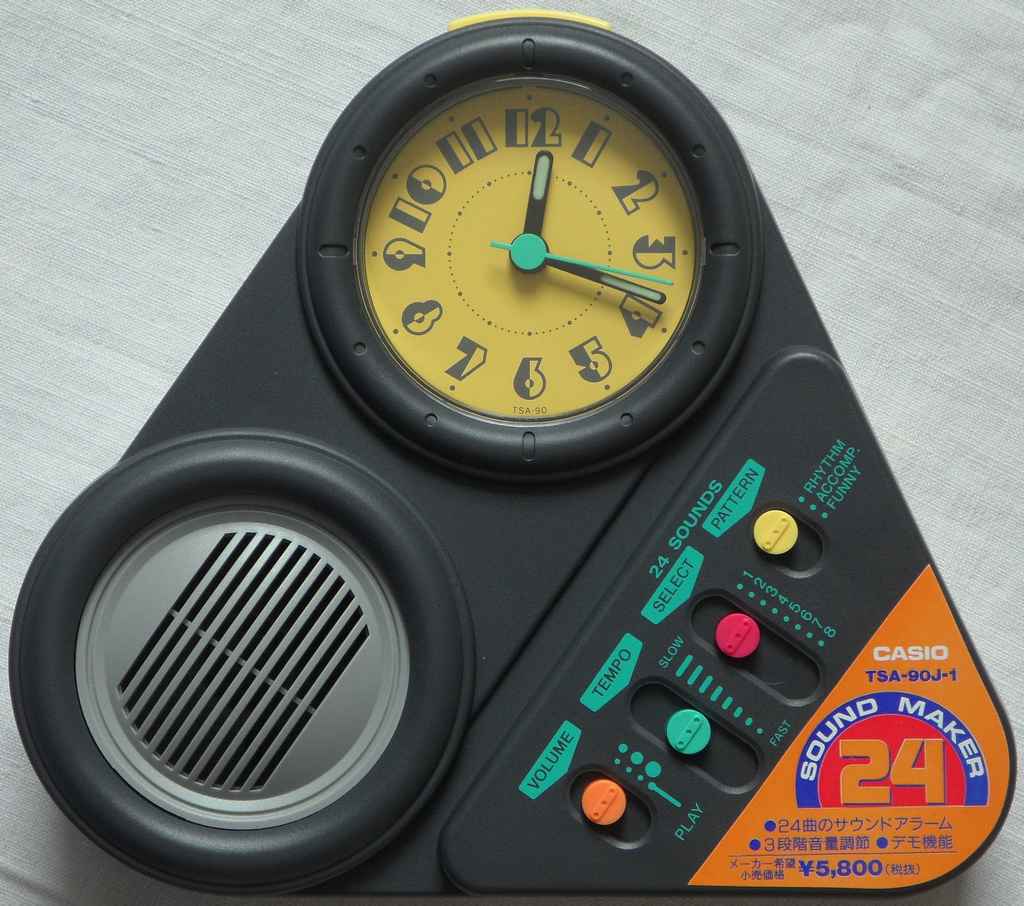
TSA-90 Sound Maker (alarm clock with SA-series accompaniments)
This rare analogue alarm clock made in Thailand is the likely most bizarre
spinoff of the Casio SA-series.
It's 24 selectable alarms are exactly the rhythm and accompaniment patterns
of SA-35 and even have tempo
control.
main features:
-
analogue quartz movement
-
fairly big speaker
-
8 preset rhythms {8 beat, 16 beat, swing, slow rock, shuffle, march, samba,
waltz}
-
8 preset rhythms with accompaniment {rock, pops, jazz, funk, house, country,
latin, classical}
-
8 "funny" accompaniments {fanfare, hopper, computer sound, horror, child's
play, orient, jungle, comedy}
-
rhythms/accompaniments selected through 'select' (8 steps) + 'pattern'
(3 steps) slide switch
-
tempo slide switch (8 steps)
-
volume slider (3 steps + test)
-
CPU= "OKI M6387-19, 5192318,
Japan" (30 narrow pin DIL)
eastereggs:
-
5 drumpads + select button (3 banks) addable.
-
shitshot sometimes plays garbled "Twinkle Twinkle Little Star" (not a demo).
notes:
It is unknown what Casio had planned with this. For an alarm clock the
speaker in its deep triangular case sounds surprisingly good, and the selection
of sound patterns with tempo control is odd. Possibly they intended to
create a cheap beginner's drummachine with accompaniment, but the M6387
CPU turned out to be a poor choice, so they may have stopped the project
in the middle and decided to only make an alarm clock of the half-baked
thing. The chip internally still supports 5 drumpads with 3 sound sets,
but I found no rhythm start/stop button nor pattern variations nor other
kinds of programmability.
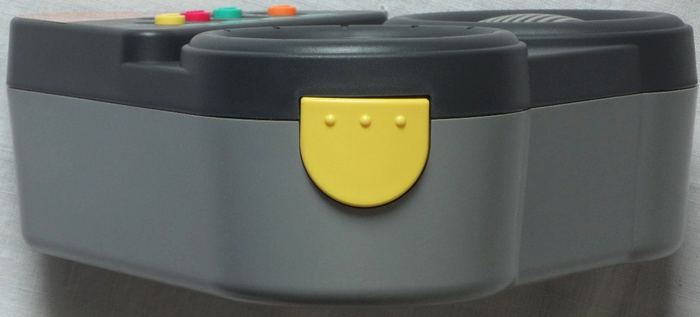
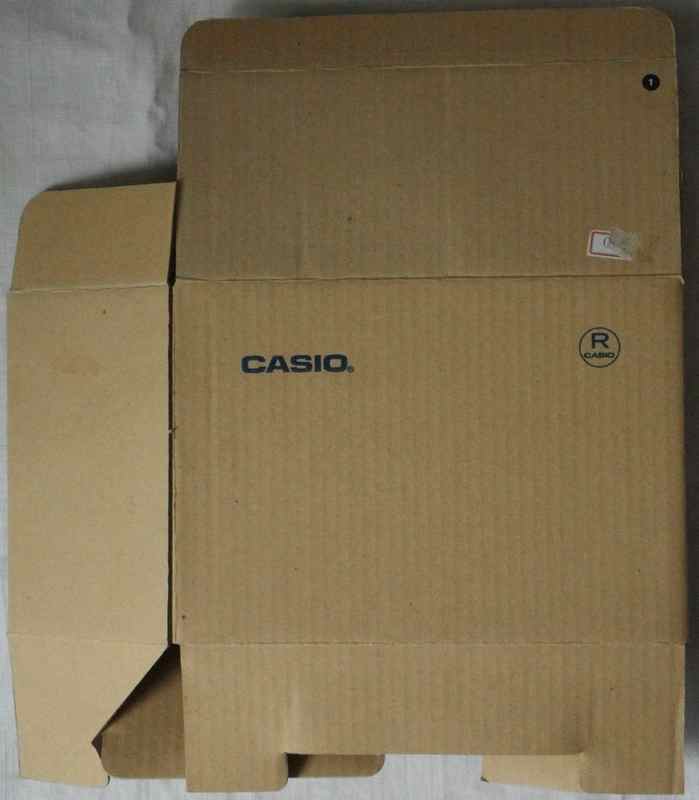
My version TSA-90J-1 (a Japan import, bough used on eBay) has
a yellow clockface and came in an undecorated plain beige original box
with blue Casio label. The clock still has the orange sticker "SOUND MAKER
24" with the intended retail price of 5800 Yen; apparently this version
was sold only in Asian countries. On eBay I saw another package variant
in colourful printed retail box that depicts a blue version with cyan clock
face and red speaker. It came with multilingual manual, but the clock itself
(also depicted on box side) had colours like mine.
In my Japanese language instruction sheet the 24 patterns have the same
names like in SA-35. The 4th step of the volume slider (loudest, like 3)
acts as alarm test mode to always activate the sound at full volume as
an accompaniment device. If you want to play them quieter, simply remove
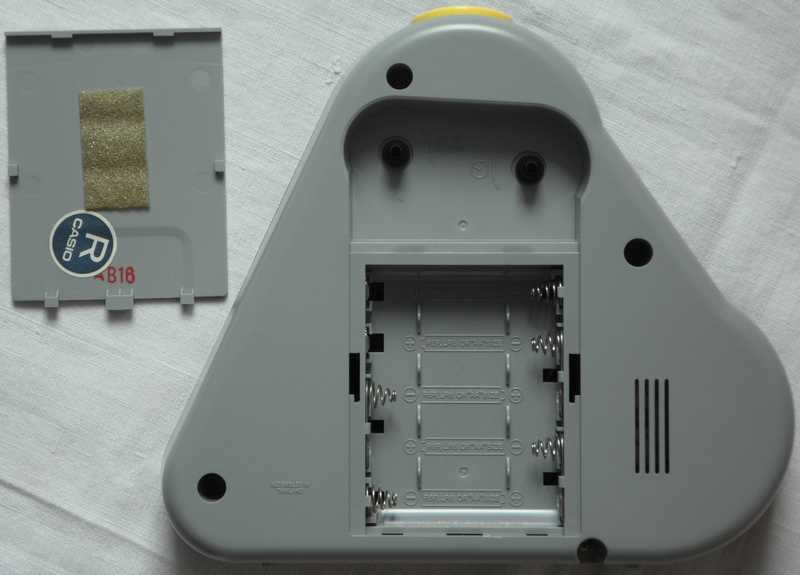
the clock battery (the AA cell closest to the set knobs) and set the clock
hands to alarm time.
hardware details
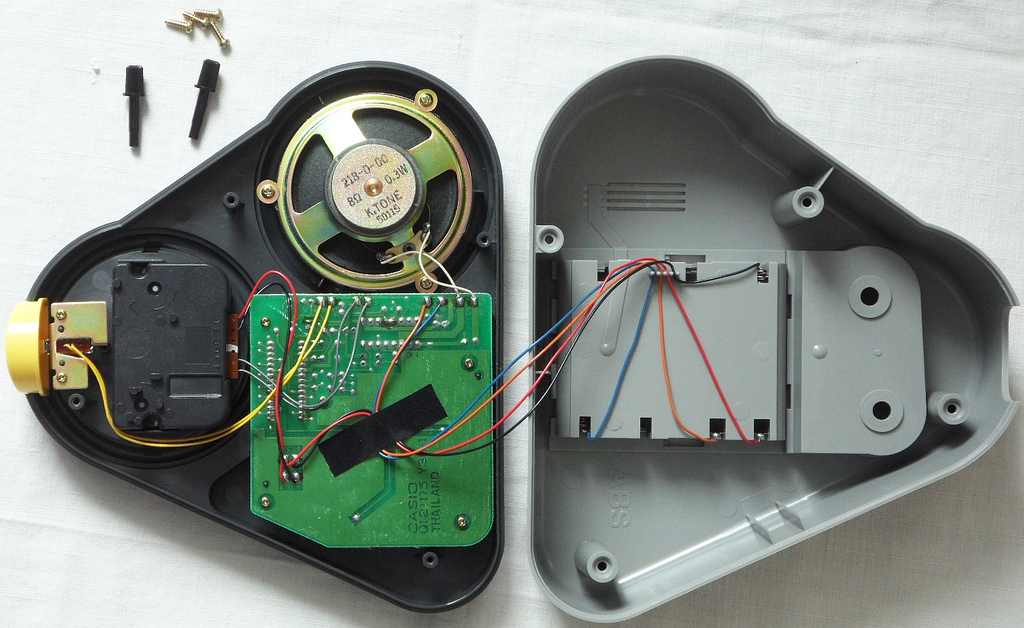
The Casio TSA-90 is based on classic SA-series
keyboards. It is built around the "OKI M6387-19"
CPU with amp IC "Motorola AN8053N" (16 pin DIL).
The analogue quartz movement has a separate 1.5V AA battery and its alarm
contact in series to the alarm off switch simply interrupts the supply
voltage to the sound hardware (powered by 4 AA batteries) when alarm is
not sounding. The 4th step of the volume slide switch bypasses both to
act as alarm test mode.
keyboard matrix
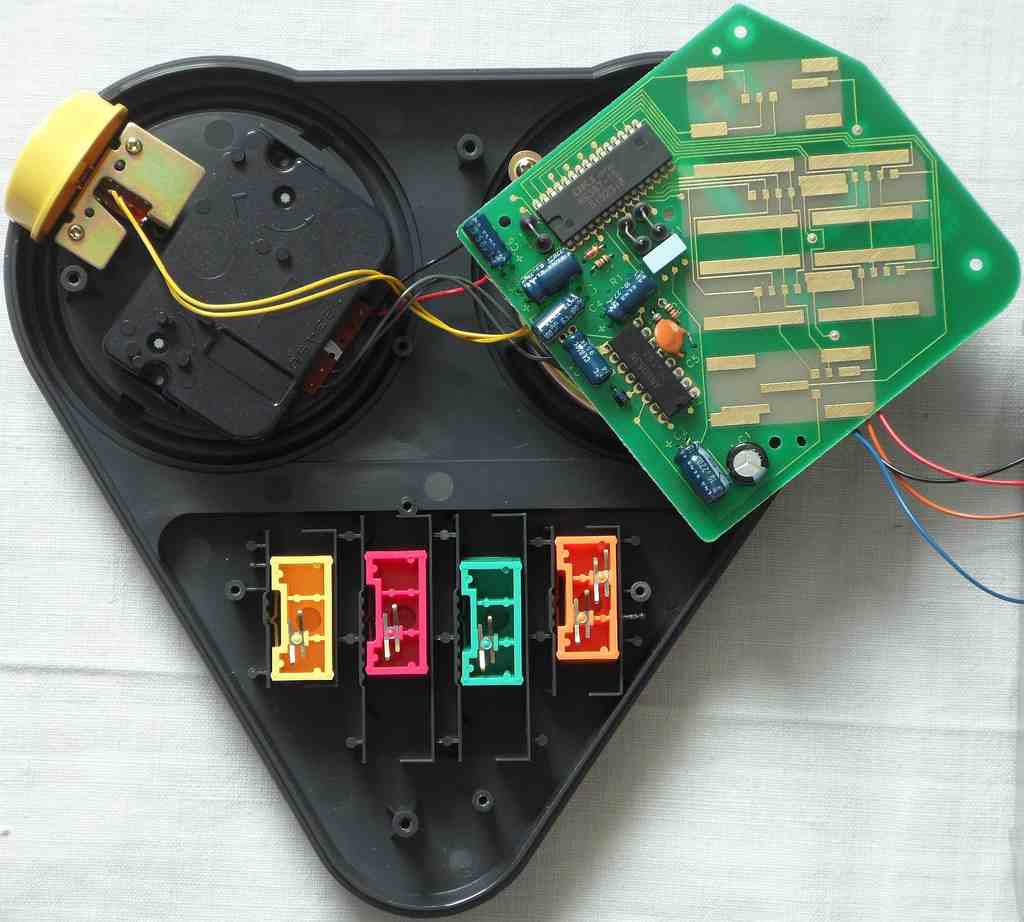
The keyboard matrix has no diodes. Each row is one function. The pattern
starts and keeps playing automatically so long the CPU is connected to
power. The 'pattern' switch simply changes the matrix row of the 'select'
switch to change among {rhythm, accomp, funny}. Technically they don't
need to be locking. With all slide switches open (intermediate position),
the CPU starts with default pattern '8 beat', tempo 4 and volume 5.
As eastereggs there are 5 drumpad buttons + select button (3 banks).
The lots of empty matrix places next to them look wasted, but make sense
to avoid collisions by the lack of diodes.
|
11 KI0
|
12 KI1
|
13 KI2
|
14 KI3
|
15 KI4
|
16 KI5
|
17 KI6
|
18 KI7
|
|
CPU pin
|
|
in 0
|
in 1
|
in 2
|
in 3
|
in 4
|
in 5
|
in 6
|
in 7
|
in / out
|
|
|
8 beat
|
16 beat
|
swing
|
slow rock
|
shuffle
|
march
|
samba
|
waltz
|
out 0
(rhythm)
|
30 KO0
|
|
rock
|
pops
|
jazz
|
funk
|
house
|
country
|
latin
|
classical
|
out 1
(accomp)
|
29 KO1
|
|
fanfare
|
hopper
|
computer sound
|
horror
|
child's play
|
orient
|
jungle
|
comedy
|
out 2
(funny)
|
28 KO2
|
|
1 (slow)
|
2
|
3
|
4
|
5
|
6
|
7
|
8 (fast)
|
out 3
(tempo)
|
27 KO3
|
|
1 (quiet)
|
2
|
3
|
4
|
5 (loud)
|
5
|
5
|
5
|
out 4
(volume)
|
26 KO4
|
|
D. 1
|
-
|
-
|
-
|
-
|
-
|
-
|
-
|
out 5
|
25 KO5
|
|
D. 2
|
-
|
-
|
-
|
-
|
-
|
-
|
-
|
out 6
|
24 KO6
|
|
D. 3
|
-
|
-
|
-
|
-
|
-
|
-
|
-
|
out 7
|
23 KO7
|
|
D. 4
|
-
|
-
|
-
|
-
|
-
|
-
|
-
|
out 8
|
22 KO8
|
|
D. 5
|
-
|
-
|
-
|
-
|
-
|
-
|
-
|
out 9
|
21 KO9
|
|
D. bank
|
-
|
-
|
-
|
-
|
-
|
-
|
-
|
out 10
|
20 KO10
|
The input lines are active-high, i.e. react on +Vs. Any functions can
be triggered by a non- locking switch in series to a diode from one "out"
to one "in" pin (which here is not needed).
legend:
|
|
|
D.
|
= drumpad |
orange
background |
= easteregg |
grey
background |
= unconnected doublet |
The 5 drumpads connect from pins 25..21 (outputs) each to pin 11 KI0.
The bank select button at pin 20->11 cycles through 3 sound sets. By the
special layout no diodes are needed.
| bank |
drumpad
|
| |
1
|
2
|
3
|
4
|
5
|
|
1
|
base |
snare |
tom (synth-) |
hihat |
cymbal |
|
2
|
conga |
afro percussion (hi) |
agogo (hi) |
cowbell (lo) |
clave |
|
3
|
car horn |
laser beam |
marimba (ringing) |
wah voice |
bird (pearl drop) |
These percussions are very close to preset sounds found in Casio
SA-1. The 'tom' is a typical synth tom that goes "piu!". The bird tweet
seems to be a very short note of 'pearl drop'. The ringing 'marimba' may
be intended as a classic phone bell. (Unlike SA-1, ring tempo does not
change with volume setting.) Holding drumpads does not change the sound
duration, i.e. e.g. marimba was not meant to simulate a bell alarm clock.
They also don't stop or interrupt the rhythm/ accompaniment pattern.
The software number 19 of the M6387 CPU seems to be a castrated version
of version 16 found in the SA-35. So order and content of the rhythm/accompaniment
patterns are fully identical. But by the changed keyboard matrix most other
features were omitted to implement the simple slide switch control without
diodes. Shitshot experiments (diode in series to 330 Ohm resistor across
quartz pins) hint that much of the original program code may be still intact.
So despite the matrix seems to support no demo button, it e.g. could glitch
into a loop that played "Twinkle Twinkle Little Star" simultaneous with
the selected rhythm/accompaniment pattern (still switchable); only tempo
control was disabled. |
Another analogue alarm clock with SA-series sound is the Casio
TSA-85 Space Sonic 8 (one slide switch for 8 sounds), which only
plays short looped samples through a simpler CPU.
| removal
of these screws voids warranty... |
|
|
 |

|
|
| |
back
|
|