 |
|
strange
squarewave Casio Rapman knock-off |
|
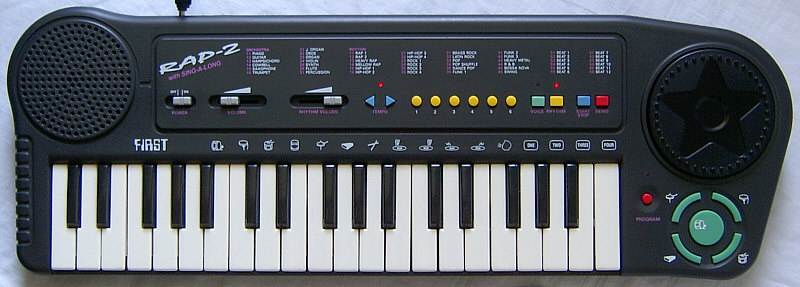
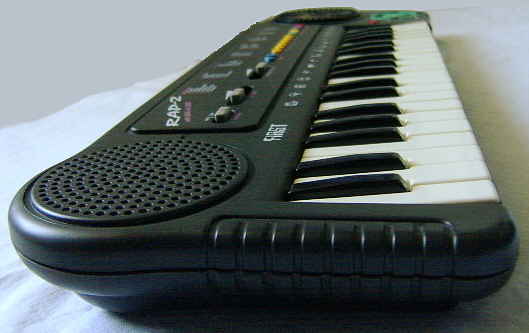
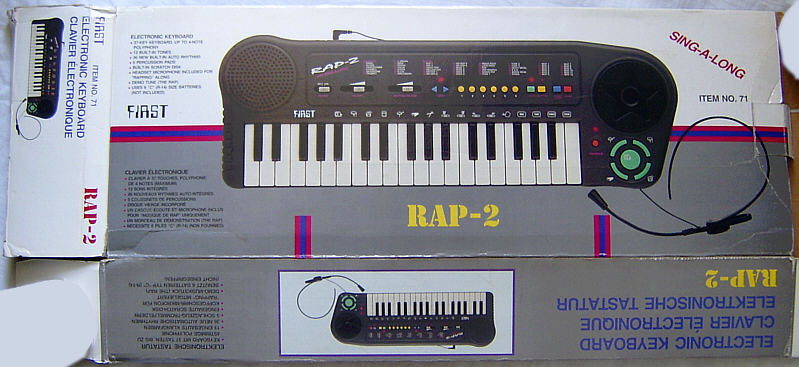
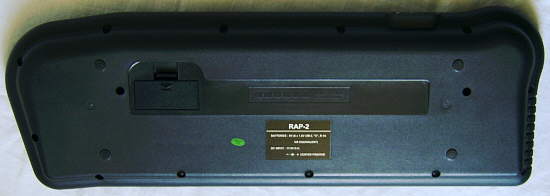
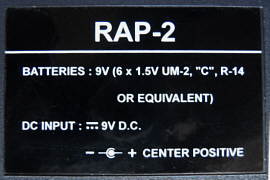
This apparent Medeli instrument from 1994 (?, serial sticker
"94 04") was the Chinese answer to Casio
Rapman RAP-1. Unlike the real thing, the main voice is squarewave
(like MC-3) and there is no voice changer.
Percussion employs short lo-fi samples of drumkit, scratch and voice sounds.
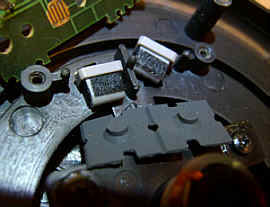
Like RAP-1, the spring loaded scratch disc is fake and only presses 2 buttons,
but unlike it, disc and drumpads can be assigned to any of the 16 keyboard
percussion samples. 12 of the 36 rhythms contain fixed-key accompaniments
and reduce polyphony to 1, but unlike Rapman, with plain rhythms it stays
polyphonic and the keyboard is longer, so it is hard to decide which is
better.

This instrument was also released as Thompsonic TS-22 (seen on
eBay).
main features:
-
37 midsize keys
-
polyphony 4 notes (only 1 with accompaniment)
-
13 preset sounds {piano, guitar, harpsichord, cowbell, saxophone, trumpet,
j. organ, oboe, organ, violin, synth, flute, percussion}
-
36 preset rhythms {rap 1..2, heavy rap, mellow rap, hip-hop 1..4, rock
1..4, brass rock, latin rock, pop, pop shuffle, dance pop, funk 1..3, heavy
metal, r & b, bossa nova, swing, beat 1..12} (first 12 contain fixed-key
accompaniment)
-
6 cipher buttons {'1'..'6'} + select buttons for preset sounds & rhythms
-
rhythm volume slider (percussion + accompaniment)
-
tempo +/- buttons (16 steps)
-
5 drum/effect pads {base, tom, snare, cowbell, hihat}
-
scratch disc controller mock-up (presses 2 buttons) {scratch 1..2}
-
keyboard percussion mode {base, tom, snare, conga, hihat, cowbell, claves,
scratch 1..4, "ha!", "one", "two", "three", "four"}
-
multi-chip hardware:
-
CPU= "MC-RAP-1, 3142364, Japan" (42 pin DIL | likely
MC-3DX
with changed software)
-
sound IC= "DSG-MC-3, 3793 (K)"
(24 pin DIL)
-
sample percussion IC= "RAP[?], 1203" (11
pin COB)
-
amp IC= "ST TBA820M, 95A335" (16 pin DIL)
-
main voice is squarewave based. Percussion employs 2 note polyphonic short
medium resolution samples.
-
demo "The Rap" (funky medley of accompaniments with those voice samples)
-
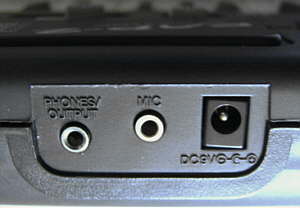
jacks for AC-adapter, microphone, phones/output
eastereggs:
12 lower note keys addable
metronome button addable (percussion test, button can cycle through all
16 samples)
notes:
The rubber drumpad circle (button are plastic) and case design elements
resemble Fujitone 6A.
Preset sounds and rhythms are selected by typing 2 digit numbers; cipher
and tempo buttons sound claves, which disturbs live performance. The demo
starts talking "four, three, two, one", which was likely original planned
for a lesson mode (like in Medeli MC-32)
but not implemented. The combination of squarewave main voice with COB
percussion sample IC resembles Elite MC2200
and Bontempi ES3000
(aka MC-2100). Despite instrument name "RAP-2" the CPU is "MC-RAP-1",
so possibly the creator wanted to name the instrument "RAP-1" but feared
trouble with Casio.
The main voice sounds like MC-3 with
very simple linear volume envelope (neither vibrato nor mandolin ring effects),
which of course doesn't sound realistic. The 'guitar' doesn't decay and
has 2s sustain. The 'j. organ' is percussive plain squarewave with 2s sustain;
'synth' is similar with thinner timbre. 'flute' is made from plain squarewave
and resembles a clarinet. Fast played monophonic notes truncate others,
which was possibly done to avoid note clusters in long sustaining sounds.
Higher numbers than 31 (i.e. sound 12 = 'percussion') are ignored, but
valid digits switch the sound.
The percussion samples sound a little too high and are very short. So
'cowbell' and 'claves' sound like short blips. 'scratch' 1..2 (used
by scratch disc) are blatant copies of the corresponding Casio RAP-1 vocoder
sounds, while 3 and 4 are a low and high hissy zap. The 'ha!' resembles
a barking small dog or cuica, while the numbers are spoken by a male voice
very short with truncated ends ("Yello"-style, "three" sounds like
"freak"). Keyboard percussion sounds only on the rightmost 16 white keys;
others stay silent.
To assign percussion sounds to a drumpad or scratch disc direction,
press "program" (LED lit). Hold the corresponding key and operate the pad
or direction (you hear it sound). You can repeat this for others. Press
"program" again (LED off) to end.
The rhythms resemble Casio RAP-1 and were designed for oldschool rap.
Also here those with accompaniment (like RAP-1) play fixed key and render
the main voice monophonic, which makes them badly suited for melody play.
The 3 note polyphonic accompaniment styles resemble the "Sonic the Hedgehog"
videogame (funk or jazz patterns) and use a saxophone- like organ tone.
Unlike RAP-1, at least those without accompaniment keep 4-note main voice
polyphony.
circuit bending details
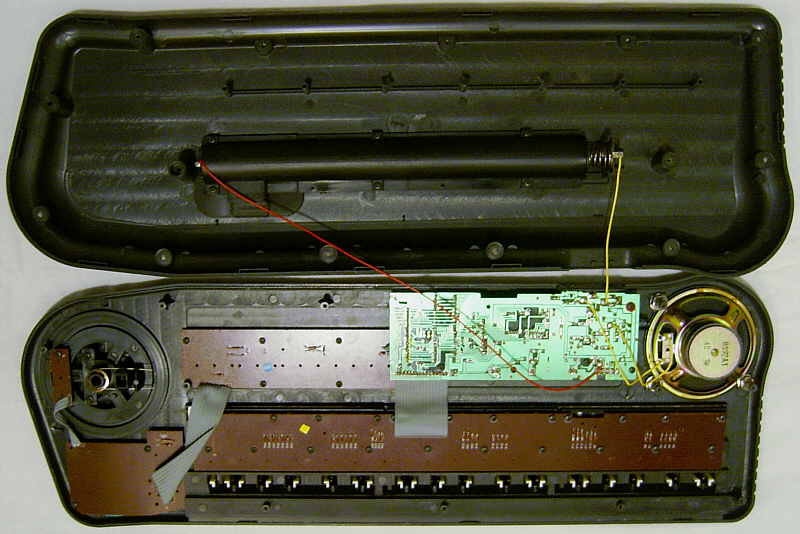
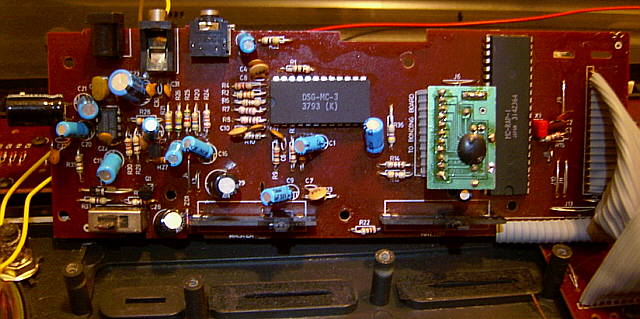
The First RAP-2 is build around the CPU "MC-RAP-1" (software variant
of MC-3DX, crystal clocked @ 1MHz)
with squarewave sound IC "DSG-MC-3"
and sample percussion IC "RAP[?] 1203".
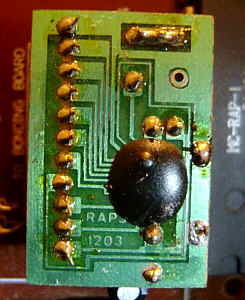 |
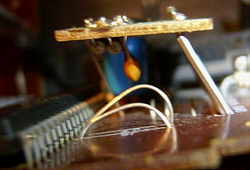 percussion sample IC
 |
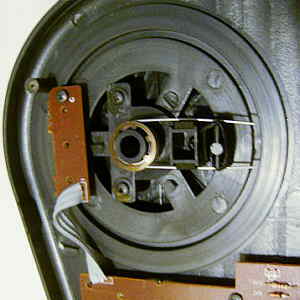 |
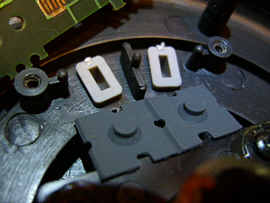 scratch disc pushes 2 buttons
 |
 |
This hardware strongly resembles Letron
MC-3, but has an additional percussion IC and fewer LEDs. The high
pitched button click is 'claves' played by the percussion IC. The unused
percussion outputs of the DSG do nothing. The fake scratch disc only simulates
2 button presses.
keyboard matrix
The matrix layout is obviously based on MC-3,
but the crippled software here has many features omitted. E.g. it supports
no fingered nor single finger chord anymore, and the "program" button only
assigns drumpad sounds instead of a custom drummer. Although output pin
37 still exists, its matrix places are all empty. The matrix out pins 34..37
also drive each a panel LED through a 2.7k resistor from +Vs; for this
the pauses between the short scan pulses (when the inputs are active) are
pulled lo to light the LED (else hi). Eastereggs are 12 lower note keys
and a metronome-like percusion test mode.
|
41
|
40
|
39
|
38
|
34
|
35
|
36
|
|
CPU pin
|
|
out 4
|
out 3
|
out 2
|
out 1
|
out 5
|
out 6
|
out 7
|
out / in
|
|
o
B4
|
o
B3
|
o
B2
|
o
B1
|
-
|
tempo -
|
-
|
in 12
|
4
|
o
A#4
|
o
A#3
|
o
A#2
|
o
A#1
|
P.
disc right
|
tempo +
|
-
|
in 11
|
3
|
o
A4
|
o
A3
|
o
A2
|
o
A1
|
P.
disc left
|
demo
|
-
|
in 10
|
2
|
o
G#4
|
o
G#3
|
o
G#2
|
o
G#1
|
P.
cowbell
|
P.
metronome
|
-
|
in 9
|
1
|
o
G4
|
o
G3
|
o
G2
|
o
G1
|
P.
hihat
|
-
|
'4'
|
in 8
|
8
|
o
F#4
|
o
F#3
|
o
F#2
|
o
F#1
|
P.
base
|
-
|
'3'
|
in 7
|
7
|
o
F4
|
o
F3
|
o
F2
|
o
F1
|
P.
tom
|
-
|
'2'
|
in 6
|
6
|
o
E4
|
o
E3
|
o
E2
|
o
E1
|
P.
snare
|
-
|
'1'
|
in 5
|
5
|
o
D#4
|
o
D#3
|
o
D#2
|
o
D#1
|
-
|
-
|
'5'
|
in 4
|
29
|
o
D4
|
o
D3
|
o
D2
|
o
D1
|
P.
program
|
-
|
'6'
|
in 3
|
28
|
o
C#4
|
o
C#3
|
o
C#2
|
o
C#1
|
-
|
start/stop
|
rhythm
select
|
in 2
|
27
|
o
C4
|
o
C3
|
o
C2
|
o
C1
|
o
C5
|
-
|
voice
select
|
in 1
|
26
|
The input lines are active-low, i.e. react on GND. Any functions can
be triggered by a non- locking switch in series to a diode from one "in"
to one "out" pin.
legend:
|
|
|
"o"
|
= keyboard key |
|
P.
|
= drumpad |
orange
background |
= easteregg (unconnected feature) |
A button at 1->35 starts a simple beat (like a metronome) using the
1st percussion sound. Pressing the button again cycles it through all 16
available percussion sounds. This was likely intended as a test mode for
the percussion IC. Press "start/stop" to exit.
pinout RAP 1203
The "RAP[?] 1203" (11 pin COB, by Medeli?) is the percussion IC
of First RAP-2. It is monophonic with on board clock source (capacitor
+ 2 resistors) and contains 16 low resolution percussion, scratch and voice
samples {base, tom, snare, conga, hihat, cowbell, claves, scratch 1..4,
"ha!", "one", "two", "three", "four"} selected by bit combinations on 5
data bus inputs. 2 additional handshake inputs indicate when the data is
valid.
This description was made from my own examination and likely inaccurate.
All pin names were chosen by me.
| pin |
name |
purpose |
| 1 |
GND |
ground 0V |
| 2 |
D1 |
data bus in |
| 3 |
D2 |
data bus in |
| 4 |
D3 |
data bus in |
| 5 |
D4 |
data bus in |
| 6 |
D5 |
data bus in |
| 7 |
/SE1 |
handshake in 1 |
| 8 |
/SE2 |
handshake in 2 |
| 9 |
/RESET |
reset |
| 10 |
SND |
audio out |
| 11 |
+Vs |
supply voltage +5V (through 47 Ohm resistor) |
Shorting both handshake lines with each other double triggers some samples,
which makes me conclude that they have to be pulled low and high again
in a certain order (like the protocol of Casio 4 bit bus) to permit clock
independent communication. |
| removal
of these screws voids warranty... |
|
|
 |

|
|
| |
back
|
|