|
|
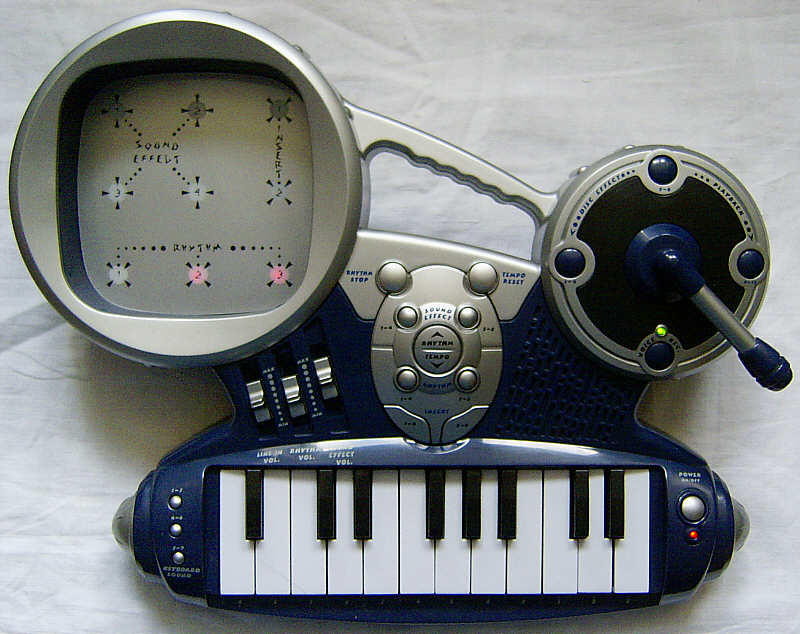
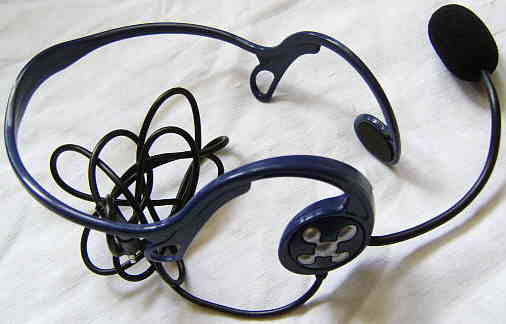
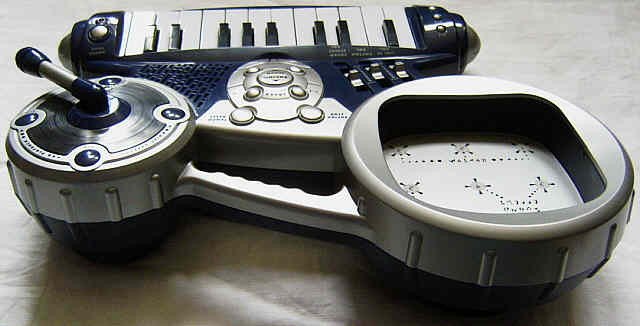
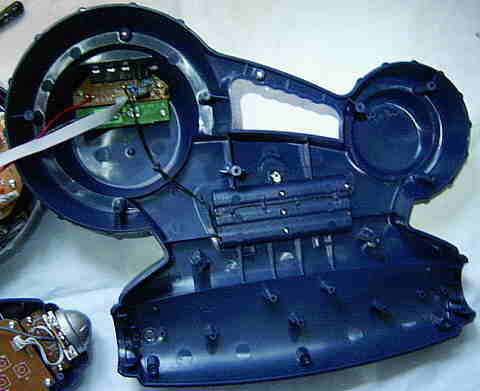
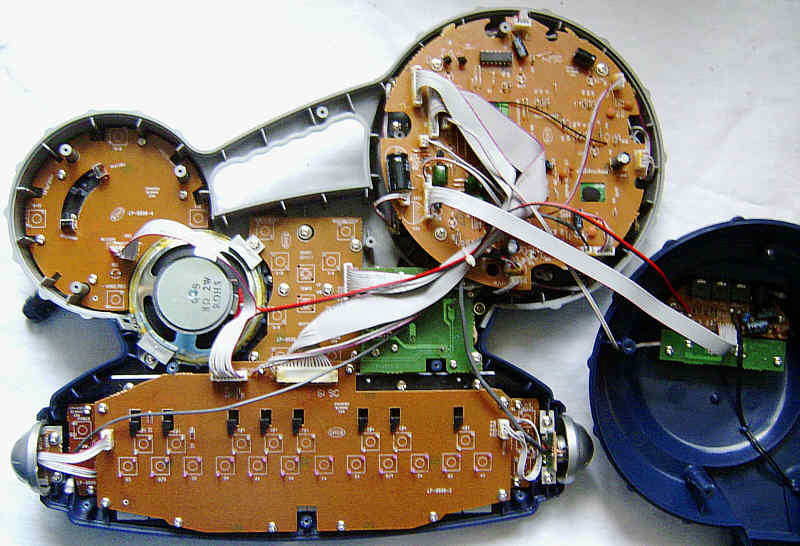
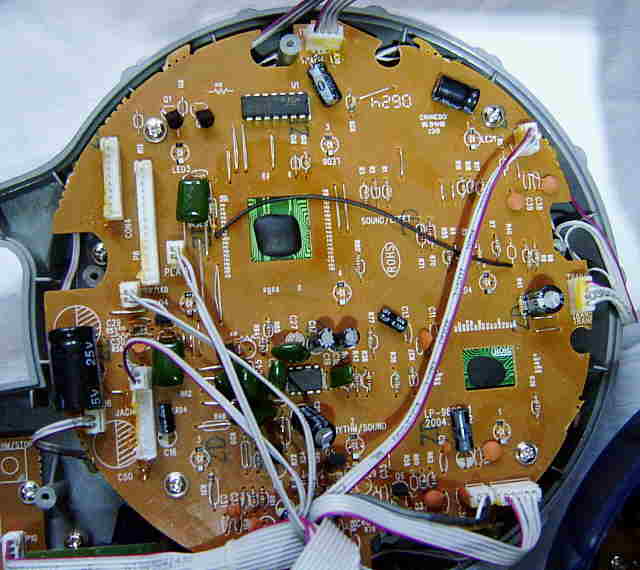
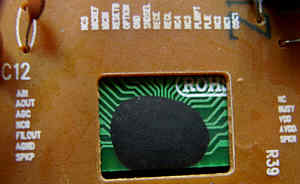
What's that? - is this an extraterrestrial lawnmower with built-in kitchen sink? No, it is a toy groovebox keyboard made in 2004 (printed PCB date) by Lollipop Industrial Limited, with plenty of sound effect samples and lo-fi background preset music pattern loops. Instead of drumpad buttons it employs optical touch sensors and can even store a 5 seconds short lo-fi sample.
 |
 |
 |
 |
 |
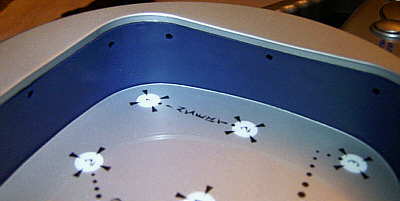
light barrier sensor holes |
 |
|
 |
 |
 |
 |
 |
 |
 |
 |
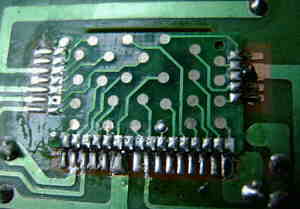 |

pcb back with leds |
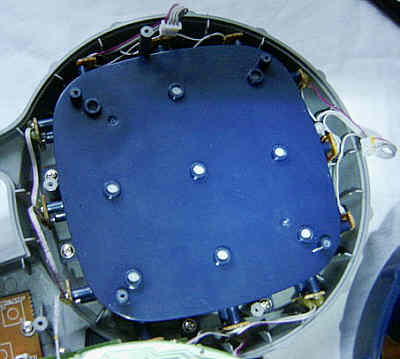
light barriers |
 |
The keyboard preset sounds are plain low resolution samples and sound quite bright, grainy and a bit thin. Some are up to 3s long, but most are <1s; they are all unlooped samples and ignore key press duration, which is annoying particularly with the longer sounds. Some have a key split zone in the middle. Nice is that when a key is trilled, each new note occupies a new sound channel, which produces a nice phasing sound and volume increase effect although this eats up polyphony. The sounds have only numbers instead of names thus all sound names were chosen by me. The "synth gamelan chord" is a short major chord sound that roughly resembles a gamelan or xylophone. The "synth saxophone" is a dry buzzing saxophone- like tone with somewhat smacking attack. The "sitar" is a long bright tone that goes "wwoiiing" with a brighter turning resonance in the middle; it may be a synth filter sweep with much resonance. The "ah! voice" roughly resembles a children choir singing "ah!"; high notes rather resemble "eh!". "orchestra hit 1" is percussive and may be a major chord, while "orchestra hit 2" is a bright and scratchy yelling violin chorus sound. The "synth piano chord" seems to be a major chord on piano. "e-organ chord" resembles an about 2s long major chord on a dull and slightly rough Hammond timbre (as used in ambient music) that decays at the end. The "heavy metal guitar" buzzes bright and about 2s long.
The "rhythms" are genuinely loop samples and include a lot of wicked complex tekkno synth stuff. Each rhythm number selects a set of 3 different patterns those can be switched, started and re-triggered in realtime with the 3 "rhythm" sensor pads. Rhythms can be stopped at any time with the "rhythm stop" button. Any rhythm can be breaked with the 2 "insert" pads, those start each an "insert" pattern. The difference between "rhythm" and "insert" patterns is that the latter stops immediately when the pad is released, and then continuous the previously running rhythm pattern (like a fill-in) exactly from the point where the insert begun, so far a rhythm was running. But nothing is automatically synchronized, thus the player has to decide when to switch or re-trigger rhythms or stop insert patterns. This is all very basic sample- based stuff and nothing in any way sequencer- like. Also the tempo control only changes the speed and pitch of "rhythm" pattern (like changing the speed of a phono record) but not of the "insert"; it anyway has only 8 steps and doesn't go very far. Selecting a new rhythm set or pressing "tempo reset" resets it to default.
The "rhythm" pattern loops are:
1-4:
tribal breakbeat | rhythm with female scream & male "yeah!" | e-guitar,
e-bass & drum kit
tribal scratch rhythm with "jip!" voice | slow ambient with disharmonic
bass | woody knocking rock rhythm
fat base & snare | tribal/ reggae with congas | scratch rhythm
with metallic clicks
fat base with howling ghost sounds | tribal with bass drum & metallic
cymbals | scratch rhythm with harsh reverbing claps
5-8:
jungle rhythm | breakbeat with agogo bells | fast samba rhythm with
cymbals
slow irregular fat bass drum with synth gong | scratchy phaser rhythm
with synth digeridoo "ou!" | fast tribal with shouting man
fat irregular reverbing cymbal cough phaser rhythm | tribal with shouting
man | fat breakbeat rhythm with female "ah!"
fat jungle rhythm | phaser breakbeat | 4-beat scratch rhythm
The "insert" pattern loops are:
1-4:
fat synth drum 2-beat | fat synth drum 2-beat with hihat
heavy metal guitar 1 | heavy metal guitar 2
warm dull synth woing hum | sitar pattern
tribal with congas | distorted crunching tekkno 2-beat
5-8:
phone call message | fat breakbeat
louder fading psychedelic train sound | slow howling scratch noise
ocean waves | fast buzzy squarewave synth loop
thin fading phaser rhythm | dull bubbling synth loop
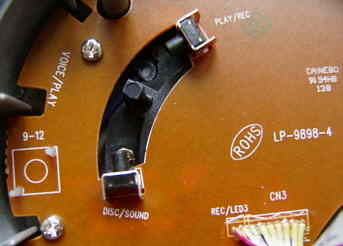 The
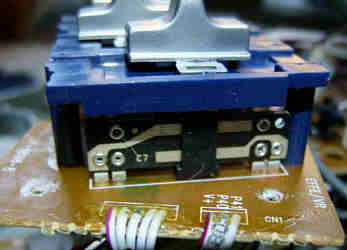
"scratch disc rod" is fairly flimsy and simply pushes a button switch contact
on each end to start a sample, thus it can not do anything that 2 buttons
could not do also. The sample plays as long you hold the rod there, which
has nothing to do with simulated record scratching, but is a similar cucumber
like the scratch disc of Casio Rapman
and most other DJ toy keyboards. The
"scratch disc rod" is fairly flimsy and simply pushes a button switch contact
on each end to start a sample, thus it can not do anything that 2 buttons
could not do also. The sample plays as long you hold the rod there, which
has nothing to do with simulated record scratching, but is a similar cucumber
like the scratch disc of Casio Rapman
and most other DJ toy keyboards. |
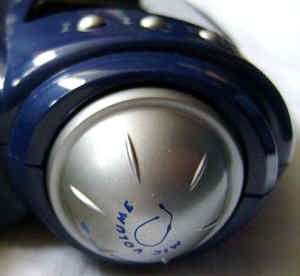
The sampler can only record one sample of max. 5s; hold "voice rec."
for the desired duration and e.g. speak or make a noise into the microphone.
Purring blips indicate that the memory is full. But the sampler is pretty
useless since it can be neither edited nor played on the keyboard. You
can only play it by turning the rod clockwise; holding the rod for longer
plays it in a loop (with noticeable pop noise at the loop point). As soon
anything has been sampled, the green LED above the "voice rec." button
will start to flash and keeps flashing from that time on to annoy the user
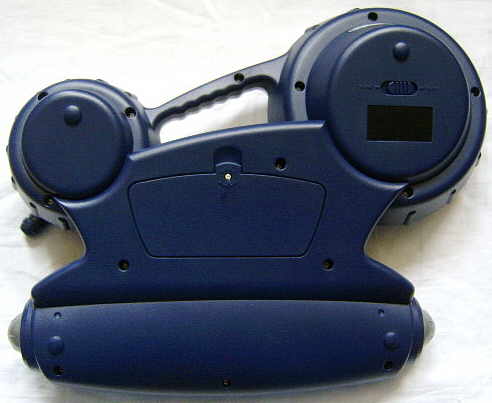
until you take the battery out. And because you can open the battery compartment
only by screwdriver, this feature really sucks, because the sampler was
never designed to purge the memory contents again; even when you press
"voice rec." very short or with microphone disconnected to fill the memory
with silence, the LED will keep flashing. Of course the LED goes out when
you turn the instrument off, but it flashes again after you switch it on,
so this pilot LED is useless when you use batteries. Only during AC-adapter
operation it can be seen as a small warning not to unplug it because a
sample has been recorded. But the LED does not show whether the memory
contains only silence (e.g. after accidentally hitting "voice rec." again),
and since there is only space for a single sample, it will be anyway overwritten
very often during performance, which makes it fairly pointless.
| removal of these screws voids warranty... | ||
 |
 |
|
|
|