 |
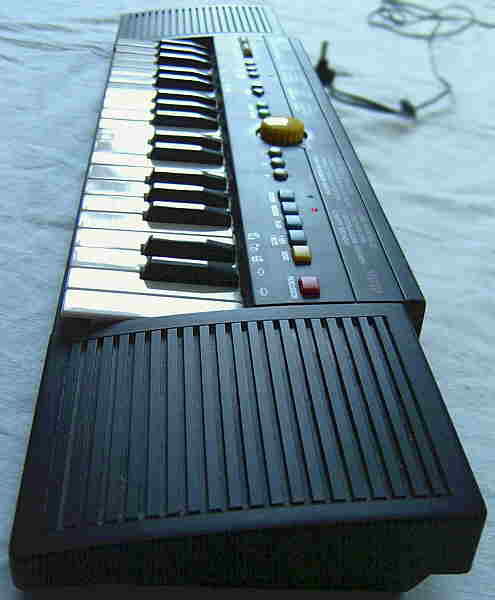 |
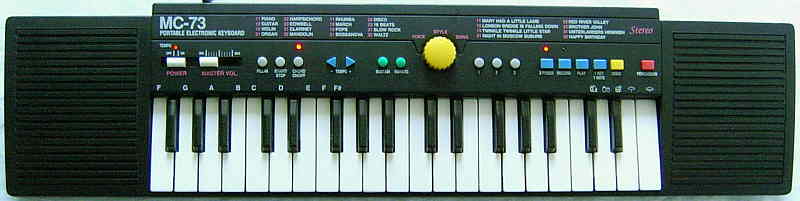
This rare squarewave keyboard from 1996(?, part of sound IC number) is yet another small member of the MC-3 hardware family. It has less features but the sound is very similar.
|
|
 |
 |
The main voice sound is much like MC-3 but the "mandolin" rings and vibrato is slower. Also the accompaniment and rhythm sounds like with MC-3, but there is only a single finger accompaniment and no manual chord mode with rhythm off. During accompaniment, also the fill-in pattern contains accompaniment notes. There is no programmable drum pattern, but only the rightmost 5 keys can be switched into keyboard drumkit mode (sounds like MC-3).
There is a simple record/ playback sequencer which records all sounds (maximum 51 notes) and control panel events. Unlike most other such keyboards, the playback tempo can not be changed with the tempo buttons, but instead it even records tempo changes in the rhythm. (Pattern is erased by power off.)
The 8 demo melodies employ the currently selected preset sound. They play monophonic with standard accompaniment and repeat each in a loop.
The demo melodies are:
With the "1 key 1 note" button you enter any-key-play mode. For this
press first "1 key 1 note" ("record" LED will flash), then "demo" and select
a song. No you can step through the song note by note with keyboard keys.
Press "1 key 1 note" again to exit. (My Thompsonic
TS-37 accidentally came with MC-73 manual, which cleared up this
detail.) This seems to be only monophonic with neither rhythm nor accompaniment.
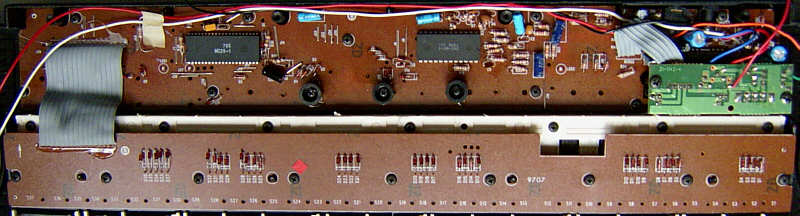
circuit bending detailsThe Pan Toys MC-73 is based on the CPU "MC25-1" (crystal clocked @ 1MHz) with separate sound IC "DSG-MC-3". Unlike all other DSG based MC-series keyboards, this 42 pin CPU has SDIL package (narrower pins) and completely different from "MC-3DX". So it was likely one of the last instruments by Medeli with this sound IC.
keyboard matrixThis keyboard matrix layout has nothing common with MC-3 hardware anymore, but keys are grouped by 4 and then divided in 2 horizontal halves which looks very messy. The rotary switch does not need locking contacts. The empty places seem to do nothing. As eastereggs there are 4 lower and 7 higher note keys addable, 5 drumpads and transpose down (different direction, same function).
The input lines are active-low, i.e. react on GND. Any functions can
be triggered by a non- locking switch in series to a diode from one "in"
to one "out" pin.
pinout MC25-1The "MC25-1" (42 pin SDIL) is the CPU of the Pan Toys MC-73 keyboard. Important is that this seems to be the only Medeli MC-series 42 pin CPU that is not based on MC-3DX. It has internal ROM, controls a squarewave sound IC "DSG-MC-3" and polls the keyboard matrix through 8 output and 12 input lines (active-low). There are outputs for 5 panel LEDs. It is crystal clocked @ 1MHz and likely a generic microcontroller.By lack of schematics, all pin names were chosen by me (partly inspired
by Casio naming conventions), based on my own examination. So do not depend
on them - they may change if I find schematics or an official datasheet.
The supply voltage pin 21 is connected through a 47 Ohm resistor. This may be done either to keep spikes out of the analogue circuitry, or to avoid overload damage if the CPU in crash state switches shorted matrix inputs as outputs and draws too high current. But during shitshot I saw no voltages output through key matrix inputs, which may hint that this CPU has dedicated input-only pins. The unused pin 41 is either an NMI pin without supporting software and/or a test pin. It is lo, and pulling it high (tested with 1k resistor) immediately locks up the CPU. This usually disables keys and buttons, and often plays accompaniments or demos with wrong timbres. The strangest is that when pulled hi during power-on, all matrix pins stay lo and data bus pins hi; when quickly releasing pin 41 (resistor removed) and pull hi again, pin 12 outputs a clock divider frequency (4.6µs measured on oscilloscope = about 217 kHz, but sometimes also slower like e.g. 72µs = 13.9 kHz) as long pin 41 stays hi. Repeating this makes the amplitudes change a little, which suggests that the CPU attempts to output serial data over other lines and so differently burdens the supply voltage (fed through 47 Ohm resistor). Possibly the internal ROM can be dumped through a serial protocol here, similar like with Intel MCS-48 microcontrollers. (I haven't examined this further.) |
By the CPU type label, also a keyboard variant named "MC-25" may exist,
which appears to be the genuine name of this hardware class. The preset
sound and rhythm list of the Pan Toys MC-73 resembles Bontempi
ES3000 (aka MC-2100) although the latter has different hardware
and less polyphony.
| removal of these screws voids warranty... | ||
 |
 |
|
|
|