The odd Japanese 1970th compact stereo set contains a nicely warm sounding
full polyphonic analogue organ with analogue rhythm. It has no accompaniment,
but the 5 OBS rhythm buttons are combinable and there are many separate
volume controls like on a mixing console.
The main voice is an almost envelopeless plain squarewave organ tone; instead
of preset sounds there are only 2 octave settings, but it has a lovely
ancient warm timbre and square vibrato. The 5 OBS rhythm buttons are combinable
to get 31 rhythms in total, those have a typical analogue home organ appeal
and can be switched at any time (nice for tekkno). All functions are selected
through locking OBS switches, there are bass & treble controls and
plenty of individual volume knobs. The tip of the rod antenna contains
a small microphone for singing or recording on the built-in cassette recorder.
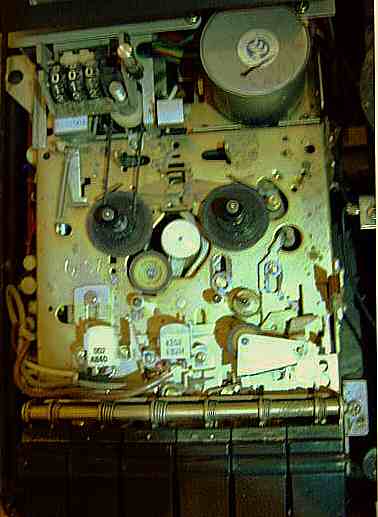
The radio and cassette deck are nothing special and pretty standard for
their era; at least you can adjust the record level, and like with a mixing
console you can mix cassette, microphone, rhythm and organ together in
various combinations. Although the organ main voice (not rhythm) turns
off the radio, and as well radio as cassette have no own volume controls,
all other combination work and you can also mute the channels individually
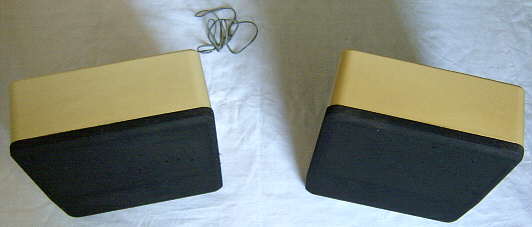
with their buttons. The cheap plastic speaker boxes have too little bass
for their size.
 The
instrument was made in Japan with the strange brand name Sankei,
which I never saw before. But because such names are usually translations
from Asian characters, they may later have renamed itself into Sankai,
which is nowadays a Chinese company related to Yongmei
and released cheap plastic tablehooters like the Sankai
01504H and 01870K. However
this old Sankei Entertainer is still fairly heavy and not particularly
waggly. The
instrument was made in Japan with the strange brand name Sankei,
which I never saw before. But because such names are usually translations
from Asian characters, they may later have renamed itself into Sankai,
which is nowadays a Chinese company related to Yongmei
and released cheap plastic tablehooters like the Sankai
01504H and 01870K. However
this old Sankei Entertainer is still fairly heavy and not particularly
waggly. |
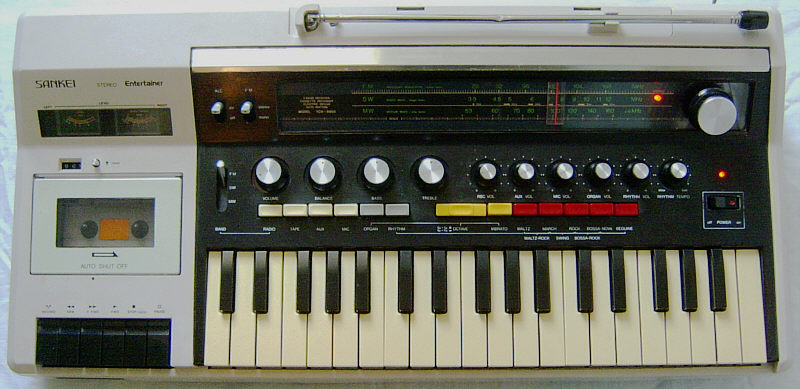
main features:
-
37 long midsize keys (quite responsive)
-
full polyphonic analogue main voice
-
2 loudspeaker boxes (with too little bass and tubby midrange resonance)
-
octave button {C3-C6, C2-C5)
-
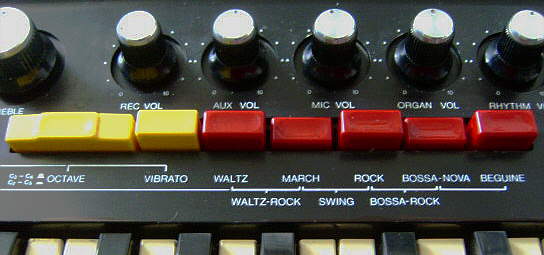
5 combinable OBS preset rhythms {waltz, march, rock, bossa-nova, beguine};
combinations include {waltz + march = waltz-rock, march + rock = swing,
rock + bossa-nova = bossa-rock}
-
vibrato button
-
main volume knob
-
separate volume knobs for AUX, microphone, organ (main voice), rhythm (all
are mixable; only organ main voice disables radio)
-
stereo balance knob
-
tempo knob
-
treble & bass knobs
-
organ volume knee lever attachable at case bottom
-
most functions selected through locking buttons
-
main voice is made from full polyphonic plain squarewave with noticeable
polyphony hum when enabled. Each key has a small envelope capacitor for
a tiny dose of sustain, and likely some kind of filtering.
-
rhythm employs analogue percussion {base, close hihat, open hihat, close
cymbal, open cymbal, clave} with capacitor envelopes. Cymbals/ hihats are
made from transistor noise.
-
complex analogue multi-chip hardware:
-
top octave generator= "Sanyo LM8071, 8E2" (24 pin DIL)
-
5x frequency divider= "Sanyo LM3216, G82" (14 pin DIL)
-
rhythm generator= "Sanyo LM8972, 7H3" (16 pin DIL)
-
radio tuner:
-
tuning knob
-
analogue scale with illuminated needle
-
FM stereo, SW, MW
-
rod & ferrite antenna
-
ALC switch
-
stereo/ mono switch
-
FM stereo LED
-
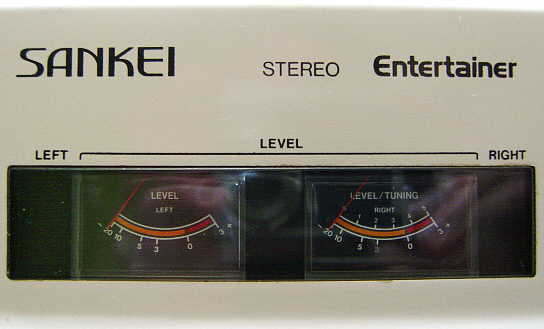
uses right level meter as tuning indicator
-
cassette deck:
-
record level knob (mono)
-
tape counter (mechanical)
-
pause button
-
neither dolby nor tape sort selector
-
2 level meters (analogue)
-
mono microphone on rod antenna tip (no telescope antenna)
-
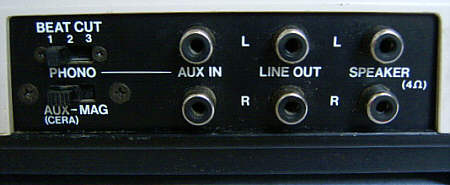
beat cut switch {1..3}
-
mains operated
-
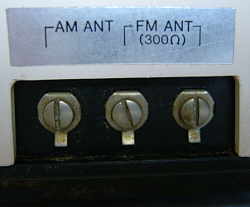
FM & AM antenna screw terminals
-
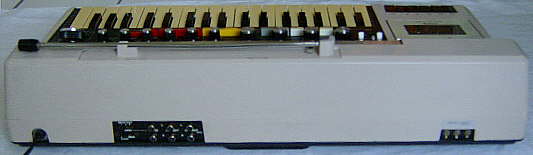
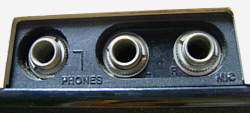
jacks for 2 speakers, line out, AUX in (switchable to phono in), 2 microphones
eastereggs:
-
pushing the octave button down at its right end makes the organ sound duller
than pushing it at the left end. The button can lock in both positions.
(I am not sure if this was intended, or a mechanical flaw of my specimen.)
notes:
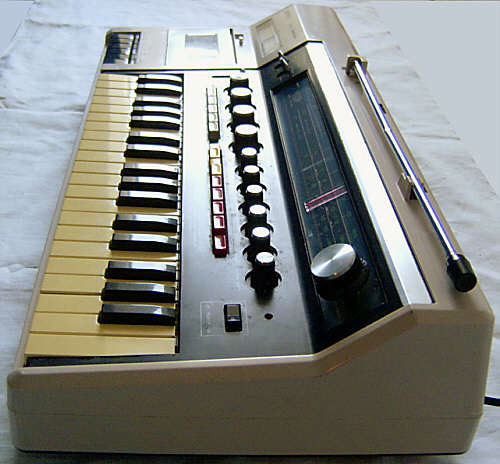
This strange compact stereo set was likely built in mid or end of 1970th,
since the full polyphonic keyboard hardware has no keyboard matrix and
contains for each key still a synched oscillator with plenty of discrete
components - a concept that was abandoned in later full polyphonic instruments
(see e.g. Ramasio 892). Also the
flat case shape is typical for 1970th; my father owns a black Schneider
stereo set in the same shape (with record player and no keyboard) made
in 1976. When I bought this thing on eBay, it was horribly dirty,
like when it had spent its last 20 years in a hen stable. There were centimeters
of caked dust and animal hairs inside, a loose metal part from the cassette
recorder rumbled around and the PCB traces under the keys were full of
smeary goo and partly corroded through because either the thing was operated
after it had badly rained on it, or someone had spilled a corrosive drink
on the keys in his cellar bar. But after thorough cleaning, patching rotten
copper traces with soldered wires and replacing cassette deck belts and
a missing screw, I finally got it to work. Only the ALC switch of the tuner
does almost nothing beside slightly moving the needle of the tuning meter,
and the potentiometers are still noisy.
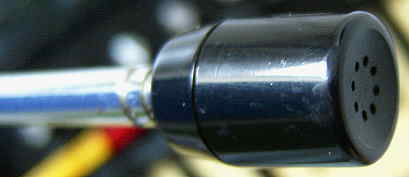 Unique
is that the antenna rod tip is a small microphone, however this has the
side effect that unlike standard telescope antennas this one is not extendable,
because the cable inside would likely make such a mechanism much more complicated
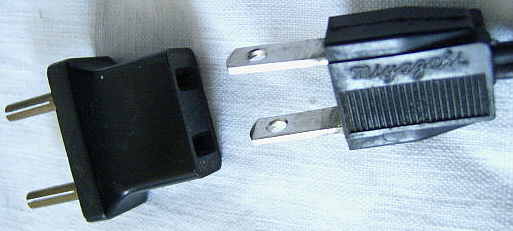
to prevent twisting and properly wind up the cable. Another unique feature
is the mains plug, which consists of a small US plug that is relatively
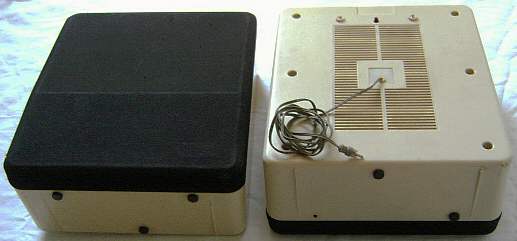
firmly inserted into a small adapter for European sockets. The lightweight
plastic speaker boxes are a cheap construction with too little bass for
their size and a tubby midrange resonance that is particularly audible
during keyboard play. (I own similarly lightweight
RFT plastic speaker
boxes with only 4W sine/ 6W music power rating (from a broken Europhon
record player), those full range speakers have almost high-end quality
and sound great when placed on the floor and running through a small tube
amplifier.) Generally I would not recommend to turn this thing too loud,
since neither these flimsy speakers look halfway robust, nor were average
1970th compact stereo power amplifiers particularly reliable. (I have repaired
a dozen of them after teenagers or my father toasted the amp at full volume.)
As usual with ancient analogue organs, all controls employ locking OBS
switches and respond immediately, which permits plenty of live play tricks.
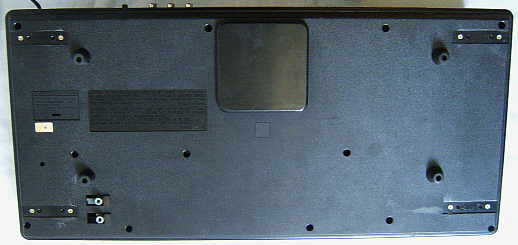
Near the right front rim of the case bottom there is a fixture for an attachable
knee lever (which my specimen is missing) to turn the organ voice louder
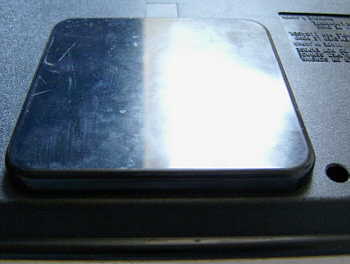
and brighter. Bizarre is that at the case bottom there is a square black
cover, which inner side has closed embossed marks for speaker grill holes.
Apparently a predecessor with a single internal speaker or subwoofer at
the case bottom (like in 1970th Bontempi keyboards or Casio
MT-640) was planned or made.
Unique
is that the antenna rod tip is a small microphone, however this has the
side effect that unlike standard telescope antennas this one is not extendable,
because the cable inside would likely make such a mechanism much more complicated
to prevent twisting and properly wind up the cable. Another unique feature
is the mains plug, which consists of a small US plug that is relatively
firmly inserted into a small adapter for European sockets. The lightweight
plastic speaker boxes are a cheap construction with too little bass for
their size and a tubby midrange resonance that is particularly audible
during keyboard play. (I own similarly lightweight
RFT plastic speaker
boxes with only 4W sine/ 6W music power rating (from a broken Europhon
record player), those full range speakers have almost high-end quality
and sound great when placed on the floor and running through a small tube
amplifier.) Generally I would not recommend to turn this thing too loud,
since neither these flimsy speakers look halfway robust, nor were average
1970th compact stereo power amplifiers particularly reliable. (I have repaired
a dozen of them after teenagers or my father toasted the amp at full volume.)
As usual with ancient analogue organs, all controls employ locking OBS
switches and respond immediately, which permits plenty of live play tricks.
Near the right front rim of the case bottom there is a fixture for an attachable
knee lever (which my specimen is missing) to turn the organ voice louder
and brighter. Bizarre is that at the case bottom there is a square black
cover, which inner side has closed embossed marks for speaker grill holes.
Apparently a predecessor with a single internal speaker or subwoofer at
the case bottom (like in 1970th Bontempi keyboards or Casio
MT-640) was planned or made.
The organ main voice is a simple plain squarewave toot, which has almost
no envelope and resembles a wooden pipe organ rank or clarinet. But it
sounds better than many other plain squarewave organs, because it apparently
has a fixed capacitor filter per key that adds a tiny bit of sustain, and
may also mix a small fraction of other octaves into the sound. When the
main voice is enabled (it can be switched of, keeping only the rhythm running),
you always hear a dose of the characteristic polyphony hum (like pressing
down all keys simultaneously). Generally it sounds very archaic, sweet
and warm, comparable with an undistorted plain Hammond organ timbre.
Because the keys are filtered individually, you don't get the problem that
high notes are muffled way too dull (which happened in various preset sounds
of early
Casio keyboards). The octave button is wider than all other
buttons and behaves odd; so long it is up, you get the higher octave; when
you push it down at the left end of the button, it will lock and the organ
sounds an octave lower. However when you instead push it in at the right
end, it will lock a little lower and make the sound additionally duller
and quieter. I am not sure if this is a mechanical bug of my specimen or
intended as a timbre variation. As a sound effect you can also push it
in at the left end (sounds bright) and slightly trill on the right end
to rhythmically toggle between bright and dull with a weak pop noise (pushing
harder will make it lock at dull). The vibrato button adds a square 7Hz
vibrato, which sounds nicely cheesy (speed and depth can be likely adjusted
with trimmers inside).
There is neither an accompaniment nor automatic chord mode of any kind.
The rhythms correspond to a typical analogue 1970th drum machine or home
organ. Despite there are only 5 OBS preset rhythm buttons, they lock individually
and you can press multiple of them to switch at any time between 31 rhythm
variants without restarting the pattern, which is nice for tekkno. The
rhythm volume control not only reduces rhythm volume, but also turns the
rhythm duller. The "rhythm" button as well enables the rhythm track (with
a pop noise) in the mixer, as restarts the rhythm pattern from beginning,
which permits various live play tricks. The tempo can be set quite fast,
but not extremely slow (which can be likely modified at the potentiometer).
hardware details
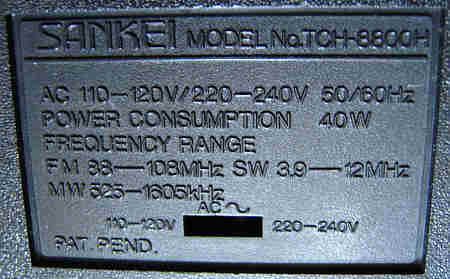
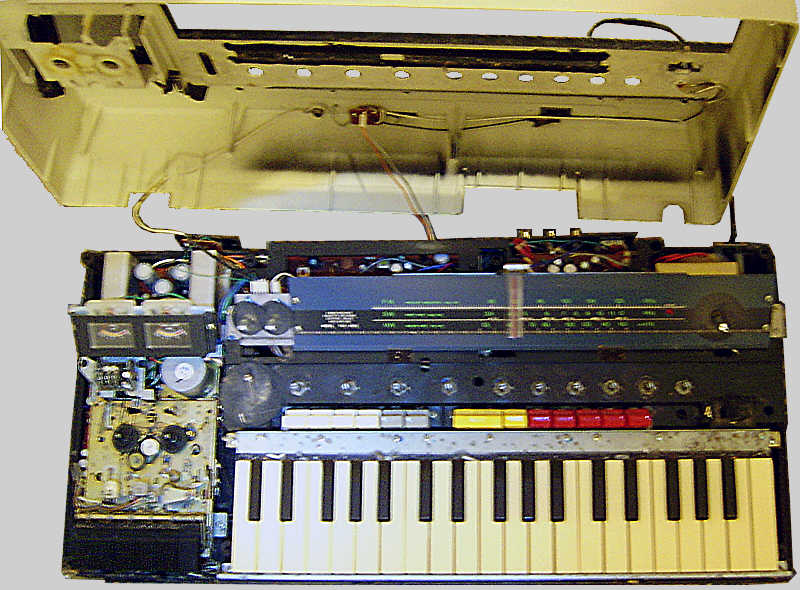
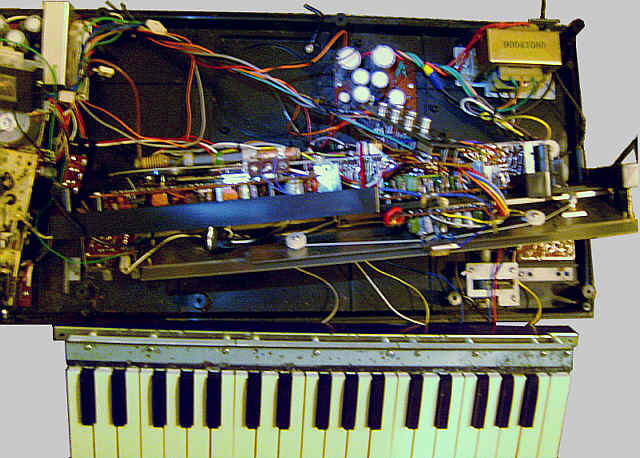
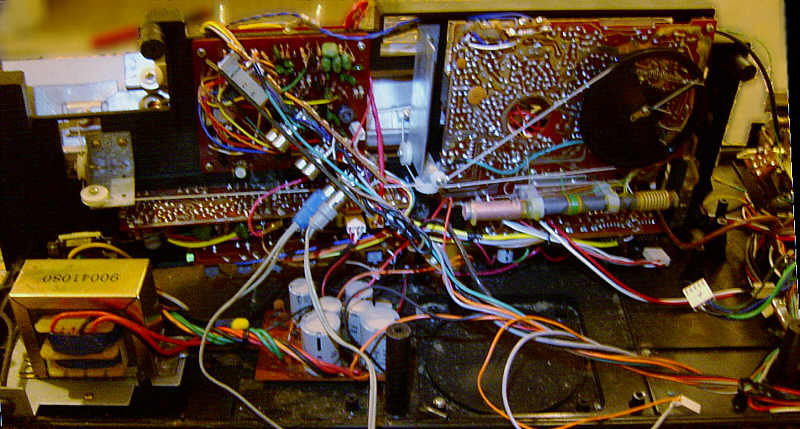
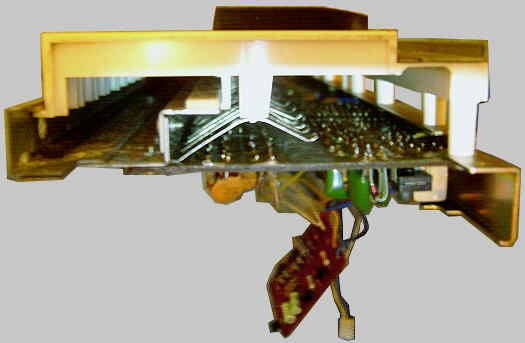
The music keyboard of the Sankei Entertainer TCH-8800 is based on
typical 1970th full polyphonic home organ technology using Sanyo
main ICs. These are the top octave generator LM8071, 5 frequency dividers
LM3216 and the rhythm generator LM8972. Everything uses plenty of discrete
components for filtering and analogue percussion.
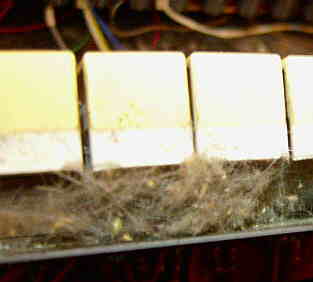 yuckety-yuck... keys got stuck
 |
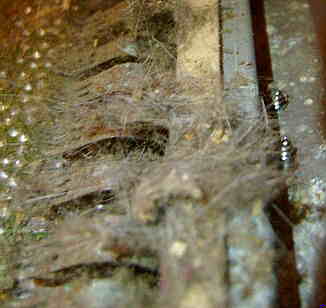
sneeze - cough cough! |
 |
 |
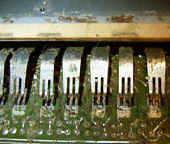
corroded key contacts |
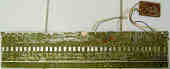 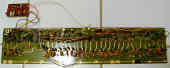 |
 main voice hardware
 |
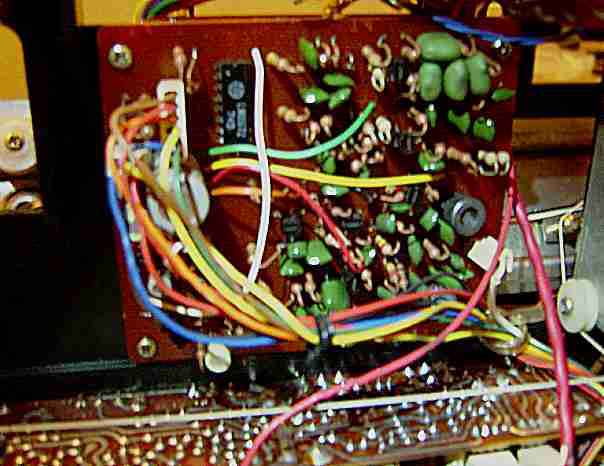
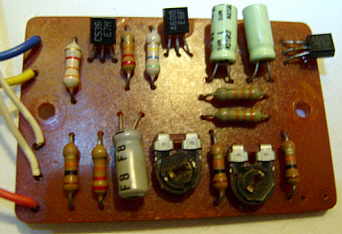 vibrato PCB
 |
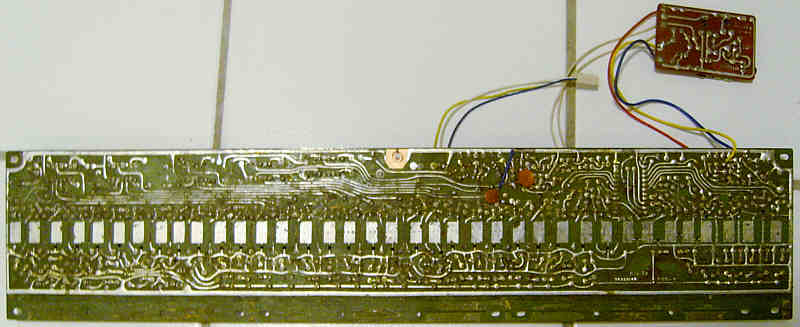
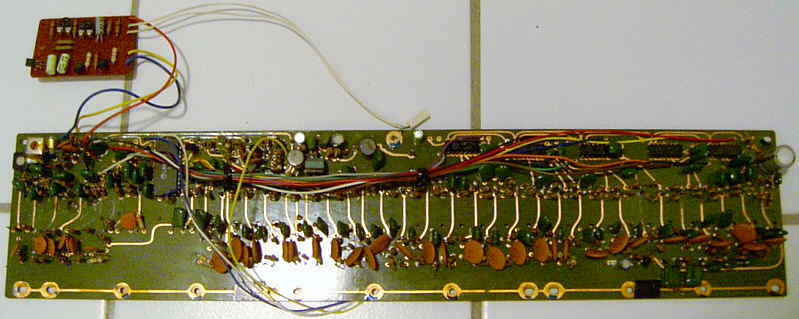
On the keyboard PCB is a trimmer to tune the main voice; a small PCB connected
to it contains the vibrato circuits with 2 additional adjustment trimmers.
The frequency dividers LM3216 may output some additional lower octave notes
(not tested).
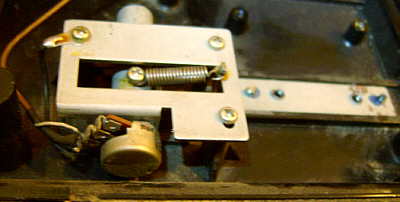 The knee lever potentiometer can act as a volume pedal.
 |
 |
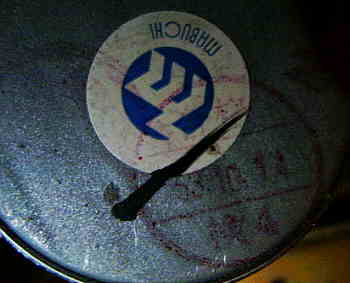 cassette drive motor
 |
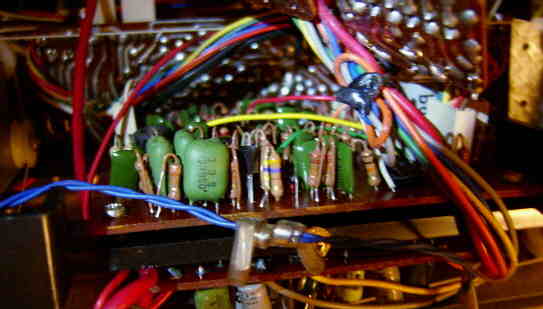
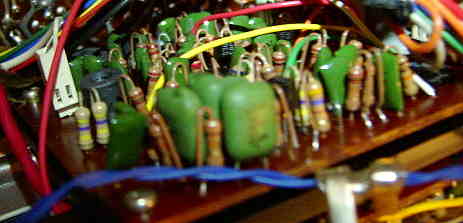
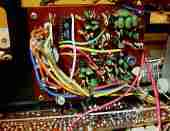 rhythm PCB
 |
  |
|
The Sankei Entertainer TCH-8800 seems to be very rare. However
in 1970th various fullsize home organs with cassette recorder were made,
and it also can be regarded as ancestor of the famous keyboard boombox
Casio KX-101 (which uses its cassette
deck also for data storage of the its sequencer).
| removal
of these screws voids warranty... |
|
|
 |

|
|
| |
back
|
|