|
|
This odd guitar-like sound toy from 1990 is not really a keyboard and hard to describe in few words. It is basically a strap-on accompaniment machine with only 3 styles, squarewave sound and no rhythm, and by the lack of a chromatic scale you can not even play all melodies on it, however it has a genuine realtime controlled wahwah filter (analogue low-pass VCF with resonance) and a musically well designed user interface that makes it very playable. The sound is warm, fat and amazingly C64- like. Although it was designed as a toy, several musicians have played this thing. With pitch set extremely low and active wahwah, you can even get some acid house!

The concept of this semi-automatic instrument can be compared best with a Suzuki OmniChord, although it is more restricted. Like with Kawai's One Finger Ad-Lib (see Kawai MS-720) there are different pre- programmed accompaniment tracks assigned to the keys. By holding any white key, you start a corresponding bass accompaniment pattern loop (one per key), which repeats until you release all keys (it always finishes the bar before it stops). When you press any black key, the main voice starts to play another automatic pattern loop (one per key), which immediately stops by releasing that key. Thus you can play 2 automatic patterns simultaneously. While no accompaniment is running, the main voice pattern is re-started every time you press the black key. With running accompaniment the main voice pattern is only muted when the black key is released, but keeps running silently in the background and continues its play without re-start when its black key is pressed again. When the instrument is switched from "lead" into "single" mode, the 8 black keys play notes like an almost normal keyboard (without accompaniment even 2 note polyphonic), however instead of a standard tone scale, a matching (pentatonic?) subset of notes is assigned to these keys, depending on the selected chord (like with an OmniChord). The instrument can only play in 3 different keys; the actual chord is switched with 2 buttons, and like with a guitar, decaying notes change their pitch when a different chord is played. Thus you can not play all melodies on it, or at least not they way you would do it on a keyboard.
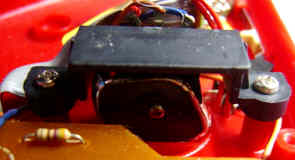
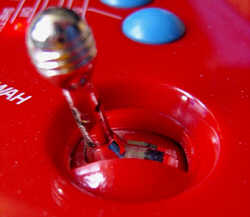
The main voice can be cycled through each 3 envelope, chorus and vibrato settings with each a button. But the most spectacular feature of the instrument is the wahwah lever, which is a small, springless analogue joystick with that the sound can be turned duller or brighter in realtime when enabled. In "auto" mode the main voice has a real voice-like VCF envelope that goes "wow", responds on key press duration and can be turned brighter by the joystick. In "manual" mode the filter envelope is off, so it only responds to the joystick. By the cackling potentiometer it often sounds a little scratchy, but this thing generally has a lot of analogue "dirt" in the sound, and that in a very positive sense. As well the timbres as styles have strong similarities with the good old Commodore C64 homecomputer music. The filter and chorus timbres sound authentic like Rob Hubbard's simulated e-guitars on the SID chip. The main voice with vibrato can also well imitate the typical Asian analogue synth musics from 1970th kung-fu movies. The transposer has a very wide pitch range and odd glitches; when it is set extremely low and combined with wahwah, you can even get a freaky kind of acid house. Although it sounds not exactly like a Roland TB-303, the similarity is still obvious. Like the latter, the HotKeyz is unfortunately fairly rare (but not that expensive), so watch out on eBay if you want one.
On the case bottom is the following embossed company info:
| Patent Pending
© 1990 Tyco Industries, Inc. Moorestown, NJ 08057 All Rights Reserved Manufactures in People's Republic of China Model No. 1275 complies with the limits for a Class B computing device pursuant to subpart J of Part 15 of FCC rules. |
 |

 |
 |
The tone scales of the black keyboard in "single" mode are:
| chord mode: | tone scale: | ||||||||
| default | A#0 | C1 | D#1 | F1 | G1 | A#1 | C2 | D#2 | |
| SHIFT IV | D#1 | F1 | G#1 | A#1 | C2 | D#2 | F2 | G#2 | |
| SHIFT V | F1 | G1 | A#1 | C2 | D2 | F2 | G2 | A#2 | |
Despite mono speaker the headphone jack is even wired in stereo, thus you get the main voice on the left and the bass voice on the right channel. Unfortunately there is no power supply jack.
All sounds behave very analogue. The main and bass voice always use the same sound setting with the only difference that the bass notes play lower and thus sound buzzy at normal pitch setting. Like with older electronic organs, there are no OBS preset sounds, but combinations of settings form the sound. The envelope "piano" is a normal decay envelope that resembles a guitar and fades silent within 2 seconds. "organ" has a soft attack, but then decays the same. "pop" is a short beep envelope that has percussive attack and stops after about 0.25s. All envelopes can be shortened and played a little softer by pressing main voice keys shorter; especially "pop" can be turned into a short blip this way. The voice setting "normal" has a mild 1Hz chorus that fades brighter and reminds to a bright 12 string guitar, "funk" sounds thinner and reminds to a banjo, while "chorus" has a 6Hz chorus tremolo. The vibrato "more" adds a fairly strong 6Hz vibrato, while "less" adds a weaker one. (Some preset main voice patterns already contain strong vibrato as an accent on some notes.)
The wahwah (resonance filter) affects only the main voice. The setting "auto" makes timbre turn hollower and voice- like nasal while the envelope decays; the joystick controls the intensity of the filter effect. The setting "manual" makes only the joystick control the filter, however in all positions it sounds different from the same timbre without wahwah, so it turns e.g. from a bright guitar into a more banjo- like hollow timbre. Unfortunately with enables wahwah the manual main voice can be only played monophonic; likely this was done because it uses the bass voice sound channel for the 2nd voice, which analogue signal is not routed through the filter to simplify the hardware.
The transposer (high/ low buttons) has an impressive wide pitch range
and fairly fine steps (at least 1/8 note), so it can be also used for tuning.
When one of these buttons is held while a sound is played, you hear the
pitch slowly bend up or down. Like with the glitch in the Elecking
- My Party Piano HP-29 the tone bends higher and higher until the
high note keys suddenly play the lowest possible buzzy notes due to numerical
overflow. Generally the pitch can be set extremely low (but normally does
not flip over into high notes) until the notes turn into buzz, and combined
with wahwah you get a wicked bubbling kind of acid house out of it.
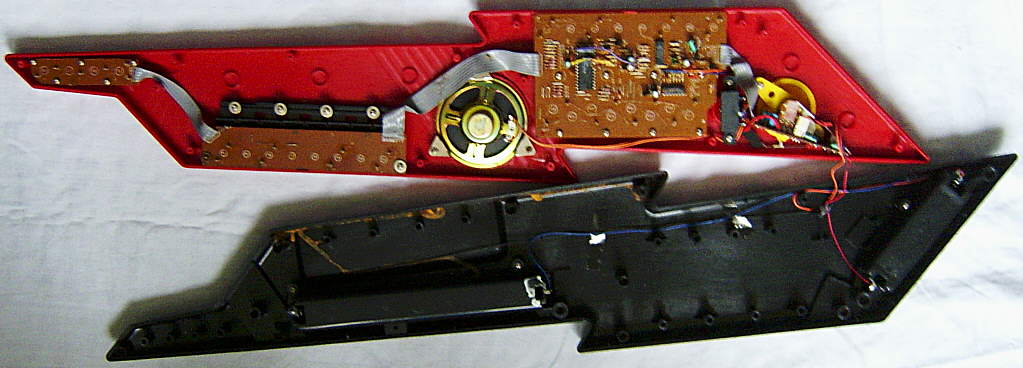
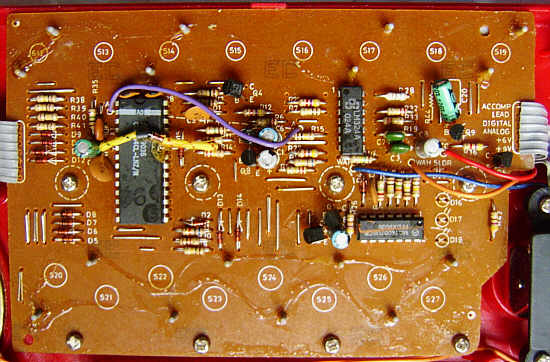
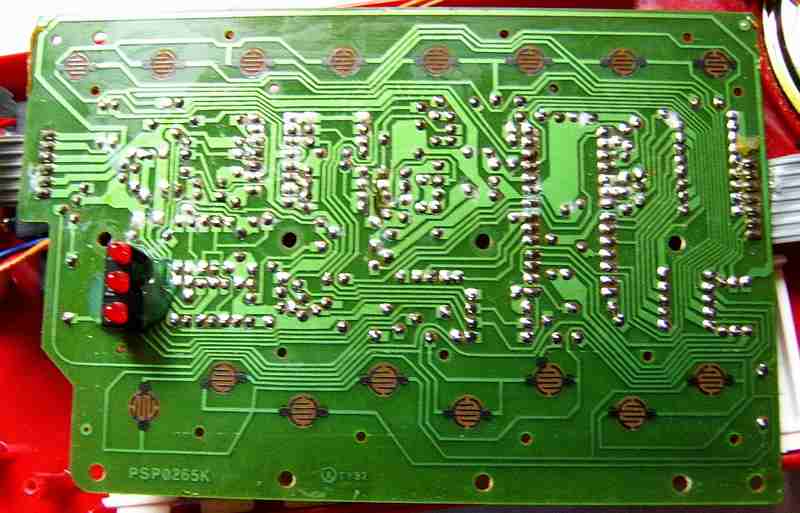
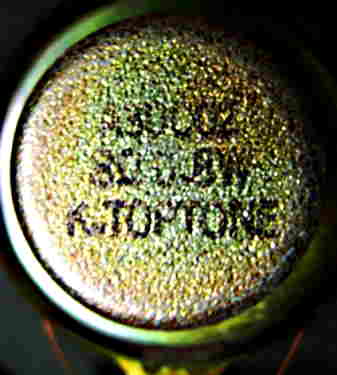
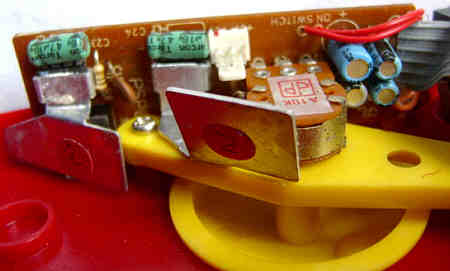
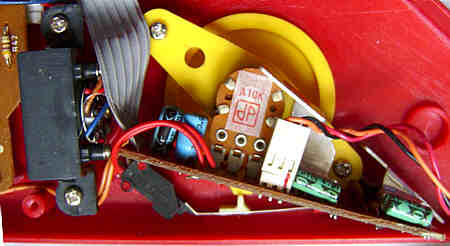
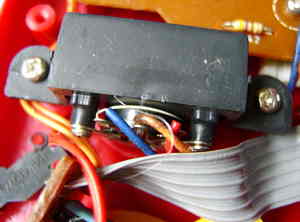
hardware detailsThe Tyco HotKeyz ist built around the CPU "National Semiconductor COP884CL-LNZ/N, -B9036, AD" (crystal clocked @ 10 MHz) that routes its sound through an external VCF.
(I haven't analyzed the hardware further yet.) |
Another interesting toy synth keytar with similar concept is the PaperJamz
- Justin Bieber Keyboard (sample based digital lofi with ribbon controller
for tremolo & flanger). Other instrument with great C64 sound are the
Yamaha PSS-100 and Letron
MC-38.
| removal of these screws voids warranty... | ||
 |
 |
|
|
|