Simba
ELECKING
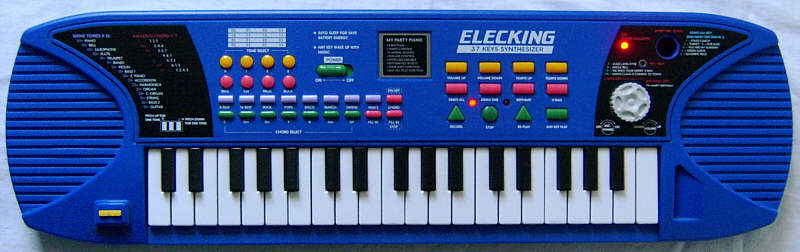
My Party Piano
(HP-29) |
|
lo-fi
toy keyboard with accompaniment, pitchbend & nice demos |
|
|
This sample based lo-fi toy tablehooter has 16 preset sounds, 8 preset
rhythms and 7 chord buttons for single finger accompaniment. The main voice
is 3 note polyphonic with simple pitchbend. There are 11 nicely arranged
demo melodies, those patterns can be looped with "any key play", and pitchbend
has a strange siren effect glitch (suitable for tekkno).
The sounds are made from medium low resolution samples with strong DAC
aliasing noise, that makes the sound thin and digitallic. The OBS preset
rhythms have each a fill-in & ending and a cheesy single finger accompaniment
that is played through a row of 7 chord buttons (similar like with Casio
PT-30, but less flexible) and can be switched off. Despite the
3 note polyphony behaves correctly, the keyboard sometimes skips or truncates
very fast played notes (likely by a too slow responding keyboard matrix).
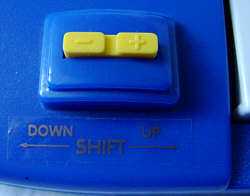
There are 4 animal sound pad buttons. The yellow pitchbend rubber lever
makes only the pitch of already held notes slowly bend up or down by 1
note; the 3 keys have a glitch that makes the pitch keep ascending or descending
forever so long pitchbend is held, which can be used as a siren- like sound
effect. But generally the user interface has annoying design flaws those
make it rather badly suited for live performance. Like with My
Song Maker there is a primitive monophonic sequencer and the "any
key play" mode, which repeats the current accompaniment pattern of a demo
in a loop (suitable for tekkno).
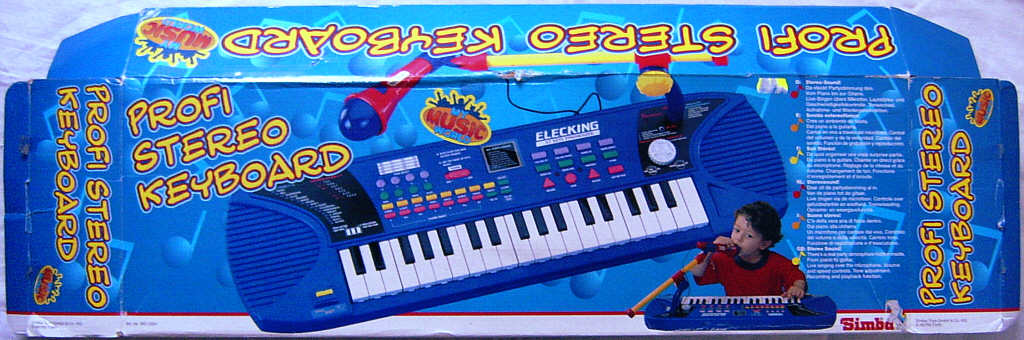
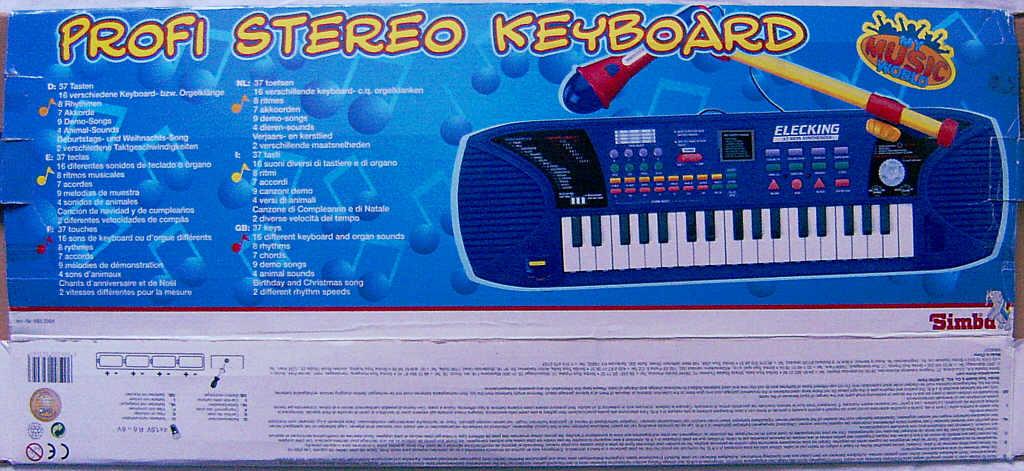
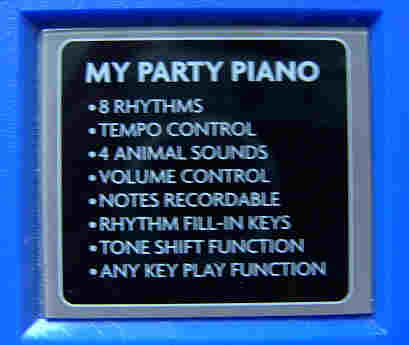
While the packaging box is branded by Simba, the only brand name
on the keyboard itself is Elecking. Under this label stands "37
keys synthesizer" and on the square decal in the center (resembling the
fake LCD of Jin Xin Toys JX-20165)
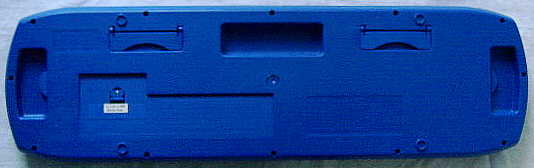
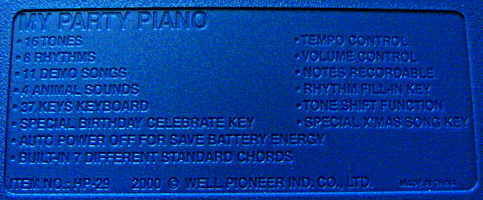
stands "MY PARTY PIANO". Embossed into the case bottom is a list of features
and "ITEM NO.: HP-29 2000 © WELL PIONEER IND. CO., LTD
Made In China", thus "My Party Piano" is likely the official name of this
instrument.
main features:
-
37 mini keys (wider than normal, black keys need a bit much force)
-
7 select buttons for direct selectable single finger chords
-
main voice polyphony 3 notes
-
2 built-in speakers (stereo, sound bassless)
-
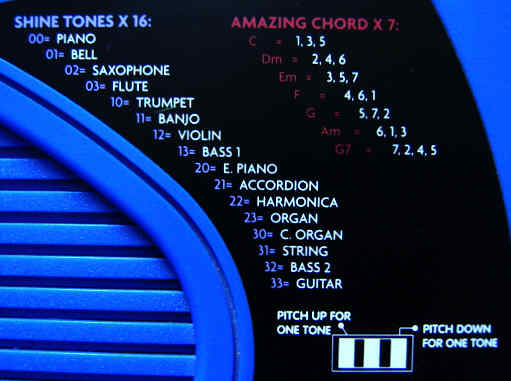
16 preset sounds {piano, bell, saxophone, flute, trumpet, banjo, violin,
bass 1, e. piano, accordion, harmonica, organ, c. organ, string, bass 2,
guitar} (selected through 4 cipher buttons {"0".."3"})
-
8 OBS preset rhythms {8 beat, 16 beat, rock, pops, disco, march, swing,
waltz}
-
volume +/- buttons (16 steps)
-
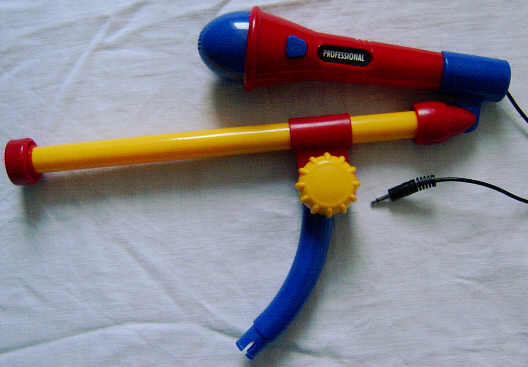
separate microphone volume knob (switches amp on/ off)
-
tempo +/- buttons (28 steps?)
-
pitchbend up/down rubber button
-
4 animal sound pad buttons {dog, cat, frog, duck}
-
fill-in & ending button
-
single finger accompaniment (only with rhythm, no manual chord mode)
-
useless sequencer (monophonic record/ play of 32 notes, no edit, contents
is erased as soon anything else but "replay" is pressed)
-
sound generator based on low and medium resolution samples with maximum
1 loop point and simple volume envelope. It has audible DAC aliasing distortion
& zipper noise. Percussion samples sound thin and resemble My
Music Center. The stereo sound pans main voice notes alternatingly
left or right; apparently the polyphony channels are each statically assigned
to the left or right speaker.
-
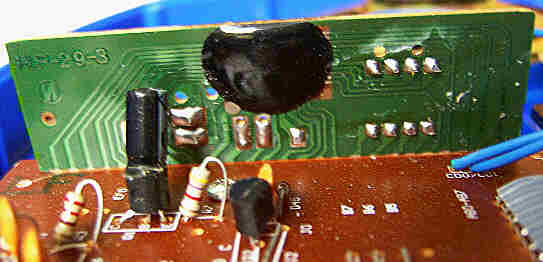
CPU= "HP-29-3" (26 pin COB)
-
11 demo melodies (also used for "any key play" mode)
-
auto power-off with jingle
-
jacks for AC adapter & microphone
modifications:
-
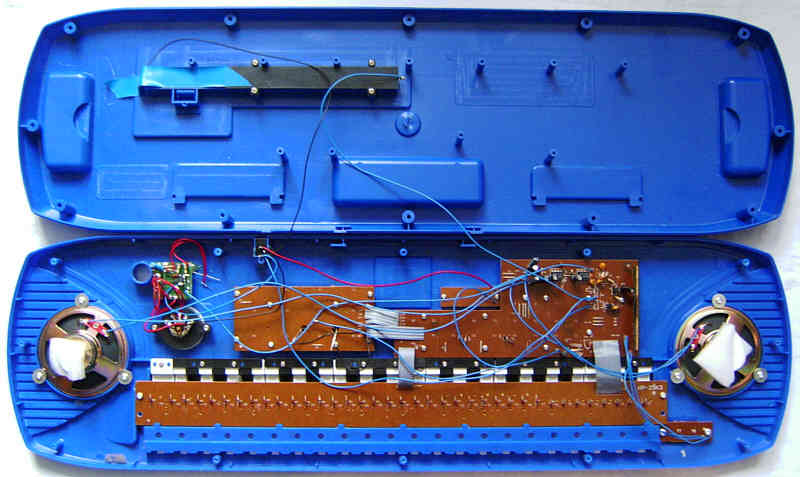
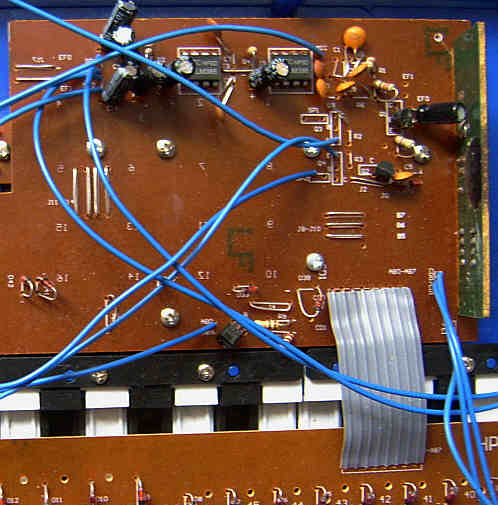
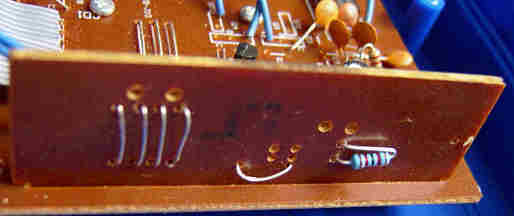
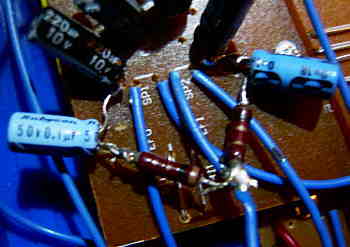
diode chain added to reduce supply voltage of overheating CPU.
-
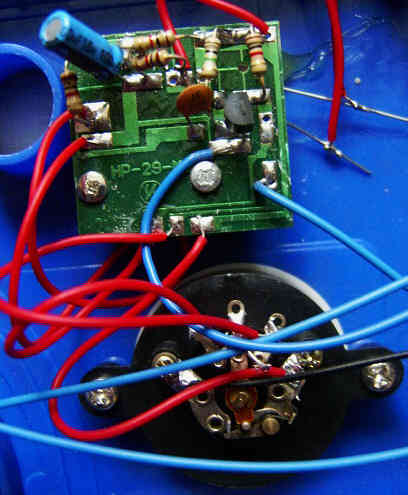
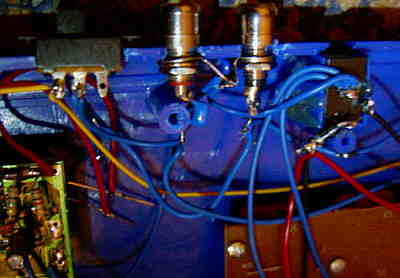
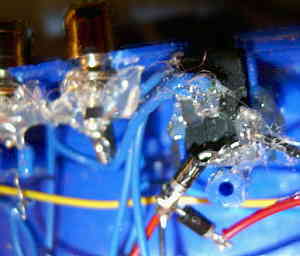
cinch sound output jacks with speaker mute switch added.
eastereggs:
The pitchbend lever behaves very odd. It bends notes normally by 1
full note up or down within 0.25s or so, but it only bends notes those
already sound before the lever is pressed. Notes played while the lever
is held down are not affected at all, so far no other notes are still sounding.
Playing a new note while bending an old note stops bending that old note
further. Even worse, the pitch of key 36 and 37 rises infinitely
instead of only by 1 note when pitchbend up is held, i.e. with sustaining
preset sounds ("organ" etc.) the pitch ascends higher and higher, causing
plenty of DAC aliasing distortion (sounds like a whistling old shortwave
radio) until after some minutes it warps around (apparently by internal
numerical overflow) and turns into a very low tone which keeps ascending
from there. When you release the pitchbend lever but keep the note held,
it will howl all the way back down, which takes quite long and sounds like
an US police car siren. Exactly the opposite happens when you bend down
the note of key 5, it falls quickly to the lowest possible pitch (sounds
a bit like a motorcycle) and than warps around to the highest possible
pitch and keeps descending (with plenty of DAC aliasing distortion) from
there. (Like with normal notes, the pitch stops bending further when any
additional notes are played during this.)
notes:
The outer case shape was obviously inspired by Casio
SA-65. Unusual is that the microphone volume knob switches the
internal amplifier on (with separate indicator LED) even when the main
power switch is off. The CPU (COB module) ran somewhat hot on 6V battery
voltage, which may damage it over time and wastes batteries. Thus I reduced
the voltage to about 4.7V(?) by inserting a diode chain into the positive
supply voltage line to make it run reasonably cool. Unfortunately the user
interface has some quirks those disturb live play. Starting any rhythm
not only resets tempo to default and enables single finger accompaniment,
but even switches the main voice preset sound to "piano" (happens also
by stopping rhythm), which is very annoying. Like with My
Music Center, with rhythm off all button presses play a hihat sample.
The tempo/ record LEDs mix a bit of hum into the sound when lit. After
power on there is a quite loud startup- jingle; after some minutes it plays
another jingle for battery alarm.
The main voice preset sounds are made from low and medium resolution
samples with maximum 1 loop point and simple volume envelope. High notes
sound cold by DAC aliasing distortion, and the envelopes have audible zipper
noise. The "piano" sounds fairly natural with high notes, but turns grainy
in the bass range since like all sounds it is made from only 1 sample without
key split zones. "bell" resembles a vibraphone without vibrato. The "flute"
sounds a bit dull and too noisy by aliasing distortion; bass range has
too slow attack. The "banjo" loop sample contains sampled mandolin ring,
which tempo thus strongly varies with the note pitch; it continues ringing
after key release with very long sustain (7s in the bass range). "violin"
is just a static tooting loop sample without vibrato. "bass" 1 is a warm
e-bass; 2 is duller. "e. piano" is a Rhodes or music box timbre with percussive
attack. The "accordion" toots cold and rather harsh by aliasing distortion.
"organ" is a plain pipe or Hammond organ tone with semi- percussive attack.
"c. organ" means likely chord organ and sounds like a thinner "accordion"
variant. "string" is a static tooting loop sample without any chorus or
vibrato; ba harsh aliasing distortion it resembles rather an oboe. "guitar"
is a bright one with metal strings.
The yellow rubber pitchbend "lever" behaves very odd. The pitch of key
36 and 37 rises infinitely (and finally warps around to low pitch) instead
of only by 1 note when pitchbend up is held. The pitch of key 5 falls
infinitely (and warps around to high pitch) instead of only by 1 note when
pitchbend down is held (see eastereggs). Pirchbend can not be used during
rhythm or sequencer record mode.
The rhythms are started by pressing their OBS buttons; pressing any
rhythm button during running rhythm stops it, which makes it awkward to
quickly switch between rhythms. Rhythms generally start with enabled single
finger accompaniment in key C at default tempo. You can mute the accompaniment
with the "chord on/ off" button, but after pressing "fill-in" it always
activates itself again. When accompaniment was on before pressing "fill-in",
also the fill-in is accompanied. Pressing "fill-in stop" plays an ending
pattern. Also pressing "fill-in" or "fill-in stop" without running rhythm
plays a default drum kit pattern. The thin and cheesy accompaniment patterns
are quite over- orchestrated (thus less versatile) and remind to Sankai
01870K or SoundWaves
MG-1530.
The monophonic record/ playback sequencer is quite useless because it
looses its contents when anything but "re-play" is pressed. (Playing any
notes or rhythm overwrites the sequence.) At least you can immediately
restart the sequence (make it rhythmically stutter) by pressing "re-play"
again. You can also during playback switch the preset sound or tempo, but
that's all. During recording always plays the "8 beat" rhythm (without
accompaniment), which can be muted with "chord on/ off". During playback
no rhythm can be used, but strange is that both fill-in buttons still work,
however reaching the end of the fill-in patter deletes the sequence, which
can be prevented by restarting the sequence (which stops the fill-in) before
the fill-in pattern ends.
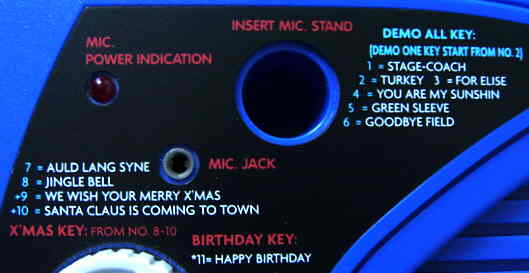
The 11 demo melodies are nicely arranged and quite long. The demo melodies
are:
-
Stage-Coach
-
Turkey
-
For Elise [the entire classical piano piece including interlude etc.]
-
You Are My Sunshine
-
Green Sleeve
-
Goodbye Field
-
Auld Lang Syne
-
Jingle Bell
-
We Wish Your Merry X'Mas [starts nicely C64- like]
-
Santa Claus Is Coming To Town
-
Happy Birthday
Odd is that different subsets of these songs are played by the 4 different
demo buttons. "demo all" plays all songs in a loop. "demo one" repeats
one song in a loop; it cycles per press through these songs: {2, 3, 4,
5, 6, 7, 8, 1}. "birthday" plays only 11. "x'mas" plays the songs {8, 9,
10}. This somewhat reminds to the hidden demos in Sankai
01870K. During demos you can not only select a different regular
preset sound for the main voice, but even exchange it with any of the animal
voices by pressing one of their buttons. You can also mute the accompaniment.
With the "any key play" button you can mute the main voice and step through
the song manually with any keyboard keys. During this the song's accompaniment
repeats in a loop, which can be used for tekkno.
Another strange toy keyboard with imitated Casio
SA-65 case design was the Jin
Xin Toys JX-20165.
| removal
of these screws voids warranty... |
|
|
 |

|
|
| |
back
|
|