Yamaha PSS-20
(monophonic squarewave keyboard with nice electronic percussion & arpeggio)
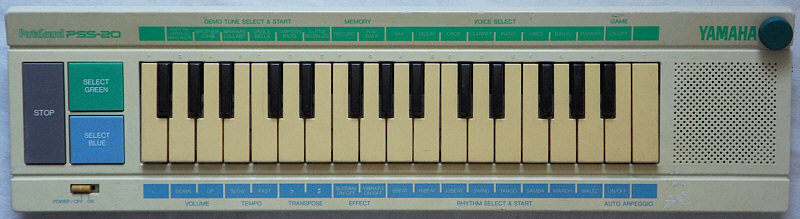
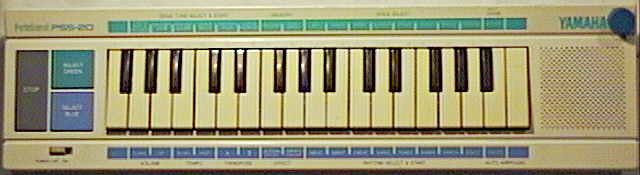
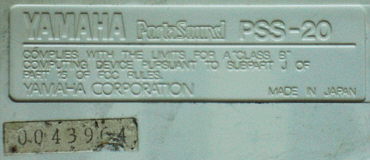
This small white tablehooter from 1989 (embossed case date) has coarse
electronic blip percussion that is interesting for tekkno.
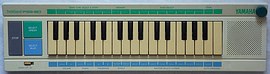
This was the certainly trashiest keyboard ever made by Yamaha.
The whole thing is only monophonic and everything is selected through 2
big silicone rubber buttons ("SELECT GREEN", "SELECT BLUE") pressed together
with keyboard keys. The digital volume control badly steals bit resolution
from the already grainy percussion. But despite crappy specs it is fun
to play; so it has strange multipulse timbres, vibrato, sustain and even
"arpeggio", which here however replaces the main voice with a kind of monophonic
single finger accompaniment. Additionally there is a simple audiogame for
pitch recognition.
main features:
-
32 mini keys
-
small built-in speaker
-
monophonic
-
8 quasi OBS preset sounds {sax, violin, oboe, clarinet, piano, vibes, banjo,
marimba}
-
8 quasi OBS preset rhythms {8beat, 16beat, 12beat, swing, tango, samba,
march, waltz}
-
all functions selected through green & blue button + keyboard key.
-
volume control (4 steps; low ones distort lousy because they steal DAC
bit resolution)
-
sustain
-
vibrato
-
tempo (8 steps)
-
transpose (-6..+5 semitones)
-
monophonic arpeggio accompaniment (not with melody).
-
main voice is based on multipulse squarewaves with complex digital envelopes
with audible zipper noise. The pitch of this crystal clocked instrument
is unfortunately quite detuned.
-
percussion made from 4 unique electronic sounds:
-
open & closed hihat (very grainy metallic)
-
conga (squarewave)
-
base (click)
-
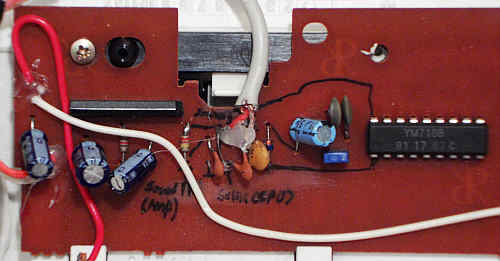
CPU= "Yamaha YM7108, 91 17 67 C" (18 pin DIL
| GE13)
-
pitch recognition audiogame
-
simple sequencer (record, playback, no edit)
-
6 demo melodies
-
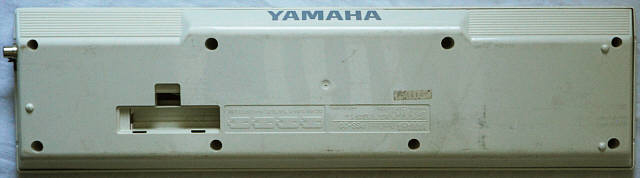
no jacks
modifications:
-
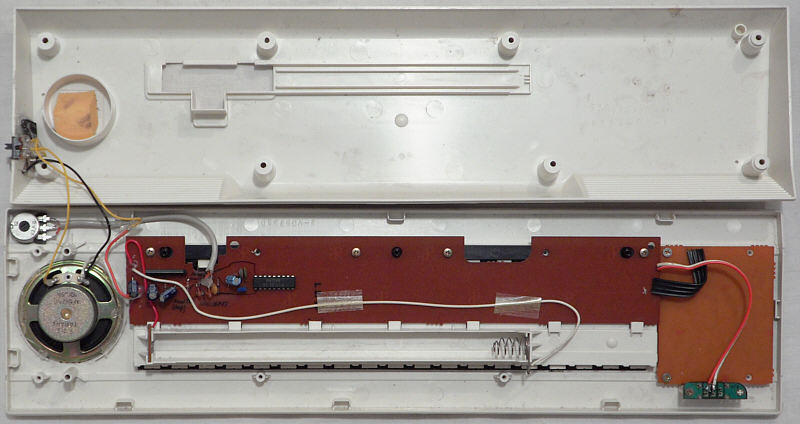
cinch sound output jack with speaker mute switch added.
-
real volume pot added
notes:
I like here how much play fun Yamaha created from an ultra-low spec chip.
Many modern toy instruments are way less inspiring despite their polyphonic
hifi samples. Annoying is that all decaying sounds (piano etc.) ignore
key press duration. But keys are nicely responsive and also permit short
blipping notes. The only additional control beside green & blue button
is the big grey "stop" button - likely it was made so big to quickly shut
up the annoying demos in shopping centers. But it also tends to accidentally
stop rhythm when another function is selected with green or blue. The arpeggio
accompaniment can NOT be used together with melody play, but replaces it
and always starts rhythm. All 8 preset sounds can be used for it. The transpose
function makes the lowest notes wrap around into high notes (also within
arpeggio).
The main voices are nothing really great; they resemble Casio
VL-1 but sound thinner and harsher. The 'violin' has mild vibrato.
Most interesting are the following 3 multipulse timbres: These are the
hollow and sonorous 'vibes' (vibrato can not be disabled), the 'banjo'
(rings with 12 Hz?) and the 'marimba'. The latter automatically toggles
between 2 octaves with 6 Hz, but unlike VL-1 the toggle tempo can not be
adjusted. The optional sustain is 1s long, the "vibrato" is rather a 6Hz
tremolo.
The rhythms of this small tablehooter are very impulsive and quite interesting
for tekkno-like things (although there is no tekkno base drum included).
Their tempo can be set quite slow but only medium fast (depending on selected
rhythm).
The audiogame starts with a jingle and then plays a row of ascending
and descending notes. The player has to listen an press the corresponding
key as a pitch recognition training. Hitting the correct one sounds a signal
(high note).
The 6 demos start a rhythm in the background, but belong to the most
boring monophonic arrangements ever heard by Yamaha. They simply doodle
in an endless loop and neither change sound nor rhythm.
-
When the Saints Go Marching In
-
Brother John
-
Brahms' Lullaby
-
Jingle Bells
-
Camptown Races
-
A Little Brown Jug
This song list likely even became the model for the even lousier tooting
melody chips in transistor tooters like Golden
Camel 7A, those include most of them.
hardware details
The Yamaha PSS-20 is based on the single-chip CPU "Yamaha YM7108"
(crystal clocked @ 720 kHz). The power amp IC is a "NJM 386S, JRC 8603"
(9 pin SIL).
| preset sound |
multipulse pattern |
vibrato |
| sax |
3:5 |
|
| violin |
1:7 |
X
|
| oboe |
1:15 |
|
| clarinet |
1:1 |
|
| piano |
1:3 |
|
| vibes |
1010101000000000 |
X
|
| banjo |
1010000000000000 |
|
| marimba |
= vibes |
|
|
The main voice is made from multipulse squarewave of 16 steps length.
(For readability, simple patterns are written as ratio.) The 'vibes' and
'marimba' pattern has 4 spikes followed by a blank half. 'banjo' has only
2 such spikes and then 3/4 blank. These can be also interpreted as normal
1:1 or 1:4 squarewave with logical AND of a 3 octaves higher plain squarewave.
The logarithmic volume envelope is 31 unequal steps high. The 'banjo'
and 'marimba' with held key retrigger their envelope (mandolin ring) when
the level falls to volume step 16. The vibrato in 'vibes' can not be disabled.
(The ratios were estimated on an analogue oscilloscope, which isn't
very accurate.) |
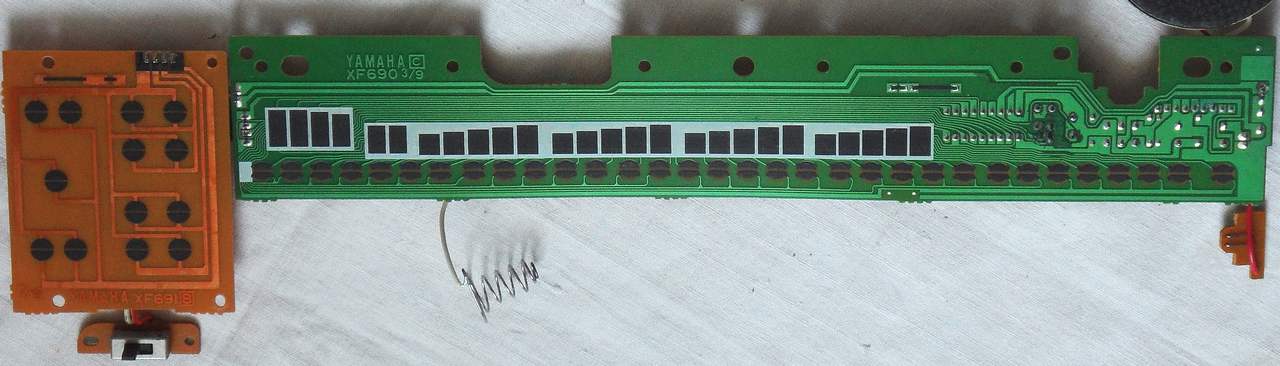
keyboard matrix
Beside a power-off there are no eastereggs. But here is it for completion.
The keyboard matrix is grouped by 6 (N#=notes, B#=groups. The official
pin numbering is strange. I hope I haven't messed it up.)
|
13 N5
|
12 N4
|
11 N3
|
10 N2
|
9 N1
|
8 N0
|
|
CPU pin
|
|
out 1
|
out 2
|
out 3
|
out 4
|
out 5
|
out 6
|
out / in
|
|
|
power off
|
stop
|
select
blue
|
select
green
|
o
F1
|
o
F#1
|
in 1
|
7 B5
|
o
G1
|
o
G#1
|
o
A1
|
o
A#1
|
o
B1
|
o
C2
|
in 2
|
6 B4
|
o
C#2
|
o
D2
|
o
D#2
|
o
E2
|
o
F2
|
o
F#2
|
in 3
|
5 B3
|
o
G2
|
o
G#2
|
o
A2
|
o
A#2
|
o
B2
|
o
C3
|
in 4
|
4 B2
|
o
C#3
|
o
D3
|
o
D#3
|
o
E3
|
o
F3
|
o
F#3
|
in 5
|
3 B1
|
o
G3
|
o
G#3
|
o
A3
|
o
A#3
|
o
B3
|
o
C4
|
in 6
|
2 B0
|
The input lines are active-low, i.e. react on GND. Any functions can
be triggered by a non- locking switch in series to a diode from one "in"
to one "out" pin.
legend:
|
|
|
"o"
|
= keyboard key |
orange
background |
= easteregg (unconnected feature) |
pinout YM7108 (GE13)
The "YM7108" (18 pin DIL) is the CPU of Yamaha PSS-20; it seems
to be the simplest single-chip keyboard CPU ever made by Yamaha. The multipulse
squarewave main voice is only monophonic. The blip percussion has 4 sounds
made from squarewave and a hissy semi-metallic waveform. Both are output
multiplexed through a time slice DAC (3 internal channels) on a single
pin. Unlike other Yamaha keyboards, the waveforms not even return to a
center voltage, but are only pulled into one direction (up from GND, to
save battery?). The only modern feature is that the volume envelopes are
logarithmic; the nonlinear envelope DAC has 31 steps (5 bit) of varying
height (upper end is higher).
This pinout is based on partial schematics photos of Yamaha PSS-20.
| pin |
name |
purpose |
| 1 |
VDD |
supply voltage +5V |
| 2 |
B0 |
key matrix in |
| 3 |
B1 |
key matrix in |
| 4 |
B2 |
key matrix in |
| 5 |
B3 |
key matrix in |
| 6 |
B4 |
key matrix in |
| 7 |
B5 |
key matrix in |
| 8 |
N0 |
key matrix out |
| 9 |
N1 |
key matrix out |
| 10 |
N2 |
key matrix out |
| 11 |
N3 |
key matrix out |
| 12 |
N4 |
key matrix out |
| 13 |
N5 |
key matrix out |
| 14 |
XOUT |
crystal out |
| 15 |
XIN |
crystal in (720 kHz) |
| 16 |
IC |
reset |
| 17 |
GND |
ground 0v |
| 18 |
AOUT |
audio out |
|
More advanced instruments with similar timbres and simple synthesizer
are Yamaha PSS-80 and the great
PSS-100.
| removal
of these screws voids warranty... |
|
|
 |

|
|
| |
back
|
|