| Yamaha
PSS-6 |
|
mini keyboards with sample sounds &
many lovely demos |
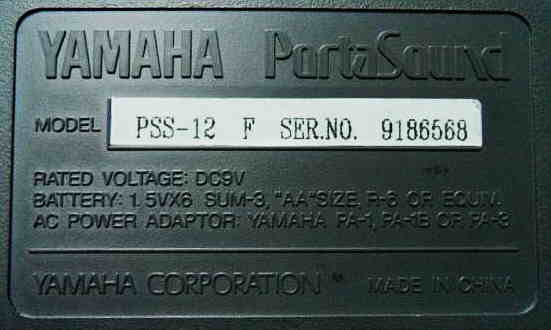
PSS-12
Yamaha PSS-6
This small keyboard has sample based sound with astonishingly high sound
quality and a lot of lovely demos. (Mine contains a sticker "10 OCT 1996",
but IC copyright label and embossed case date stamp from 1994.)
The concept of this instrument has many similarities with Casio
SA-5. Like the latter it selects its 100 preset sound by multiple
presses of 5 group buttons and a 4 variations button. But unlike the SA-5,
the Yamaha PSS-6 has no tekkno sounds but only natural instrument
samples, and the variations are mainly duet or trio versions of the same
preset sound or add echo etc. The rhythms have an optional fixed- key accompaniment
(called "jam tracks") that plays pre- programmed chord sequences and can
automatically switch the main voice sound all few patterns.
This keyboard has been emulated on MAME.
main features:
-
32 mini keys (black keys are fragile)
-
built-in speaker (high quality)
-
main voice polyphony 2 notes
-
100 preset sounds divided into 5 groups with each 5 sounds and each 4 variants
per sound selected by the "variation" button: {piano, e piano, harpsichord,
clavi, e organ | violin, vibraphone, marimba, flute, clarinet | folk guitar,
e guitar, banjo, harp, strings | saxophone, harmonica, accordion, trumpet,
horn | fantasy, wood bass, e bass, slap bass, piano split}
-
15 preset "jam track" rhythms {dance, rap, funk, rock, minor blues | rock
'n' roll, r&b, slow rock, jazz blues, fusion | bossa nova, samba, tango,
march, waltz} (switch main voice sound all few patterns).
-
preset sounds & rhythms selected through multiple presses of group
buttons
-
"jam tracks" accompaniment (fixed- key chord sequences, can be switched
off)
-
volume button (7 steps, stepping down & up again)
-
tempo button (7 steps, stepping down & up again)
-
"AWM" wavetable sound generator with sounds based on medium resolution
samples with partly complex volume envelopes (those e.g. simulate echo)
and surprisingly high sound quality (16 bit?).
-
multi-chip hardware:
-
CPU= "Yamaha YMW282-F, 9620 ABGB" (80 pin SMD | GEW7S, crystal clocked
@ 8 MHz)
-
ROM= "©1994 Yamaha, XP733A0, M531031B-12, 5132352" (32 pin DIL, 128KB)
-
15 lovely demo melodies (wonderful complex polyphonic orchestrations)
-
"minus one" function (mutes melody voice of demos to train playing)
eastereggs:
-
service mode: Hold the 2 leftmost white keys during power-on to
run the test program. Red and green LED will light up. All keys play "e
organ" notes without vibrato (which is no preset sound). All panel buttons
play sine wave notes. The "voice/ song" button lights alternatingly both
LEDs when held. The volume always stays at maximum. Press leftmost + rightmost
white key to exit.
-
echo speed controllable by tempo button.
notes:
The Yamaha PSS-6 was likely intended as competitor to the Casio
SA series, but in opposite to it the tone quality of the PSS-6 is astonishingly
high and sounds almost too good for such a toy- like mini keyboard - it
would have been even enough for a cheap fullsize General MIDI keyboard,
thus it is badly understandable why Yamaha omitted a sound output
jack. The CPU uses an external ROM ©1994 by Yamaha. I first
thought the higher polyphony of the PSS-12
can be also added as a matrix easteregg by installing a diode somewhere,
but the different ROM makes this unlikely, although PSS-12 seems to use
more of its CPU pins. (I haven't analyzed the hardware further.)
The preset sounds are selected by pressing the button of the desired
sound group multiple (up to 5) times, which always plays the currently
selected sound as a hint. Then the 4 variants of that sound can be tried
by pressing "variation" multiple times, which also each time plays the
current sound. (They don't play sounds during rhythm.) The "volume" and
"tempo" buttons play always a low or high knock to indicate whether they
are stepping down or up. Rhythms and demos are selected with the same group
buttons like the main voice preset sounds. The group buttons are switched
by the "voice/ song" button, that indicates its current mode by lighting
a red or a green LED (that also flashes as tempo LED during rhythm). Any
selected sound or demo starts immediately. This user interface concept
is very intuitive, but it also disturbs live performance.
The main voice preset sounds are based on medium resolution samples
and thus behave static, but they sound very clean and in no way noisy or
lo-fi. Unfortunately they are strictly focussed on natural instrument samples
those sound very establishment and don't include any remotely extreme tekkno
sounds. (For tekkno try a Yamaha PSS-7
instead.) The best thing it can do is soft pad timbres. Like with Casio
SA-35, each preset has 4 variations, but here the variations are
typically just duet or trio or other fixed chord versions of that preset
sound (these variations play only monophonic), or a different instrument
sample is selected. Some add a dose of reverb or chorus, and a simple repeating
echo is already the most avantgardistic effect of this instrument - at
least its speed can be adjusted with the tempo button. The "fantasy" sound
is here simply a sort of mellow vibraphone (on Casio
VL-1 it was a creaky synth organ tone with vibrato, while on Casio
SA series "fantasy" sound like a sitar). There are also a few key split
sounds (bass + others) and layer sounds (piano + strings).
(The full sound set list can be found in the manual of this instrument,
downloadable on the Yamaha Manual
Library site.)
The rhythms use medium resolution samples of acoustic percussion. They
select their own default tempo and normally start with an automatic fixed-
key accompaniment called "jam track", that plays a pre- programmed chord
sequence (like a demo without melody voice) and also automatically select
and switch the main voice preset sound. This behaviour can be disabled
by manually selecting a preset sound after the rhythm is started. With
the "minus one" button the accompaniment can be muted and re- enabled while
the rhythm stays on.
The instrument has a song bank of 15 wonderful orchestrated polyphonic
demo melodies:
-
Original Song 1 [fusion]
-
Original Song 2 [latin fusion]
-
Original Song 3 [slow latin fusion]
-
Deck the Halls
-
Sur Le Pont d'Avignon
-
Beautiful Dreamer
-
Londonderry Air
-
Symphony #40
-
La Cucaracha
-
House of the Rising Sun
-
Silent Night
-
Oh! Susanna
-
Song of Joy
-
O. Vrenelli
-
Troika [one of the Atari Tetris arcade tunes, jazz version]
With the "minus one" button the main voice can be muted to improvise to
the demos. All demos are quite long and complex arranged. The 3 "Original
Song" pieces are jazzy funk/ fusion musics. Also "Deck the Halls", "Londonderry
Air", "Symphony #40", "Troika" are in a dreamy blues/ jazz style that sounds
very mellow and muzak- like - just like out of a senior's home. Apparently
Japanese like such stuff, because I also found it in Japanese videogame
highscore musics and Anime movies.
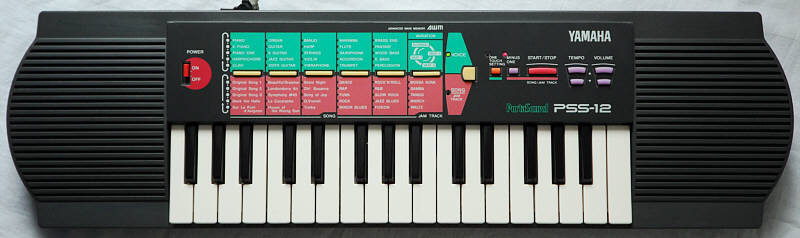
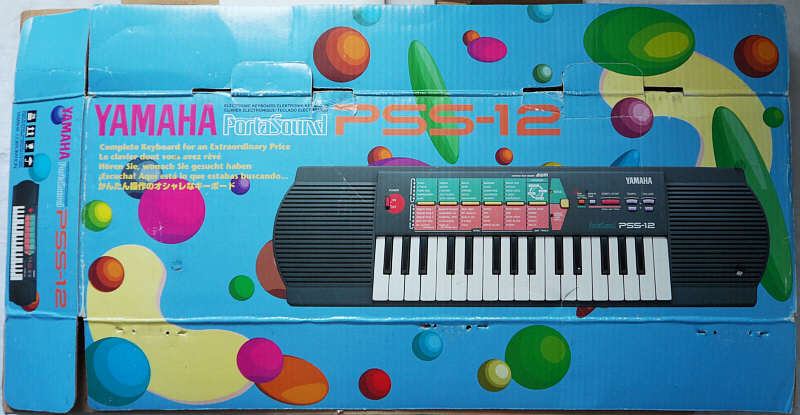
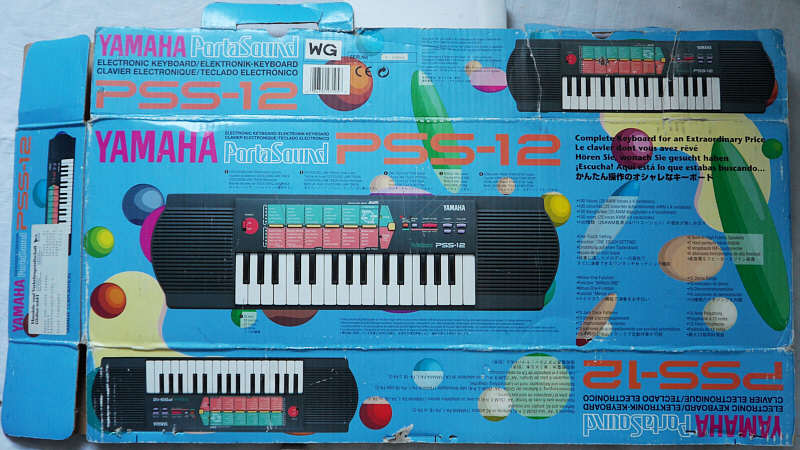
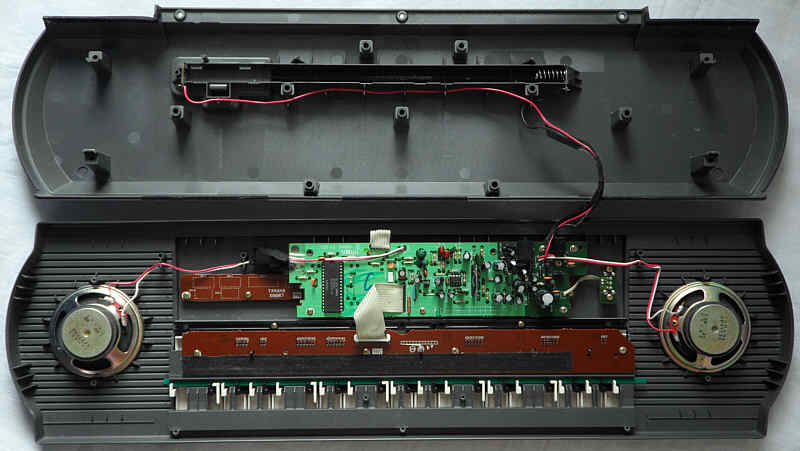
Yamaha PSS-12
This keyboard from 1994 (embossed case date) is the midsize version of
the Yamaha PSS-6. The most important
difference is its very high polyphony, but some preset sounds were changed
and here include a keyboard percussion mode.
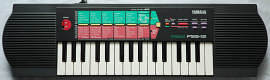
This keyboard has been emulated on MAME.
different main features:
-
32 midsize keys
-
2 built-in speakers (high quality, mono)
-
main voice polyphony >12 notes (8 with accompaniment, only 1 with duet/trio
preset sound variations)
-
different 100 preset sounds, divided into 5 groups with each 5 sounds and
each 4 variants per sound selected by the "variation" button: {piano, e
piano, piano ens, harpsichord, clavi | organ, guitar, e guitar, jazz guitar,
12str guitar | banjo, harp, strings, violin, vibraphone | marimba, flute,
saxophon, accordion, trumpet | brass ens, fantasy, wood bass, e bass, percussion}
-
volume +/- buttons (16 steps)
-
tempo +/- buttons (51 steps)
-
"one touch setting" button
-
multi-chip hardware:
-
CPU= "Yamaha YMW282-F, 9423 GEDB"" (80 pin SMD | GEW7S)
-
different ROM "©1994 Yamaha, XP598A0, M532031B-04, 4392352" (32 pin
DIL, 256KB)
-
headphones/ aux jack
eastereggs:
-
service mode: Hold the 2 rightmost keys during power-on to run the
test program. All LEDs will light up. All keys play "organ" variation 1
notes without vibrato (which is no preset sound). All panel buttons
play sine wave notes and unlight LEDs. Buttons with LED light them when
held; the "voice/ song" button lights alternatingly red and green. The
volume always stays at maximum. Press leftmost + rightmost white key to
exit.
-
echo speed controllable by tempo button.
notes:
Unlike PSS-6, the tempo here can be adjusted much finer in 51 steps, but
it resets to default when rhythm is started or changed. The additional
"one touch setting" button here automatically switches the main voice preset
sound when the "jam tracks" accompaniment patterns change. The PCB here
is double sided and seems to use more CPU pins. The amp has noticeable
static noise. I saw schematics photos mentioning a 2M ROM, which apparently
means 2Mbit (256KB) i.e. twice the PSS-6 capacity.
The direct successor of the PSS-6 was the pretty Yamaha
PSS-7, which has way lower sample resolution and features also
great granular tekkno sounds; its midsize variant is the PSS-14.
A technically close relative of the PSS-12 is the Yamaha
PSS-31 (similar sounds and hardware).
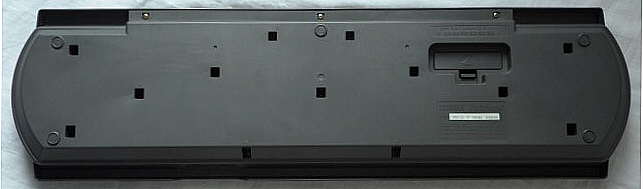
| removal
of these screws voids warranty... |
|
|
 |

|
|
| |
back
|
|