 |
BS
2010
KE
3860
BS
3000
BS
2000 |
8
bit waveform keyboard with simple lo-fi synth |
 |
|
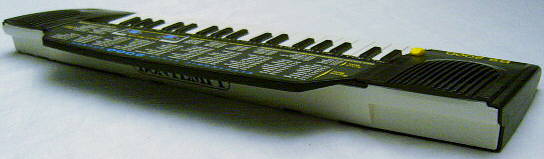
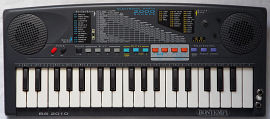
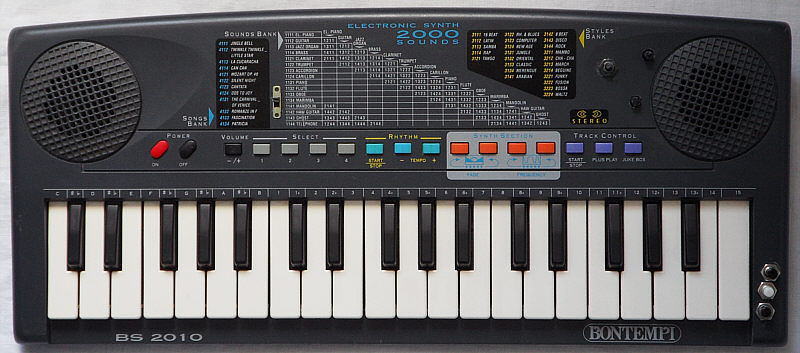
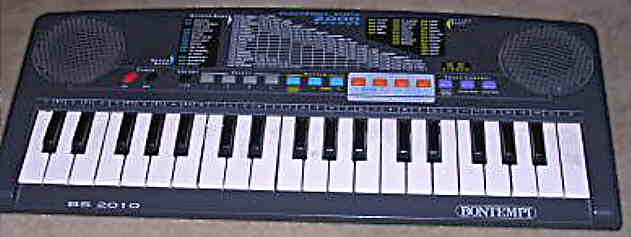
Bontempi BS 2010
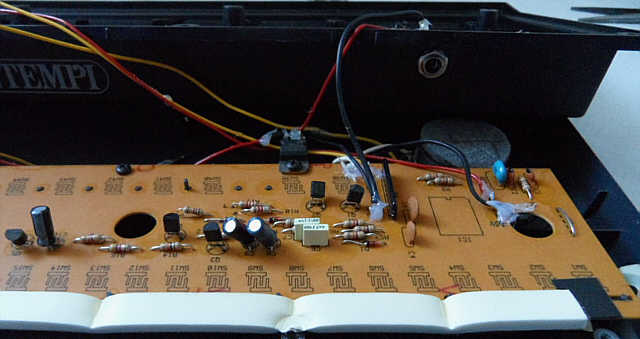
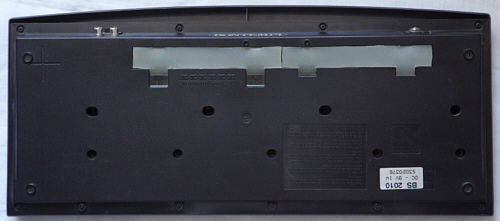
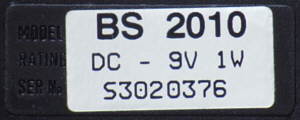
This 2 note polyphonic synth tablehooter of 1995 (PCB date code "25-95")
was one of the successors of Bontempi B50.
All
non- percussion sounds are made from combinations of 2 static waveforms
with volume and pitch envelopes. Most spectacular are the stereo crossfade
and howl effects.
The sound of the internal speakers is quite tinny with coarse 8 bit
waveform resolution, but fortunately at least the cruel beeping continuous
tone of the B50 is gone. Most interesting is that the thing has a so-called
synthesizer, which in fact only replaces the pitch- and/or volume crossfade
envelope of a sound with 1 of 5 different preset ones. Also certain combinations
of 2 preset sounds can be layered in a way that all together 2000 sounds
(with hack even 3000 sounds) can be generated. While these simple combinations
of presets not really deserve the term "synthesizer" (you can not tweak
intermediate values), the instrument can make some funny, howling sounds
and strange stereo crossfade and panning effects those are quite unusual
and not often heard. Fans of Rob Hubbard's C64 SID compositions may easily
fall in love with it.
The keys are very (almost too) responsive, so you can nicely glide on
them. Unfortunately a design flaw often makes both polyphony channels cancel
out each other during fast play, which limits usability. So it should be
rather considered a monophonic instrument - not least because also some
synthesizer settings or the use of rhythm forces monophonic play. But for
lead synth voices or pads it is otherwise nice because it has certain unusual
grainy special sounds those don't exist on average modern standard instruments.
The fairly soft and thin digital waveforms have a clean drawbar organ appeal
resembling Casiotone 1000P, although
the coarse resolution and stereo crossfade/ howl effects make it unique.
The rhythms unfortunately all include a fixed key accompaniment pattern,
which makes them quite useless for melody play.
main features:
-
37 midsize keys (very responsive)
-
max. 2 note polyphony (a keyboard flaw truncates held notes during fast
play, only 1 note with rhythm)
-
stereo (with panning sound effects)
-
2 lousy built-in speakers
-
16 basic preset sounds {el. piano, guitar, jazz organ, brass, clarinet,
trumpet, accordion, carillon, piano, flute, oboe, marimba, mandolin, haw
guitar, ghost, telephone}
-
80 (listed 64) layered sound combinations (each made from 2 of the above)
-
24 preset rhythms {16 beat, latin, samba, rap, tango, rh. & blues,
computer, new age, jungle, oriental, classic, merengue, arabian, 8 beat,
disco, rock, mambo, cha-cha, march, beguine, funky, fusion, bossa, waltz}
with accompaniments (fixed key, can not be turned off)
-
4 cipher buttons (to select preset sounds, rhythms & melodies)
-
tempo +/- buttons
-
main volume button (only 4 steps, most are too loud, eats bit resolution)
-
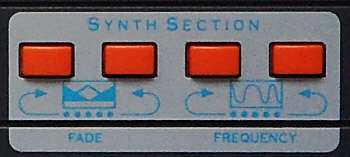
2 "frequency" (pitch) envelope buttons (cycling through 5 different envelopes)
-
2 "fade" (panning & mixing) envelope buttons (cycling through 5 different
envelopes)
-
sound generator based on low- res digital waveforms with volume, pitch
and panning envelopes. Each sound consists of 2 layered sub- voices with
different envelopes. Percussion is based on very boring drum samples, the
hihats possibly from shift register feedback noise. Both stereo channels
share 1 common resistor array as 8 bit DAC and are demultiplexed by transistors,
which causes audible beeping noise.
-
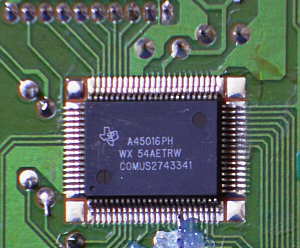
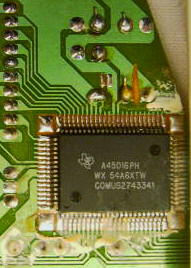
CPU= "Texas Instruments A45016PH, WX 54AETRW,
COMUS 2743341" (80 pin SMD)
-
12 built-in melodies for demo or "plus play" (training mode with muted
melody voice)
-
battery alarm (plays a high note)
-
no jacks
eastereggs:
-
3000 sound mode
-
preset sound 2211 = 'trumpet + el. piano'
-
3 higher note keys addable.
-
group of 8 buttons addable those modify the sound in strange ways.
-
battery alarm selects a preset sound ('carillon' variant) that is not on
the control panel.
modifications:
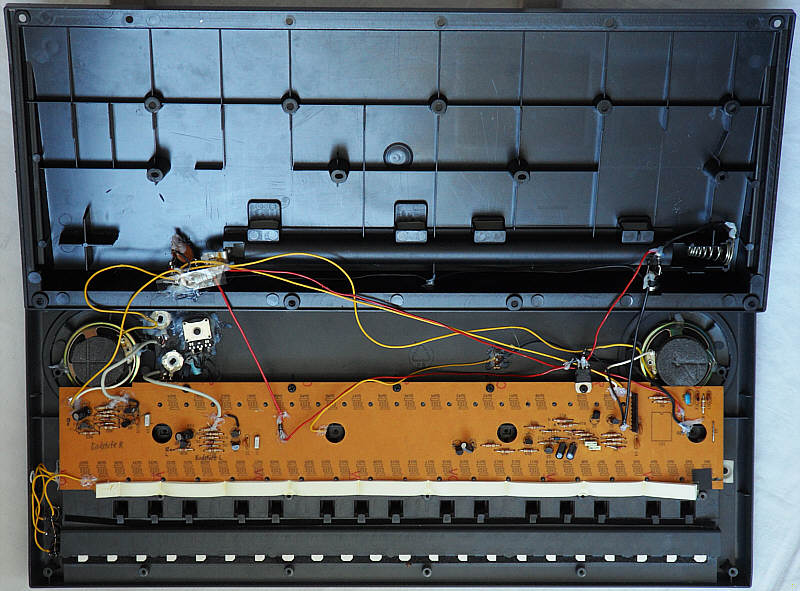
-
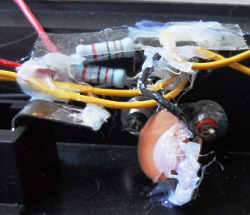
power supply jack with voltage regulator added.
-
stereo cinch outputs with speaker mute switch added.
-
volume pot added (stereo).
-
2 distortion pots added.
-
mode switch for control panel buttons added.
-
rewired for 3000 sounds mode
notes:
The accompaniment repeats always the same pattern loop in a fixed key and
thus is barely usable for playing given musics (even the built-in demo
songs partly plays in a wrong key!) - only for improvising it may be of
some use. Due to it is impossible to play rhythms without accompaniment,
and accompaniment always limits the keyboard to monophonic play, there
is only little serious use for the rhythm/ accompaniment feature of this
tablehooter. It is hard to understand why Bontempi didn't add single finger
chord or at least a mute button for that pesky accompaniment track to play
rhythm-only. Also the concept to prevent certain layered sound combinations
in cheaper variants (BS 3000 was
the real thing) sounds like a nasty ripoff to me.
All preset sounds, rhythms and demos are selected by a 4 digit number
entered with cipher buttons {"1", "2" ,"3", "4"}. Entering a number sounds
a snare drum, which disturbs live performance. Despite there are 56 empty
fields in the "sounds bank" matrix table, entering other sound numbers
than the official ones mostly do nothing. The only working easteregg number
is 2211 'trumpet + el. piano' (found on KE
3860 list). The battery alarm plays a clang (resembles 'marimba+carillon'
on note C4, but slightly thinner) in a preset sound that is not on the
control panel of BS 2010 (nor KE 3860) and keeps that sound selected. (It
has an electronic power switch and not much else to keep in memory - why
didn't add Bontempi a proper auto-power-off?!)
The preset sounds partly include envelopes those are not selectable
by the synth buttons. E.g. the 'telephone' sound uses a fast pitch switching
envelope (squarewave vibrato) which can be replaced by pressing the 'frequency'
buttons (i.e. the digital phone ring sound character disappears), but you
can not switch back to the original envelope this way, because that special
envelope is not available by these buttons. (Re-selecting the preset sound
always gets back its default envelope.) The behaviour of the synth section
is thus sometimes a bit confusing, particularly because after 5 presses
they cycle back to the 1st setting, which is not necessarily the default
for a sound, and there is no display to see which setting is currently
selected.
All basic preset sounds are made from 2 layered static waveforms (resembling
drawbar timbres) and thus not too realistic. High notes have noticeable
DAC aliasing noise. When not mentioned otherwiese, they all have a mild
5hz vibrato (aparrently the default 'frequency' envelope). 'el. piano'
sounds like a simple dull FM piano; 'piano' is the same in brighter and
'guitar' in even brighter. 'jazz organ' resembles a metal pipe organ rank
(no clicking attack) with somewhat sonorous bass range. 'brass' is similar
in even more sonorous with some phasing (LFO speed 8s); 'trumpet' is the
same in slightly duller. The 'clarinet' sounds more like a dull harmonium.
The 'accordion' with its sonorous bass range (and 8s phasing) sounds quite
realistic; 'oboe' is the same in thinner. 'carrilon' has 4Hz tremolo and
resembles tubular bells. 'flute' resembles a metal flute (with 8s phasing),
but the reedy bass range rather a harmonium. The 'marimba' (ignores key
press duration) has a picked string attack and thus rather resembles a
harp or koto. The 'mandolin' rings at about 5hz, using the 'guitar' waveform
(8s phasing); editing synth 'frequency' removes the ringing. The 'haw guitar'
is 'guitar' with a grainy pitchbend up followed by strong 5hz vibrato.
'ghost' resembles a thin e-piano (1 octave higher) with strong siren-like
2hz vibrato (sets 'frequency' to supervibrato). 'telephone' is a digital
telephone ring made from a flute-like waveform (1 octave higher) with rapidly
purring strong square vibrato (depth -1 semitone?); editing synth 'frequency'
removes the special LFO mode and so turns it into a piccolo flute.
The panel sound list has some bugs causing to doublets and missing combinations.
While the rows normally count the numbers diagonally to the right down,
the number 1333 is followed by 1134 instead of 1334 for 'haw guitar+marimba'
which is the basic 'marimba' (same on KE 3860). The right end of the diagonal
strip partly continues in the 2nd strip below the gap, but many combinations
were (intentionally?) omitted. The "2000 sounds" instruments support no
high sound numbers with 22xx, 23xx and 24xx (entering them does nothing).
The only exception 2211 ('trumpet + el. piano') is not listed on BS 2010
panel.
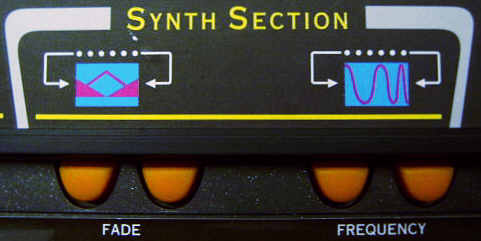
The synth section buttons cycle each through 5 different modulations
(in both groups the left one backward, the other forward) and so transform
each preset sound into 25 variants. Selecting a new preset sound (basic
or combination) always returns the synth mode to default. I found their
official mode names (without explanation) in the BS
2000/ BS 3000 user manual.
This is what they do.
fade
Each sound consists of 2 subvoices output through the stereo channels.
The right channel seems to play the higher component, the left channel
the 1 octave lower one. The fade parameter changes the volume envelope
they crossfade with.
| |
name: |
function: |
| 0 |
normal |
Both subvoices sound simultaneously. |
| 1 |
echo |
Begins like 0, but after key release timbre toggles with 2hz between
both subvoices (i.e. 2hz square DCO envelope at 100% depth on right channels
and inverted on left channel) during the added 3s sustain. |
| 2 |
sweep |
Crossfades within 1s from the right (high) to the left (low) subvoice
and stays there. |
| 3 |
pan pot |
Continuously crossfades with 2hz between the right (high) and left
(low) subvoice (i.e. 2hz triangular DCO envelope at 100% depth on right
channels and inverted on left channel). |
| 4 |
rebound |
like 3, but much slower 0.16Hz (6s) crossfade. |
frequency
This controls the pitch LFO. In preset sounds those already contain
special modulations (telephone vibrato or mandolin ring) the original LFO
setting is removed when edited and will not return to default at 'normal'.
| |
name: |
function: |
| 0 |
normal |
mild 5hz vibrato. |
| 1 |
portamento |
This sets the keyboard monophonic and makes the pitch quickly (within
0.1s?) glide to the next pressed key. |
| 2 |
glide |
This makes the attack phase pitch of each note rapidly (0.1s?) ascend
to the played note (kind of bagpipe imitation). |
| 3 |
hawaii |
Like 2 with slower pitch ascend (0.3s?) followed by additional square
5Hz vibrato. |
| 4 |
supervibrato |
Strong (about +1 semitone) 2Hz vibrato. |
| - |
mandolin ring |
Not selectable. Retriggers the whole envelope with 5Hz (only used by
'mandoline'). |
| - |
telephone ring |
Not selectable. Rapidly purring strong square vibrato (depth -1 semitone?,
only used by 'telephone'). |
I really don't understand why Bontempi didn't include this simple synth
into their later System5 instruments. With real accompaniment and
flawless polyphony it could have been much more fun to play, and their
versatile "666 sounds" synthesis engine likely supports such internal parameters
anyway.
circuit bending
details
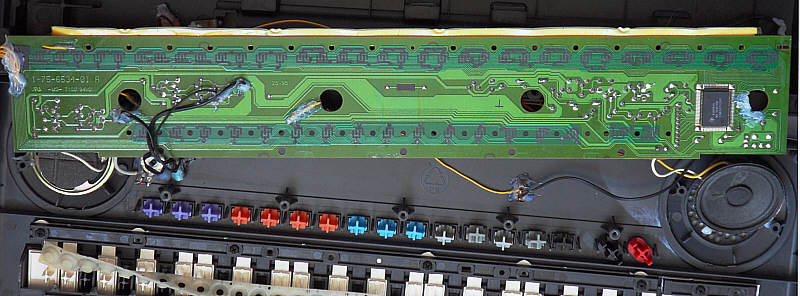
The Bontempi BS2010 is based on the single chip CPU "Texas Instruments
A45016PH, ... , COMUS 2743341" (crystal clocked at 32MHz); the 2nd row
"WX 54AETRW" seems to be only a serial number; the behaviour is identical
with the CPU of Bontempi KE 3860,
BS
2000 and BS 3000. So this
hardware analysis is valid for them as well.
Both stereo channels are output by the CPU through a single 8 bit resistor
array DAC ("8BIT 103G") and get demultiplexed by a strange transistor circuit
(sample & hold?, controlled by CPU pins 6 and 7). This adds some harsh
overtones and HF residues to the audio signal. To smoothen it, you may
upgrade it with something like the glitch-free Casio DAC circuit of Robin
Whittle.
wiring differences
In BS 2010 there is capacitor C5 connecting pin 51 to GND. Pin 52 seems
unused. Pin 55 is on GND. (Pins 56+57 are in all versions on GND.) In KE
3860 there are small PCB layout changes. Under capacitor C5 (pin 51 to
GND) is a solder blob jumper connecting pins 52+55. An unused pad can instead
connect 52 with GND. In BS 2000 there is a cut trace between pin 51 and
empty solder holes for a resistor R4 to +Vs (pin 52), but there is still
a (zener) diode D1 from pin 51 to 52 which is on +Vs. Instead of C2 there
is a 10k resistor from pin 51 to GND. Pin 55 is connected through a solder
blob jumper with GND. In BS 3000 there is even a cable running from the
power switch to a disconnected cut trace(!) where R4 was omitted. It has
(on solder side) the diode D1 from pin 51 to +Vs (pin 52 and through a
solder blob 55), and instead of C2 a 10k resistor from pin 51 to GND. Connecting
a resistor R4 turns the instrument on, so the cable to the power switch
was possibly a leftover from a factory test or repair.
Some changes were likely result of different power switch wiring and
desperate attempt of fixing a design flaw. That is to say, the BS 3000
case was apparently quickly re-designed in the last moment from a power-on
button (like in B50) to a locking
slide switch (holding down the same rubber contact driving a transistor)
when Bontempi noticed too late that the new CPU has no auto-power-off and
the case layout lacks a power-off button. The later BS 2010 and KE 3860
thus got equipped with electronic power-on and additional power-off button.
Small Bontempi keyboards are generally notorious of making nonsense like
crashing (shitshot by incomplete reset), buzzing (resetting in a loop)
or not stay off at all (happens in my Arturo) when power buttons
are pressed with batteries empty or conductivity properties have changed
by ageing or battery leak corrosion.
Pin 51 is reset. While BS 2010 and KE 3860 have here a capacitor (C5)
to GND, both BS 2000 and BS 3000 have a 3.6V zener diode (BZX 3V6) to +Vs
and 10k resistor to GND. Pin 52 in all models seems to be +Vs.
| model |
sounds on panel |
pin 55 |
| BS 2010 |
65 |
GND |
| BS 2000 |
80 |
jumper to GND |
| KE 3860 |
105 |
jumper to +Vs |
| BS 3000 |
121 |
jumper to +Vs |
3000 sounds mode
Manufacturing 4 different CPUs with only fewer sound combinations enabled
makes commercially no sense. So it could be expected that wiring changes
somehow setup the count of available preset sounds during power-on. First
there seem to be indeed only 2 versions of behaviour ("2000 sounds" vs.
"3000 sounds") because all sounds of the BS 2000 panel list do indeed also
work on BS 2010, and those of BS 3000 also on KE 3860. When I found nothing
in the keyboard matrix and the suspicious cable to a cut trace in my BS
3000 I did expect something evil. But fortunately there is no nasty stuff
like flash rom reprogramming involved.
The entire magic is done by pin 55 that selects the 3000 sounds mode
when pulled hi, else 2000 sounds. (When disconnected, it somehow seems
to memorize its last setting until reset. It is unknown if this is by stray
capacitance or an intentional polling algorithm.) All models except BS
2010 have a solder pad jumper for this. Pin 55 has to be disconnected from
GND and rewired to +Vs (e.g. pin 41) to enable sound combination numbers
beginning with 22xx..24xx. The highest supported sound number is 2431.
(2432..2444 do nothing.)
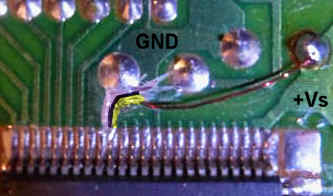 In
my BS 2010 pins 55+56+57 are on the same broad GND trace (impossible to
figure out without comparison). Thus pin 55 first has to be carefully cut
out of that trace (e.g. with small screwdriver or nail scissor, gap here
marked black) before you can solder that part (here marked yellow)
with a thin enamelled wire to +Vs. Clean up copper debris thoroughly and
verify not to short +Vs and GND before you insert batteries. (An overlooked
short circuit would likely destroy power switch transistors Q1 or Q2.) In
my BS 2010 pins 55+56+57 are on the same broad GND trace (impossible to
figure out without comparison). Thus pin 55 first has to be carefully cut
out of that trace (e.g. with small screwdriver or nail scissor, gap here
marked black) before you can solder that part (here marked yellow)
with a thin enamelled wire to +Vs. Clean up copper debris thoroughly and
verify not to short +Vs and GND before you insert batteries. (An overlooked
short circuit would likely destroy power switch transistors Q1 or Q2.)
The jumper inside KE 3860 suggests that a later BS 2010 version was
made with the same (easier to modify) mainboard. But it also may be that
this was done only to exchange faulty mainboards during warranty repair
and switch them to the same count of sounds. |
keyboard matrix
When I originally wrote down the keyboard matrix, I badly messed up the
CPU pin count and numbering (they count anticlockwise). I later reconstructed
their order by PCB photos. Likely other instruments on this page have the
same keyboard matrix. So I verified and re-sorted the matrix by comparison
with my BS 3000. The instruments itself have no matrix diodes (thus restricts
polyphony to 2 notes) and so make matrix mess when panel buttons are held
during keyboard play.
|
40
|
39
|
38
|
37
|
36
|
35
|
34
|
33
|
|
CPU pin
|
|
in 1
|
in 2
|
in 3
|
in 4
|
in 5
|
in 6
|
in 7
|
in 8
|
in / out
|
|
o
C1
|
o
C#1
|
o
D1
|
o
D#1
|
o
E1
|
o
F1
|
o
F#1
|
o
G1
|
out 1
|
23
|
o
G#1
|
o
A1
|
o
A#1
|
o
B1
|
o
C2
|
o
C#2
|
o
D2
|
o
D#2
|
out 2
|
21
|
o
E2
|
o
F2
|
o
F#2
|
o
G2
|
o
G#2
|
o
A2
|
o
A#2
|
o
B2
|
out 3
|
19
|
o
C3
|
o
C#3
|
o
D3
|
o
D#3
|
o
E3
|
o
F3
|
o
F#3
|
o
G3
|
out 4
|
22
|
o
G#3
|
o
A3
|
o
A#3
|
o
B3
|
o
C4
|
o
C#4
|
o
D4
|
o
D#4
|
out 5
|
11
|
|
-
|
volume
+/-
|
'1'
|
'2'
|
'3'
|
'4'
|
S.
fade -
|
S.
fade +
|
out 6
|
15
|
T.
juke box
|
T.
plus play
|
T.
start/stop
|
S.
frequency -
|
S.
frequency +
|
tempo
-
|
tempo
+
|
rhythm
start/stop
|
out 7
|
8
|
|
reset
|
click 1
|
click 2
|
reset
|
click 3
|
accomp
ring
|
reset
|
rhythm
start/stop 2
|
out 8
|
17
|
The input lines are active-low, i.e. react on GND. Any functions can
be triggered by a non- locking switch in series to a diode from one "in"
to one "out" pin.
legend:
|
|
|
"o"
|
= keyboard key |
|
T.
|
= track control |
|
S.
|
= synth section |
orange
background |
= easteregg (unconnected feature) |
grey
background |
= unconnected doublet |
-
alternate button functions
The CPU keyboard matrix inputs are pin 33 to 40. The outputs for keys
are pin 11, 19, 21, 22, 23. (Pin 11 supports 3 additional higher note keys.)
The control panel button outputs are pin 8 and 15. At the unused pin 17
a set of 8 additional buttons can be added, those do strange sound changes.
I instead added a switch that switches the line to the control panel from
pin 8 to pin 17. This changes the function of 8 buttons in the following
way:
|
normal
|
juke box
|
plus play
|
track
start/ stop
|
frequency -
|
frequency +
|
tempo -
|
tempo +
|
rhythm
start/stop
|
|
alternate
|
reset
|
click 1
|
click 2
|
reset
|
click 3
|
accomp. ring
|
reset
|
rhythm
start/stop 2
|
The 'accomp. ring' button exchanges (until reset) the bass
of the accompaniment with a bell (carillon?), which sounds particularly
nice with the "Jingle Bells" demo tune. After a stopped rhythm it makes
its last accompaniment note hang. Also held keys can make a note hang.
In 'juke box' demo mode it can turn the next song into sound chaos (a dangling
pointer bug?). The 'click' buttons make a click noise (volume depends on
the button). When these buttons are pressed together with keys, sometimes
strange sound changes appear. The "reset" buttons resets everything to
power-on condition (like after pressing "on"). The "rhythm start/stop 2"
button behaves like the normal one, except that it can pause and resume
the juke box mode; after resume the main voice is missing (like "plus play",
which normally does not work here).
I don't know what this stuff shall be - it was likely a test feature.
They also don't change the count of preset sounds or other obvious things
when held as a fixed diode during power-on.
distortion
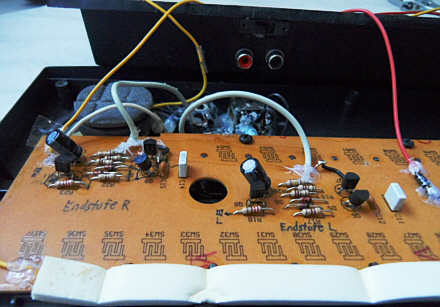
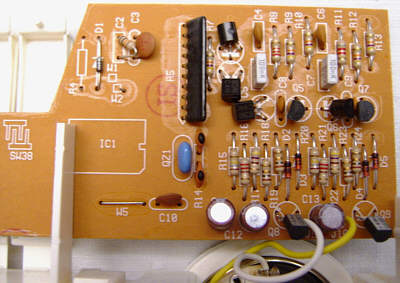
The stereo amplifier consists od 2 identical channels which each 3 transistors.
The transistor Q10 is the preamp, Q9 + Q10 form the power amplifier of
the right channel; Q8 and Q6 + Q7 do the same for the left channel. To
add distortion, solder a diode from the base of transistor Q10 to the wiper
of a 50 kOhm pot, and the left end of the pot to GND; do the same with
the other channel.
volume control
For real volume control, cut the trace between C14 (100 nF) and the 1µF
electrolytic cap. Connect the wiper of a logarithmic 100 kOhm stereo potentiometer
with the now open end of C14, and the right end of the pot with the open
end of the 1µF cap; connect the left pot end with GND. Connect the
same way the 2nd amplifier channel with the 2nd channel of the stereo pot.
pinout A45016PH
The single chip CPU "Texas Instruments A45016PH, COMUS2743341" (80 pin
SMD pins count anticlockwise, COMUS... = software number of internal ROM)
is the CPU of the "Bontempi Synth" cheap mini keyboard series. It is crystal
clocked at 32 MHz and apparently has 6 internal sound channels (2 melody
voice, 3 chord, 1 bass?) and very low resolution sampled(?) digital percussion.
It supports a keyboard matrix of at least 8 in and out pins. Sound is output
through an 8 bit resistor ladder DAC, multiplexing both stereo channels.
This (likely incomplete) pinout was made by myself, because I have no
service manuals. So all pin names were chosen by me (partly inspired by
Casio naming conventions), so do not depend on them - they may change if
I find schematics. The table is based on own BS 3000 examination and my
old BS 2010 description.
| pin |
name |
purpose |
| 1 |
DATA1 |
hf data out (not used) |
| 2 |
|
(hi out) |
| 3 |
|
(hi out) |
| 4 |
DATA2 |
hf data out (not used) |
| 5 |
+Vs |
supply voltage (+4.3V) |
| 6 |
MUXL |
dac demux left sound channel |
| 7 |
MUXR |
dac demux right sound channel |
| 8 |
KO7 |
key matrix out |
| 9 |
|
(hi) |
| 10 |
|
(hi) |
| 11 |
KO5 |
key matrix out |
| 12 |
GND |
ground 0V |
| 13 |
+Vs |
supply voltage (+4.3V) |
| 14 |
|
(hi) |
| 15 |
KO6 |
key matrix out |
| 16 |
|
(hi) |
| 17 |
KO8 |
key matrix out |
| 18 |
|
(hi) |
| 19 |
KO3 |
key matrix out |
| 20 |
DATA3 |
data out (phase modulated 200Hz, not used) |
| 21 |
KO2 |
key matrix out |
| 22 |
KO4 |
key matrix out |
| 23 |
KO1 |
key matrix out |
| 24 |
|
(hi out) |
| 25 |
|
(hi out) |
| 26 |
|
(hi out) |
| 27 |
|
(hi out) |
| 28 |
|
(hi out) |
| 29 |
|
(hi out) |
| 30 |
|
(hi out) |
| 31 |
|
(hi out) |
| 32 |
+Vs |
supply voltage (+4.3V) |
| 33 |
KI8 |
key matrix in |
| 34 |
KI7 |
key matrix in |
| 35 |
KI6 |
key matrix in |
| 36 |
KI5 |
key matrix in |
| 37 |
KI4 |
key matrix in |
| 38 |
KI3 |
key matrix in |
| 39 |
KI2 |
key matrix in |
| 40 |
KI1 |
key matrix in |
|
|
| pin |
name |
purpose |
| 41 |
+Vs |
supply voltage (+4.3V) |
| 42 |
+Vs |
supply voltage (+4.3V) |
| 43 |
|
(lo) |
| 44 |
|
(lo) |
| 45 |
|
(lo) |
| 46 |
|
(lo) |
| 47 |
|
(lo) |
| 48 |
|
(lo) |
| 49 |
|
(lo) |
| 50 |
|
(lo) |
| 51 |
/RESET |
reset |
| 52 |
+Vs |
supply voltage (+4.3V) |
| 53 |
GND |
ground 0V |
| 54 |
CLK3 |
hf clock + hi out (not used) |
| 55 |
SEL |
select 3000 sounds mode |
| 56 |
GND |
ground 0V |
| 57 |
GND |
ground 0V |
| 58 |
O8 |
dac out (MSB) |
| 59 |
O7 |
dac out |
| 60 |
O6 |
dac out |
| 61 |
O5 |
dac out |
| 62 |
O4 |
dac out |
| 63 |
O3 |
dac out |
| 64 |
O2 |
dac out |
| 65 |
O1 |
dac out (LSB) |
| 66 |
|
(hi out) |
| 67 |
|
(lo out) |
| 68 |
CLK1 |
clock out (0.26us = 3.8 MHz?, not used) |
| 69 |
CLK2 |
clock out (0.15us = 6.66 MHz?, not used) |
| 70 |
OSC1 |
crystal in (32 MHz) |
| 71 |
OSC2 |
crystal out |
| 72 |
GNDC1 |
(crystal center pin, wired to GND) |
| 73 |
GNDC2 |
(wired to 72) |
| 74 |
GND |
ground 0V |
| 75 |
GND |
ground 0V |
| 76 |
GND |
ground 0V |
| 77 |
GND |
ground 0V |
| 78 |
GND |
ground 0V |
| 79 |
GND |
ground 0V |
| 80 |
GND |
ground 0V |
|
Some of the many +Vs and GND pins may be in fact hidden configuration
inputs (like pin 55) to setup software behaviour. Unused pins marked with
"(hi out)" or "(lo out)" have a low resistance output, while normal pins
are high resistance (i.e. strongly change level when burdened with 1k pullup
resistor against GND or +Vs). The keyboard matrix outputs however are high
resistance anyway to avoid damage when many keys or buttons are held down
in the diodeless matrix. (Don't ask me why the key matrix out pin order
is such a mess. - Casio often did the same.)
The DAC demultiplexing pins 6, 7 output a strange waveform (multipulse
squarewave 111010?) to switch the DAC between both stereo channels. It
is unknown why no simple squarewave is used (overtones?, HF interferences?).
Pins 1 and 4 output very high frequency data. Pin 20 apparently outputs
data through a phase modulated 200Hz squarewave signal (may be IRQ, frequency
resembles keyboard matrix). Pin 54 looks like hi, but on my scope there
is a pale shade hinting that it is mixed with extremely high (clock?) frequency
that my old analogue oscilloscope can not enlarge further. The unused output
pins 24..31 become lo when the 'accomp ring' matrix easteregg is on. Also
during shitshot unused pins output strange stuff, and pinouts of Bontempi
single chip CPUs differ strongly, which hints that it may be a generic
Texas
Instruments microcontroller with internal ROM. Shitshot (touching crystal
pins, keeping reset pin hi) on this CPU usually results in total lockup
(neither keys nor panel buttons work). This sometimes producing a grainy
digital noise loop (may contain internal ROM code worth to capture and
analyse) but nothing playable (typical for small Bontempi sound bank keyboards),
which hints that the algorithm strongly depends on RAM contents without
much prewired hardware functions. I.e. this is likely a softsynth on a
chip (like Casio SA-Series),
similar like the (later?) "666 sounds" engine. |
The instrument has 12 demo songs with standard accompaniment:
-
Jingle Bell
-
Twinkle Twinkle Little Star
-
La Cucaracha
-
Can Can
-
Mozart Op. 40
-
Silent Night
-
Cantata
-
Ode To Joy
-
The Carnival Of Venice
-
Romanze In F
-
Fascination
-
Patricia
They can be started either in a big loop with the 'juke box' button or
individually with the track control 'start stop' button. Only in the latter
mode the main voice can be muted with the 'plus play' button to permit
manual keyboard play training to their accompaniment track; the user plays
the main voice while the instrument selects accompaniment and timbre by
itself.
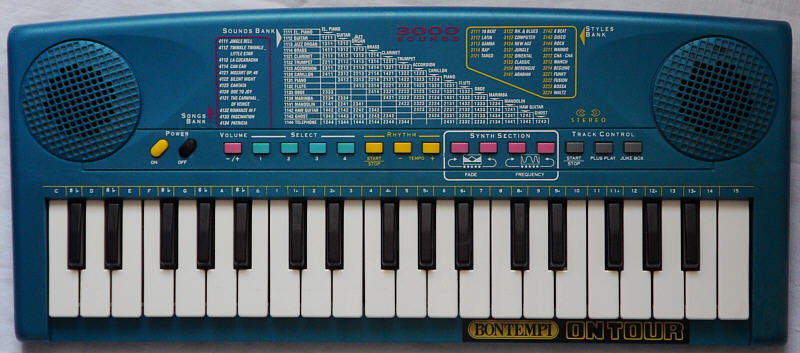
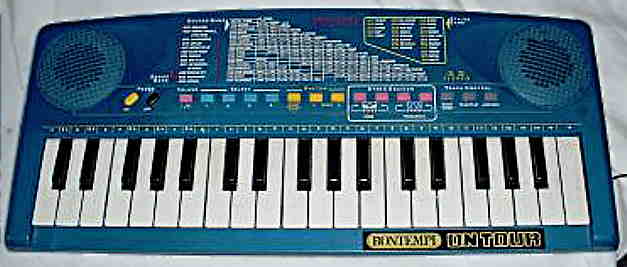
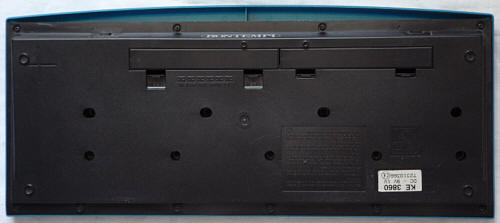
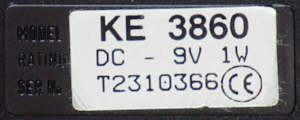
Bontempi - On Tour KE 3860
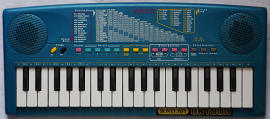
This instrument of the "Bontempi On Tour" series of 1996 (PCB
date code "16-96") was the direct successor of the Bontempi
BS 2010. It is almost identical (including the annoying polyphony
flaw and beeping demultiplexer noise) except that it has a blue case, 9V
DC power supply jack and includes instead of 80 now 121 layered preset
sound combinations. So it provides 3000 sounds in total (despite the label
"electronic synth" is gone) because its "sounds bank" matrix table contains
far less empty entries (those identical with BS 2010 even have same numbers).
Strange is that there are still 15 empty fields (2 diagonal rows) in
the matrix; I guess it was no technical limitation but marketing reasons
because it wouldn't have resulted in a round thousands number of sounds.
The hardware accepts the same 121 sounds like BS
3000.
different main features:
-
121 (listed 105) layered sound combinations
-
CPU= "Texas Instruments A45016PH, WX 65A533W,
COMUS 2743341" (80 pin SMD)
-
AC-adapter jack
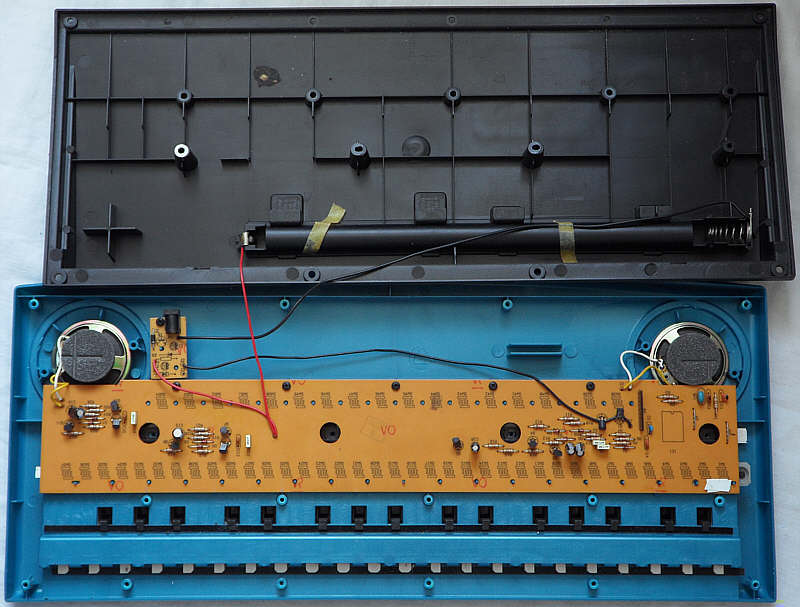
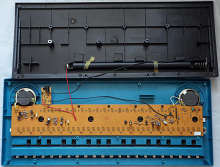 |
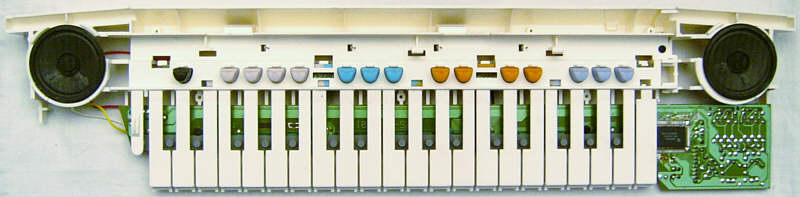
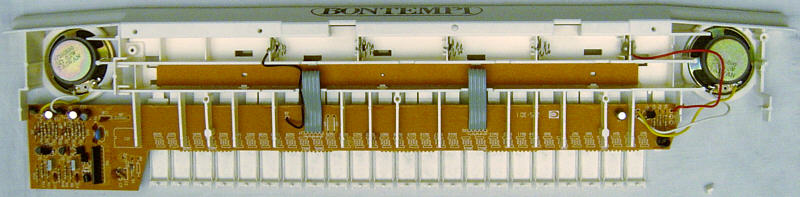
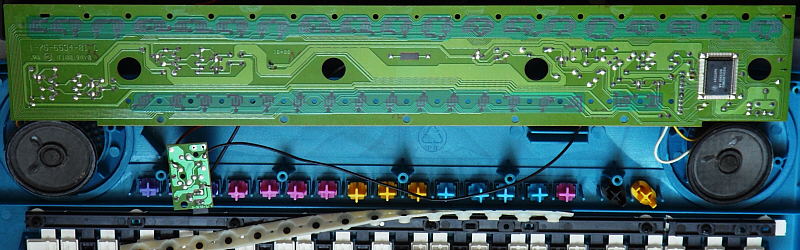
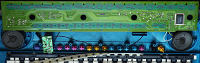 Differences to BS2010 hardware are small...
 |
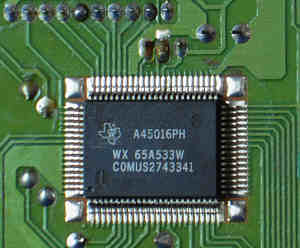 The pin 55 jumper above the CPU selects 3000 sounds mode.
 |
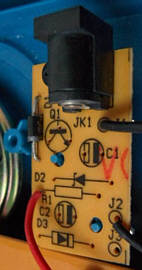 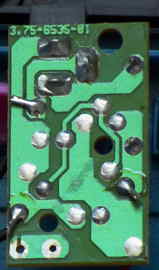 |
...although this one has an AC adapter jack.
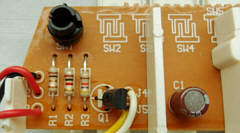
The empty solder holes were likely designed for a discrete voltage regulator.
The same PCB in BS 3000 is fully equipped
and only lacks capacitor C2. |
Sound and behaviour of this instrument (including rhythms and demos) are
fully identical with my BS 2010 and BS 3000. The only technical difference
to BS 2010 is a jumper for the 3000 sounds mode.
Other Bontempi keyboards with the same case style like KE 3860
were released in blue as Bontempi
On Tour KE 3760 (contains B40
hardware) and in orange (different demo) as Confetti
Kla4.
|
|
BS
3000 & BS 2000 |
The top of the line model of this hardware family was the mysterious
"6 note polyphonic" Bontempi BS3000 mini synth. Unfortunately it
seems to be terribly rare, so I expected it to be vapourware of that only
some prototypes were made (like with the Commodore C65 home computer).
The only hint to its existence was this advertisement on the
Bontempi
homepage of the year 2000.
|
BS3000 Synth.
37 Mini Key Digital Keyboard * (C-C) * 120
individual sounds * 24 Rhythms * Synthesiser function to create 3000 sounds
* Polyphony: up to 6 notes * 12 Songs with Plus Play function * Controls
; volume & tempo * 15 keys for selection of functions * Pre-set Effects
: Sustain, Reverb, Vibrato, Chorus * Stereo Amplification & High Performance
Loudspeakers * On/Off switch * Switch Off Reminder *
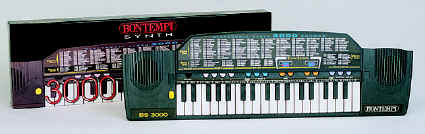
Requires 4 x R6/AA 1,5V batteries
to operate (not included) Can be used with AD170 mains adaptor (not
included)
|
|
|
It had a similar case like my B50,
but was claimed to have 3000 sound combinations, 120 individual sounds,
24 rhythms, 12 demos and up to 6 note polyphony - apparently it was the
top of the line model of Bontempi's pre "System 5" mini keyboards.
However later I indeed found and bought a BS3000 and BS2000 on eBay.
Their behaviour is very much like the later KE
3860 and BS 2010, i.e. they are only
2 (not 6) note polyphonic and have the same sounds, rhythms and
playability flaw. Even the demos are the same.
Likely the case style with mini keys, rubber buttons and paper printed
control panel didn't sell well and so they got soon replaced with a more
conventional midsize design.
|
Bontempi BS 3000
This odd shaped instrument was basically a Bontempi
KE3860 with small keys. It is one of the rarest and the holy grail
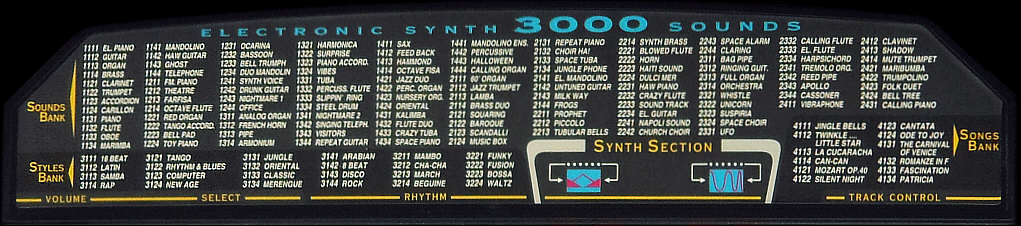
of Bontempi mini keyboards, because with 121 layered sound combinations
on its control panel it has the most complete sound set of the series.
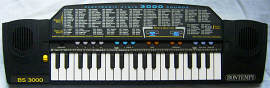
Like KE3860 it has the nice little synth with many siren-like howling
envelopes, and also here the annoying keyboard bug makes both polyphony
channels cancel out each other during fast play. Unlike the ad suggests,
it is not 6 note polyphonic. Possibly Bontempi counted internal sound channels
of the accompaniment or suboscillators as a similar customer misleading
scam like their fantasy name "midi keys" for midsize keys.
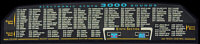 The
control panel lists all supported preset sound combinations with own names,
counting without gaps and so making the available number range more obvious.
The highest supported sound number is 2431. (2432..2444 indeed do nothing.) The
control panel lists all supported preset sound combinations with own names,
counting without gaps and so making the available number range more obvious.
The highest supported sound number is 2431. (2432..2444 indeed do nothing.) |
 |
 |
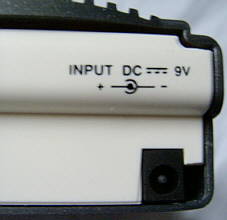 Only
the BS3000 has a power supply jack. Only
the BS3000 has a power supply jack. |
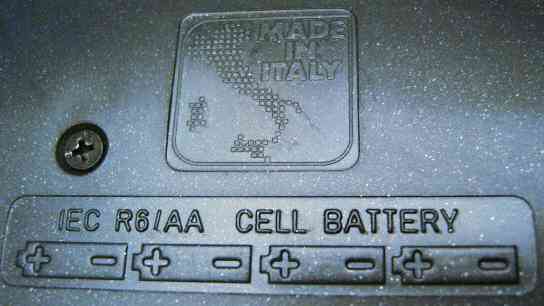
 |
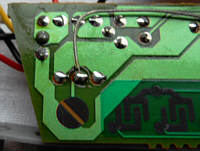 An unused cable at power switch ends on cut trace near CPU.
 |
  Unlike
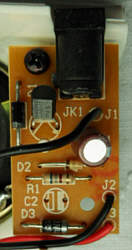
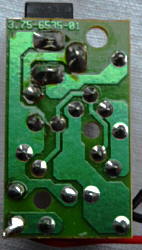
KE 3860 the PSU jack PCB apparently has a voltage regulator circuit. Unlike
KE 3860 the PSU jack PCB apparently has a voltage regulator circuit. |
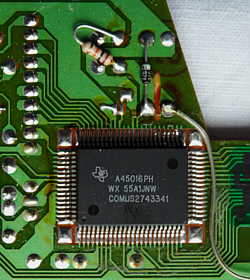
The CPU of my BS 3000 is "Texas Instruments A45016PH, WX 55A1JNW, COMUS
2743341".
Bontempi BS 2000
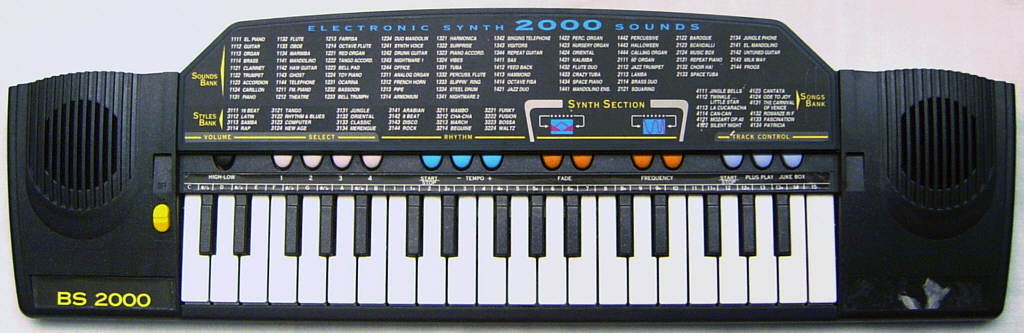
This was the cheaper and crippled variant of the Bontempi
BS 3000. Its only difference are fewer preset sounds (only 80 listed
on control panel) and the missing AC adapter jack. Also this instrument
is extremely rare. Basically it is a BS
2010 with small keys.
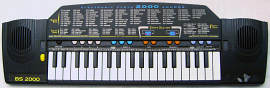
The continuous control panel numbering scheme is like BS 3000 and so
makes it obvious that all preset sounds beginning with 22xx, 23xx or 24xx
are missing. But even here the still supported number 2211 ('trumpet +
el. piano') is not mentioned.
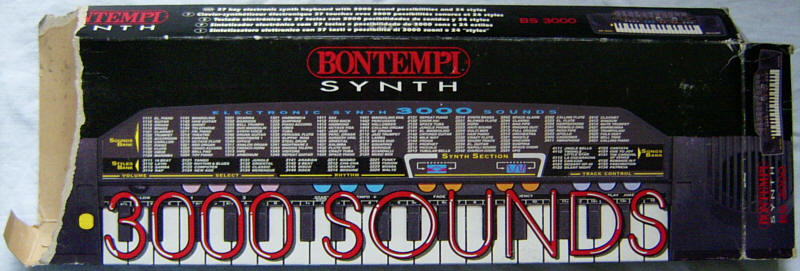
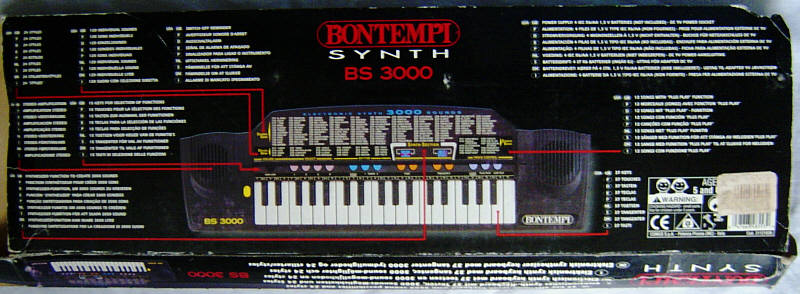
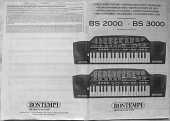 Both
the BS 2000 and 3000 came with the same combined manual, which indicates
that they were not technical successors of each other, but that BS 3000
was designed as the more expensive variant. The only hardware difference
is a jumper setting. The manual claims that BS 3000 has 120 (I count 121)
and BS 2000 only 80 sounds. Both
the BS 2000 and 3000 came with the same combined manual, which indicates
that they were not technical successors of each other, but that BS 3000
was designed as the more expensive variant. The only hardware difference
is a jumper setting. The manual claims that BS 3000 has 120 (I count 121)
and BS 2000 only 80 sounds. |
eastereggs:
-
3000 sound mode (CPU pin 55)
-
preset sound 2211 = 'trumpet + el. piano'
-
3 higher note keys addable.
-
group of 8 buttons addable those modify the sound in strange ways.
-
battery alarm selects a preset sound ('carillon' variant) that is not on
the control panel.
hardware details
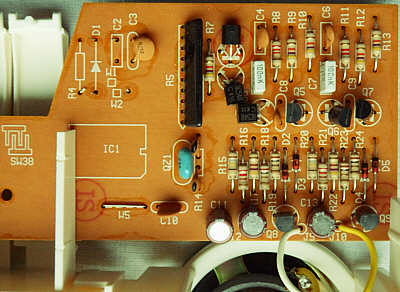
The CPU of my Bontempi BS 2000 is "Texas Instruments A45016PH,
WX 54A6XTW, COMUS 2743341". See BS 2010
for general hardware description. How to open the case without damage see
Bontempi
B50.
Only the solder jumper in the middle above the CPU (pin 55) makes it have
fewer sounds.
3000 sounds mode
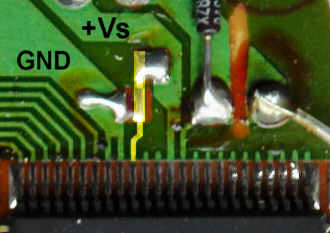 In
BS 2000 a solder pad jumper connects pin 55 with GND. Resolder it to +Vs
like in BS 3000 (here marked yellow) to enable 3000 sounds. (Do not connect
all 3 contacts, else you short supply voltage with GND and likely destroy
the power switch transistor Q1.) In
BS 2000 a solder pad jumper connects pin 55 with GND. Resolder it to +Vs
like in BS 3000 (here marked yellow) to enable 3000 sounds. (Do not connect
all 3 contacts, else you short supply voltage with GND and likely destroy
the power switch transistor Q1.) |
|
If you like the sound style of these instruments, also watch out for
Bontempi
ET 202. (It has no synth, but 4 note polyphony and nice, arpeggio-
like accompaniment.) Another Bontempi Keyboard with nice howling synth
sounds is the Bontempi GT 770.
Another great digital lo-fi synth with strange howling sounds is Casio
SA-35.
| removal
of these screws voids warranty... |
|
|
 |

|
|
| |
back
|
|

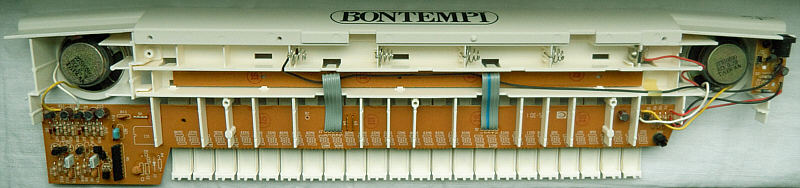
 (old picture from eBay)
 (old picture from eBay)
 Differences to BS2010 hardware are small...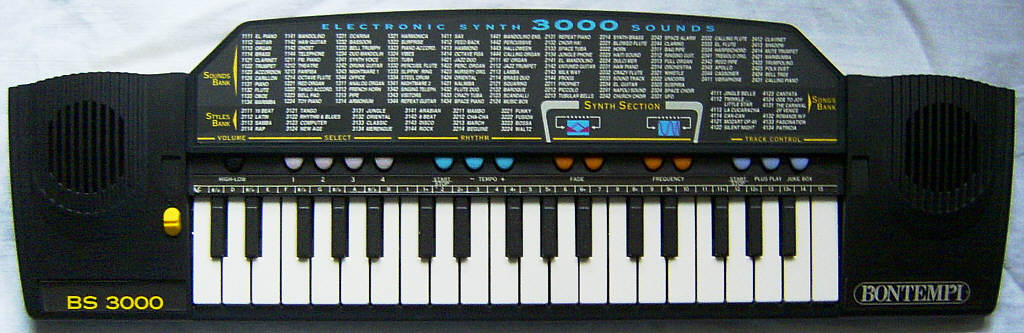
 The
control panel lists all supported preset sound combinations with own names,
counting without gaps and so making the available number range more obvious.
The highest supported sound number is 2431. (2432..2444 indeed do nothing.)
The
control panel lists all supported preset sound combinations with own names,
counting without gaps and so making the available number range more obvious.
The highest supported sound number is 2431. (2432..2444 indeed do nothing.)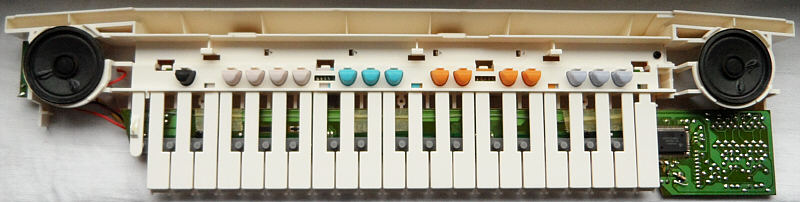
 Both
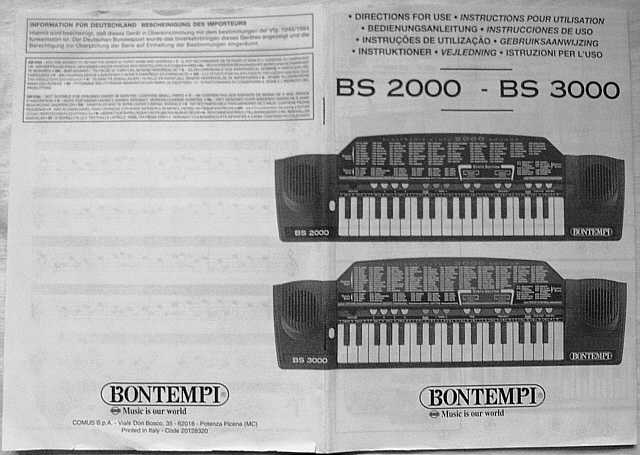
the BS 2000 and 3000 came with the same combined manual, which indicates
that they were not technical successors of each other, but that BS 3000
was designed as the more expensive variant. The only hardware difference
is a jumper setting. The manual claims that BS 3000 has 120 (I count 121)
and BS 2000 only 80 sounds.
Both
the BS 2000 and 3000 came with the same combined manual, which indicates
that they were not technical successors of each other, but that BS 3000
was designed as the more expensive variant. The only hardware difference
is a jumper setting. The manual claims that BS 3000 has 120 (I count 121)
and BS 2000 only 80 sounds.