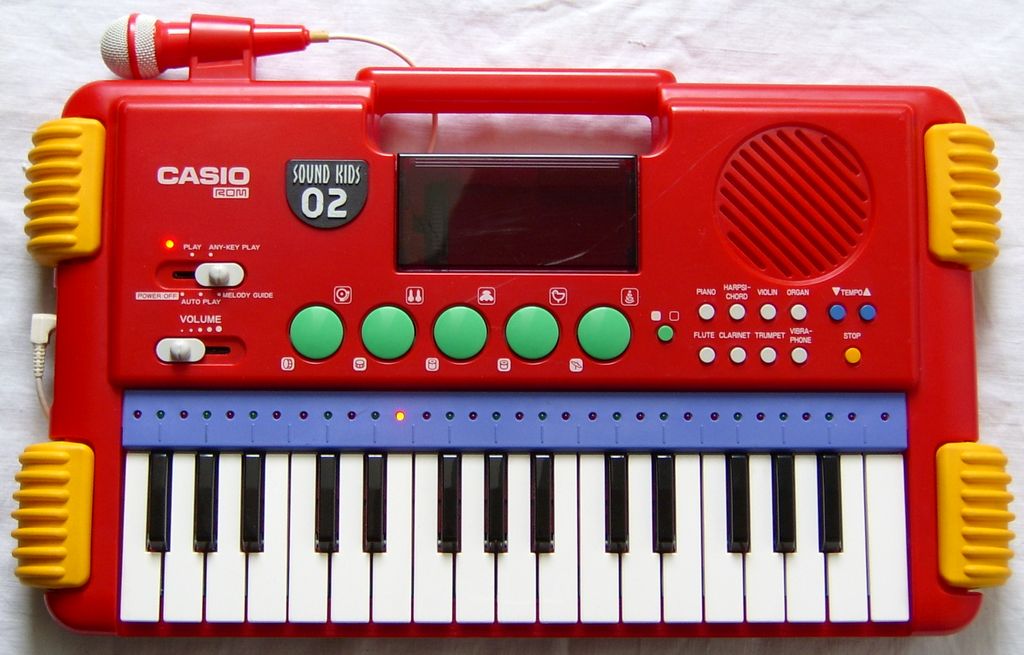
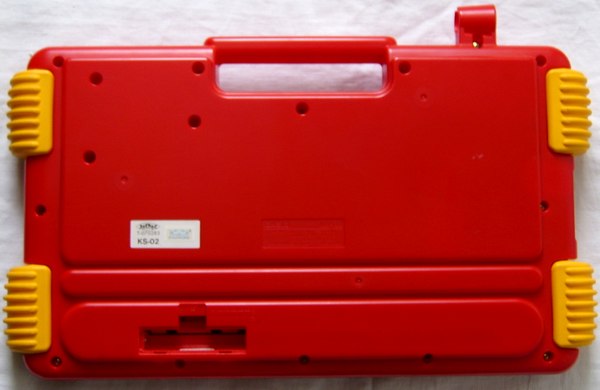
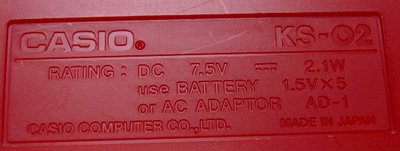
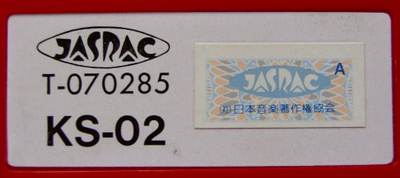
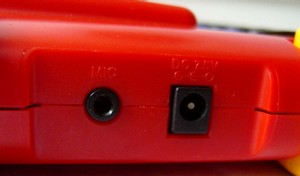
This rare toy keyboard of 1991 (embossed case date) has ROM-Pack slot with key LEDs and microphone, but only 8 preset sounds and no rhythm.
It has 5 drum/effect pads (10 sounds) and typical SA-series sound. The volume switch has 5 steps of those 1 is too quiet and the rest too loud. Historically most important is that its case design obviously inspired the (in)famous Chinese My Music Center, which in 1990th became much more widespread than the rather obscure KS-02.
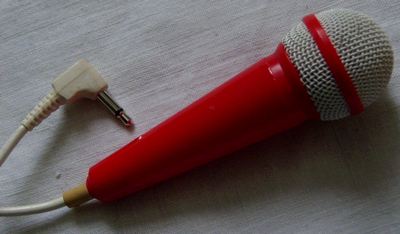
caution: There are melt marks scorched into the case plastic those may have been caused by plasticizer of the white microphone cable. So keep the cable away from it by wrapping it in plastic bag.
 |
 |
 |
 |
 |
The 8 preset sounds correspond to Casio
SA-1. Different are 'violin' and 'trumpet' (duller, from SA-35?).
The 'organ' is 'pipe organ', the 'flute' is 'whistle'.
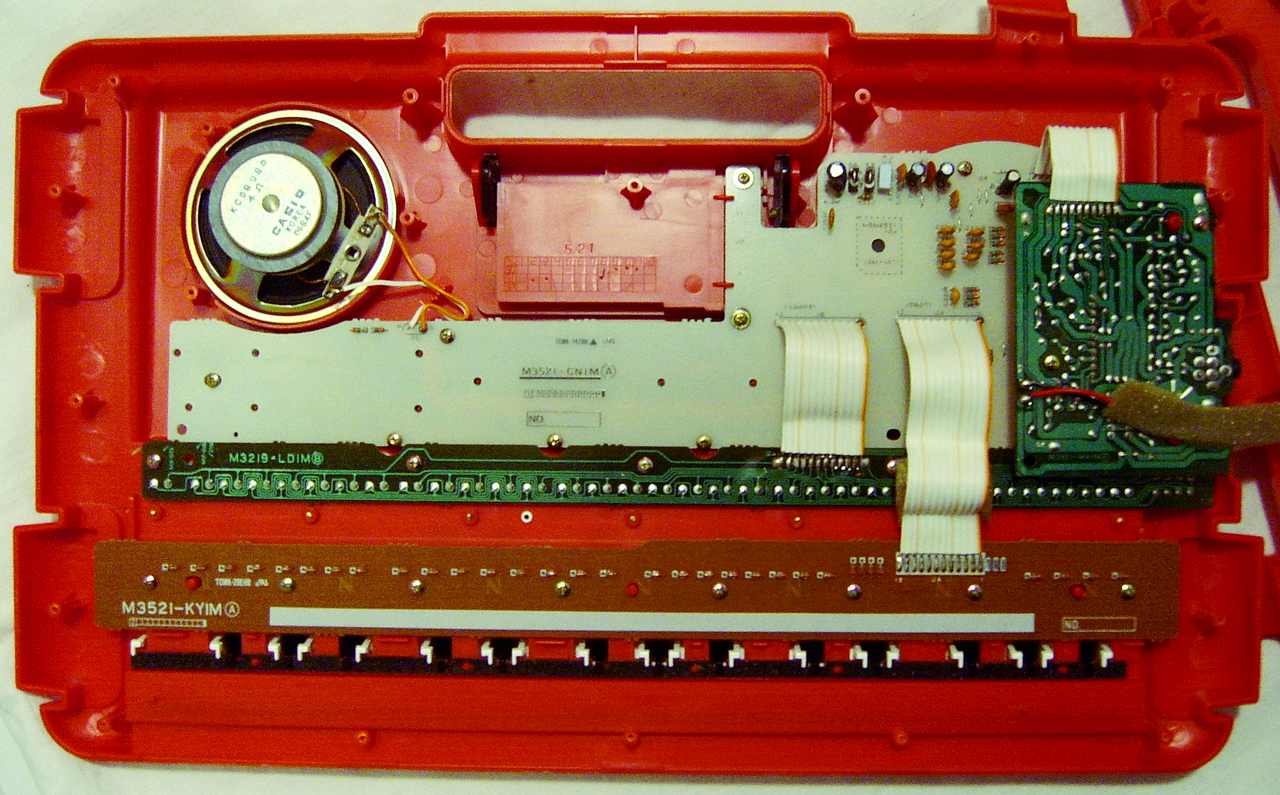
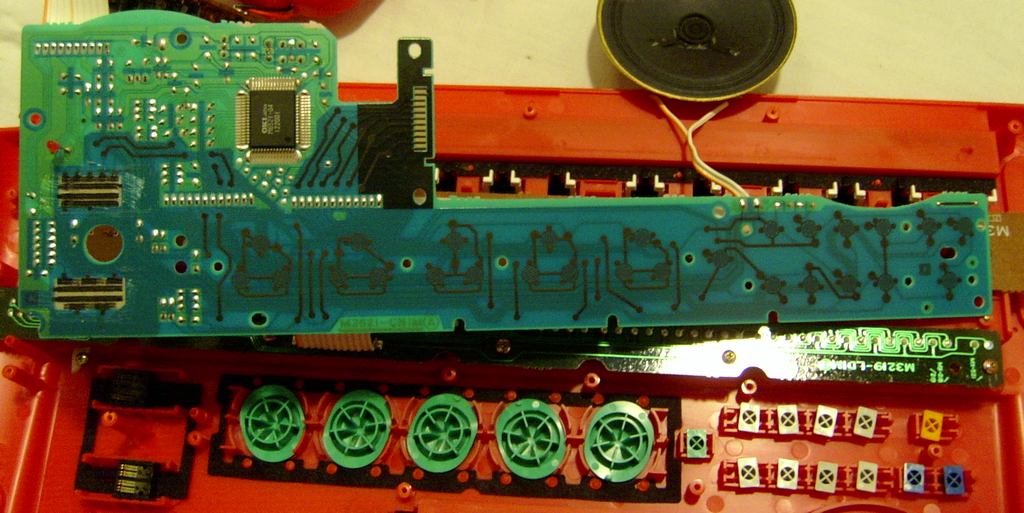
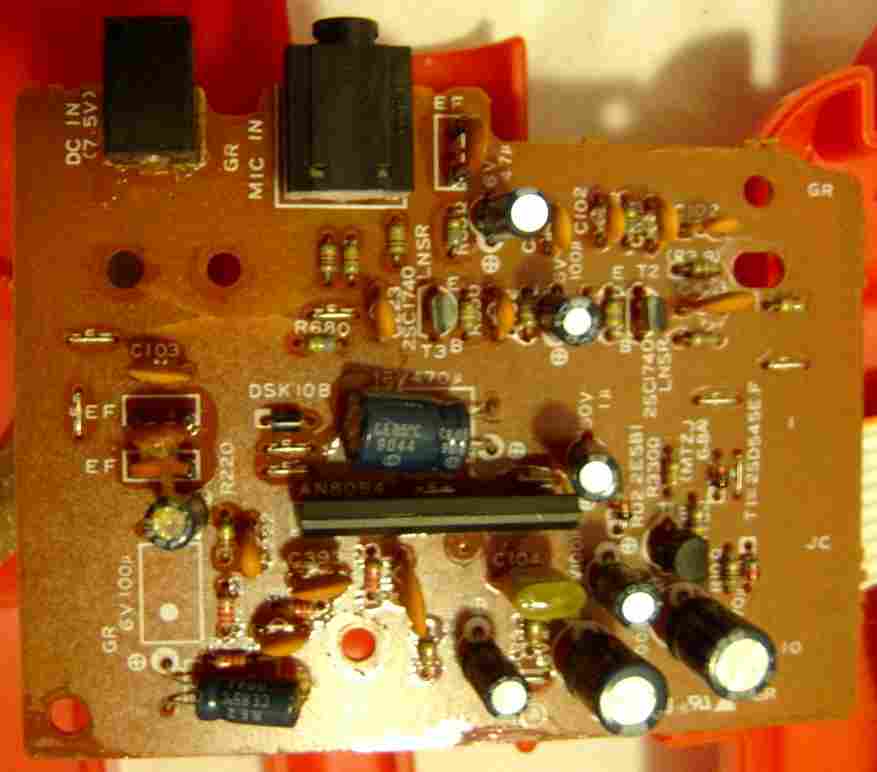
circuit bending detailsThe Casio KS-02 is built around the CPU "OKI M6521-04". It is derived from PT-88 hardware and mainly differs in crippled user interface software and different internal songs.
keyboard matrixThe KS-02 is obviously derived from Casio PT-88 hardware, so the layout is very similar. So a select button for the same 12 preset rhythms can be added, 3 more drumpads and a different melody guide mode without waiting. Most interesting are 2 bank switch buttons to access many omitted PT-88 preset sounds.This matrix was analyzed by myself with the help of service manuals
of Casio ML-2, ML-3, ML-1.
The input lines are active- high, i.e. react on +Vs, thus any functions
are triggered by a switch in series to a diode from one "out" to one "in"
pin.
I measured also here a fixed diode at KO7->KI7 that apparently enables the 3-note polyphony mode. (Without it would be 2. I didn't test this.) In the LED matrix each LED is wired from an LY# to an LX# pin of the CPU. eastereggs
A rhythm select button wired at KO6->KI6 can select the 12 preset rhythms of PT-88 through the leftmost white keys. Very bizarre are the 2 bank switch buttons addable at KO5->KI1 and KO5->KI2. These select many additional preset sounds and behave quite unintuitive. You have to press them, optionally followed by a preset sound button or a bank button to take effect. What they do only becomes understandable when comparing with a PT-88 next to it. That is to say, the 100 Tonebank of PT-88 has 10 cipher buttons, and typing any cipher shifts the previously entered cipher left to form the 2nd digit of the currently selected preset sound number. The old 2nd digit is overwritten. Usually such details don't matter when using a keyboard. But the KS-02 software apparently contains a crude hack to this system, that replaces 8 of these cipher buttons with preset sound buttons those each internally write 2 digits corresponding to their preset sound. Howeverin in the unused matrix places KO5->KI1 and KO5->KI2 the original cipher buttons "1" and "2" remained intact. Thus pressing them shifts the previous 1st cipher left, enters their cipher and (this is strange) waits for a 2nd cipher which for one button press(?) apparently turns the preset sound buttons back into their original cipher button mode (numbers see keyboard matrix). This way 2-digit numbers can be typed so long at least one of the digits contain '1' or '2'. I didn't wire buttons here and haven't fully investigated it, but I could reach many of the PT-88 preset sounds, including some those number don't contain a '1' or '2' (e.g. 77 "car horn" or 90 "triangle"). The strange behaviour helps to conclude details of the implementation. According to patents, the PCM engine softsynth is very timing critical. So it may be that the code for individual preset sound buttons in KS-02 was made to change as little as possible for keeping the exactly same count of CPU clock cycles, while leaving most of the PT-88 code intact. |
Like with PT-88, the 6 internal songs behave like a ROM-Pack when none is inserted (selected on leftmost 6 keys). They are arranged a bit jazzy. The first notes of song 2 sound like the start of the "Frogger" arcade game music.
| removal of these screws voids warranty... | ||
 |
 |
|
|
|