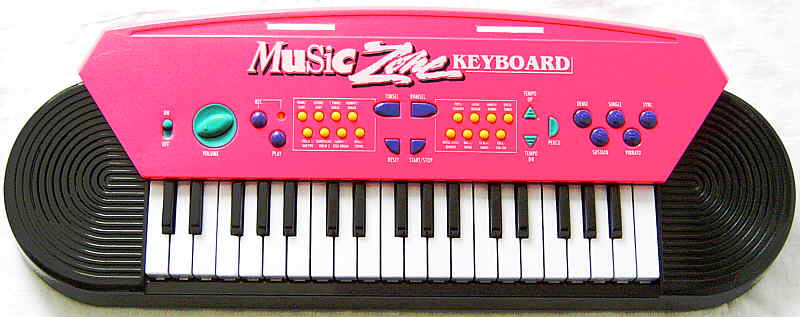
MusicZone Keyboard
(toy keyboard with squarewave accompaniment & nice demo melodies)
At the first look this pink plastic tablehooter appears to be yet another
of the many My Music Center successors.
Possibly it is even older because in detail it behaves and sounds quite
different.
The instrument has 16 semi- OBS preset sounds and rhythms, but the most
interesting features are the cheesy single finger accompaniment, the drum
kit mode and the sustain and vibrato buttons. Unlike My Music Center
most preset sounds employ no chorus effect, and the the few ones with chorus
can be only played monophonic. Also the primitive sequencer here does not
loose its data when anything else is selected, and the instrument even
often holds its data when switched off. Unfortunately at least in unmodified
state a keyboard matrix flaw prevents to play certain notes simultaneously
despite it is 2 note polyphonic, and another flaw often makes the 2 polyphony
voices cancel out each other during fast play.
main features:
-
37 midsize keys (those need a bit much force)
-
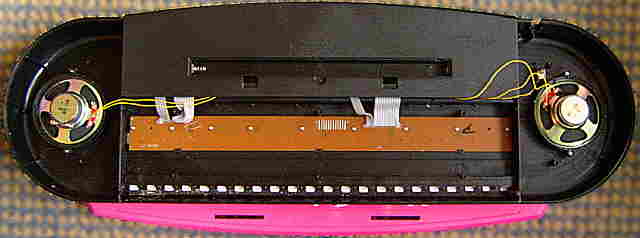
2 built-in speakers (very harsh and hissy, mono)
-
main voice polyphony 2 notes (a keyboard matrix flaw prevents to play certain
notes simultaneously, another flaw truncates held notes during fast play
| only 1 note with chorus sounds)
-
16 semi- OBS preset sounds {piano, guitar, e.piano, trumpet, violin 1,
saxophone, clarinet, brass | clavi, harp, banjo, organ, ban pipe, violin
2, reed organ, string} selected by individual buttons + select button.
-
16 semi- OBS preset rhythms {pops, latin, march, disco, bossa nova, waltz,
16 beat, rock | country, reggae, rumba, tango, beguine, swing, samba, cha-cha}
selected by individual buttons + select button.
-
volume knob
-
tempo +/- buttons (24 steps)
-
single finger accompaniment (only accompaniment made from 2 note polyphonic
plain squarewave tones, no manual organ chord mode).
-
sustain & vibrato button
-
drum kit mode {base, snare, tom, low synth- tom, mid synth- tom, high synth-
tom, hihat, open cymbal, closed cymbal, shaker, clap, clave, woodblock,
cowbell}
-
sound generator resembles My Music Center (see there)
but has only 2 channels for main voice polyphony. Thus most preset sounds
have no chorus effect and ones with chorus {reed organ, brass, string}
can play only monophonic. Additionally there are 2(?) channels (squarewave
organ tone) for accompaniment + 1 dedicated for percussion samples.
-
CPU "SF, LC-8114C" (30 pin COB, "Holtek HT3378")
-
primitive monophonic sequencer (record & play of 30 notes + accompaniment,
no edit)
-
battery backed- up memory (crashes often).
-
reset button
-
22 demo melodies (nicely arranged)
-
AC- adapter jack
modifications:
-
cinch sound outputs with speaker mute switch added.
-
AC- adapter jack polarity changed to standard
-
polyphony bug fixed (matrix diodes added)
notes:
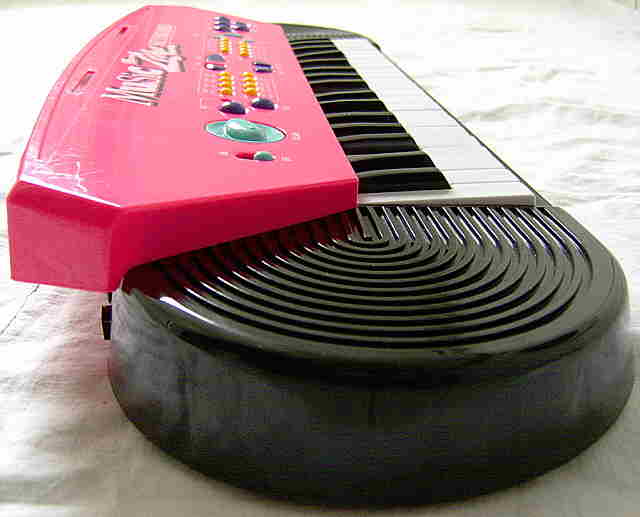
The case design of this instrument was obviously inspired by the
Casio
SA-6 mini- keyboard, although the MusicZone keyboard it is about
twice as large. There are also some Engrish misspellings on it. The most
bizarre one is that the voltage of the AC adapter jack is labelled "DC
1.5V X 5" (because the battery compartment contains 5 batteries with each
1.5V); apparently the case designer was to stupid to do maths and calculate
that it would be "DC 7.5V". Also on the bottom is the AC- adapter described
as "ADAPTER INPUT: AC117/220V 50/60V, OUTPUT:DC1.5Vx5 800MA". (The adapter
input voltage would have been completely irrelevant here since the instrument
gets only the output voltage.) Despite the user interface and sound has
most elements common with the My Music
Center hardware family, there are many subtle differences. E.g.
panel button presses play no noises, and the well hated wannabe- sequencer
here does not lose its data by switching back to normal mode. Also the
single finger chord, the keyboard drum kit mode and the sustain and vibrato
buttons are unusual for My Music Center hardware. A noticeable difference
is also that the percussion channel seems to play only monophonic (also
in drum kit mode) while My Music Center variants normally dynamically
assign percussion sounds when drumpads are played. Also 3 of the preset
sounds can be played only monophonic because they employ a chorus effect
that occupies both sound channels. Possibly this instrument is technically
more similar with the Sunlight - Music
Playkeys (which has no digital volume control and also battery
backed-up memory) or even was a predecessor of the strange K-Mark
keyboard (which has single finger chord and similar percussion). The instrument
seems to be mono, although it contains a stereo amplifier for its 2 speakers.
Later I found out by the datasheet of 1996-04-23 that its CPU is the Holtek
HT3378 "37 Key Melody Piano" - a variant of Ad-lib
Micro® HT3650 with slightly changed pinout.

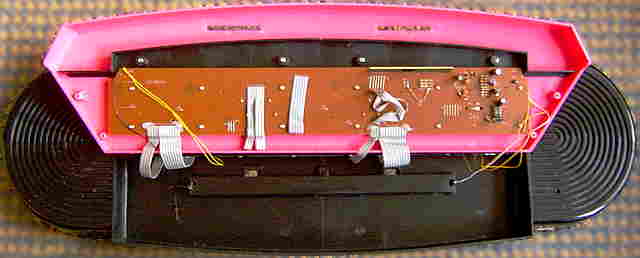
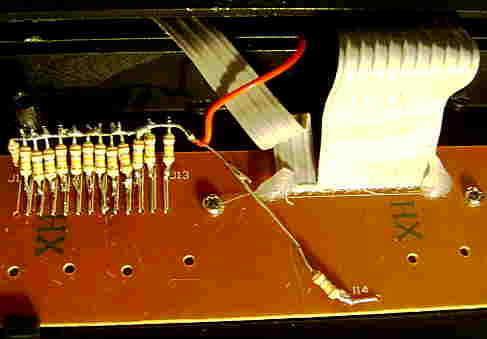 Despite the hardware is 2 note polyphonic, in unmodified state some key
combinations don't work due to a keyboard matrix flaw. The matrix consists
of 3 output and 14 input lines (quite odd combination); to fix the flaw,
solder a diode into each of the 3 output lines. (To prevent crosstalk problems
I also soldered an 18 kOhm pull-up resistor from each input line against
the +5V line at the zener diode that supplies the CPU. With this fix all
key combinations work, but there is still a design flaw that makes notes
cancel each other during fast play. The keys also respond a bit slow. I
haven't fully analyzed the keyboard matrix yet, but there seem to be no
higher note keys addable because function buttons share the same row with
the highest keys.
Despite the hardware is 2 note polyphonic, in unmodified state some key
combinations don't work due to a keyboard matrix flaw. The matrix consists
of 3 output and 14 input lines (quite odd combination); to fix the flaw,
solder a diode into each of the 3 output lines. (To prevent crosstalk problems
I also soldered an 18 kOhm pull-up resistor from each input line against
the +5V line at the zener diode that supplies the CPU. With this fix all
key combinations work, but there is still a design flaw that makes notes
cancel each other during fast play. The keys also respond a bit slow. I
haven't fully analyzed the keyboard matrix yet, but there seem to be no
higher note keys addable because function buttons share the same row with
the highest keys.
The preset sounds are quite bright and some even really harsh (which
partly may be a loudspeaker problem). They are made from static waveforms
with volume envelope. Like with My Music Center they include quite
strong and creaky digital distortion. The "piano" resembles a harpsichord;
the "clavi" is a bit duller. Also the "guitar" sounds similar and has a
bit more sustain. The "harp" is too harsh (rather an e-guitar) and the
note with held keys is shorter than without. The "e.piano" has a harsh
distorted metal organ pipe timbre and resembles more a vibraphone. The
"banjo" is short and harsh (like expected), but note is shorter with held
key. The "trumpet" is rather a harsh reed organ or accordion (with a dose
of oboe?). The "organ" fades louder and a bit quieter again and also is
rather a harsh reed organ. The "violin 2" sounds almost the same but an
octave higher. The "violin 1" sounds like a very harsh oboe (or bagpipes?)
The "ban pipe" is a bright metal pipe organ timbre (same waveform like
"e.piano") which especially in the bass range has a strong purring aliasing(?)
distortion. The "saxophone" timbre is fairly realistic. The "clarinet"
sounds rather like a dull saxophone. The "reed organ" has the same timbre
with chorus effect. Also "brass" has chorus and resembles more a harsh
accordion or reed organ. Also "string" has chorus; it fades louder at the
beginning and sounds too bright and glassy and resembles more an accordion
(or the My Music Center "violin"). All sounds with chorus play only
monophonic. The "sustain" button adds a longer release phase to the sounds
(like intended), while the "vibrato" button adds a quite strong and fast
(square?) vibrato that has about 6Hz and gives the sounds a similar appearance
like the famous "fantasy" preset sound of Casio
VL-Tone 1. The vibrato button works also with held notes and thus
works also well as a realtime sound control. The semi- OBS preset sound
buttons don't change held notes but only affect new ones.
The rhythms employ quite a lot of different low- res percussion samples
and sound rather thin. The single finger accompaniment sounds cute and
cheesy and can be switched on and off with its OBS button without stopping
the rhythm (no matter of course with such keyboards). The accompaniment
is made from 2 note polyphonic squarewave(?) organ tones and resembles
much the ones on Elite MC2200. It
knows only 4 different standard chords and there is no manual organ chord
mode (without rhythm).
With the "percu" button the keyboard can be switched into drum kit mode,
in which the left keyboard section stays mute (or plays single finger accompaniment
when enabled). Very bizarre is that also in the right half as well some
of the black as of the white keys are mute (play no percussion samples).
Also the demo melodies are selected through keyboard keys with the same
inactive keys in between. Apparently the CPU was originally designed to
have a keyboard beginning on the "F" key instead of "C", and the here inactive
keys were intended to be only black ones. Remarkable is that the misalligned
note letter strip above the keys of my Jin
Xin Toys JX-20165 also begins with an "F" instead of "C". Thus
perhaps the MusicZone keyboard also sounds too thin (most noticeable
with percussion) because its pitch was tuned up by half an octave using
a wrong CPU clock resistor to make the pitch match a given keyboard assembly.
It would be mechanically quite easy to modify the keyboard back like the
CPU designer intended it.
Unlike with other similar keyboards, the primitive sequencer here
does not loose its data when anything else is selected, and the instrument
even often holds its data when switched off. When you start a rhythm or
demo music and power the instrument off, you can hear its pitch falling
down, and when you switch it on again, the instrument normally continues
where it was switched off. But often it also crashes (especially when buttons
were pressed with power off) when powered on again, which was likely a
known bug, since it has a dedicated "reset" button on its control panel.
(Also my Chicco - Sing 'n'
Dance Orchestra has such a button, despite it anyway resets when
powered on.)
The 22 demo melodies are nicely arranged, although many of them are
very short. Unlike other such keyboards there is no "one key play" mode,
but the keys always (re-) start their corresponding demo melodies. Many
of the tunes are classical musics those English names I didn't know. I
could later identify these by the "Holtek HT3378" datasheet.
The 22 demo melodies of this instrument are:
-
Little Short Man in the Woods ["Ein Männlein steht im Walde"]
-
Canon ["Utopia" theme, Brahms?]
-
Last Rose of Summer ["Kleine Rose, Wie Blühst Du Einsam"]
-
Symphony No. 9 ["Ode to Joy"]
-
Turkish march ["Mr.Do!" bonus tune]
-
Go Go Bach [Minuet (J. S. Bach)]
-
Fly Me to the Moon
-
Marche Royal Du Lion [slow oriental tune]
-
Romanize
-
Peter and the Wolf
-
Valse lente
-
Allegro ["Eine Kleine Nachtmusik" (Mozart)]
-
Le Cygne ["Swan Lake"]
-
Long Live Love
-
Etude OP.10 No.3
-
Yong Prince and Princess [waltz from C64 "Tales of Arabian Nights"]
-
Copacabana
-
Skip to my Lou ["Ten Little Indians"]
-
Song of India [waltz]
-
Humoresque ["Eine Kleine Liebesweise"]
-
London Bridge Is Falling Down
-
Waltz of the Flowers
I remember that around 1996(?) I saw in a Turkish shop a yellow and green
toy keyboard with similar keys and drum kit mode (also 16 preset sounds/
rhythms?), although this one had a smaller (and higher?) case. The vendor
wanted 50DM (about 25€) for it, which I considered too high to buy
it. Likely it was the MusicStudio keyboard (later seen on eBay
in yellow/ red, box showed yellow/ blue version), which has a similar (yellow)
control panel but only 32 keys, and its keyboard indeed begins with an
"F" key, which corresponds to the odd demo/ drum kit mode behaviour of
the MusicZone keyboard.
| removal
of these screws voids warranty... |
|
|
 |

|
|
| |
back
|
|