Ouda
 |
lo-fi tablehooter with impulsive percussion & cheesy
accompaniment |
|
|
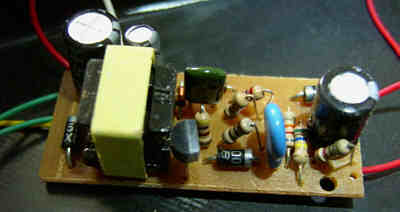
This wacky Chinese plastic tablehooter is rather an arson timer to burn
houses down than an instrument - it contains the most life-threatening
dangerous mains voltage circuitry I ever saw.
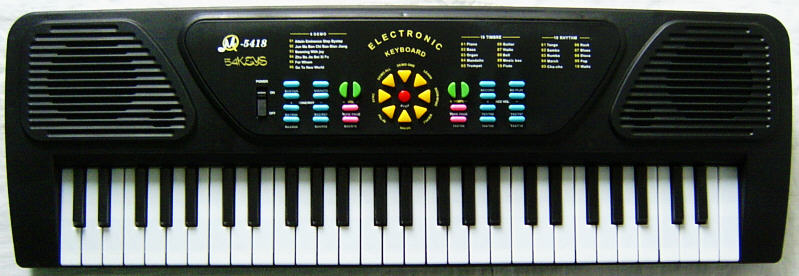
There are each 10 preset sounds and rhythms, but despite 54 midsize
keys and cheesy accompaniments the main voice is only monophonic. There
is also a keyboard drumkit mode (many pitches, not combinable with rhythm),
a primitive sequencer and 6 nicely arranged Chinese demo melodies with
any key play mode.
By the lack of keyboard matrix diodes the fingered accompaniment makes
a lot of flaws, because the keyboard can not reliably sense more than one
pressed key. Although the main voice of the demos can be theoretically
played by hand, also here it skips plenty of notes by software bugs. Generally
the user interface is quite a mess. The sound generator is based on low
resolution loop samples. There is also a quite useless sequencer, that
looses its contents by any key or button press. The sound is only mono;
the 2nd speaker grill is an empty prop. Like with My
Song Maker there is an any key play mode that repeats the accompaniments
of the demos in a loop, which can be used for tekkno. Also the grainy sound
and impulsive percussion may make it interesting for this (as far it won't
catch fire on a gig...).
The instrument itself has no manufacturer label, but the horrible construction
strongly reminds to early Yongmei/
Meisheng
products (see Golden Camel-7A)
and it also stinks like them. However I never saw one of these with internal
switching power supply, thus I conclude it must be newer; all later Yongmei
models I saw have their battery compartment wired correctly with diodes
(see Yongmei YM-238C). On the
box of my specimen was a sticker with the German importer Ouda.
Importfirma ouda
Herzbergstr. 128-139
(Halle 3, Raum 335)
10365 Berlin (DEUTSCHLAND)
Hergestellt in V.R.C.
Nicht geeignet fuer
Kinder unter 3 Jahren
NR: 00327
|
|
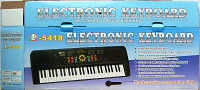 |
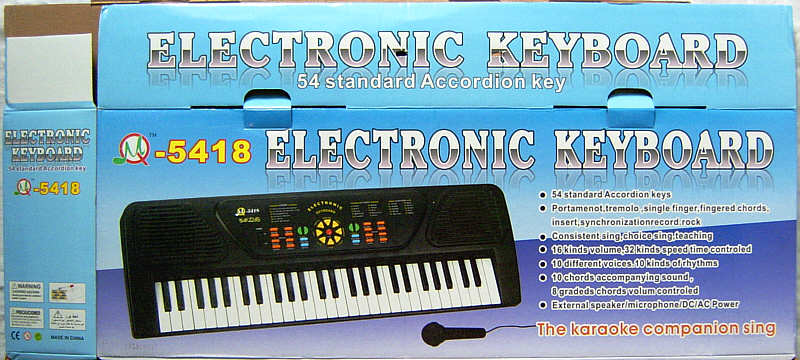
Although originally packaged, it came without manual. The brand icon
looks like a written 'M' with a musical note in front of a 'Q', which may
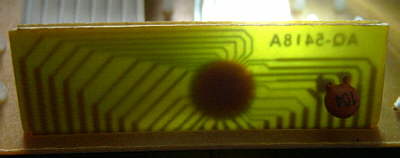
mean "MQ" or "QM"; the CPU however is labelled "AQ-5418A", thus I guessed
the model name as Ouda MQ-5418. The later Bandstand MQ-5408
(silver with LCD + disco lights in speakers) contains a similar deadly
power supply. According to Chinese wholesaler websites, MQ-keyboards are
made by Jinjiang Shengle Toys.
main features:
-
54 midsize keys
-
1 built-in speaker (sounds thin and bassless, 2nd grill is empty)
-
monophonic main voice (Due to missing key matrix diodes it skips notes
with keys held down for accompaniment.)
-
10 semi- OBS preset sounds {Piano, Bass, Organ, Mandolin, Trumpet, Guitar,
Violin, Bell, Mnsic box, Fiute} (selected by 5 buttons + "tone page" button)
-
10 semi- OBS preset rhythms {Tango, Samba, Rumba, March, Cha-cha, Rock,
Blues, Disco, Pop, Waltz} (selected by 5 buttons + "tone page" button)
-
additional tone/rhythm +/- button to cycle through them
-
volume +/- buttons (16 steps)
-
separate accompaniment volume +/- button (8 steps, with rhythm)
-
vibrato & sustain buttons
-
tempo +/- buttons (32 steps)
-
fill-in button
-
single finger & fingered accompaniment (no manual chord mode)
-
keyboard drumkit mode {clap, crash cymbal, hihat, closed hihat, base, snare,
bird tweet} (chaotically spread among keys in many pitches, not combinable
with rhythm)
-
main voice & accompaniment sound is based on short looped medium low
resolution sample with volume envelope. They have a bit of zipper noise
and noticeable DAC aliasing noise especially with high notes. There is
also some digital noise in the bass range. Percussion employs plain medium
resolution samples.
-
CPU= "AQ-5418A" (27 pin COB)
-
primitive sequencer (monophonic record/ play of 54 notes or drumkit events
without rhythm/ accompaniment, no edit, contents is erased by almost any
key or button press)
-
6 Chinese demo melodies (nicely arranged, with any key play mode)
-
mains & battery operated
-
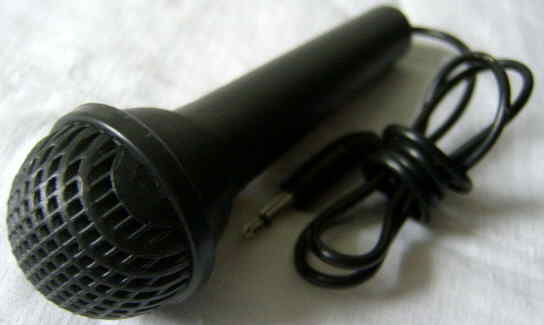
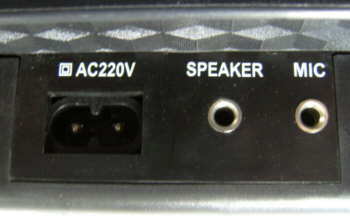
jacks for mains cable, microphone, speaker
modifications:
-
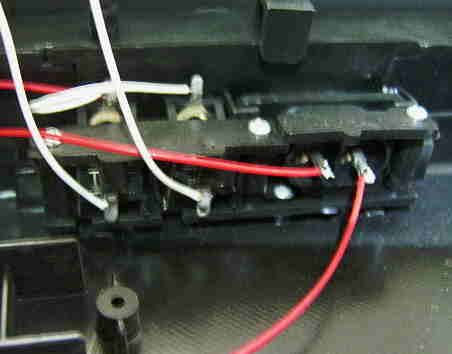
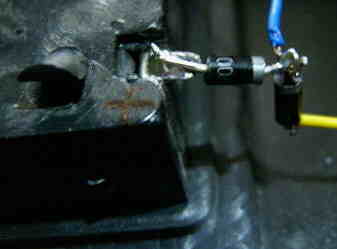
battery decoupling diodes added (strictly necessary to prevent battery
explosion when mains powered).
-
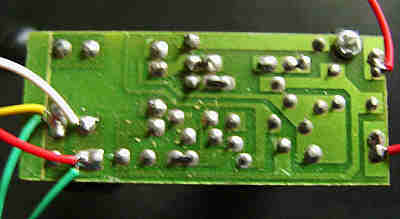
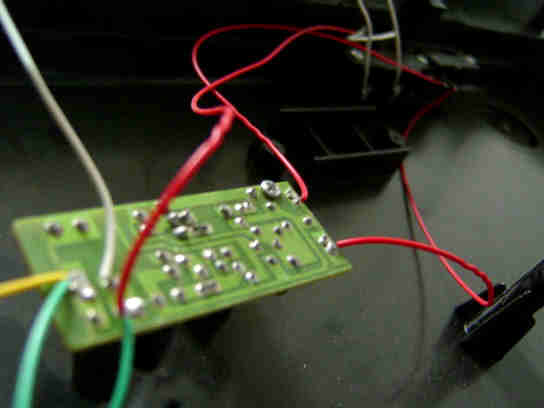
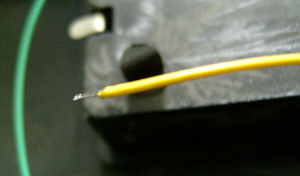
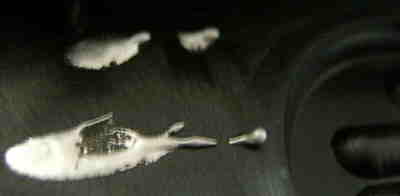
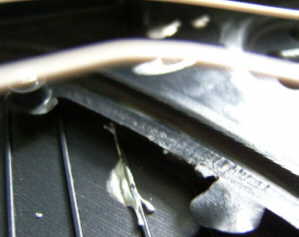
loose components fixed with hotglue and useless stray GND cable removed
to prevent short circuit.
-
internal mains wires replaced by less fragile cable.
notes:
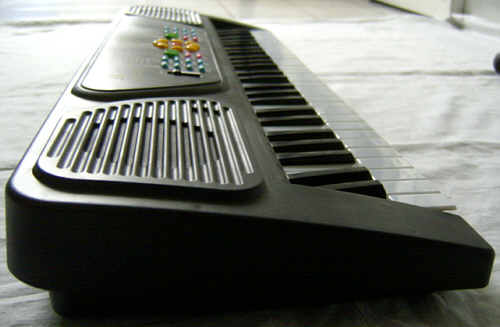
The case design has superficial shape similarities with Miles
MLS-4900A, but in detail (e.g. jacks) it resembles rather the Miles
3738. The yellow circle of function buttons reminds to the button
circle of the absurd Kamichi
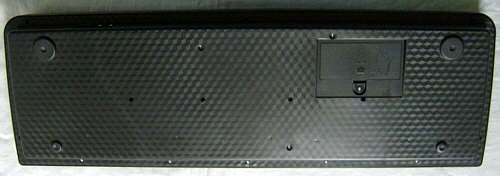
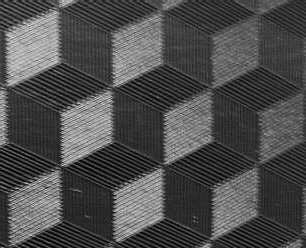
tablehooter. Strangely deplaced appears the stylish, almost noble looking
pseudo- engraved cube pattern across the entire bottom surface. Although
the plastic case is very lightweight, at least it feels less fragile than
the horrible yoghurt cup grade Golden
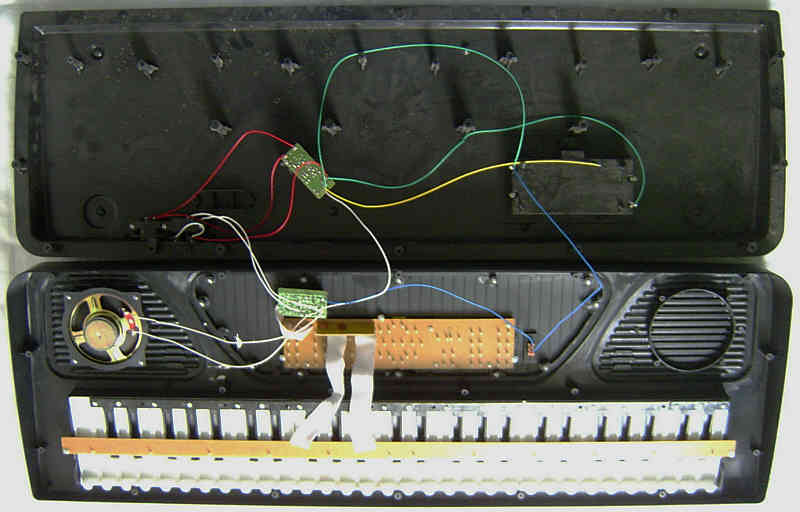
Camel-7A. Inside there are empty fixtures for a real (non switching)
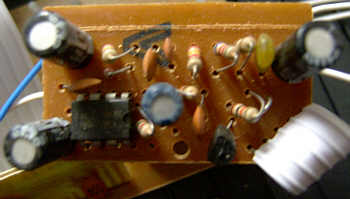
small mains transformer and a 2nd speaker. The hardware employs a couple
of small separate PCBs for amp and power supply like typical Yongmei
constructions, but despite the components look fairly modern (switching
PSU, simplified control panel PCB with COB CPU, very few components), the
build quality is much worse than in modern Yongmei designs. (May be that
Yongmei has sold their old tooling machines to an even worse manufacturer.)
The volume can not be set lower than low ambient volume. All buttons beep
(and truncate held notes with rhythm on), which disturbs life performance.
Also the control panel layout is an illogical mess; like with Miles 3738
the preset sounds and rhythms have numbers instead of names printed on
their buttons to imitate a sound bank, but here they have each only 5 semi-OBS
buttons with select button (both labelled "tone page"), and unusual for
bank select buttons is that they do no change the current preset sound
or rhythm but only toggle the behaviour of of their select button group.
Additionally the preset sounds and rhythms can be cycled through with the
"tone/rhy" +/- buttons; whether sounds or rhythms are affected depends
on which bank select button was pressed before. Apparently the user interface
programmer could not decide whether to make OBS or sound bank controls
and thus combined the worst of both. By the lack of key matrix diodes the
fingered accompaniment makes a lot of flaws, and even the single finger
mode makes trouble. Pressing certain key combinations does not work, and
some also causes odd digital beep noises (likely from the key matrix) in
the speaker. (I haven't analyzed the hardware closer yet.)
The main voice is based on short looped medium low resolution samples
with volume envelope. They have a bit of zipper noise and noticeable DAC
aliasing noise especially with high notes. There is also some digital noise
in the bass range. All sounds are quite bassless, which may also be result
of a too small speaker output capacitor. Within the scope of their limited
resolution, most presets resemble what their name suggests. The "piano"
uses a fairly short looped sample. The "bass" reminds to a distorted dull
e-guitar with grainy overtones; it sounds a bit of a sawtooth waveform.
"organ" is a metal pipe organ rank with dull bass range and soft attack.
The "trumpet" reminds in the bass range to a tuba and turns harsh with
high notes; the fluttering attack resembles a bit the Casio
SK-1 "trumpet". The "guitar" may be a nylon stringed on; "mandolin"
is the same sound ringing at 6Hz. "violin" resembles more a harmonica or
oboe; bass range resembles a dull saxophone and high notes sound harsh.
"bell" sounds like a xylophone; bass range is a bit dull and high notes
resemble a glockenspiel. "mnsic box" resembles a glockenspiel or steel
drum; the bass range is dull and grainy. "flute" may be a metal flute,
but sounds too fat; bass range sounds sonorous and somewhat harsh with
slow attack. The vibrato button a 6Hz square vibrato, which makes especially
high notes sound nicely cheesy because it modulates the overtones of the
DAC aliasing noise in a creaky way that reminds to 1960th beat organs or
Casio
VL-1. (It's a pity that this tablehooter is only monophonic.) The
sustain button adds a 3s long sustain.
The percussion of this instrument is made from medium low resolution
samples. The rhythms contain drumrolls and impulsive accents, which makes
them sound nicely special, but also less versatile. Despite different sound
generator they somewhat remind to Hing
Hon EK-001. The preset rhythm and "tone/rhy" +/- buttons (in rhythm
mode) immediately (re-)start their rhythm, but also select a default tempo
and volume for each rhythm, which limits their use as a realtime sound
control. The "fill in" button plays a fill-in pattern instead of the rhythm
(together with standard accompaniment when enabled). With the "stop" button
any rhythms or other sounds can be stopped immediately, which makes also
a good realtime effect.
The accompaniment resembles Sankai 01870K
and recognizes only very few chord types. The accompaniment consists of
e-bass and usually sweetish e-piano chords, and the styles are quite over-
orchestrated and thus less versatile. Most styles contain a sweetish pop
arpeggio and remind to Casio SK-1.
By the limited choice of chords they can never sound nasty or disharmonic
and also react a bit slow on chord changes. There is no manual chord mode
(without rhythm). Strange is that the accompaniment section reaches to
the 19. key of the keyboard (2nd octave "F#") while the letters above the
keys suggest it to end already on the 2nd "C". Unlike the main volume control,
the accompaniment volume control ("ACC VOL") reduces the bit resolution
of accompaniment notes, which truncates their decay envelopes the earlier,
the lower the volume is set. But this I consider rather a sound effect
than a flaw. Worse is that the control does nothing when accompaniment
is off, thus the only way to control the rhythm volume without accompaniment
is to start it with accompaniment (i.e. press "single" or "finger" followed
by any key in the main voice section) and avoid touching any chord section
keys (which would start the accompaniment).
Like My Music Center, also this
tablehooter has the known record/ playback sequencer, which is almost useless
because its contents is erased when anything beside preset sound selection
or "re-play" is pressed. It also ignores key press duration and can not
be combined with rhythm. To use it, press "record" and play some notes.
Press "re-play" to play it back. You can rhythmically press this button
to re-start the running pattern and you can select a different preset sound,
however sustain, vibrato and tempo +/- don't work. When you have pressed
"drum mode" before recording, the sequencer will record the keyboard percussion
instead of notes, but you can neither use it as a rhythm nor do anything
else with it.
The 6 Chinese demo melodies are nicely made and seem to consist of 4
polyphony channels {main voice, obligato, bass, rhythm} and use different
preset sounds. Their accompaniment employs a real 2nd voice instead of
the cheesy standard arpeggios.
-
Attain Eminence Step Bystep
-
Jun Ma Ben Chi Bao Bian Jiang
-
Beaming With Joy
-
Zhu Ba Jie Bei Xi Fu
-
For Whom
-
Go To New World
The "learn" button enables an "any key play" mode, with that the demos
can be stepped through note by note with the keyboard keys while the accompaniment
repeats in a loop (like with My Song Maker).
The resulting monotos (sound loops) can be quite inspiring for tekkno.
| removal
of these screws voids warranty... |
|
|
 |

|
|
| |
back
|
|
 bottom pattern