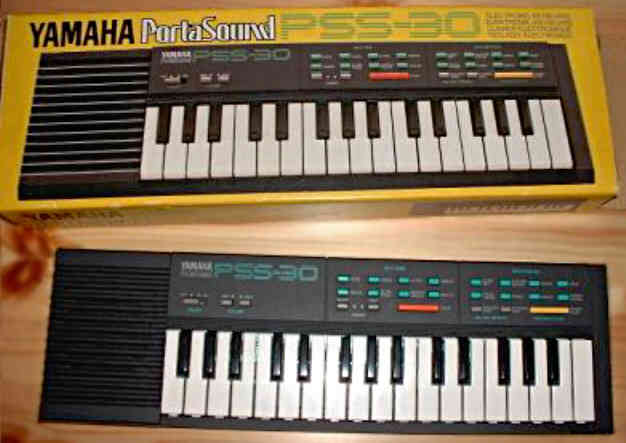
(old eBay photo of my specimen)
|
|
(old eBay photo of my specimen)
|
 |
 |
 |
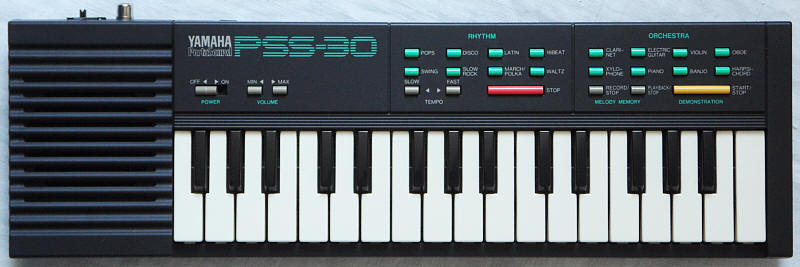
The sounds are digital squarewave with audible zipper noise (resembling LetronMC-3). The "electric guitar" is rather a thin organ with vibrato. Also the "violin" has vibrato. The "xylophone" is a short blip. The "banjo" includes a mandolin ring effect (8 Hz). All tones are a little rough/ gently distorted and resemble friendly C64 SID sounds. Like with many old OBS keyboards you can hold a key down and bounce around among sound select buttons to rhythmically switch the timbre (does not work with 2 held keys).
The drums (base, conga?) are squarewave blips of different pitch. The cymbal/ hihat are metallic. The snare(???) has unusual digital waveform made from a semi-metallic hiss mixed with a lot of dull noise; its timbre resembles compressed air or gas flowing through a valve inside narrow metal tubes. (This may be an extremely low-res waveform sample.) A similar cymbal timbre has also my Yamaha MK-100.
Although the keyboard is only 2 note polyphonic, the sequencer can be used to playback a 3rd monophonic voice while playing to it. (Rhythm does not reduce polyphony, but sequencer playback always starts the rhythm it was recorded with. The sequencer can not be used without rhythm, and always plays with the sound that was selected first during recording.)
The monophonic demo tune (Yankee Doodle) cycles through all sounds and
can be also accompanied 2 note polyphonic. Like with the sequencer, the
user selected sound only affects keyboard play but not the demo tune.
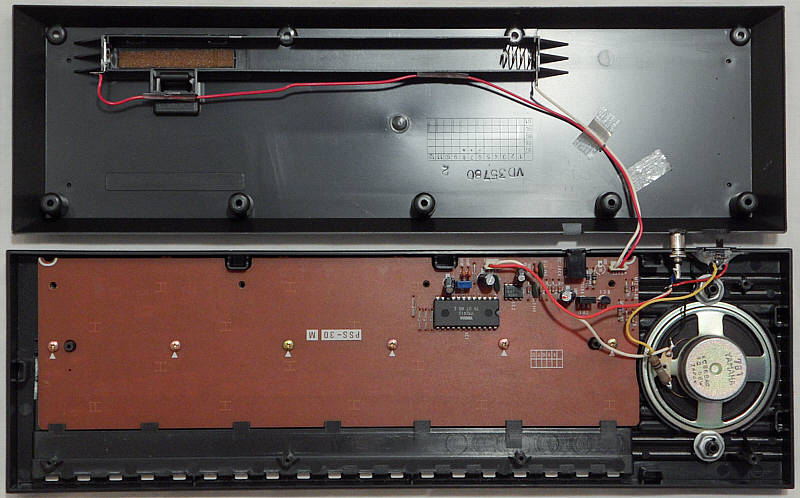
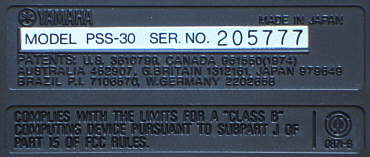
hardware detailsThe Yamaha PSS-30 is based on the single-chip CPU "Yamaha YM2410" (crystal clocked @ 607kHz) with power amp IC "JRC 3860, 7570" (8 pin DIL).
note: Long ago several circuit benders asked me strange things
because they apparently confuse this keyboard with something else. Thus
to say it again here - this keyboard has absolutely nothing to do with
FM synthesis, nor you can get any remotely interesting new sounds out of
it by circuit bending. There are no eastereggs and it has one of the most
stubbornly preprogrammed chips I ever found (likely an LSI made from gate
logics); all you can get by shitshots are boring things like playing demos
with wrong instrumentation, make the instrument start at different rhythm
tempo and so on. You may distort the analogue parts or replace the clock
oscillator to change pitch, but that's it.
At my sound output jack the waveform on oscilloscope had strange ripple that looks like DAC stair steps (about 32?), and their height changes by digital volume control. It looks like when the output filter that deforms the squarewave would be a digital simulation instead of capacitor. But measuring the pins shows that it behaves like a DSG. The diodeless keyboard matrix is grouped by 8 and inputs are active-low, but I found neither eastereggs nor empty places. A bit strange is that inputs make no sound when pulled to GND, so the CPU apparently recognizes when more than 2 contacts are closed and ignores it as an error. volume control fixThe volume can not be set low enough and yells so loud that it distorts (possibly because there was an uncommon 6 Ohm speaker instead of an 8 Ohm type built-in). To fix this, wire a 10 Ohm resistor into the speaker output line.keyboard matrixThe diodeless keyboard matrix is grouped by 8. A bit strange is that inputs make no sound when pulled to GND, so the CPU apparently recognizes when more than 2 contacts are closed and ignores it as an error. I found neither eastereggs nor empty places, but here it is for comparison.
The input lines are active-low, i.e. react on GND. Any functions can
be triggered by a non- locking switch in series to a diode from one "in"
to one "out" pin.
pinout YM2410 (GE10)The Yamaha YM2410 (24 pin DIL) is the CPU of Yamaha PSS-30 and variants. It has internal 3 note polyphonic squarewave mainvoice with different pulse width, linear volume envelope and vibrato. Only 2 can be played on keyboard (to save matrix diodes); the 3rd is sequencer playback or demo. The blip percussion generator outputs 2 squarewave drums and hissy metallic cymbal and snare(?) waveforms. Much like in DSG YM2163, the polyphony channel output is time sliced to avoid upper envelope DAC bits. With mainvoice always 1 of 4 time slots stays empty, which hints that there may be an unused 4th channel. Also percussion uses 4 time slice channels. Stubborn behaviour during shitshot tests hint that the YM2410 is likely an LSI made from gate logics with very little software control.This pinout is based on photo fragments of Yamaha PSS-120 service
manual. Very bizarre is that the pin function list in schematics numbered
pins 13..24 wrongways, which contradics DIL conventions. (I thought the
error was by me and changed my handwritten docs, until I re-measured and
found out that Yamaha was wrong! The pinout in their schematics itself
looks correct.) This is the correct version.
The "test" pin 5 behaves like a unused keyboard matrix input that prevents key recognition when pulled lo through GND or a matrix out, but I found no eastereggs (nor normal empty places). Pulling it lo does not interfere with running rhythm or demo, which is untypical for a test pin, so it guess it was rather a leftover row of empty keyboard matrix places. The CPU runs hand warm (at 5.8V battery voltage), which hints that it is no energy efficient design. |
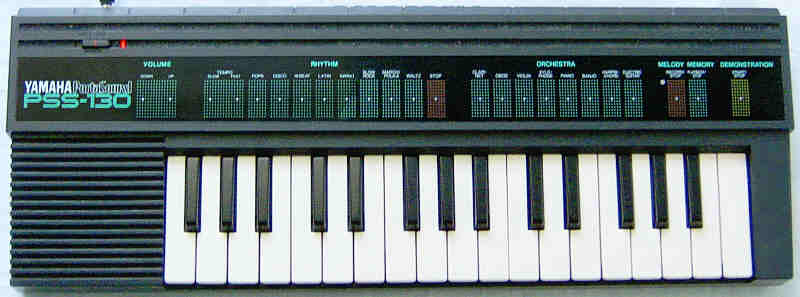
An idiot at eBay sold this thing without photo, claiming in few
words it would be a (never heard) "Yamaha Pss133" and "like new". I asked
by e-mail if that was a typo, but he claimed the type was correct, thus
I dared to bid for it as the only bidder. I won and he wrote he would only
answer by phone. First only a granny answered, who knew not a brown smelly
sausage what eBay is. When I finally reached her son(?), he told me that
he had yet no own PC and still claimed the keyboard would be a PSS-133.
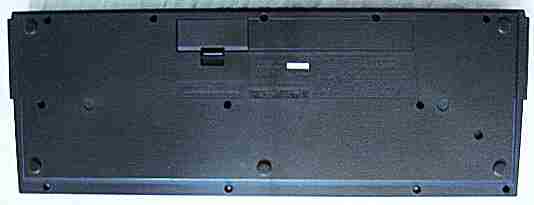
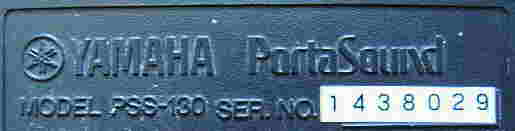
But when it finally arrived I disappointedly found in the parcel the at
that time very dirt stained PSS-130 (not just wrong model, but not even
remotely "like new"), thus I gave him a negative eBay rating with explanation
that he delivered the wrong model PSS-130 and very dirty. The sucker returned
me a negative revenge rating, claiming that I lie and that it would be
indeed a (likely never existing) "Yamaha PSS-133". Afterward he even had
the impudence to request additional 2€ postage from me because he
had accidentally written the wrong postage amount in his announce. But
I strictly refused to pay these 2€, wrote him an annoyed detailed
e-mail and reported the incident to eBay. =>When anyone is to stupid to
describe his wares correctly on eBay, then he should piss off there and
sell it on a fleamarket instead!

 |
 |
 |
A similar sounding but more advanced squarewave instrument was released
as Yamaha PSS-80, which contains
even a primitive synthesizer (4 buttons select timbre brightness and envelope
duration).
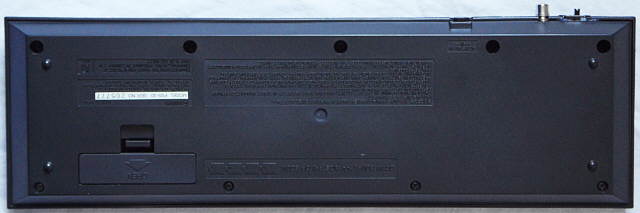
| removal of these screws voids warranty... | ||
 |
 |
|
|
|